
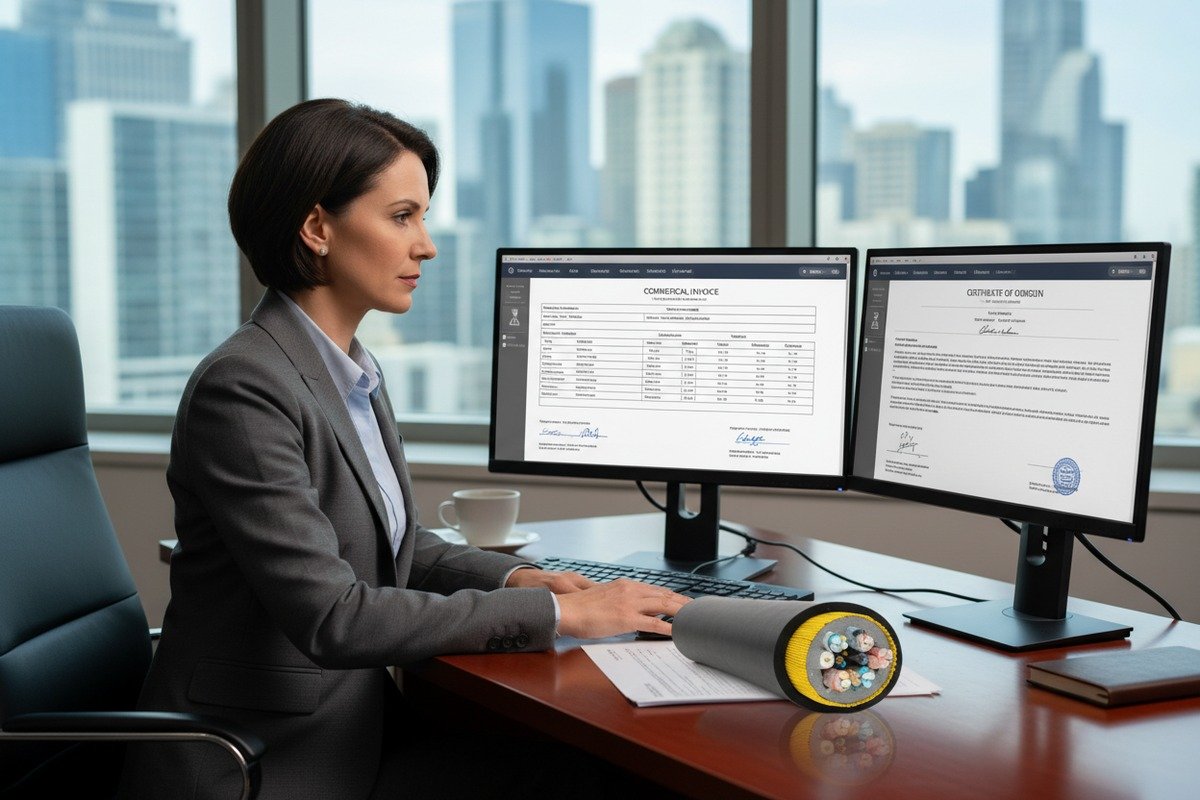
Every year, our export team handles hundreds of ADSS cable shipments bound for US ports—and the tariff questions never stop coming US Trade Representative 1. Buyers who skip the homework risk paying thousands more than expected, or worse, watching their cargo sit in customs limbo while project deadlines slip away.
ADSS fiber optic cables from China are classified under HTSUS 8544.70.0000, which carries a 0% base duty rate. However, Section 301 tariffs add up to 25% on top, and importers must provide correct documentation including commercial invoices, certificates of origin, and bills of lading to clear US Customs without delays.
This guide breaks down the exact tariff rates, classification codes, required paperwork, and anti-dumping risks you need to know before placing your next ADSS cable order CBP CROSS database 2. Let's walk through each one step by step.
How much will Section 301 tariffs increase my total landed cost for ADSS cables?
When we quote FOB prices to US buyers, the number on the invoice is only the starting point. The real shock comes when Section 301 duties hit—and many first-time importers underestimate just how much these tariffs add to their total spend.
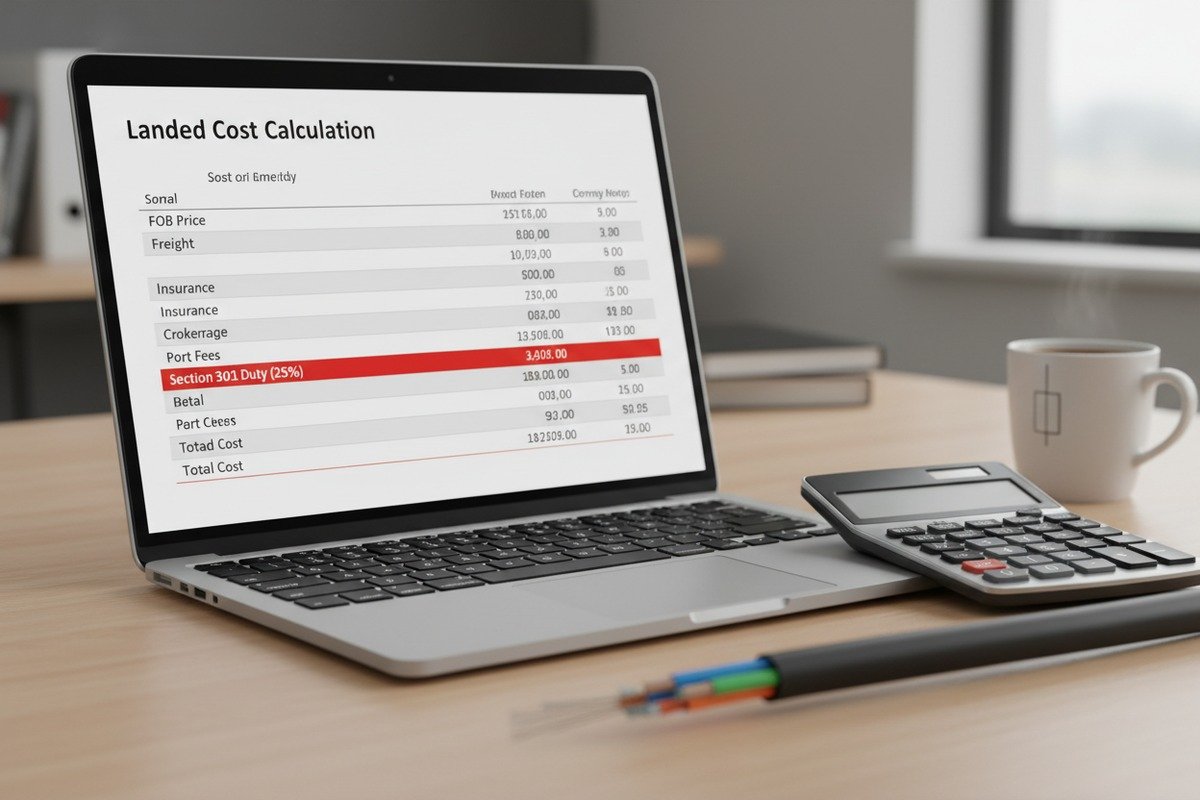
Section 301 tariffs can add 25% to the declared customs value of ADSS cables from China. On a typical $100,000 shipment, that means $25,000 in additional duties alone—before you factor in freight, insurance, brokerage fees, and port charges into your true landed cost.

Understanding the Section 301 Framework
Section 301 of the Trade Act of 1974 3 gives the US Trade Representative the power to impose additional tariffs on goods from countries engaged in unfair trade practices. Since 2018, China-origin products across thousands of HTS codes have been hit with these extra duties. ADSS fiber optic cables fall squarely within the scope.
For HTS code 8544.70.0000, the standard Most-Favored-Nation (MFN) duty rate is 0%. That sounds great—until you check HTSUS Chapter 99, Subchapter III, U.S. Note 20. That is where the Section 301 additional duties live. ADSS cables from China typically fall under List 3 or List 4A, which carry a 25% ad valorem rate.
How to Calculate Your True Landed Cost
Many buyers make the mistake of calculating duties only on the product price. But US Customs assesses duties on the transaction value, which includes the cost of the goods plus certain charges like assists and packing. Here is a simplified breakdown for a 10 km ADSS cable shipment:
| Cost Component | Amount (USD) | Notes |
|---|---|---|
| FOB Price (10 km ADSS cable) | $15,000 | Mid-to-high-end, 48-core |
| Ocean Freight (FCL) | $2,500 | US West Coast port |
| Marine Insurance | $150 | 0.5% of CIF value |
| CIF Value (Customs Value) | $17,650 | Basis for duty calculation |
| MFN Duty (0%) | $0 | HTS 8544.70.0000 |
| Section 301 Duty (25%) | $4,412 | Applied on CIF value |
| Customs Brokerage Fee | $250 | Typical range $150–$400 |
| Port Handling & Drayage | $800 | Varies by port |
| Total Landed Cost | $23,112 | Before inland transport |
That 25% tariff just added over $4,400 to a $15,000 order. Scale that to a large project with 200 km of cable, and the tariff bill alone can exceed $88,000.
Are There Any Exemptions or Exclusions?
Some HTS codes have received temporary Section 301 exclusions in the past. However, as of 2025, no specific exclusion applies to 8544.70.0000 for ADSS cables. The USTR periodically reviews and publishes exclusion lists, so it is worth checking the Federal Register for updates. But do not count on an exclusion when building your project budget. Plan for the full 25%.
The De Minimis Rule No Longer Helps
Previously, shipments valued under $800 could enter the US duty-free under the de minimis threshold 4. That exemption has been suspended for goods originating from China. Even small sample shipments of ADSS cable will face Section 301 duties now.
Our advice to buyers: always request a DDP (Delivered Duty Paid) quote from your supplier so you can compare apples to apples. At our facility, we routinely help US clients model their total landed cost before they commit to an order quantity, because surprises at the port are the last thing anyone needs during a tight construction schedule.
Which HTS code should I use to ensure my fiber optic cables are classified correctly?
Getting the HTS code wrong is one of the most expensive mistakes an importer can make. In our experience shipping ADSS cables to over 30 countries, we have seen buyers lose thousands in back duties and penalties simply because they—or their broker—used the wrong classification.
ADSS fiber optic cables should be classified under HTSUS subheading 8544.70.0000, which covers "optical fiber cables, made up of individually sheathed fibers." This classification has been consistently confirmed by CBP rulings and applies to all standard ADSS configurations with jacketed fiber cores and PE outer sheaths.

Why 8544.70.0000 and Not 9001.10.00?
This is the most common point of confusion. HTS 9001.10.00 covers optical fibers and optical fiber bundles that are not sheathed—basically raw fibers or fiber bundles without a protective jacket. The moment fibers are individually jacketed with resin and assembled into a cable with an outer sheath (as is the case with every ADSS cable we produce), the product moves to 8544.70.0000.
CBP has been very clear on this distinction. Ruling NY N065166 and later decisions like HQ H337046 (September 2024) both classify sheathed fiber optic cables under 8544.70. Attempting to classify ADSS cable under 9001.10.00 to avoid Section 301 duties is a red flag that will trigger an audit, reclassification, and potential penalties.
Key Classification Differences at a Glance
| Product Type | HTS Code | MFN Duty | Section 301 Applicable? |
|---|---|---|---|
| ADSS fiber optic cable (sheathed) | 8544.70.0000 | 0% | Yes (25%) |
| Unsheathed optical fibers/bundles | 9001.10.0000 | 6.6% | Varies by list |
| Optical modules/transceivers | 8517.62.0090 | 0% | Yes (up to 27.5%) |
| Copper power cables | 8544.49.9000 | 3.5% | Yes |
How to Verify Your Classification
Do not rely on your supplier's suggestion alone—though we always provide the correct HTS code on our commercial invoices. Here is a simple verification process:
- Search the USITC HTS tool at hts.usitc.gov. Enter "optical fiber cables" and look for 8544.70.
- Check the CBP CROSS database (Customs Rulings Online Search System). Search for "ADSS" or "fiber optic cable" to find binding ruling 6s.
- Request a binding ruling from CBP if your cable has unusual specifications, such as hybrid fiber-copper designs or armored variants like GYTA53.
- Hire a licensed customs broker who has experience with telecommunications products. A good broker will cross-reference your product specs against existing rulings before filing your entry.
What About GYTA, GYXTW, and GYTA53 Variants?
All of these cable types—ADSS, GYTA, GYXTW, and GYTA53—fall under 8544.70.0000 as long as they contain individually sheathed optical fibers assembled into a cable. The presence of metallic strength members (as in GYTA53's steel tape armor) does not change the classification. The defining factor is the optical fiber cable construction, not the armor or messenger wire.
Our engineering team often gets asked whether the all-dielectric nature of ADSS cables puts them in a separate category. It does not. Dielectric or metallic, if it is a sheathed fiber optic cable, it goes under 8544.70.0000.
What documentation do I need from my Chinese supplier to pass US Customs without delays?
One thing we learned early in our 30 years of exporting fiber optic cable: a perfect product stuck at customs is worse than no product at all. Missing or incorrect paperwork is the number one reason ADSS shipments get held at US ports, and the delay costs add up fast—demurrage, storage fees, and idle construction crews.
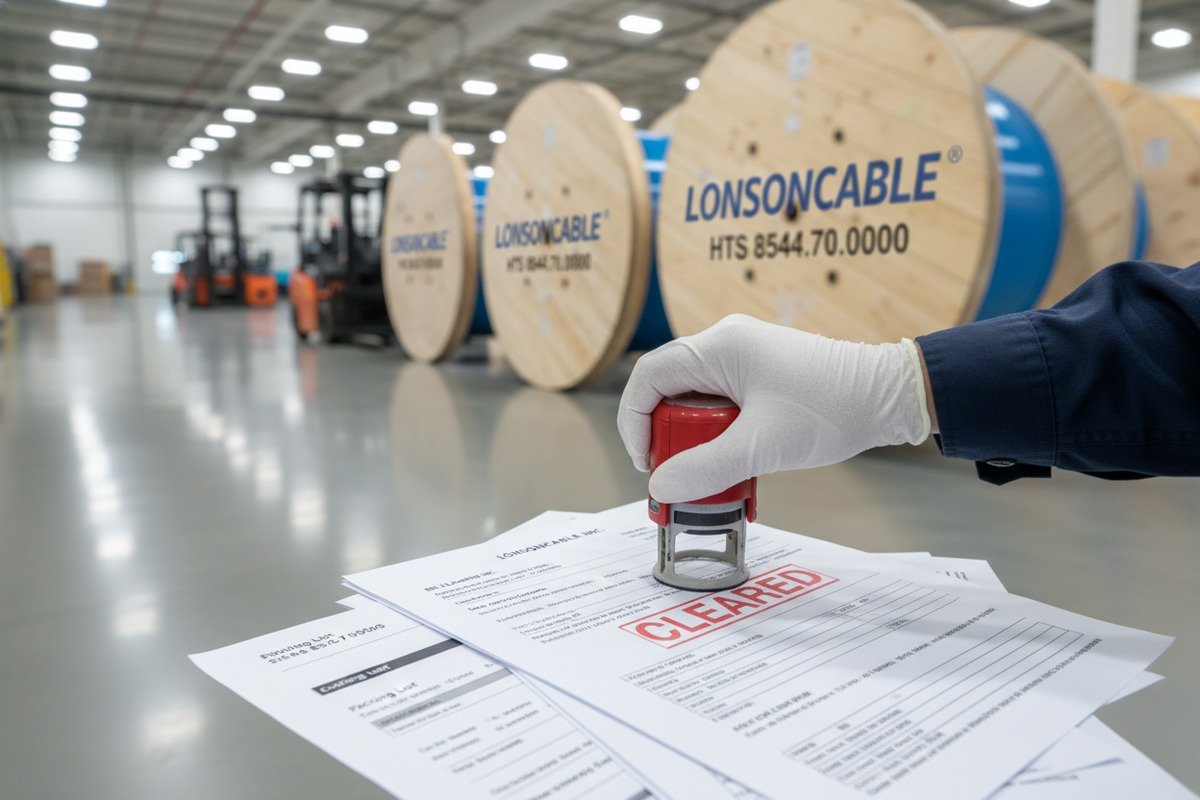
To clear ADSS cable shipments through US Customs without delays, you need a commercial invoice with accurate declared values, a detailed packing list, a bill of lading, a certificate of origin proving Chinese manufacture, and any applicable CBP ruling references. Working with an experienced customs broker is strongly recommended.
The Core Document Checklist
Here is every document you should have in hand before your ADSS cable shipment arrives at a US port:
| Document | Purpose | Who Provides It |
|---|---|---|
| Commercial Invoice | Declares value for duty assessment | Supplier (us) |
| Packing List | Details weight, dimensions, reel count | Supplier (us) |
| Bill of Lading (B/L) | Proof of shipment and ownership | Freight forwarder |
| Certificate of Origin 8 (CO) | Proves country of manufacture | Supplier or chamber of commerce |
| CBP Ruling Reference | Supports HTS classification | Importer's broker / CBP CROSS |
| ISF (10+2 Filing) | Required 24 hours before vessel loading | Importer or broker |
| Customs Bond | Guarantees payment of duties | Importer's broker |
| Product Test Reports | Proves quality compliance (OTDR, tensile) | Supplier (us) |
Why the Certificate of Origin Matters More Than You Think
The Certificate of Origin is not just a formality. It directly determines whether Section 301 duties apply. CBP uses substantial transformation rules to decide country of origin. For ADSS cables, the sheathing and jacketing process—where individual fibers are coated with resin and assembled into a finished cable with a PE outer jacket—constitutes substantial transformation. When that happens in China, the cable is "a product of China," and Section 301 duties kick in.
Some importers have tried to argue that because the raw glass fiber preform came from Japan or the aramid yarn was sourced from the Netherlands, the cable should not be considered Chinese-origin. CBP has rejected this argument. Ruling HQ H337046 makes clear: the sheathing process in China confers Chinese origin, full stop.
The ISF Filing Deadline
The Importer Security Filing (ISF) 9, also known as 10+2, must be filed at least 24 hours before the cargo is loaded onto a vessel bound for the US. Late or inaccurate ISF filings can trigger penalties of $5,000 per violation. Make sure your freight forwarder or broker has all product details early—especially the HTS code, manufacturer name, and factory address.
Practical Tips From Our Export Team
At our facility, we prepare a complete shipping document package for every order. This includes dual-language commercial invoices (Chinese and English), detailed packing lists showing each reel's fiber count, length, and net/gross weight, and factory test reports including OTDR traces for every reel. We also stamp and sign the Certificate of Origin through the local China Council for the Promotion of International Trade (CCPIT).
One detail many buyers overlook: ADSS cable reels can weigh over 500 kg each. Your packing list must accurately reflect these weights, because discrepancies between declared and actual weights will trigger a CBP inspection. We have seen shipments delayed by a week because the packing list said 480 kg and the actual reel weighed 520 kg. Accuracy matters down to the kilogram.
Working With a Customs Broker
We always recommend US-based customs brokers who specialize in telecommunications or electrical products. A general broker may not know the difference between 8544.70 and 9001.10, and that ignorance can cost you. Ask your broker if they have filed entries for fiber optic cables before, and whether they are familiar with Section 301 Chapter 99 provisions. A good broker will also monitor your shipment's entry status and respond to CBP requests for information (CF-28) within the required timeframe.
Will my shipment be subject to anti-dumping or countervailing duties on Chinese fiber products?
This is the question that keeps procurement managers up at night. Beyond Section 301, the threat of anti-dumping duties (ADD) 10 or countervailing duties (CVD) can turn a profitable import into a financial disaster. When we discuss pricing with US clients, we always flag this risk upfront—because transparency now prevents panic later.
As of 2025, ADSS fiber optic cables under HTS 8544.70.0000 are not subject to specific anti-dumping or countervailing duty orders from the US Department of Commerce. However, importers must stay vigilant because new petitions can be filed at any time, and related optical products have faced AD/CVD investigations in the past.
What Are Anti-Dumping and Countervailing Duties?
Anti-dumping duties (ADD) are imposed when a foreign manufacturer sells goods in the US market below fair market value—essentially, below the cost of production or below the home-market price. Countervailing duties (CVD) target government subsidies that give foreign manufacturers an unfair price advantage.
The US Department of Commerce investigates these claims, and the US International Trade Commission (ITC) determines whether domestic industry has been injured. If both find affirmatively, ADD/CVD orders are issued, and the duties can be steep—sometimes 50% to 200% or more.
Current Status for Fiber Optic Cables
Right now, there is no active ADD or CVD order targeting fiber optic cables classified under 8544.70.0000 from China. This is good news. But here is why you should not be complacent:
- Optical fiber (the raw material, not the finished cable) has been the subject of trade petitions in other countries.
- Related telecommunications products like certain steel wire and aluminum products from China do face ADD/CVD orders.
- The US domestic fiber optic industry, while smaller than China's, has the standing to file a petition if they believe Chinese imports are being dumped or subsidized.
- Political pressure and US-China trade tensions can accelerate new investigations with little warning.
How to Monitor ADD/CVD Risks
| Resource | What It Covers | URL |
|---|---|---|
| USITC AD/CVD Orders Database | Active and pending orders by HTS code | usitc.gov |
| Commerce Department's Enforcement & Compliance | Investigation notices, preliminary/final determinations | trade.gov/enforcement |
| Federal Register | Published notices of new petitions and scope rulings | federalregister.gov |
| Your Customs Broker | Real-time alerts on new trade remedies | N/A |
Transshipment and Evasion Risks
Some importers consider routing Chinese ADSS cables through a third country—say Vietnam or Malaysia—to avoid Section 301 tariffs or potential ADD/CVD exposure. This is called transshipment, and CBP actively investigates it. If the cable is manufactured in China (substantial transformation occurs in China) and merely transshipped through another country, it remains a product of China. Getting caught means not only full back duties but also penalties for fraud or negligent entry.
We have been approached by buyers asking if we can ship through our partner warehouses in Southeast Asia to change the origin. The answer is always no. Relabeling or rerouting does not change the legal country of origin. And CBP's Enforce and Protect Act (EAPA) investigations specifically target these schemes in the fiber optic and telecommunications sectors.
What Happens If an ADD/CVD Order Is Issued in the Future?
If a new ADD/CVD order is issued covering fiber optic cables from China, the duties would be applied retroactively to entries made up to 90 days before the preliminary determination. This means even goods already in transit could be affected. The only way to protect yourself is to:
- Monitor trade publications and the Federal Register regularly.
- Maintain a relationship with a knowledgeable customs broker.
- Diversify your supply chain—consider supplementing Chinese ADSS with cables from alternative origins where possible.
- Keep detailed records of all transactions, pricing, and communications with your supplier.
At our company, we provide full transparency on pricing, including detailed cost breakdowns that show material costs, labor, and overhead. This kind of documentation can be critical if CBP or Commerce ever requests evidence that the cable was sold at fair market value. We believe honest pricing protects both the buyer and the seller in the long run.
Conclusion
Importing ADSS fiber optic cables from China demands careful attention to HTS classification, Section 301 tariffs, documentation, and evolving trade regulations. Plan ahead, work with an experienced customs broker, and partner with a transparent supplier who provides complete paperwork. If you need help modeling your landed cost or preparing customs-ready documentation, reach out to our team at lonsoncable.com.
Footnotes
1. Identifies the federal agency responsible for trade policy. ↩︎
2. Direct link to the Customs Rulings Online Search System (CROSS) database. ↩︎
3. Official PDF of the Trade Act of 1974 from GovInfo.gov. ↩︎
4. Explains the general de minimis exemption for imports. ↩︎
5. Official USTR page explaining Section 301 investigations. ↩︎
6. Explains the official process for obtaining pre-entry customs decisions. ↩︎
7. Official Harmonized Tariff Schedule of the United States search tool. ↩︎
8. Defines the document and its role in international trade. ↩︎
9. Outlines the mandatory filing for ocean cargo. ↩︎
10. Explains the purpose and enforcement of anti-dumping duties. ↩︎