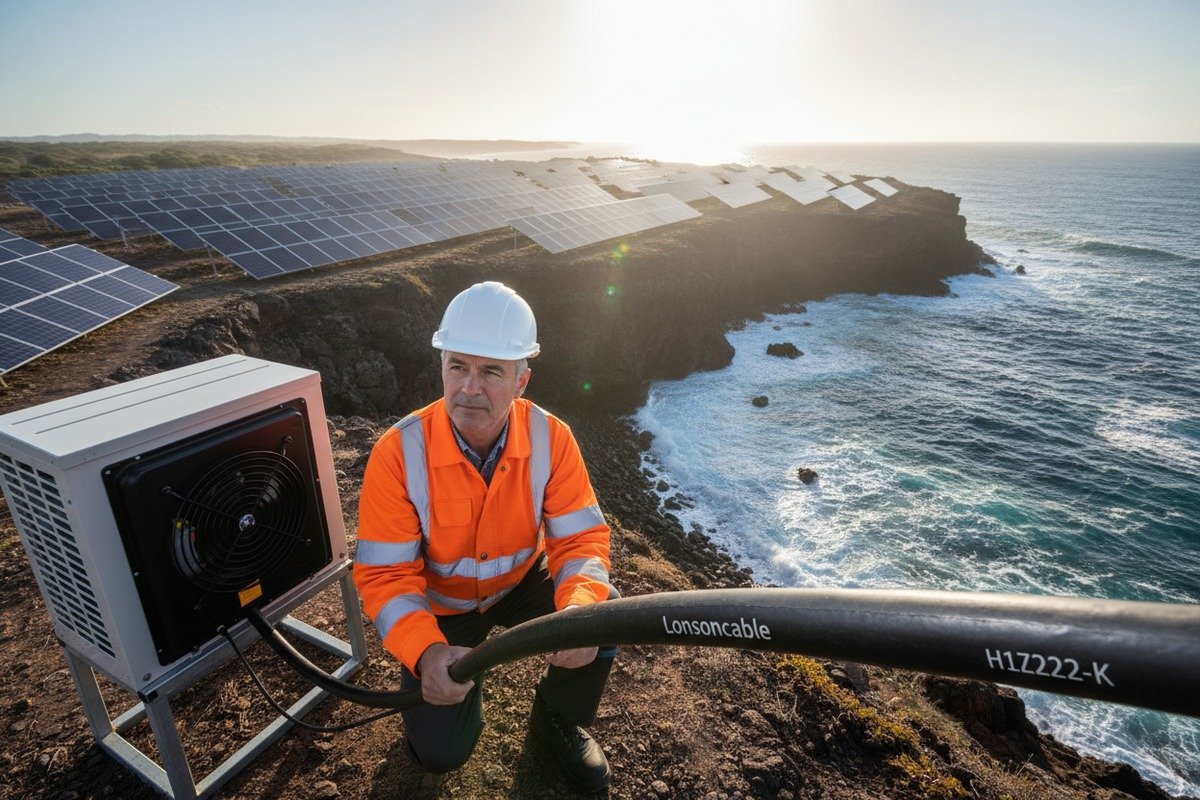
Every year, our technical team gets calls from coastal project owners dealing with corroded cable terminations, melted connectors, and unexpected system shutdowns — all caused by salt spray nobody planned for during the design phase.
To choose the right solar PV cable for high salt spray coastal areas, prioritize tinned copper conductors with XLPE or thermoplastic elastomer jackets, verify IEC 61701 salt mist certification, use IP68-rated connectors, and match all system components for marine-grade corrosion resistance to achieve a reliable 25-year service life.
Salt doesn't just rust metal. It creeps into every weak point of your PV system — connectors, terminations, even micro-cracks in insulation stainless steel 316 1. Below, we break down the exact materials, certifications, testing methods, and installation practices that separate a 25-year coastal solar system from a 5-year failure story.
What specific insulation materials should I prioritize to prevent salt spray corrosion in my coastal solar projects?
When we formulate insulation compounds on our production line, we run hundreds of salt fog hours before a material ever reaches a product datasheet. The wrong jacket compound is the fastest path to cable failure on a coastline.
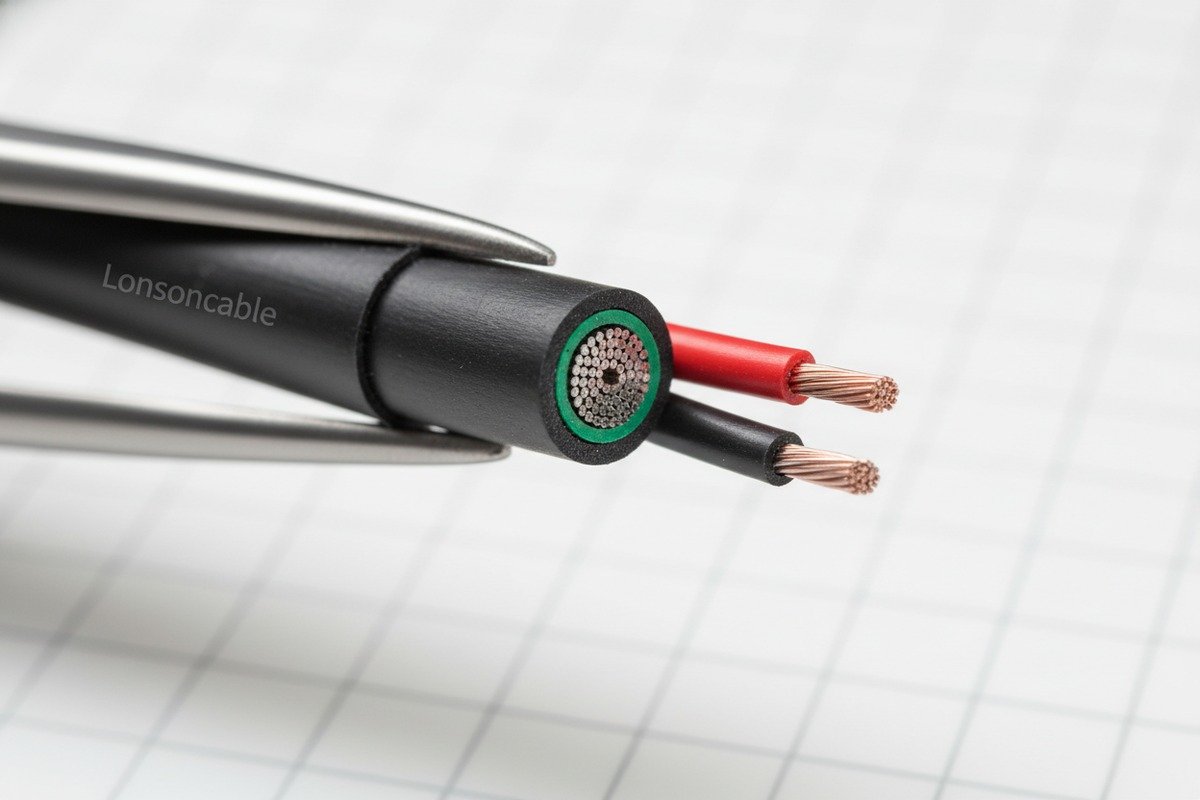
Prioritize cross-linked polyethylene (XLPE) or thermoplastic elastomer (TPE) insulation paired with tinned copper conductors. These materials resist chloride penetration, UV degradation, and moisture absorption — the three forces that destroy standard PV cables in coastal environments within just a few years.
Why Standard PVC and PE Insulation Fail at the Coast
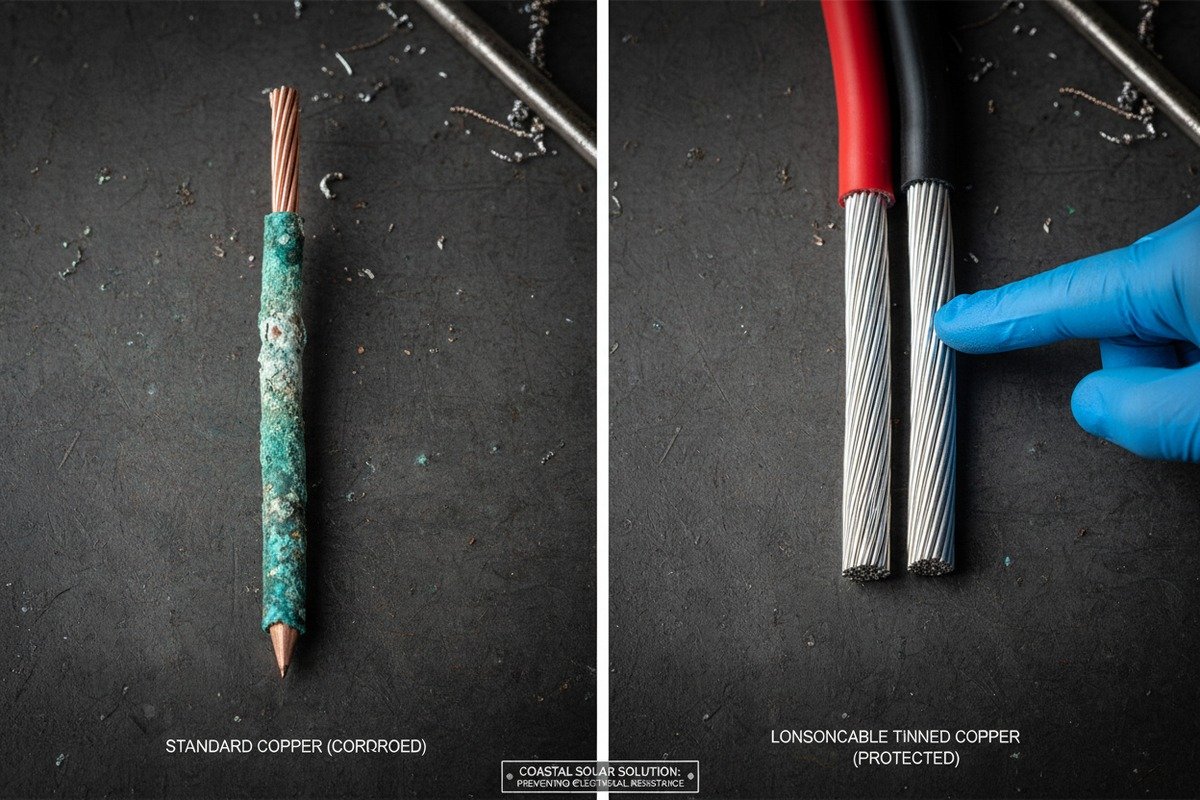
Standard polyvinyl chloride (PVC) 2 and basic polyethylene (PE) insulation absorb moisture over time. In a salt-laden atmosphere, that moisture carries chloride ions 3 directly to the conductor surface. The result is accelerated copper oxidation, increased electrical resistance, and eventual hot spots that can cause fires or system trips.
Salt spray does not attack the middle of a cable first. It attacks terminations, connector interfaces, and any point where the jacket has been stripped or nicked. This is why conductor material matters just as much as the jacket.
Tinned Copper: The Non-Negotiable Conductor Choice
Bare copper corrodes roughly three times faster than tinned copper in salt fog environments. Tinning creates a sacrificial barrier that protects the base copper from direct chloride contact. Critically, tinned copper retains 100% IACS conductivity 4 — you lose nothing electrically by upgrading.
On our H1Z2Z2-K and EN50618 production lines, we use electrolytic tinned copper as the default conductor for any order destined for coastal regions. The cost premium is typically 10–15%, but it eliminates the single biggest failure mode in salt environments.
Insulation and Jacket Material Comparison
| Material | Salt Resistance | UV Resistance | Moisture Absorption | Typical Use |
|---|---|---|---|---|
| XLPE (Cross-Linked Polyethylene) | Excellent | Excellent | Very Low | Marine-grade PV cables, coastal rooftops |
| TPE (Thermoplastic Elastomer) | Excellent | Good | Low | Flexible marine-grade cables, floating PV |
| LSZH (Low Smoke Zero Halogen) | Good | Good | Low | Dense commercial installs near coast |
| Standard PVC | Poor | Moderate | High | Inland residential only |
| Standard PE | Poor | Moderate | Moderate | Inland utility cables |
The Role of Jacket Thickness and Density
A thicker, denser outer jacket physically slows chloride ingress. Our engineers specify a minimum jacket thickness of 0.8 mm for single-core coastal PV cables, with higher density compounds that resist micro-abrasion from wind-blown sand and salt crystals. Over 20 years, even small abrasions become entry points for corrosion.
Don't Forget the Whole Chain
Choosing the right cable material is only half the battle. If you pair a marine-grade XLPE cable with a cheap, non-rated MC4 connector, salt will enter through the connector seal and corrode the termination from the inside out. Every component — cable, connector, gland, bracket — must match in corrosion resistance class.
Which international certifications and test standards should I verify for PV cables used in high-salinity environments?
Our quality assurance team has seen too many cases where a certificate looks correct on paper but does not reflect actual salt spray performance. Verifying the right certifications is not optional — it is your primary risk filter.
Verify IEC 61701 salt mist corrosion testing, TÜV certification for EN 50618 or PV1-F compliance, and UL 4703 for North American projects. Additionally, confirm IP66/IP68 connector ratings and request extended salt fog test reports — not just pass/fail summaries — to validate real-world coastal durability.

The Core Certifications You Must Check
Not all PV cable certifications address salt spray. Many cover only UV resistance, voltage rating, and flame behavior. For coastal projects, you need specific environmental certifications layered on top of electrical safety approvals.
| Certification / Standard | What It Covers | Region | Coastal Relevance |
|---|---|---|---|
| IEC 61701 6 | Salt mist corrosion resistance (Levels 1–6) | International | Critical — directly tests salt fog performance |
| EN 50618 | PV cable performance, insulation, UV, ozone | Europe | High — baseline for quality; pair with IEC 61701 |
| TÜV 2PfG 1169 | PV cable safety and durability | Europe (Germany) | High — widely recognized for quality assurance |
| UL 4703 7 | PV wire safety, UV, temperature | North America | Medium-High — add salt spray testing separately |
| IEC 60068-2-52 | Salt spray cyclic test for components | International | Useful for connectors and hardware |
| IP66 / IP68 | Ingress protection for enclosures/connectors | International | Essential for all connection points |
IEC 61701: The Gold Standard for Salt Resistance
IEC 61701 was originally designed for PV modules, but its salt mist severity levels (1 through 6) are increasingly referenced for full-system qualification, including cables and connectors. Level 6 represents the harshest conditions — equivalent to direct ocean-front exposure in tropical climates like Southeast Asia or the Persian Gulf.
When we supply cables for projects in the Philippines or Indonesia, our clients routinely request IEC 61701 Level 5 or 6 equivalent testing data for the entire cable assembly, not just the module.
North American Compliance: UL 4703 and NEC
For US Gulf Coast or Caribbean projects, UL 4703 is the baseline. However, UL 4703 alone does not guarantee salt resistance. You should also request USE-2/RHW-2 dual-rated cables, which are approved for both underground and exposed outdoor use, and verify that the manufacturer has performed supplementary salt fog testing.
NEC Article 690 8 governs PV system wiring. It mandates sunlight-resistant and moisture-resistant cables for outdoor use but does not explicitly require salt spray testing. This gap means you must push suppliers for documentation beyond minimum NEC requirements.
How to Spot Fake or Expired Certifications
This is a real problem in international procurement. We have seen competitors present TÜV certificates that were either expired, issued for a different product line, or simply fabricated. Always cross-check the certificate number directly on the issuing body's website (e.g., TÜV Rheinland's Certipedia database 9). Request batch-level test reports, not just type-approval certificates.
Regional Certification Requirements Summary
For European EPC projects, demand TÜV-certified EN 50618 cables with CPR fire safety ratings (minimum Dca class) and IEC 61701 salt data. For North America, require UL 4703 with supplementary salt fog test reports. For Southeast Asia and the Middle East, insist on IEC 61701 Level 5+ and IP68 connectors.
How can I ensure my solar cables will maintain their 25-year lifespan under constant exposure to salt air and high humidity?
We design our cables to last 30 years or more in lab conditions, but real-world coastal environments combine salt, UV, humidity, temperature cycling, and mechanical stress in ways that no single lab test can fully replicate. The gap between lab life and field life is where most failures hide.
To ensure a 25-year cable lifespan at the coast, combine marine-grade tinned copper XLPE cables with IP68 connectors, stainless steel fasteners, dielectric grease at all terminations, protective conduit in exposed runs, and a scheduled inspection program — because material quality alone cannot prevent failures caused by poor installation or neglected maintenance.
The Five Combined Stressors That Kill Cables
Salt alone does not destroy a cable. It is the combination of stressors acting simultaneously over decades that causes premature failure. Understanding each stressor helps you build a defense-in-depth strategy.
- Chloride attack — Salt spray deposits on surfaces and penetrates through micro-cracks, stripped ends, and connector seals.
- UV radiation — Breaks down polymer chains in insulation, creating surface cracks that let salt in.
- Humidity and condensation — Creates a continuous electrolyte film that accelerates electrochemical corrosion.
- Temperature cycling — Causes expansion and contraction, loosening connector seals and creating micro-gaps.
- Mechanical stress — Wind vibration, sand abrasion, and installation handling create physical entry points.
Installation Best Practices for Coastal Longevity
Material selection gets you to the starting line. Installation quality gets you to 25 years. Here are the practices we recommend to every coastal project installer.
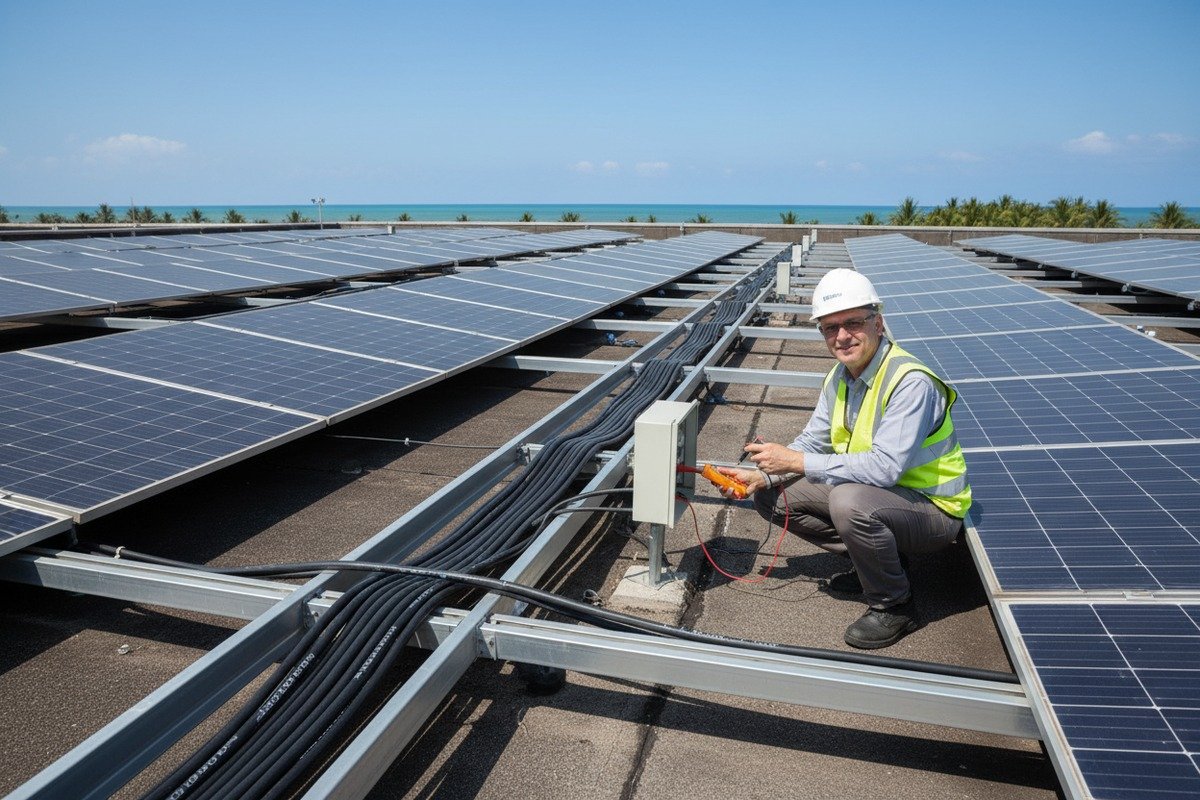
Apply dielectric grease inside every MC4 connector before assembly. This fills micro-gaps and blocks moisture ingress at the most vulnerable point in the system. Use stainless steel 316 cable clips, clamps, and fasteners — standard galvanized steel will corrode within 2–3 years in direct coastal exposure. Route cables through UV-resistant conduit wherever possible, especially on roof-mounted systems exposed to direct wind and salt spray.
Seal all cable entry points into junction boxes and inverters with IP68-rated glands. Do not mix marine-grade cables with standard connectors or brackets — a single weak link exposes the entire string to corrosion risk.
Maintenance and Monitoring Over the System Lifetime
Even the best installation degrades without monitoring. We advise our clients to implement:
- Annual visual inspections of all exposed cable runs and connectors for discoloration, swelling, or white salt crystal buildup.
- Insulation resistance testing every 2–3 years using a megohmmeter to detect early degradation.
- Infrared thermography scans to identify hot spots caused by increased resistance at corroded terminations.
- Smart monitoring systems that track string-level current and voltage deviations, which can flag a corroding connection before it becomes a safety hazard.
Cost of Prevention vs. Cost of Failure
| Cost Factor | Marine-Grade Approach | Standard Approach |
|---|---|---|
| Cable cost premium | +10–15% | Baseline |
| Connector upgrade (IP68, marine) | +$2–5 per pair | Standard MC4 |
| Stainless steel hardware | +20–30% over galvanized | Galvanized steel |
| Conduit and sealing | +$500–2,000 per system | Minimal |
| Expected replacement at year 10 | None | 1–2 string replacements |
| Downtime cost over 25 years | Minimal | $5,000–$50,000+ depending on system size |
| Total 25-year cost of ownership | Lower | Higher |
The upfront premium for a marine-grade approach is typically 15–25% of total cable and BOS (balance of system) cost. But a single string replacement on a commercial rooftop in year 8 — including scaffolding, labor, permitting, and lost generation — can exceed the entire original premium.
How do I evaluate if a manufacturer's salt spray resistance testing meets my project's strict compliance needs?
From our side of the table, we know exactly how easy it is to produce a test report that looks impressive but tells you very little about actual field performance. The difference between a checkbox test and a meaningful test is something every serious procurement manager must understand.
Evaluate salt spray testing by requesting full test reports — not just pass/fail certificates — that detail test duration (minimum 1,000 hours for harsh coasts), cycling conditions, post-test insulation resistance values, and visual corrosion grading. Cross-reference results against IEC 61701 severity levels and demand testing on the exact cable assembly, including connectors.
What Does a Real Salt Spray Test Look Like?
A proper salt spray test follows IEC 60068-2-52 (cyclic salt spray) or ASTM B117 (continuous neutral salt fog) 10. The cable sample is placed in a sealed chamber where a 5% sodium chloride solution is atomized at 35°C. The test runs continuously for a set number of hours.
The critical question is: how many hours? A 96-hour test is common for basic hardware qualification. But 96 hours does not simulate 25 years of coastal exposure. For high-severity coasts (Gulf of Mexico, Southeast Asia, Arabian Gulf), we recommend a minimum of 1,000 hours of continuous or cyclic salt fog testing.
What to Look for in a Test Report
Do not accept a one-page summary. Request the full laboratory report with the following data points:
- Test standard reference (IEC 60068-2-52, ASTM B117, or equivalent)
- Test duration in hours
- Cycling protocol (continuous vs. wet/dry cycles — cyclic is more realistic)
- Post-test insulation resistance measured in megohms
- Post-test visual inspection photos showing conductor, termination, and jacket condition
- Corrosion grading per ISO 9227 or equivalent scale
Red Flags in Manufacturer Testing Claims
| Red Flag | What It Means | What to Do |
|---|---|---|
| "Passes salt spray test" with no hours listed | Could be as low as 24–96 hours | Demand exact duration |
| Test performed on cable sample only, no connectors | Terminations are the weakest point — untested | Require full assembly testing |
| Certificate from unknown or unaccredited lab | Results may not be reproducible | Verify lab accreditation (ISO 17025) |
| No post-test electrical measurements | Visual pass only — internal degradation missed | Require insulation resistance data |
| Generic report covering "cable family" | Specific product may not have been tested | Demand product-specific reports |
Going Beyond the Lab: Real-World Validation
Lab tests are necessary but not sufficient. The most reliable manufacturers supplement lab data with field performance records. At our facility, we maintain a coastal exposure test site where cable samples are mounted outdoors in a high-salinity environment and inspected annually. This gives us — and our clients — real degradation data that no salt chamber can fully replicate.
Ask potential suppliers if they have any long-term field exposure data. Even 3–5 years of real coastal aging data is more valuable than a 2,000-hour lab test, because it captures the combined effects of UV, humidity cycling, mechanical stress, and actual salt deposition patterns.
Regional Differences Matter
A cable that performs well on a mild Mediterranean coast may not survive the relentless humidity and salt loading of the Philippine coastline or the hurricane-driven salt surges of the US Gulf Coast. When evaluating test results, match the test severity to your project's actual environment. IEC 61701 severity Level 6 is appropriate for tropical ocean-front sites. Level 3 or 4 may suffice for sheltered Mediterranean installations.
There is no universal "marine-grade" certification standard for PV cables. This means you must build your own qualification framework using IEC 61701 severity levels, extended salt fog hours, and full-assembly testing requirements. Our team regularly helps EPC clients draft these specifications for tender documents.
Conclusion
Choosing the right solar PV cable for coastal salt spray environments comes down to four pillars: tinned copper conductors, XLPE or TPE insulation, verified IEC 61701 certification, and disciplined installation with matched marine-grade components throughout the entire system.
Footnotes
1. Replaced with the Wikipedia page for SAE 316L stainless steel, which covers 316. ↩︎
2. Replaced with a comprehensive Wikipedia page on PVC properties and uses. ↩︎
3. Replaced with an authoritative PubChem page from NIH detailing chloride ions. ↩︎
4. Replaced with the Wikipedia page for International Annealed Copper Standard (IACS). ↩︎
5. Explains the composition, properties, and applications of dielectric grease in electrical connections. ↩︎
6. Official standard for salt mist corrosion testing of photovoltaic (PV) modules. ↩︎
7. Replaced with the official UL Standards page for UL 4703 Photovoltaic Wire. ↩︎
8. Replaced with the official NFPA page for the National Electrical Code (NEC), which contains Article 690. ↩︎
9. Official database for verifying TÜV Rheinland certifications and test marks. ↩︎
10. Describes the ASTM B117 standard practice for operating salt spray (fog) apparatus. ↩︎