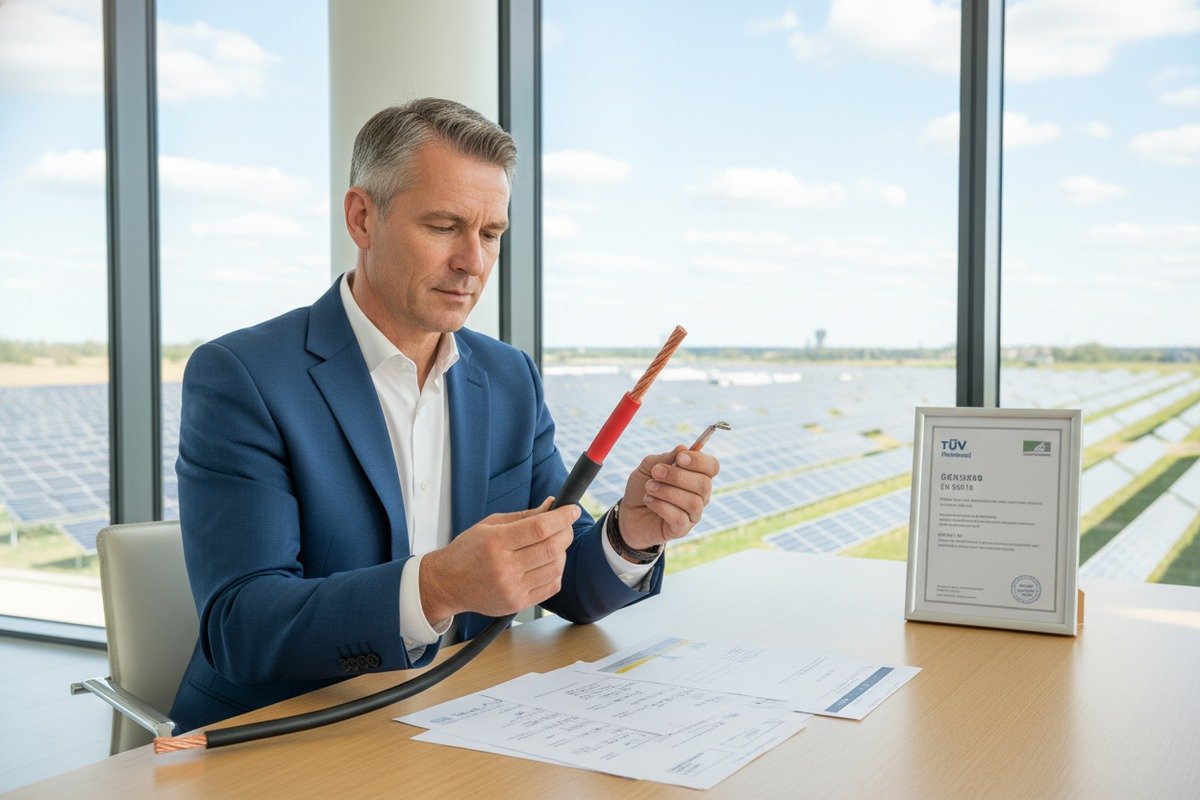
Every year, our quality team sees shipments rejected at European ports because the cables inside failed basic LSZH compliance checks 1. The financial damage is real. The project delays are worse.
To verify LSZH solar PV cables meet European standards, demand authentic TÜV EN 50618 certification, review CPR fire safety classifications with Declaration of Performance documents, request IEC 60754 and IEC 61034 test reports for halogen and smoke levels, and audit the manufacturer's material sourcing and production consistency before placing bulk orders.
This guide breaks the verification process into four clear steps TÜV Rheinland online database 2. Each section gives you specific actions, test references, and red flags to watch. Let's start with the most critical document: your supplier's TÜV certificate.
How can I verify that my supplier's TUV EN50618 certificates are authentic and up to date?
Over the past 30 years, our production lines have been audited by TÜV Rheinland multiple times, so we know exactly what a genuine certificate looks like — and how easily a fake one can fool even experienced buyers CPR fire safety classifications 3.
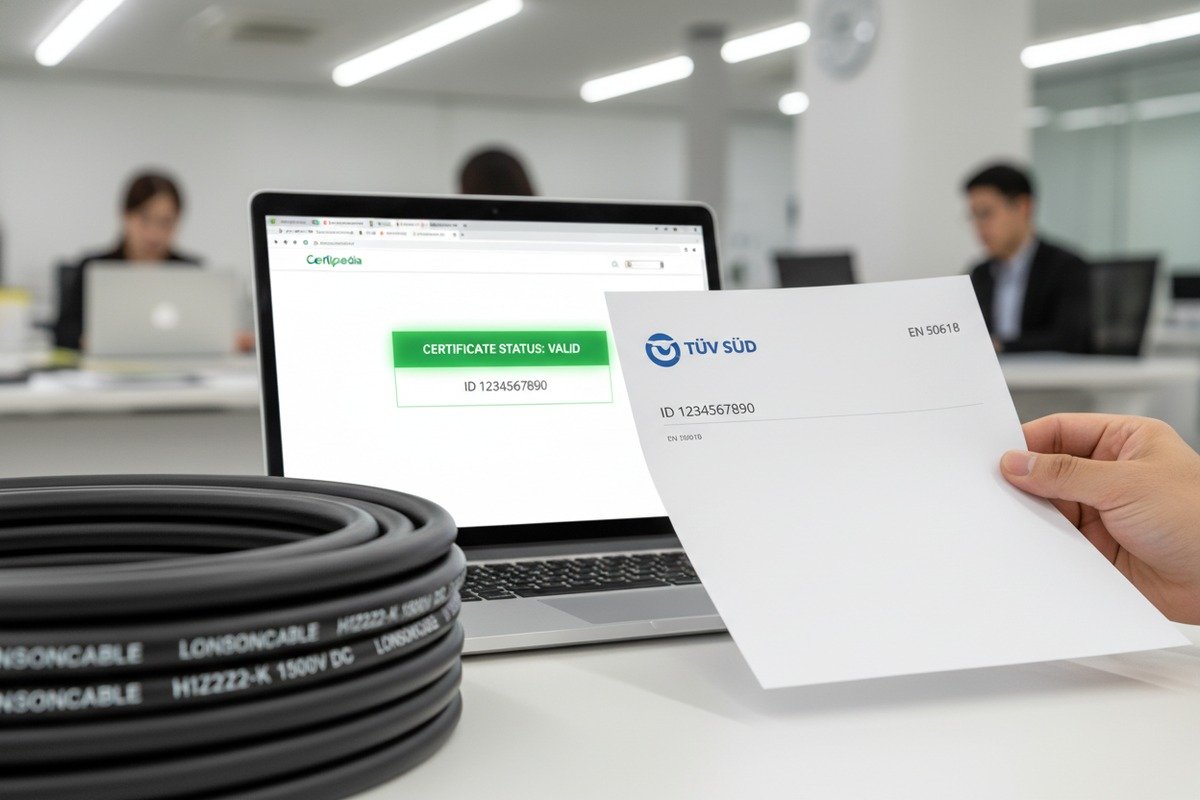
Verify TÜV EN 50618 certificates by checking the certificate number directly on the TÜV Rheinland online database (certipedia.com), confirming the expiration date, matching the listed manufacturer name and factory address, and ensuring the certificate scope covers the exact cable type and voltage rating you are ordering.
Why Fake Certificates Are a Growing Problem
Certificate fraud is not rare. Some suppliers photoshop existing TÜV certificates, change the company name, and present them as their own IEC 60754-1/2 test reports 4. Others hold expired certificates and hope buyers don't check the date. In both cases, the cables often fail inspection at the project site or at European customs IEC 61034-1/2 reports 5.
The risk is enormous. If your cables lack valid EN 50618 certification, European grid inspectors will reject the installation. You face project delays, financial penalties, and potential legal liability.
Step-by-Step Verification Process
Here is a clear process to authenticate any TÜV certificate:
- Get the certificate number. Every genuine TÜV certificate has a unique ID.
- Search on Certipedia. Visit certipedia.com and enter the certificate number. The database will show the certificate holder, product scope, and validity dates.
- Cross-check details. The factory name and address on the certificate must match your supplier's actual manufacturing site. If your supplier is a trader, not a manufacturer, dig deeper.
- Confirm product scope. The certificate must explicitly cover H1Z2Z2-K cables to EN 50618, including the voltage rating (1500V DC) and cross-section sizes you need.
- Check the expiration date. TÜV certificates are not permanent. They require annual surveillance audits. An expired certificate means the factory may have failed a recent audit.
Key Fields to Check on a TÜV EN 50618 Certificate
| Field | What to Look For | Red Flag |
|---|---|---|
| Certificate Number | Unique alphanumeric ID | Missing or cannot be found on Certipedia |
| Certificate Holder | Manufacturer's legal name and address | Name doesn't match the supplier you're dealing with |
| Product Description | H1Z2Z2-K, EN 50618, voltage rating, sizes | Vague descriptions or missing model numbers |
| Validity Period | Start and end dates | Expired or no end date listed |
| Testing Laboratory | TÜV Rheinland, TÜV SÜD, or equivalent | Unknown or unaccredited lab |
| Scope of Certification | Specific cable constructions and materials | Overly broad or doesn't match your order specs |
Don't Rely on Scanned PDFs Alone
A scanned PDF proves nothing. Always verify through the online database. If the supplier resists providing the certificate number or redirects you, treat that as a serious warning sign. Legitimate manufacturers are proud of their certifications and will share them openly.
Our export team regularly sends clients direct links to our Certipedia listings. Transparency builds trust. If your supplier can't do the same, consider why.
What specific tests should I request to confirm the LSZH and UV resistance of my solar cables?
When we calibrate our extrusion lines for LSZH compounds, we run internal tests daily — but we also know that a buyer should never rely on a manufacturer's word alone. Independent test data is your best protection.
Request IEC 60754-1/2 test reports confirming halogen acid gas content below 0.5%, IEC 61034-1/2 reports for smoke density, IEC 60332-1 for flame retardancy, and ASTM G154 or EN ISO 4892-3 for UV resistance with a minimum of 720 hours of accelerated weathering to confirm full LSZH and UV compliance.

Understanding the Core LSZH Tests
LSZH stands for Low Smoke Zero Halogen. It means the cable jacket and insulation release minimal smoke and no toxic halogen gases (like hydrogen chloride) when they burn. This matters in buildings, rooftops, and enclosed spaces where people must evacuate safely during a fire.
Two test standards define LSZH performance:
- IEC 60754-1/2 (Halogen Acid Gas Test): Measures the amount of halogen gas released during combustion. For true LSZH compliance, the halogen content must be below 0.5%.
- IEC 61034-1/2 (Smoke Density Test): Measures light transmittance through smoke. Higher transmittance means less smoke. The minimum threshold is typically 60% light transmittance.
UV Resistance Is Not Optional
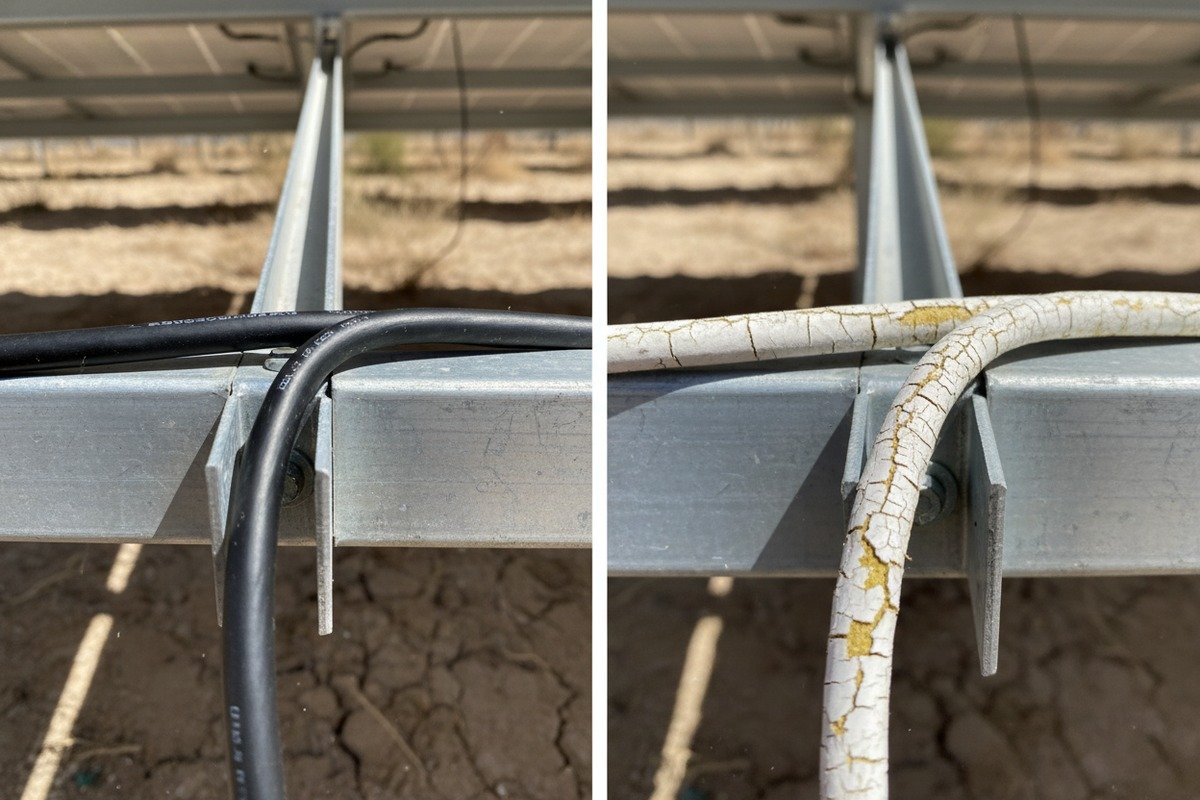
Solar cables spend 25+ years exposed to direct sunlight. UV degradation causes cracking, insulation breakdown, and eventual electrical failure. EN 50618 requires UV resistance testing.
The most common UV test methods are:
- ASTM G154: Uses fluorescent UV lamps to simulate accelerated weathering. A minimum of 720 hours is standard.
- EN ISO 4892-3: Similar accelerated aging using UV-B lamps.
- HD 605 / EN 50618 Annex: Specifies UV exposure requirements specific to solar cables.
After testing, the cable sheath should show no cracking, chalking, or significant change in mechanical properties.
Full Test Request Checklist
| Test Standard | What It Measures | Pass Criteria |
|---|---|---|
| IEC 60754-1 | Halogen acid gas amount | < 0.5% halogen content |
| IEC 60754-2 | pH and conductivity of gas | pH ≥ 4.3, Conductivity ≤ 10 µS/mm |
| IEC 61034-1/2 | Smoke density | ≥ 60% light transmittance |
| IEC 60332-1-2 | Single cable flame propagation | Self-extinguishing, limited char length |
| ASTM G154 6 | UV resistance (accelerated weathering) | No cracking after 720+ hours |
| IEC 60811-504 | Cold bend test | No cracking at -40°C |
| IEC 60811-401 | Thermal stability | Stable at ≥ 200°C |
What "LSZH" on the Label Doesn't Tell You
Some cables are labeled "LSZH" but only meet part of the standard. For example, a cable might pass the low-halogen test but fail smoke density. Or it might use a basic halogen-free compound that degrades quickly under UV. Always ask for the full suite of test reports — not just a material data sheet.
In our factory, every batch of LSZH compound is tested before it enters the extrusion line. We keep batch traceability records linking raw material lots to finished cable reels. This is the level of documentation you should demand from any supplier.
How do I ensure my bulk order meets the strict CPR fire safety ratings required for European projects?
Our engineering team has spent considerable time working with European EPC clients who were burned — sometimes literally, in terms of project timelines — by cables that claimed CPR compliance but arrived without a valid Declaration of Performance.
Ensure CPR compliance by requiring the supplier's Declaration of Performance (DoP) document showing the specific Euroclass fire rating (e.g., Cca-s1b,d1,a1 or B2ca-s1a,d0,a1), verifying the CE mark references EN 50575, and confirming the cable's reaction-to-fire classification matches the building type and installation environment of your project.
What Is CPR and Why Does It Matter for Solar Cables?
The Construction Products Regulation (EU No 305/2011) 7 requires all cables permanently installed in buildings and civil engineering works to carry a CE mark with a declared reaction-to-fire performance. This has been mandatory since July 2017.
For solar PV cables on rooftops, in commercial buildings, hospitals, schools, or public infrastructure, CPR compliance is not optional. Local building authorities in Germany, France, the Netherlands, and other EU countries will reject installations that use non-CPR-rated cables.
Understanding Euroclass Fire Ratings
CPR fire ratings follow a classification system from Aca (best) to Fca (worst). For solar cables, the most relevant classes are:
| Euroclass | Meaning | Typical Application |
|---|---|---|
| B2ca | Very limited contribution to fire | Hospitals, schools, public buildings, tunnels |
| Cca | Limited contribution to fire | Commercial buildings, large rooftop arrays |
| Dca | Medium contribution to fire | Industrial sites, ground-mounted systems |
| Eca | Basic fire performance | Low-risk environments, short cable runs |
| Fca | No performance determined | Not acceptable for EU permanent installations |
Each class also includes sub-classifications:
- s (smoke): s1a (lowest smoke) to s3 (highest smoke)
- d (flaming droplets): d0 (none) to d2 (significant)
- a (acidity): a1 (lowest acid) to a3 (highest acid)
For LSZH solar cables, you should target at least Cca-s1b,d1,a1 for commercial projects and B2ca-s1a,d0,a1 for sensitive buildings.
How to Read and Verify a Declaration of Performance (DoP)
The DoP is the legal document that accompanies CPR-compliant cables. Declaration of Performance documents 8 Here is what to check:
- Unique DoP reference number. Every DoP must have one.
- Product type and intended use. Must reference the cable model and EN 50575 as the harmonized standard.
- Notified Body number. The third-party testing lab that verified the fire rating. You can look this number up on the EU NANDO database 9.
- Declared Euroclass. The specific fire rating with all sub-classifications.
- Manufacturer details. Legal name and production site.
If your supplier cannot provide a DoP, or if the DoP references a different cable model than what you are ordering, stop the procurement process immediately.
Common CPR Pitfalls in Bulk Orders
Many procurement failures happen because the sample cables sent for approval carry a different CPR rating than the bulk production run. We have seen cases where a supplier provides Cca-rated samples but ships Eca-rated bulk cables to save cost.
To prevent this, include the CPR Euroclass requirement in your purchase contract. Specify that every reel must carry the correct CE marking and that you reserve the right to send random samples from the shipment to an independent European test lab.
At our facility, every production batch is linked to a specific DoP. We print the CE mark and Euroclass rating directly on the cable sheath. This is the standard you should expect.
What steps can I take to audit a manufacturer's production process for consistent material quality?
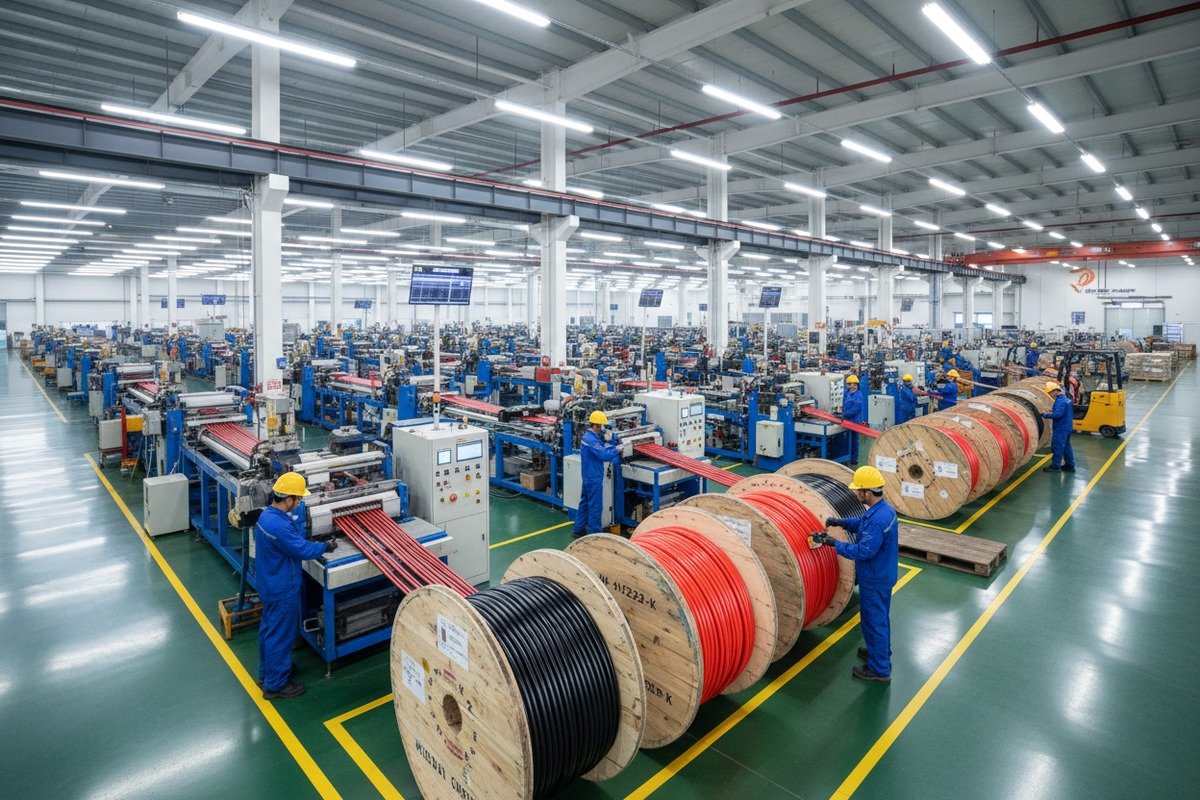
When we open our factory doors to visiting procurement teams — and we do regularly — the first thing they notice is that our raw material warehouse is as tightly controlled as our extrusion floor. That's not a coincidence.
Audit production consistency by visiting the factory, inspecting raw material incoming quality control records, reviewing XLPE and LSZH compound batch traceability, checking extrusion line temperature and speed logs, witnessing in-line testing (spark test, diameter measurement), and verifying that finished cable samples match the certified specifications through independent third-party lab retesting.
Why Factory Audits Matter More Than Certificates
A certificate tells you that a product passed tests at one point in time. It does not tell you whether every reel in your 500-km order is made from the same quality materials. Production consistency is where many manufacturers fail — and where bulk buyers face the greatest hidden risk.
Material degradation is a real concern. Some factories switch to cheaper XLPO or LSZH compounds after certification to cut costs. Others lack the process controls to maintain uniform quality across shifts and production runs.
What to Inspect During a Factory Visit
Here is a practical audit checklist:
Raw Material Control
- Are LSZH compounds sourced from approved, named suppliers?
- Does the factory test incoming material batches (melt flow index, halogen content)?
- Are material certificates (CoA) kept on file and traceable to specific cable batches?
Extrusion Process
- Are extrusion line parameters (temperature, speed, pressure) logged automatically?
- Is there a spark test running in-line to detect insulation defects?
- Are cable diameter and concentricity measured continuously?
Quality Lab
- Does the factory have its own testing lab with the equipment for IEC 60754, 61034, 60332, and mechanical tests?
- Are test records organized by batch and date?
- Can they show you a failed batch record? (This proves they actually reject non-conforming product.)
Finished Product
- Is every reel marked with the correct H1Z2Z2-K designation, EN 50618 reference, CPR Euroclass, and batch number?
- Are packaging and drum specifications matched to your logistics requirements?
Audit Red Flags vs. Green Flags
| Area | Green Flag | Red Flag |
|---|---|---|
| Raw Materials | Named compound suppliers with CoA on file | Unknown or frequently changed compound sources |
| Process Control | Automated logging of extrusion parameters | Manual records or no records |
| In-Line Testing | Continuous spark test and diameter measurement | Spot checks only |
| Lab Capability | On-site lab with IEC test equipment | No lab; relies entirely on external testing |
| Traceability | Batch codes link reels to material lots and test results | No traceability system |
| Non-Conformance | Documented reject and corrective action records | Claims of zero defects (unrealistic) |
Leverage Technology for Ongoing Assurance
For large, ongoing supply relationships, consider these modern approaches:
- Digital batch traceability: Each cable reel gets a QR code linking to its material lot, extrusion parameters, and test results. We implemented this system at our facility two years ago, and it has dramatically reduced disputes with European clients.
- Third-party random sampling: Arrange for an independent inspection agency 10 (like SGS or Bureau Veritas) to pull random samples from your shipment before it leaves the factory.
- Annual re-audits: Don't audit once and forget. Production quality can drift over time. Schedule annual visits or remote audits.
The goal is simple: make sure the cable you receive in Hamburg is identical in quality to the cable that earned the TÜV certificate.
Conclusion
Verifying LSZH solar PV cable compliance takes effort, but it protects your projects, your reputation, and your bottom line. Demand real certificates, real test data, real CPR documents, and real factory transparency.
Footnotes
1. Explains LSZH cable properties, safety benefits, and compliance with fire regulations. ↩︎
2. Replaced with the main Certipedia page on the official TÜV Rheinland website, which is accessible and authoritative. ↩︎
3. Replaced with a comprehensive overview of CPR classifications from Europacable, an authoritative industry association. ↩︎
4. Explains the international standard for measuring halogen acid gas content and acidity. ↩︎
5. Describes the international standard for measuring smoke density of burning cables. ↩︎
6. Outlines the standard practice for accelerated weathering using fluorescent UV apparatus. ↩︎
7. Wikipedia page detailing the EU regulation for harmonized conditions of construction products. ↩︎
8. Defines the legal document for CPR compliance and its importance for construction products. ↩︎
9. Official European Commission database for Notified Bodies under various EU legislations. ↩︎
10. Explains the role of third-party inspection services in ensuring product quality and compliance. ↩︎