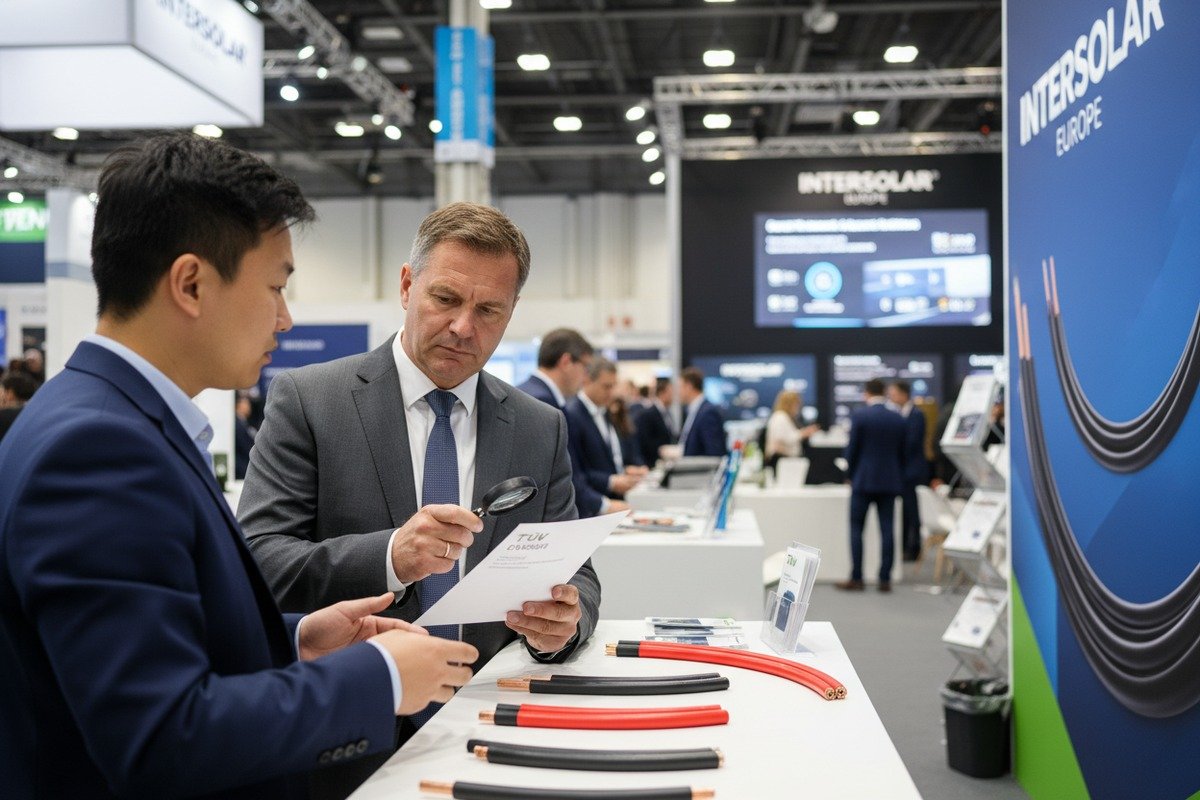
Walking the crowded halls of Intersolar Europe, our team sees the same challenge every year — buyers struggling to separate trustworthy cable suppliers from those with polished booths but questionable track records.
To evaluate solar PV cable supplier track records at European exhibitions, verify TUV EN50618 certificates directly through issuing bodies, request batch-level traceability documents, scrutinize XLPO insulation test reports, confirm CPR fire safety classifications, and assess production capacity against your grid-connection deadlines before placing any order.
This guide breaks down the exact steps, questions, and red flags you need to know before your next sourcing trip TUV online database 1. Each section targets a specific pain point that EPC procurement teams face when vetting cable manufacturers on the exhibition floor.
How can I verify if a supplier's TUV EN50618 certificates are authentic and valid for my European projects?
Every year, we encounter buyers who were burned by expired or outright fake TUV certificates — a problem that costs projects months and sometimes millions in re-inspection fees.
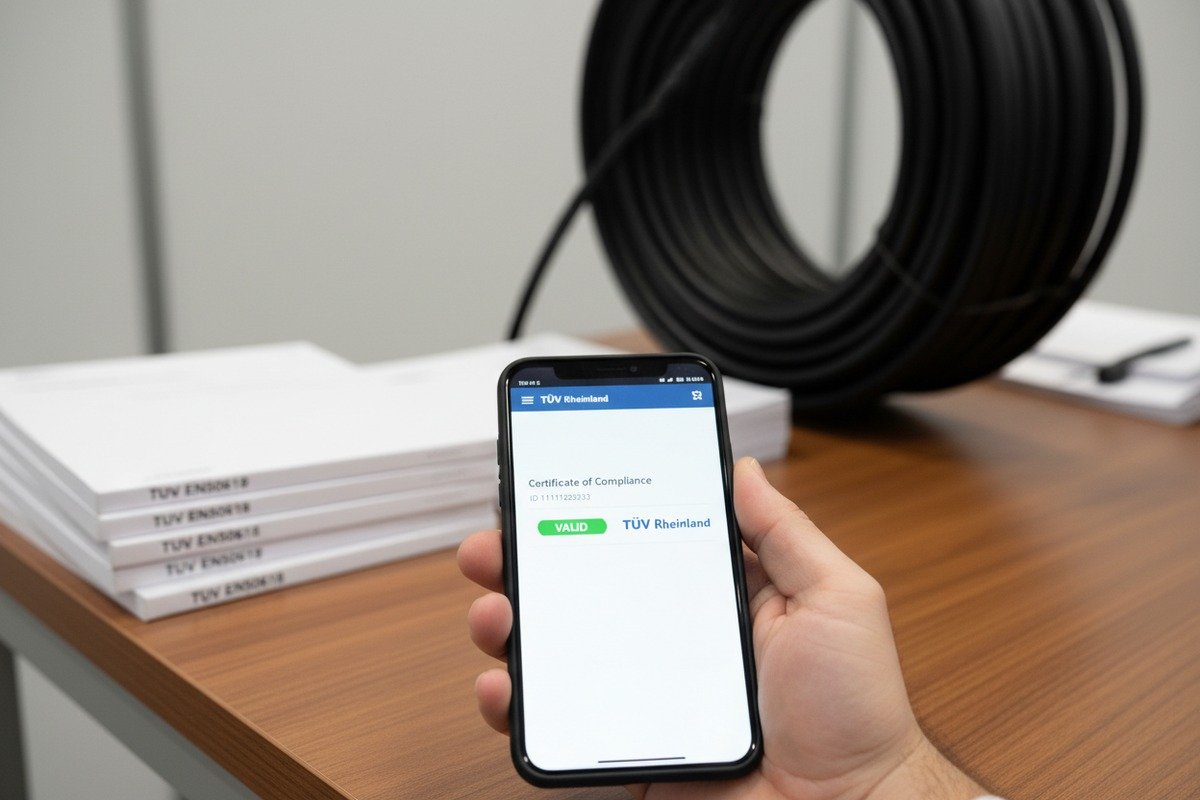
Verify TUV EN50618 certificates by cross-referencing the certificate number on the TUV Rheinland or TUV SÜD online database, confirming the exact factory location listed matches the supplier's actual production site, and checking the certificate's expiration date and scope of approval before signing any contract.
Why Certificate Fraud Is More Common Than You Think
Certificate fraud in the solar cable industry is not rare. Some suppliers photocopy certificates from other factories. Others let certificates expire and continue using them. A few even alter certificate numbers digitally. At our facility, we maintain a live certificate portal where any buyer can verify our TUV EN50618 and H1Z2Z2-K 2 certifications in real time. But not every manufacturer does this.
The core risk is simple: if your cable fails a grid-connection inspection because the certificate is invalid, you face project delays, financial penalties, and potential legal liability.
Step-by-Step Verification Process
Here is the process we recommend to every procurement team visiting our booth or any other:
- Ask for the original certificate — not a copy. Look at the certificate number, the issuing TUV body (Rheinland, SÜD, or NORD), the factory address, and the valid-through date.
- Go to the TUV online database — TUV Rheinland offers Certipedia. TUV SÜD has its own search tool. Enter the certificate number. The result should match the supplier's name, factory address, and product scope exactly.
- Check the scope — A certificate for EN50618 does not automatically cover all voltage ratings or conductor sizes. Confirm that your specific cable type (e.g., 1500V DC, 4mm² or 6mm²) falls within the certified scope.
- Verify the factory location — Some suppliers hold a certificate for Factory A but ship from Factory B. This invalidates the certificate entirely under TUV rules.
Quick Reference: Certificate Red Flags
| Red Flag | What It Means | Your Action |
|---|---|---|
| Certificate number returns no result on TUV database | Likely fake or altered | Walk away immediately |
| Factory address on certificate differs from supplier's stated factory | Product may come from uncertified facility | Request factory audit report |
| Certificate expired within last 12 months | Supplier may have failed re-certification | Ask for renewal status in writing |
| Scope lists only 1000V DC but your project needs 1500V DC | Cable is not certified for your application | Do not accept; request correct scope |
| Supplier refuses to share certificate number | Hiding something | Treat as disqualifying |
What About CE Marking?
CE marking 3 on solar cables is a self-declaration in many cases. It does not carry the same weight as a TUV certificate backed by third-party testing. Always prioritize TUV EN50618 or TUV 2PfG 1169 certification over a standalone CE mark. When we prepare shipments for European projects, our documentation package always includes both — but the TUV certificate is the one that matters at grid inspection.
What questions should I ask at the booth to ensure a manufacturer can meet my strict grid-connection deadlines?
Missing a grid-connection deadline on a European solar farm can trigger penalty clauses worth tens of thousands of euros per day — something our logistics team has helped clients avoid many times through careful planning.
At the booth, ask for documented average lead times with recent shipping evidence, inquire about current raw material inventory levels, confirm whether the supplier maintains European warehouse stock, and request references from EPC clients who completed grid connections on schedule using their cables.

The Real Cost of Late Cable Delivery
When cables arrive late, it is not just the cable installation that stops. Trenching crews sit idle. Electricians wait. Commissioning engineers reschedule. Grid operators push your connection slot to the next window — which could be weeks or months away. We have seen projects lose €15,000–€50,000 per day in liquidated damages because of a two-week cable delay.
The 10 Questions That Matter Most
Not all booth conversations are equal. Here are the questions that separate serious manufacturers from traders reselling someone else's product:
- What is your current production lead time for H1Z2Z2-K 6mm² in 500m drums?
- Do you hold any finished goods inventory, or is everything made to order?
- Can you show me a recent bill of lading or shipping record to a European port?
- Do you have a bonded warehouse or distribution partner in Europe?
- What is your monthly production capacity in kilometers?
- How do you handle raw material price locks for large orders?
- What happens if you miss the agreed delivery date — is there a penalty clause in your contract?
- Can you provide contact details for an EPC client who received on-time delivery in the last 6 months?
- Do you offer DDP (Delivered Duty Paid) shipping 5 to EU project sites?
- What is your contingency plan if a key raw material (copper, XLPO compound) faces a supply shortage?
Capacity and Delivery Comparison Table
| Criteria | Strong Supplier | Risky Supplier |
|---|---|---|
| Lead time (stock items) | 15–20 days | 45–60 days or "TBD" |
| European warehouse | Yes, with buffer stock | No, ships direct from China only |
| Monthly capacity | >5,000 km documented | Vague or unverified claims |
| DDP logistics experience | Multiple EU deliveries proven | No DDP experience |
| Penalty clause willingness | Accepts delivery guarantees | Refuses any contractual commitment |
| Client references | Provides verifiable EPC contacts | "Confidential" or unavailable |
Our production facility ships over 200 containers per year to European destinations. We keep stock items available for 15–20 day delivery. But more importantly, we are willing to put delivery guarantees in writing — and that is the single biggest differentiator you should look for.
Why "Factory Direct" Matters for Deadlines
Trading companies add a layer between you and the production floor. They often cannot control scheduling, prioritize your order, or even confirm real-time production status. When you source from a manufacturer with a 230,000 m² factory and 100+ employees, you are talking to the people who actually make the cable. That means faster answers, faster adjustments, and faster shipments.
How do I evaluate the quality of a supplier's XLPO insulation to guarantee a 25-year lifespan for my solar farm?
When our R&D engineers formulate XLPO compounds for solar cables, they test for degradation under conditions far harsher than what most cables will ever face — because a 25-year guarantee means nothing if the insulation cracks at year 8.
Evaluate XLPO insulation quality by requesting accelerated aging test reports (thermal aging at 150°C for 240+ hours), UV exposure test data per EN 50618, elongation-at-break results before and after aging, and independent third-party lab verification rather than relying solely on the supplier's in-house testing.
What Is XLPO and Why Does It Matter?
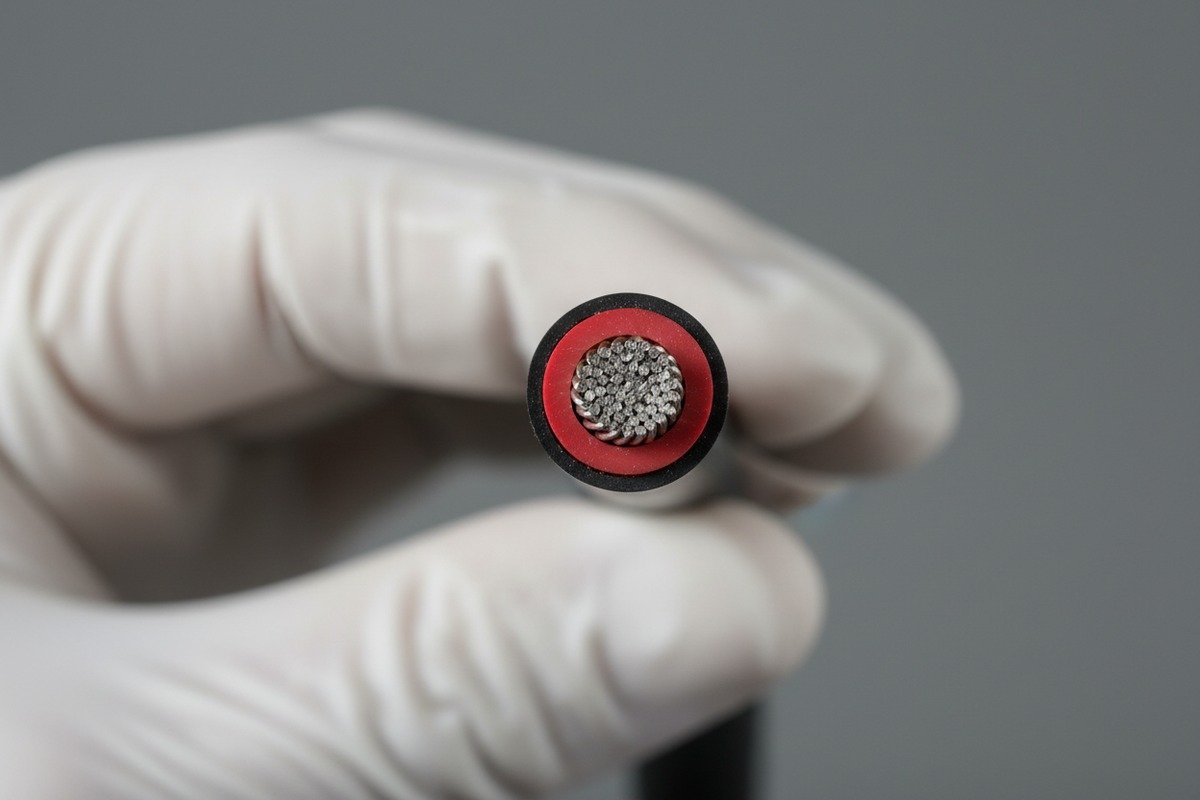
XLPO stands for cross-linked polyolefin. It is the insulation material that protects the conductor from moisture, UV radiation, extreme heat, and chemical exposure. Unlike standard PVC or PE, XLPO is cross-linked at a molecular level, which gives it superior thermal resistance and mechanical toughness. But not all XLPO is the same. The quality of the base resin, the cross-linking method (peroxide vs. silane), and the additive package (UV stabilizers, antioxidants) all determine real-world performance.
Key Test Parameters to Request
When you stand at a supplier's booth and ask about insulation quality, do not accept vague answers like "we use high-quality XLPO." Instead, ask for specific numbers from specific tests:
| Test Parameter | Standard | Acceptable Result | Red Flag |
|---|---|---|---|
| Elongation at break 6 (before aging) | EN 60811-501 | ≥ 200% | Below 150% |
| Elongation at break (after aging at 150°C, 240h) | EN 60811-401 | ≥ 120% of original | Drops below 50% |
| Tensile strength retention after aging | EN 60811-401 | ≥ 70% | Below 50% |
| UV resistance (1000h xenon arc) | EN 50618 Annex | No visible cracking | Surface cracking or chalking |
| Hot set test at 200°C | EN 60811-507 | ≤ 175% elongation under load | Exceeds 175% or melts |
| Cold bend test at -40°C | EN 60811-504 | No cracking | Cracking or fracture |
Peroxide vs. Silane Cross-Linking
There are two main methods to cross-link XLPO. Peroxide cross-linking uses heat and chemical catalysts in a continuous vulcanization line. It produces a more uniform and higher-quality cross-link. Silane cross-linking is cheaper and simpler but can result in inconsistent cross-link density, especially in thicker insulation walls.
For utility-scale solar farms where cables will be buried underground or exposed to extreme rooftop temperatures for 25+ years, peroxide-crosslinked XLPO is the safer choice. At our factory, all EN50618 and H1Z2Z2-K cables use peroxide cross-linking on continuous catenary vulcanization (CCV) lines — the same technology used by top European cable manufacturers.
Ask for Third-Party Lab Reports
In-house test reports are useful but insufficient. Any reputable supplier should be able to provide test reports from independent laboratories such as TUV, SGS, Bureau Veritas, or Intertek. These reports should reference the specific batch or production run, not just a generic "type test" from years ago. At exhibitions, we always bring batch-specific aging test reports. If a supplier cannot do the same, question whether their quality control is truly consistent.
The Degradation Timeline Nobody Talks About
A cable that passes initial type testing can still fail in the field if the XLPO compound lacks long-term UV stabilizers. UV degradation is cumulative. By year 10, low-quality XLPO starts showing micro-cracks. By year 15, those cracks allow moisture ingress. By year 18, you have insulation failures and potential arc faults. The cost of replacing cables on an operational solar farm is 5–10 times the original cable cost because of labor, downtime, and re-commissioning.
What evidence should I look for to confirm a supplier's CPR fire safety ratings and logistics reliability?
Our export team has dealt with multiple cases where European customs held cable shipments at port because the CPR documentation was incomplete or the declared fire class did not match the actual test results — a nightmare scenario for any project manager.
Look for a valid Declaration of Performance (DoP) with a specific Euroclass fire rating (Dca or higher), AVCP System 3 certification from a notified body, detailed packaging specifications for cable drum dimensions and weight limits, and documented proof of successful DDP deliveries to European project sites.
Understanding CPR for Solar Cables
The Construction Products Regulation (EU) No 305/2011 8 requires that cables installed permanently in buildings or construction works carry a CE mark based on fire performance. For solar PV cables routed through buildings (e.g., rooftop systems into inverter rooms), CPR classification is mandatory. The relevant standard is EN 50575, and cables are classified from Fca (no performance) to Aca (highest fire resistance).
Most solar farm projects require at least Dca-s2,d2,a2 classification. Some building-integrated PV installations demand Cca or even B2ca. Euroclass fire rating 9
What Documents to Request
At the booth, ask for these specific documents:
- Declaration of Performance (DoP) — This is a legal document that states the fire performance class. It must reference a specific EN standard and be signed by the manufacturer.
- Test report from a Notified Body — Under AVCP System 3, a notified body must perform the initial type testing. The report should be recent and reference the exact cable model you plan to order.
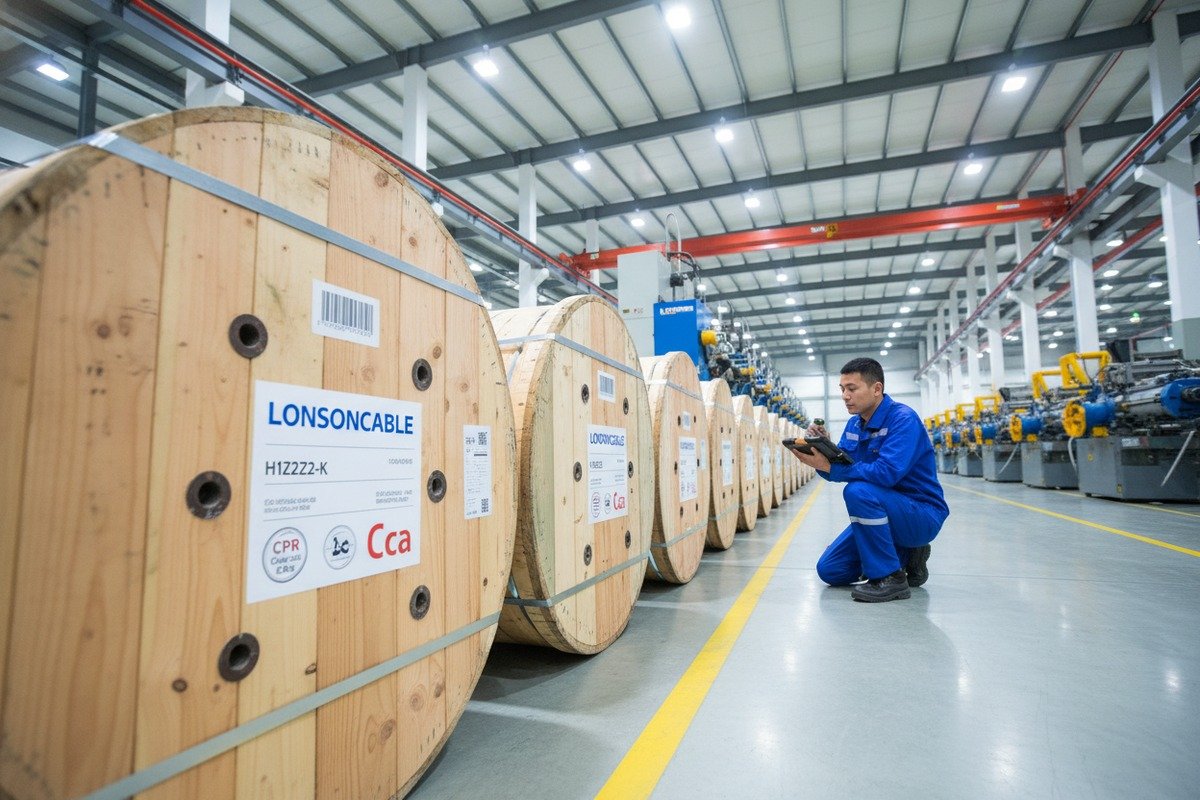
- CE marking label — The label on each drum must include the DoP reference number, the Euroclass rating, and the notified body number.
CPR Classification Quick Guide
| Euroclass | Smoke Production | Flaming Droplets | Acidity | Typical Application |
|---|---|---|---|---|
| B2ca | s1 (low) | d0 (none) | a1 (low) | High-rise buildings, tunnels |
| Cca | s1-s2 | d1 (limited) | a1-a2 | Commercial buildings, public spaces |
| Dca | s2 (medium) | d2 (moderate) | a2 (medium) | Industrial buildings, ground-mount solar |
| Eca | Not classified | Not classified | Not classified | Minimum compliance, limited use |
Logistics Reliability: Beyond the Cable Itself
A great cable means nothing if it arrives damaged or late. Packaging and logistics are where many suppliers fall short. Here is what to check:
Cable drum quality: Ask about drum material (wood, steel, or plastic), weight capacity, and whether drums are compatible with automated cable-laying machines. We use reinforced wooden drums rated to survive sea freight stacking and designed with standard flange diameters for mechanical unwinding on site.
Shipping documentation: Request sample packing lists, container loading plans, and fumigation certificates (required for wooden packaging entering the EU under ISPM-15 10). Incomplete paperwork is one of the top reasons for customs delays.
Insurance and incoterms: Clarify whether the supplier offers DDP shipping. DDP means the supplier handles all import duties, customs clearance, and delivery to your specified site. This eliminates surprises. At Lonsoncable, we offer full DDP logistics to European destinations because we understand that an EPC project manager cannot afford to chase customs brokers while construction crews wait on site.
Packaging Failures That Kill Projects
We have heard stories from clients who switched to us after receiving cables on cheap drums that collapsed during unloading. One German EPC contractor told us that a competitor's drums were too wide for their cable-laying trailer, forcing two days of manual cable handling at €800/hour in labor costs. Always ask for drum dimension drawings and confirm compatibility with your site equipment before ordering.
Conclusion
Sourcing solar PV cables at European exhibitions demands rigorous on-site verification of certifications, insulation quality, fire safety compliance, and logistics capability — backed by documentary evidence, not just booth promises.
Footnotes
1. Official TUV SÜD portal for searching and verifying product certifications. ↩︎
2. Provides general information on solar cables, including the H1Z2Z2-K standard. ↩︎
3. Official European Commission information on the purpose and application of CE marking. ↩︎
4. Official portal for verifying TUV Rheinland certifications, including EN 50618. ↩︎
5. Official source defining Incoterms 2020, including the DDP shipping term. ↩︎
6. Provides context for elongation at break as a key mechanical property in material testing. ↩︎
7. Explains cross-linked polyolefin (XLPE), a type of XLPO, and its properties. ↩︎
8. Official legal text of the European Union's Construction Products Regulation. ↩︎
9. Official European Commission explanation of the Euroclass system for fire performance. ↩︎
10. This is the official International Plant Protection Convention (IPPC) page for adopted standards, including ISPM-15, providing access to relevant information and implementation resources. ↩︎