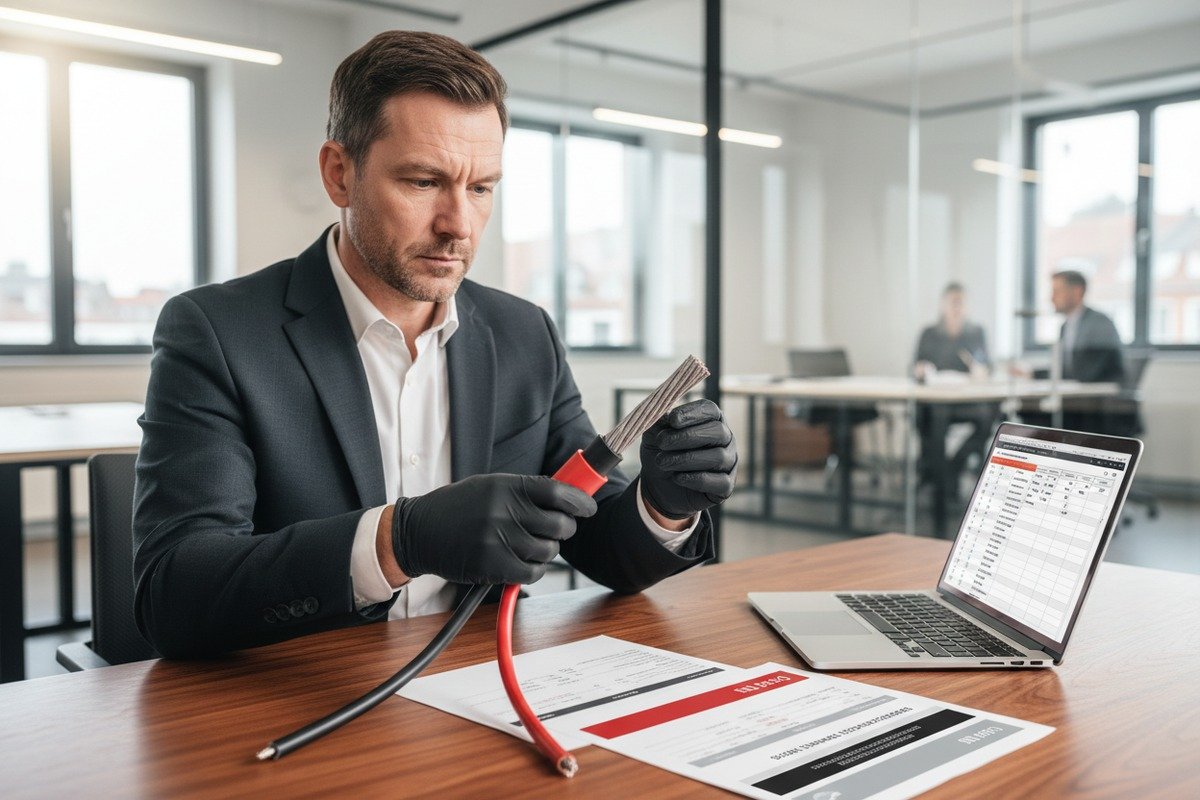
Every year, our production lines ship thousands of kilometers of solar PV cable 1 to over 40 countries. Yet the question we hear most from new buyers still catches people off guard: where exactly do you find China's export inspection requirements? The truth is, there is no single government database that lists every rule AQL sampling levels 2. The requirements depend on your destination market, your project specs, and your willingness to verify what your supplier claims. Getting this wrong means rejected shipments, customs holds, and costly project delays.
To find China export inspection requirements for solar PV cables, you must identify your destination market's mandatory standards (EN 50618 for Europe, UL 4703 for North America, IEC 62930 globally), then verify supplier certifications through accredited third-party labs like TÜV or UL, and arrange independent pre-shipment inspections before export.
This guide breaks down every step of the process. We will cover official standards, certification verification, factory inspection reports, and pre-shipment logistics. Each section draws from our 30 years of cable manufacturing experience and real cases from buyers like you.
Where can I find the official China export inspection standards for H1Z2Z2-K solar cables?
When we first started exporting H1Z2Z2-K cables to the European market over a decade ago, our team spent weeks searching for a centralized Chinese export inspection list. It does not exist in one place. This confusion costs buyers valuable time.
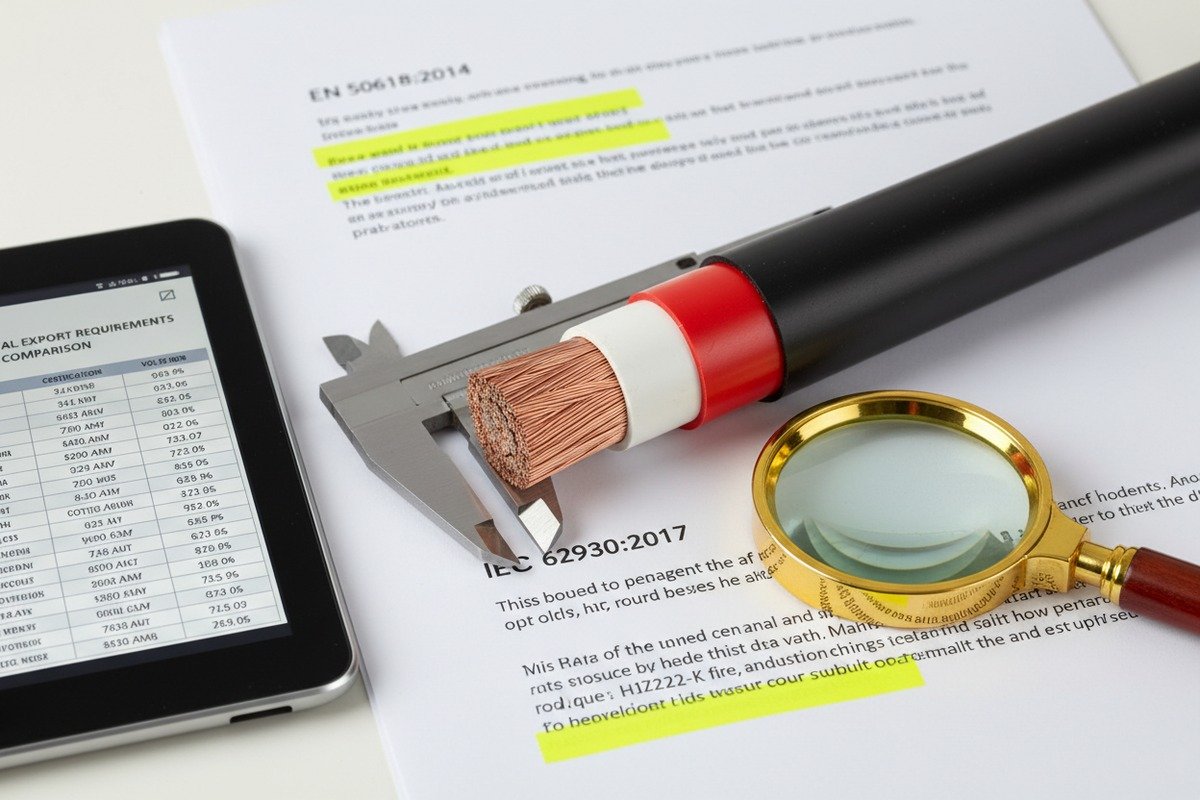
Official China export inspection standards for H1Z2Z2-K solar cables are found across multiple sources: China's GB/T 33733 national standard, the EU's EN 50618 harmonized standard, IEC 62930 for global performance benchmarks, and TÜV certification requirements. No single Chinese government portal consolidates all export inspection rules for PV cables.
Understanding the Standard Landscape
The reason there is no single database is simple. China's export inspection regime for cables is driven by the importer's country, not by a universal Chinese export law. China's General Administration of Customs (GACC) maintains a catalog of products subject to mandatory inspection. Solar PV cables may or may not appear on this list depending on their classification. But the real gatekeepers are the destination country's standards bodies.
For European projects, EN 50618 3 is the core standard. It replaced the older TÜV 2PfG 1169 specification and covers conductor requirements, insulation (electron-beam cross-linked polyolefin), UV resistance, ozone resistance, and flame retardancy. Our engineers cross-reference this with IEC 62930 4, which is the international equivalent.
For North America, UL 4703 5 governs photovoltaic wire. For Australia, AS/NZS 5000.1 applies. Japan requires JET certification. Each of these standards defines different test protocols.
Key Standards by Market
| Destination Market | Primary Standard | Key Test Requirements | Certification Body |
|---|---|---|---|
| European Union | EN 50618 (H1Z2Z2-K) | UV aging (Clause 7), flame retardancy (IEC 60332), ozone resistance | TÜV Rheinland, TÜV SÜD |
| North America | UL 4703 | Fire safety, PID resistance, sunlight resistance (720 hrs) | UL, CSA |
| Global / IEC Markets | IEC 62930 | Thermal cycling (-40°C to 90°C), wet insulation resistance | IECEE CB Scheme 6 |
| China Domestic | GB/T 33733 | Conductor resistance, voltage withstand, insulation thickness | CQC |
| Australia | AS/NZS 5000.1 | Flame propagation, mechanical durability | SAA |
Where to Actually Look
Start with the IEC website (iec.ch) for IEC 62930. For EN 50618, use the CENELEC catalog or your national standards body (DIN for Germany, BSI for the UK). China's GB/T 33733 is available through the SAC (Standardization Administration of China) portal. TÜV certification databases 7 are searchable online at certipedia.com.
Our recommendation is to always start from your destination market's requirement and work backward. Ask your Chinese supplier to show you which specific clauses of EN 50618 or UL 4703 their product has been tested against. If they cannot answer this question clearly, that is a red flag.
Also check if your project requires CPR (Construction Products Regulation 8) compliance. Since 2017, cables installed in EU buildings must carry a CPR fire classification. This is separate from EN 50618 and adds another layer of inspection.
How do I verify that my Chinese supplier's TUV and EN50618 certifications are authentic?
Our sales team has seen forged TÜV certificates more times than we would like to admit. Some are crude photocopies. Others are sophisticated fakes with real-looking certificate numbers. The stakes are enormous — a fake certificate can mean your entire shipment gets blocked at a European port.
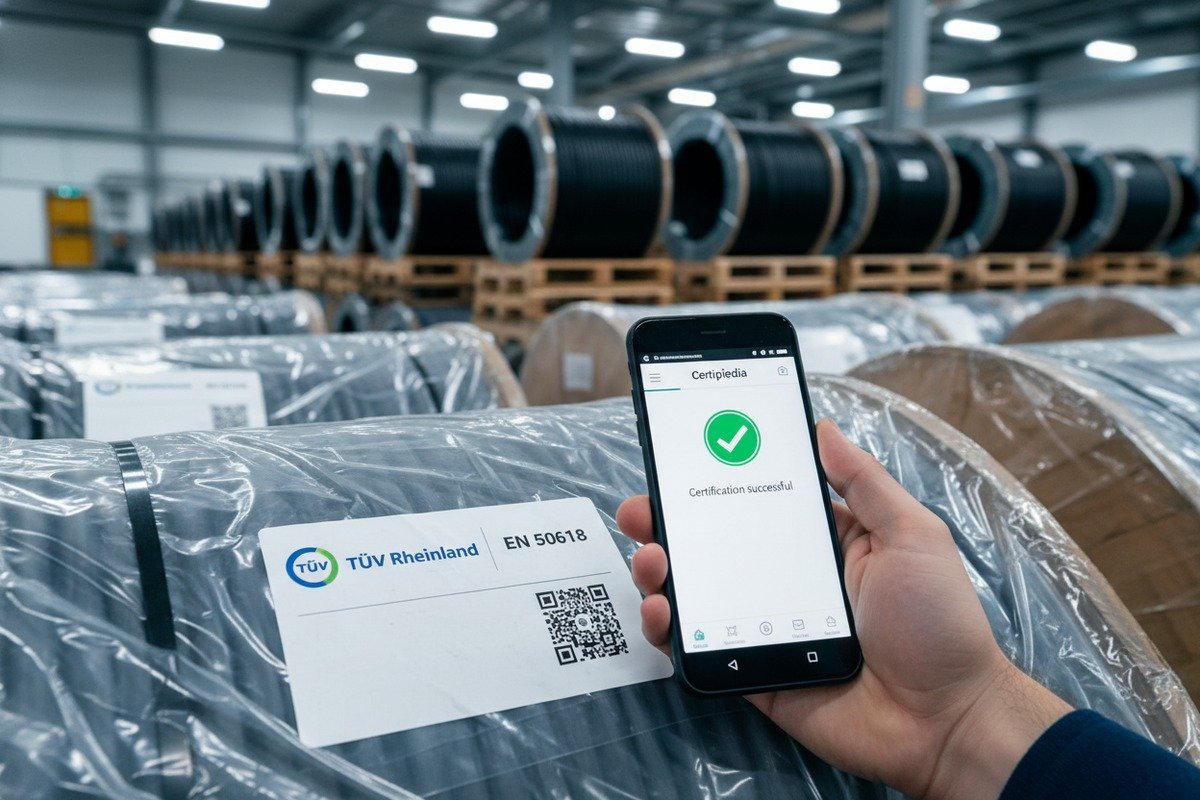
Verify TÜV and EN 50618 certifications by searching the supplier's certificate number on TÜV's official Certipedia database (certipedia.com), cross-checking the certificate holder's name and factory address, confirming the specific product model listed, and requesting the original test report directly from the issuing TÜV office.
Step-by-Step Verification Process
The first and most reliable method is Certipedia. Go to certipedia.com and enter the certificate number or the company name. Every legitimate TÜV certificate is registered in this database. If the certificate does not appear, it is either fake or expired. Pay close attention to the exact product model listed. A supplier may hold a valid TÜV certificate for one cable type but claim it covers their entire product range. That is not how it works.
Second, check the factory address on the certificate. We have seen cases where a trading company presents a certificate that belongs to the actual manufacturer. The trading company has no right to use that certificate unless formally authorized. If the address on the certificate does not match the supplier you are dealing with, ask questions.
Third, request the full test report, not just the certificate. A TÜV certificate is a summary. The test report contains the actual data: insulation thickness measurements, conductor resistance values, UV aging test results, flame retardancy scores. Our quality team always provides these reports to serious buyers.
Common Red Flags
| Red Flag | What It Means | Your Action |
|---|---|---|
| Certificate number not found on Certipedia | Likely forged or expired | Reject the supplier immediately |
| Factory address mismatch | Trading company misusing manufacturer's cert | Demand clarification and OEM authorization letter |
| Certificate covers different product model | Supplier extending cert scope illegally | Request model-specific certification |
| No test report available | Supplier may not have undergone full testing | Insist on the original lab report |
| Certificate date expired | Product may no longer meet current standards | Ask for renewed certification |
Beyond TÜV: Other Certifications to Verify
UL certifications can be verified at ul.com/database. CE declarations of conformity are self-declared in many cases, so always ask for the supporting test reports from an accredited lab. For IEC CB Scheme certificates, check the IECEE website.
At our facility, we maintain active certifications with TÜV Rheinland and keep our test reports updated annually. When a buyer from Germany or the Netherlands asks for proof, we provide the certificate, the test report, and direct contact details for our TÜV auditor. That level of transparency should be your baseline expectation from any serious supplier.
One more thing: certifications can be revoked. A supplier might have been certified two years ago but lost the certification due to a failed audit. Always check the validity period. And if possible, call the TÜV regional office directly to confirm the certificate status.
What specific factory inspection reports should I request to ensure compliance with European CPR standards?
When our factory underwent its first CPR audit for Euroclass fire rating, the level of documentation required surprised even our experienced quality team. European CPR compliance is not a checkbox exercise. It demands specific, traceable, and ongoing factory production control 9 reports.
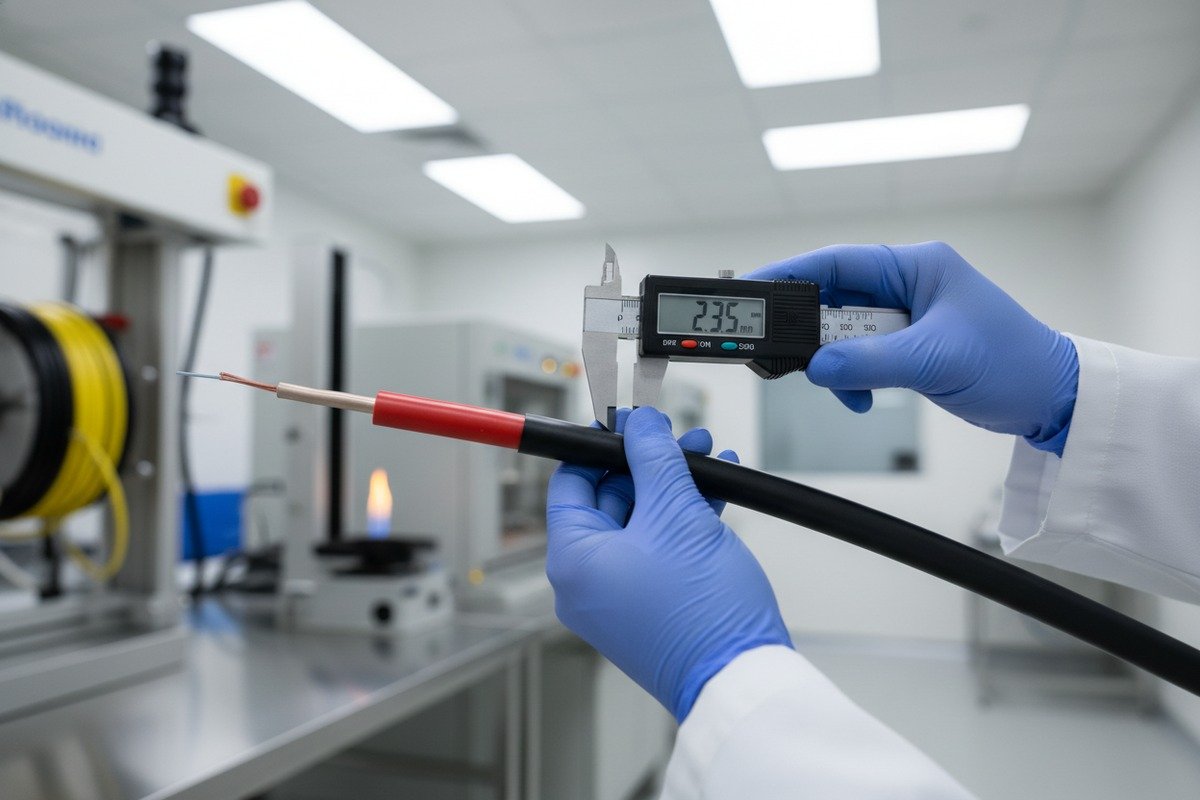
Request these factory inspection reports for CPR compliance: the Declaration of Performance (DoP), Euroclass fire classification test report (EN 50575), Factory Production Control (FPC) certificate issued by a Notified Body, raw material traceability records for insulation compounds, and ongoing surveillance audit results confirming consistent production quality.
What CPR Actually Requires
The Construction Products Regulation (EU) No 305/2011 mandates that cables permanently installed in buildings carry a fire performance classification. For solar PV cables routed through buildings or structures, this applies directly. The relevant test standard is EN 50575, which classifies cables from Aca (best) down to Fca (no performance determined).
Most solar projects require Dca-s2,d2,a2 at minimum. Some specifiers demand Cca or even B2ca for sensitive installations like hospitals or data centers. The classification is based on heat release, flame spread, smoke production, and droplet formation.
The Must-Have Documents
Here is a breakdown of every report you should request:
| Document | Issued By | Purpose | Frequency |
|---|---|---|---|
| Declaration of Performance (DoP) 10 | Manufacturer | Legal declaration of fire class and performance data | Per product type |
| EN 50575 Fire Test Report | Notified Body (e.g., TÜV, LPCB) | Actual fire test results and Euroclass rating | Initial + after design changes |
| Factory Production Control (FPC) Certificate | Notified Body | Confirms factory QMS meets CPR AVCP System 1+ | Annual surveillance |
| Raw Material Certificates | Material suppliers | Traceability of XLPO/XLPE insulation compounds | Per batch |
| Ongoing Surveillance Audit Report | Notified Body | Verifies continued compliance during production | Annual or semi-annual |
| Conductor Resistance Test Records | Factory QC lab | Confirms copper/aluminum meets spec | Per production batch |
Why FPC Matters Most
The Factory Production Control certificate is the backbone of CPR compliance. Under AVCP (Assessment and Verification of Constancy of Performance) System 1+, a Notified Body must initially inspect the factory, approve the FPC system, and then conduct ongoing surveillance. Without this, the DoP is worthless.
Our factory maintains an FPC system audited annually. We log every batch of raw XLPO insulation compound with lot numbers traceable back to the chemical supplier. If a European customs authority questions the fire rating of a specific cable drum, we can trace it back to the exact insulation batch, the production date, the machine operator, and the test results from that day.
Going Beyond Paper
Do not just accept documents. Ask your supplier these questions:
- Can you show me the Notified Body's latest surveillance report?
- What is your Euroclass fire rating, and which specific cable models does it cover?
- If I send a sample to an independent lab, will it match your DoP?
That last question is the real test. We welcome independent verification because our cables are tested to pass, not just on paper, but in every meter we ship.
How can I manage the pre-shipment inspection process to avoid delays in my solar project timeline?
We learned this lesson the hard way about fifteen years ago. A major shipment to a Middle Eastern solar farm was held at port for three weeks because the pre-shipment inspection report flagged a labeling error. The cables were perfect. The labels had a typo. That small mistake cost the project contractor over $200,000 in delay penalties. Since then, we built a pre-shipment inspection protocol that catches problems before they become disasters.
Manage pre-shipment inspections by scheduling them at 80–100% production completion, hiring independent third-party inspectors (such as SGS, Bureau Veritas, or V-Trust), defining clear AQL sampling levels and pass/fail criteria in your purchase contract, and building a 5–7 day inspection buffer into your project timeline to allow for re-inspection if needed.
When to Schedule Inspections
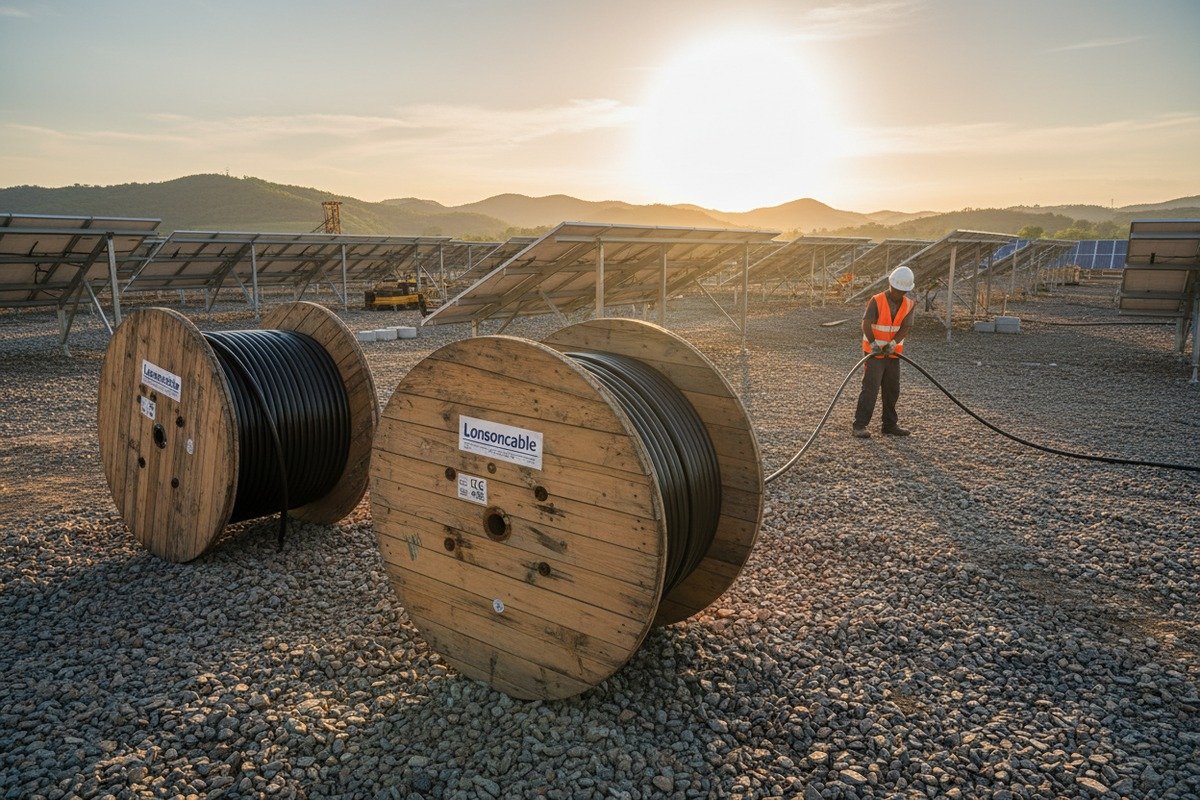
Timing is everything. Schedule your pre-shipment inspection (PSI) when 100% of the goods are produced and at least 80% are packed. If you inspect too early, the remaining production could introduce defects you never see. If you inspect too late, the container is already at the port and you have no leverage.
For standard orders, our production cycle runs 15–20 days. We recommend buyers book their inspector for day 18. This gives our QC team time to complete internal checks and gives the third-party inspector a full lot to sample.
What Inspectors Should Check
A proper PSI for solar PV cables covers these areas:
Visual and dimensional checks. The inspector measures outer diameter, insulation thickness, and conductor cross-section against your purchase order specs. They check for surface scratches (tolerance ≤2mm depth), color consistency, and print legibility on markings.
Electrical tests. Conductor resistance is measured per IEC 60228. Insulation resistance should exceed 100 MΩ/km. A high-voltage withstand test (typically 6.5 kV AC for 5 minutes) confirms dielectric strength.
Packaging and labeling. This is where many shipments fail. Cable drums must be properly wound without kinks. Drum dimensions must fit the buyer's cable-laying equipment. Labels must show the correct standard designation (e.g., H1Z2Z2-K), rated voltage, conductor size, manufacturer name, and certification marks.
Documentation review. The inspector verifies that CoC (Certificate of Conformity), test reports, packing lists, and commercial invoices all match the goods on the floor.
Setting AQL Levels in Your Contract
AQL (Acceptable Quality Limit) defines how many defects are tolerable. For solar PV cables, we recommend:
- Critical defects (safety-related): AQL 0.0 — zero tolerance
- Major defects (performance-related): AQL 0.65
- Minor defects (cosmetic): AQL 2.5
Include these numbers in your purchase agreement. Without a written AQL, you have no enforceable standard during inspection disputes.
Building Timeline Buffers
Here is a realistic timeline for managing inspections without delaying your project:
| Phase | Duration | Key Action |
|---|---|---|
| Order confirmation to production start | 3–5 days | Finalize specs, AQL, and inspection booking |
| Production | 15–20 days | During-production check at 30% completion |
| Internal QC and packing | 2–3 days | Factory self-inspection, labeling verification |
| Third-party pre-shipment inspection | 1–2 days | Full AQL sampling, electrical tests, packaging check |
| Re-inspection buffer (if needed) | 3–5 days | Fix defects, re-pack, re-inspect |
| Shipping and customs | 25–35 days (sea freight to EU) | Documentation forwarded to customs broker |
The re-inspection buffer is critical. About 10–15% of first inspections result in a conditional pass or fail, usually for minor issues like labeling errors or packaging damage. Without that buffer, a small problem becomes a massive delay.
Choosing the Right Inspection Partner
We work with buyers who use SGS, Bureau Veritas, Intertek, and V-Trust. V-Trust has over 650 inspectors across China and specializes in B2B product inspections. SGS and Bureau Veritas offer IECEE-accredited testing alongside visual inspections. Costs range from $300 to $800 per container for a standard PSI, and $500 to $2,000 for electrical lab tests.
The return on this investment is enormous. One failed shipment at a European port can cost $10,000–$50,000 in demurrage, re-testing, and project delay penalties. Spending $1,000 on a proper PSI is not an expense. It is insurance.
Our approach at the factory is to welcome third-party inspectors openly. We provide them full access to the production floor, QC records, and testing equipment. If a supplier resists third-party inspection, walk away. That resistance tells you everything you need to know.
Conclusion
Finding China export inspection requirements for solar PV cables takes persistence, not luck. Start from your destination standard, verify every certification at its source, demand full factory documentation, and never skip independent pre-shipment inspections.
Footnotes
1. Explains international standards and requirements for solar cables. ↩︎
2. Defines acceptable quality limits and their application in product inspections. ↩︎
3. Defines the European standard for electric cables used in photovoltaic systems. ↩︎
4. Describes the international standard for electric cables in photovoltaic systems. ↩︎
5. Provides details on the UL standard for photovoltaic wire in North America. ↩︎
6. Official website explaining the international system for mutual acceptance of test reports. ↩︎
7. Official database to verify the authenticity and validity of TÜV certifications. ↩︎
8. Government guidance on the EU regulation for construction products and CE marking. ↩︎
9. Explains the documented, continuous internal control system for CPR compliance. ↩︎
10. Replaced with an authoritative government source explaining the Declaration of Performance and Conformity. ↩︎