Every winter, our technical support team receives urgent calls from buyers whose ADSS cables have sagged dangerously or snapped under ice loads that should have been survivable catenary equations 1. The root cause is almost always the same—procurement decisions based on incomplete supplier data.
To evaluate supplier ADSS cable wind and ice resistance, verify aramid yarn density against local load calculations, request cyclic fatigue test reports alongside static tensile data, validate sag-tension calculations for your specific span and climate, and demand third-party certified OTDR and mechanical testing rather than relying solely on factory-internal results.
This guide walks you through each critical checkpoint. We will cover material verification, testing documentation, mechanical calculations, and quality assurance—so you can make confident procurement decisions.
How can I verify if the aramid yarn density in my ADSS cable truly meets local wind load requirements?
When we receive custom ADSS orders, our engineering team always starts by asking about the deployment region's wind profile. Many buyers skip this step and simply accept default specifications, which creates serious risk.
To verify aramid yarn density, request the cable's cross-section diagram showing yarn count, denier rating, and layer configuration, then cross-reference the resulting Rated Tensile Strength against your site-specific wind load calculations derived from local meteorological data and NESC loading district guidelines.
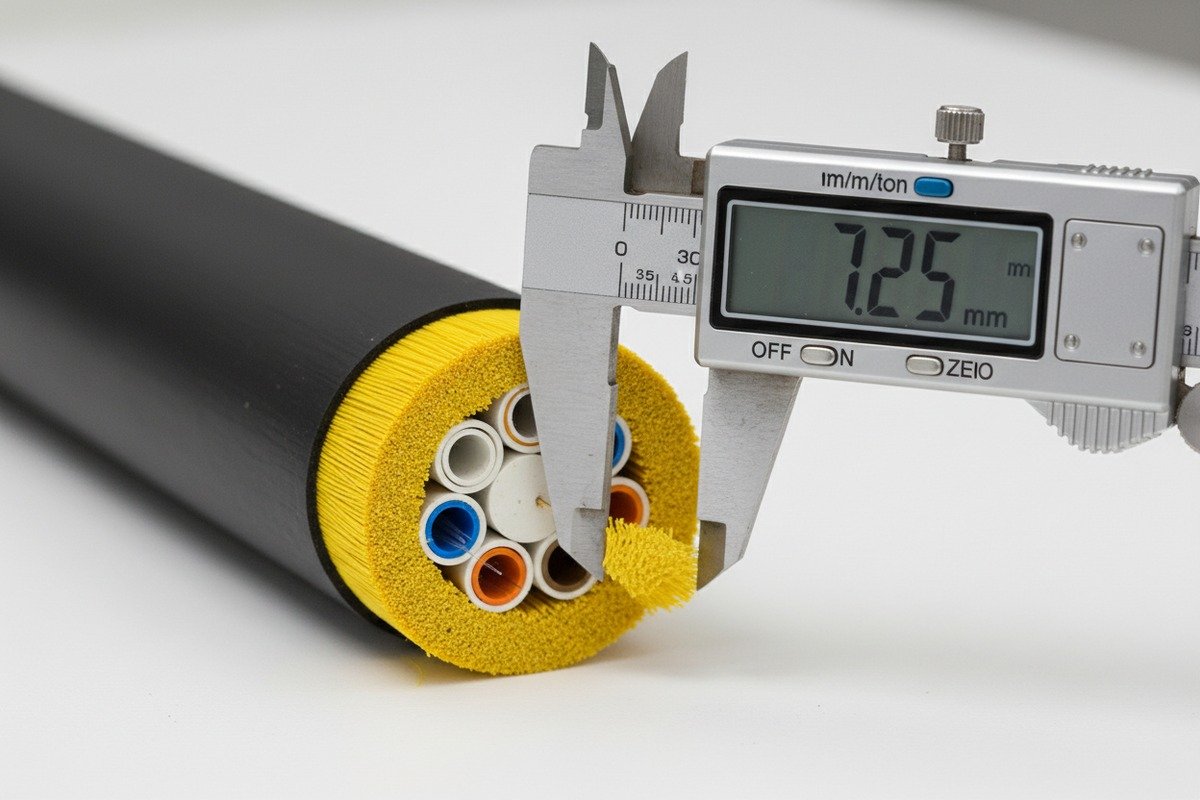
Why Aramid Yarn Density Matters
Aramid yarn is the backbone of every ADSS cable. It carries all mechanical load. The number of yarn ends, their denier (weight per unit length), and how they are arranged determine the cable's Rated Tensile Strength 2 (RTS). aramid yarn density 3 A cable with insufficient aramid cannot resist wind-induced tension, leading to excessive sag or outright failure.
Our production line uses aramid yarn from established suppliers like Dupont Kevlar and Teijin Technora. But yarn brand alone does not guarantee performance. What matters is the total cross-sectional area of aramid relative to the expected mechanical load.
How to Calculate Your Wind Load Requirement
Before evaluating any supplier's aramid specification, you need to know your site-specific wind load. Here is a simplified process:
- Identify your NESC loading district (Heavy, Medium, Light, or Warm Islands). NESC loading district guidelines 4
- Determine the design wind speed for your region.
- Calculate the wind pressure on the cable using the formula: Wind Force = 0.5 × air density × drag coefficient × cable diameter × wind speed².
- Combine wind load with cable dead weight to find the total resultant load per meter.
- Multiply by span length to get the total tension demand.
Key Parameters to Request from Your Supplier
| Parameter | What to Ask For | Why It Matters |
|---|---|---|
| Aramid Yarn Count | Number of yarn ends per layer | Directly determines tensile capacity |
| Denier Rating | Weight per 9,000 meters of yarn | Higher denier = higher individual strand strength |
| Layer Configuration | Single-layer vs. multi-layer twist | Multi-layer supports longer spans and higher loads |
| Rated Tensile Strength (RTS) | Maximum short-term breaking strength in Newtons | Must exceed your worst-case tension by a safety factor |
| Maximum Allowable Tension (MAT) | Typically 40–50% of RTS | This is the real operating limit under ice/wind |
| Every Day Stress (EDS) | Long-term tension under normal conditions | Usually 20–25% of RTS; prevents creep fatigue |
The Material Downgrading Risk
One of the most common concerns we hear from procurement managers is material downgrading. Some manufacturers substitute lower-grade aramid or reduce yarn count to cut costs. The cable looks identical from the outside. The only way to catch this is to:
- Request a certified material certificate from the aramid yarn supplier, traceable to a specific batch.
- Compare the cable's stated weight per kilometer against the cross-section diagram. Less aramid means a lighter cable.
- Ask for a sample and conduct an independent tensile pull test at a third-party lab.
On our end, we include batch-traceable aramid certificates with every shipment. This is not standard practice across the industry, so always ask.
Matching Aramid to Your Specific Wind Zone
A cable rated for 150 km/h wind speed may be perfect for a coastal area in Southeast Asia but dangerously under-specified for an exposed mountain pass in Latin America. Generic wind ratings are marketing numbers. Your procurement team must calculate the actual tension demand and compare it against the cable's MAT, not its RTS.
What specific test reports should I request from a supplier to confirm ice resistance in my region?
In our experience exporting to regions like northern Canada, mountainous Colombia, and highland areas of Turkey, we have learned that ice resistance is the most under-documented specification in ADSS procurement.
Request ice load simulation test reports per IEC 60794-1-2, cyclic fatigue test data showing performance under repeated ice loading and unloading cycles, jacket material cold-bend test results at your region's minimum temperature, and third-party verified strain measurements confirming fiber strain stays below 0.1% at maximum ice load.

Understanding Ice Load on ADSS Cables
Ice accumulates on cable surfaces as radial ice, creating a cylinder of ice around the cable. This adds both weight and wind-catching surface area. A 12mm ADSS cable with 12mm radial ice effectively becomes a 36mm cylinder—tripling wind force exposure while adding significant dead weight.
Standard ADSS cables handle ice loads up to approximately 500 N/m. But this number means nothing without context. Your region's ice accretion level determines the actual load. NESC Heavy loading, for example, assumes 12.5mm radial ice with concurrent 190 Pa wind pressure at -20°C.
The Test Reports You Must Demand
| Test Report | Standard Reference | What It Proves |
|---|---|---|
| Tensile Load Test (with ice simulation) | IEC 60794-1-2 5 Method E1 | Cable survives calculated ice + wind tension |
| Cyclic Fatigue Test | IEC 60794-1-2 Method E6 | Cable withstands repeated ice loading/shedding cycles |
| Cold Bend Test | IEC 60794-1-2 Method E11 | Jacket does not crack at minimum regional temperature |
| Fiber Strain Under Load | IEC 60794-1-2 Method E2 | Fiber strain stays ≤0.1% at max ice/wind load |
| Water Penetration Test | IEC 60794-1-2 Method F5 | Water-blocking system prevents moisture ingress |
| UV Aging Test | IEC 60794-1-2 Method F9 | Jacket resists UV degradation over service life |
Cyclic Fatigue: The Missing Data Point
Most suppliers provide static tensile test results. These show the cable can survive a single maximum load event. But ice storms are not single events. Ice builds, partially melts, refreezes, and sheds—sometimes dozens of times per winter. Each cycle stresses the aramid, the jacket, and the fiber.
Research shows that cable lifetime decreases significantly as cyclic stress frequency increases. When we test our ADSS cables at the factory, we run cyclic fatigue tests that simulate 1,000+ loading cycles at the rated ice load. Not all manufacturers do this. If your supplier cannot provide cyclic fatigue data, you are taking a significant gamble.
Jacket Material and Cold Performance
AT (anti-tracking) jacket material is essential for high-voltage environments, but it also performs differently than PE in extreme cold. PE jackets become brittle below -30°C. Double-jacket configurations—inner PE plus outer AT—provide the best combination of flexibility, electrical protection, and ice resistance.
For regions with heavy ice, we recommend requesting a cold-bend test certificate 6 at the lowest expected temperature for your deployment site. A cable that passes at -20°C may fail at -40°C.
Surface Characteristics and Ice Shedding
Cable surface roughness affects how ice adheres and sheds. Smoother jackets encourage ice to release under its own weight or with mild wind. Some advanced cable designs incorporate surface treatments that reduce ice adhesion. Ask your supplier whether they have tested ice adhesion characteristics, not just ice load capacity.
How do I evaluate if the manufacturer's mechanical calculations for sag and tension are accurate for my project?
Our engineering department produces sag-tension calculation sheets for every custom ADSS order. But we know from buyer feedback that many suppliers provide only generic charts that do not match actual field conditions.
Evaluate sag-tension accuracy by providing the supplier your exact span lengths, attachment heights, elevation profile, and local weather data, then verify their calculations use catenary equations with correct input parameters including cable weight, ice load, wind pressure, temperature range, and creep coefficients specific to the aramid type used.
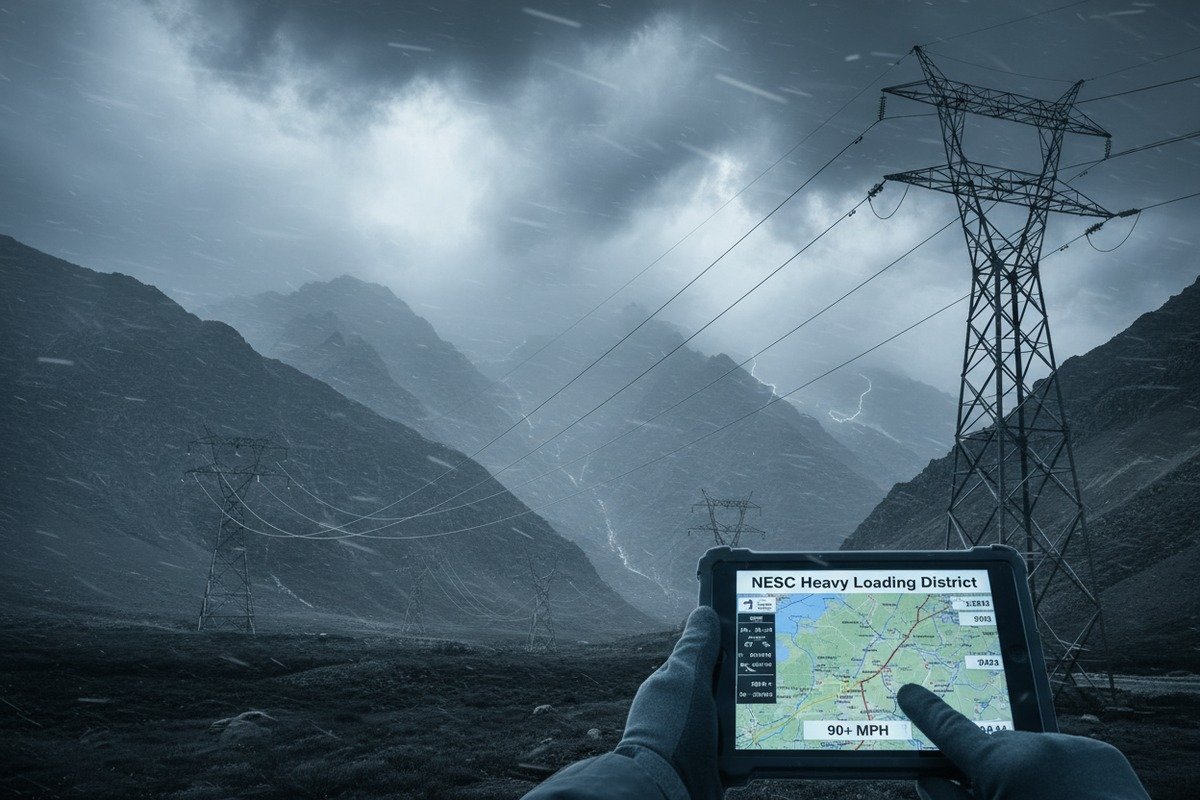
Why Sag-Tension Calculations Are Critical
Sag determines ground clearance. If a cable sags too much under ice load, it can violate minimum clearance regulations and create safety hazards. If tension is too high, the cable experiences accelerated fatigue and potential breakage. The balance between sag and tension is the core engineering challenge of every ADSS installation.
Standard installation sag is typically 1.5% of span length. Lower sag requires a stronger cable with more aramid. Higher sag reduces tension but may violate clearance requirements.
What Inputs Must Be Correct
The accuracy of any sag-tension calculation depends entirely on input parameters. Here is what to verify:
| Input Parameter | Source | Common Error |
|---|---|---|
| Span Length | Field survey | Using average span instead of actual per-span data |
| Cable Weight | Manufacturer datasheet | Not including ice load weight in worst-case scenario |
| Wind Pressure | Local meteorological data + NESC | Using generic wind speed instead of design wind pressure |
| Ice Thickness | Regional ice map or NESC loading | Underestimating radial ice for the deployment altitude |
| Temperature Range | Historical weather data | Ignoring extreme low temperatures that increase tension |
| Creep Coefficient | Aramid material specification | Using generic values instead of material-specific data |
| Attachment Height Difference | Field survey | Assuming level spans when terrain varies |
How to Cross-Check Supplier Calculations
You do not need to be a cable engineer to verify calculations. Here are practical steps:
- Ask for calculation software output. Professional suppliers use PLS-CADD 8, SAG10, or equivalent software. Request the raw output file, not just a summary table.
- Compare against a second source. Send the same input parameters to another supplier or an independent engineering consultant. Results should match within 2–3%.
- Check the worst-case scenario. The calculation must include maximum ice load at minimum temperature with concurrent wind. This produces the highest tension and deepest sag simultaneously.
- Verify the cable model matches the calculation. Ensure the cable weight, diameter, and RTS used in the calculation exactly match the product being quoted.
The Creep Factor
Aramid yarn creeps (stretches permanently) over time under sustained tension. This increases sag over the cable's service life. A proper sag-tension calculation includes a 10-year or 20-year creep prediction. If your supplier's calculations show identical sag at installation and after 20 years, the creep factor has been omitted. This is a red flag.
PBO vs. Aramid: Impact on Calculations
Next-generation PBO fiber reinforcement reduces cable weight by up to 43% and diameter by 27% compared to aramid in equivalent designs. This dramatically changes sag-tension behavior. Lighter cables produce less sag under the same span, or allow longer spans with the same sag. If your supplier offers PBO-reinforced ADSS, request separate calculations showing the performance improvement versus traditional aramid, so you can evaluate cost-benefit accurately.
Can I trust the factory's internal OTDR and tensile testing data to prevent cable breakage during winter storms?
When we run OTDR tests 10 on our production line, we generate a complete attenuation trace for every reel. But we also understand why buyers question whether internal data alone is sufficient—trust must be verified.
Factory-internal OTDR and tensile testing data provides a useful baseline but should not be your sole assurance. Always request third-party lab verification from accredited testing bodies like UL, CSA, or CNAS-accredited labs, and ensure OTDR traces include wavelength-specific attenuation at 1310nm and 1550nm with event markers for every splice and connector point.

The Value and Limits of Factory Testing
Factory OTDR testing verifies that fiber attenuation meets specification before shipment. It catches manufacturing defects like micro-bends, poor splices, and contaminated fibers. Tensile testing confirms the cable can handle rated loads. Both are essential quality control steps.
However, factory tests have inherent limitations:
- The factory controls the testing environment, conditions, and reporting.
- Internal testing equipment may not be calibrated to third-party standards.
- There is a financial incentive to pass every reel.
- Test conditions may not replicate your field environment (temperature, humidity, load duration).
What to Look for in OTDR Reports
A trustworthy OTDR report should include:
- Test wavelengths: Both 1310nm and 1550nm (and 1625nm for bend-sensitive applications).
- Attenuation coefficient: Measured in dB/km, should match ITU-T G.652D or G.657A specifications.
- Event table: Every splice, connector, and anomaly listed with location and loss value.
- Trace graph: The full OTDR trace showing the cable length and return loss profile.
- Equipment calibration date: The OTDR instrument must have current calibration certification.
- Operator identification: Who performed the test.
Third-Party Verification: When and How
For high-stakes projects—long spans, ice-prone regions, critical infrastructure—third-party testing is not optional. Here is a practical approach:
- Pre-shipment inspection (PSI): Hire a third-party inspection company to witness OTDR and tensile testing at the factory before shipment.
- Sample testing: Send cable samples to an independent lab (UL, Intertek, Bureau Veritas, or a CNAS-accredited lab) for tensile pull, fiber strain, and OTDR verification.
- Type testing: For new cable designs or first orders from a new supplier, request full type test reports per IEC 60794-4-1. This includes all mechanical, environmental, and optical tests.
Connecting Test Data to Winter Storm Survival
OTDR data alone does not predict cable breakage during storms. It confirms optical performance at the time of testing. Tensile data confirms mechanical capacity at the time of testing. What you need for winter storm assurance is the combination of:
- Tensile test results confirming RTS exceeds your worst-case ice/wind tension by at least 2.5× safety factor.
- Fiber strain measurements showing ≤0.1% strain at maximum designed load.
- Cyclic fatigue test data proving the cable survives repeated loading cycles.
- OTDR traces confirming no degradation after mechanical testing.
Our quality system at the factory runs OTDR tests both before and after mechanical proof testing. If attenuation increases after a tensile pull, it indicates the cable design has insufficient excess fiber length (EFL) in the loose tubes, meaning fibers will experience strain under field loads. This before-and-after comparison is the single most important quality indicator for winter storm resilience. Always ask for it.
Certifications That Back Up the Data
| Certification | Issuing Body | What It Validates |
|---|---|---|
| UL Listed | Underwriters Laboratories | Fire resistance, material safety, electrical compliance |
| CSA Certified | Canadian Standards Association | Cold weather performance, Canadian code compliance |
| CE Marked | European conformity | EU market safety and environmental requirements |
| ISO 9001 | International Organization for Standardization | Quality management system in manufacturing |
| CNAS Lab Report | China National Accreditation Service | Third-party test lab accreditation and report validity |
| Telcordia GR-20 | Telcordia Technologies | North American fiber optic cable qualification |
If your supplier holds UL, CSA, and ISO 9001 certifications—as our factory does—it means their quality system and testing procedures undergo regular external audits. This provides a layer of trust beyond any single test report.
Conclusion
Evaluating ADSS cable wind and ice resistance requires going beyond datasheets. Verify aramid density, demand cyclic fatigue reports, validate sag-tension calculations, and insist on third-party testing for every critical project.
Footnotes
1. Explains catenary equations in the context of cable sag and tension. ↩︎
2. Defines and explains the importance of Rated Tensile Strength in cables. ↩︎
3. Replaced with a relevant article discussing aramid yarn density in optical cables. ↩︎
4. Provides an overview of NESC weather loading requirements and districts. ↩︎
5. Official standard for basic optical cable test procedures. ↩︎
6. Describes the cold bend test for cables and its purpose in evaluating low-temperature performance. ↩︎
7. Replaced with an IEEE standard discussing fatigue performance and cyclic flexing tests for ADSS cables, an authoritative source. ↩︎
8. Replaced with the official product page for PLS-CADD from Power Line Systems, the developer. ↩︎
9. Replaced with an article directly discussing conductor creep coefficients and their modeling in cable systems. ↩︎
10. Replaced with a comprehensive and authoritative guide to OTDR testing from VIAVI Solutions. ↩︎