

Over the years, our export team has seen too many buyers burned by vague contracts that left them with substandard ADSS cables and zero legal recourse.
To protect yourself when sourcing ADSS fiber optic cables from China, your contract must include precise material specifications, enforceable penalty clauses for shipping delays, mandatory pre-shipment testing documentation like OTDR reports, and clear terms covering packaging damage during sea freight.
Each of these contract areas addresses a real risk that can derail your project third-party material verification 1. Let's break them down one by one so you know exactly what language to include before signing anything.
How can I ensure my contract specifies the exact aramid yarn density and material quality for my ADSS cables?
When we test aramid yarn tensile strength on our production line, we see first-hand how small density variations can make or break a cable's span performance in the field.
Your contract should list the exact aramid yarn type (e.g., Kevlar 49), the minimum denier count, the required tensile strength in kilonewtons, and a clause granting you the right to third-party material verification before shipment.
Why Aramid Yarn Density Matters
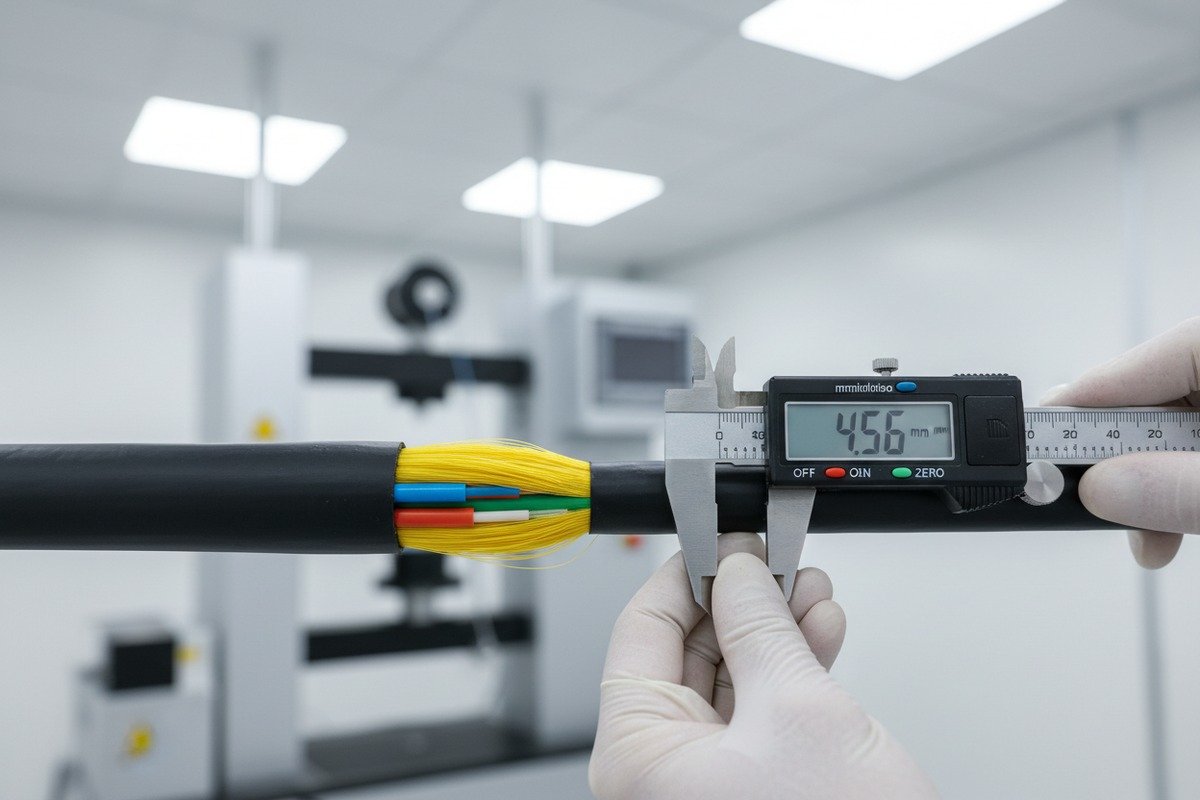
Aramid yarn is the backbone of any ADSS cable. It carries the mechanical load between spans. If a factory quietly reduces the aramid yarn density or substitutes a cheaper alternative, your cable sag increases. In extreme cases, the cable snaps mid-span. This is not a hypothetical risk. It happens regularly when buyers rely on generic purchase orders instead of detailed contracts.
What to Specify in Your Contract
Your contract should go beyond saying "aramid yarn included." It should name the exact material grade and measurable properties. Here is a reference table you can adapt:
| Contract Parameter | Example Specification | Why It Matters |
|---|---|---|
| Aramid Yarn Brand/Type | Kevlar 49 2 or Twaron 2200 | Prevents substitution with inferior yarn |
| Minimum Denier Count | 1580d per strand | Defines yarn thickness and load capacity |
| Minimum Tensile Strength | 6–50 kN (based on span design) | Ensures cable survives rated wind and ice loads |
| Number of Aramid Strands | Per approved cable cross-section drawing | Prevents reduction in strand count |
| Third-Party Testing Right | SGS or Bureau Veritas inspection before shipment | Gives you an independent verification option |
| Material Certificate Requirement | Original mill certificate from yarn manufacturer | Proves the yarn is genuine, not relabeled |
How to Enforce Material Quality
Include a clause that says you can reject the entire shipment if third-party lab testing shows the aramid yarn density falls below the stated specification by more than 5%. Spell out that replacement costs and re-shipping fees fall on the supplier. Also require the factory to provide the original aramid yarn mill certificate — not a photocopy, not a scan, but the original document with a traceable lot number.
The Cross-Section Drawing Trap
Many buyers skip requesting a detailed cable cross-section diagram. This is a mistake. The cross-section drawing shows every layer: the central loose tube or stranded tubes, the aramid yarn layer, the water-blocking tape, and the outer PE or AT sheath. Without this drawing locked into the contract as an appendix, the factory can alter internal construction without technically breaching a vague specification. Our engineering team always provides a full cross-section diagram with every quotation. Insist on receiving one, and make it a binding part of your agreement.
Sheath Type: PE vs. AT
Your contract must also specify the outer sheath material. PE sheaths work for power lines below 110 kV with electric field strength under 12 kV/m. AT (anti-tracking) sheaths are required for lines above 110 kV with field strength up to 20 kV/m. Using the wrong sheath type is a safety hazard that can cause tracking damage and eventual cable failure. State the sheath type explicitly in your contract, tied to the voltage environment of your installation.
What penalty clauses should I include to protect my project from unexpected shipping delays?
Our logistics coordinators in Hainan manage dozens of ocean freight bookings every month, so we know exactly how delays cascade into idle construction crews and blown project budgets.
Your contract should include a liquidated damages clause that triggers a fixed daily penalty — typically 0.5% to 1% of the order value — for each day of delay beyond the agreed shipping date, capped at a reasonable maximum like 10% of the total contract price.

The Real Cost of Late ADSS Cable Shipments
When ADSS cables arrive late, it is not just an inconvenience. Construction crews sit idle. Tower access permits expire. Seasonal weather windows close. For power grid and telecom projects, a single week of delay can cost tens of thousands of dollars in standby fees alone. Your contract must account for this.
Structuring the Penalty Clause
A well-drafted liquidated damages (LD) clause has four parts:
| Element | Recommended Language | Purpose |
|---|---|---|
| Trigger Date | "Shipment must depart origin port by [DATE]" | Creates a clear, verifiable deadline |
| Daily Penalty Rate | 0.5%–1% of total order value per calendar day | Compensates buyer for downstream losses |
| Maximum Cap | 10% of total contract value | Protects supplier from unlimited liability |
| Exclusions | Force majeure events 3 as defined in Clause [X] | Prevents unfair penalties for genuine emergencies |
Milestone-Based Payment as Leverage
Do not pay 100% upfront. Structure your payment to retain leverage. A common arrangement is 30% deposit upon order confirmation, 60% against Bill of Lading copy, and 10% after delivery inspection. If the shipment is late, you can withhold the final 10% until the penalty is settled. This gives you real bargaining power.
Force Majeure: Keep It Tight
Factories sometimes claim "force majeure" for events that do not qualify. Your contract should define force majeure narrowly. Include natural disasters, government-ordered shutdowns, and port closures. Exclude raw material price increases, labor shortages due to poor planning, and routine customs delays. Require the supplier to notify you within 48 hours of a force majeure event and to provide documentary evidence. If the event lasts more than 60 days, give yourself the right to cancel the order and receive a full refund of deposits paid.
Delivery Terms and Incoterms
Specify Incoterms clearly 4. If you are using FOB, the supplier's obligation ends when the goods cross the ship's rail at the origin port. If you are using CIF or DDP, the supplier retains more responsibility during transit. The penalty clause should align with the chosen Incoterm. For example, under FOB, penalties apply up to the point of origin port loading. Under DDP, penalties can extend to the final destination delivery date.
Communication Requirements During Delays
Add a clause requiring the factory to provide weekly production progress photos and a shipping status update. If the supplier anticipates a delay, they must notify you at least 14 days in advance. Early warning gives you time to adjust your construction schedule, rebook installation crews, or source partial quantities from alternative suppliers.
How do I guarantee that the factory provides authentic OTDR test reports and technical diagrams before shipment?
Every cable reel that leaves our 230,000 m² facility is accompanied by an OTDR test report 6 — but we know not every factory in China operates that way, and some buyers have received fabricated test data.
Your contract should require the supplier to deliver original OTDR test reports per reel, factory acceptance test (FAT) records, and a detailed cable cross-section diagram at least 7 days before shipment, with a clause allowing you to reject shipment if documents are missing or falsified.
Why Pre-Shipment Documentation Is Non-Negotiable
An OTDR (Optical Time-Domain Reflectometer) test measures fiber attenuation, splice loss, and continuity along the entire cable length. Without this report, you have no way to confirm the cable will perform to specification once installed. Technical diagrams confirm that the internal cable structure matches what you ordered. Together, these documents are your proof of conformity.
What Documents to Require
| Document | Details to Include | Delivery Deadline |
|---|---|---|
| OTDR Test Report (per reel) | Wavelength (1310 nm & 1550 nm), attenuation per km, event map, total link loss | 7 days before shipment |
| Cable Cross-Section Diagram | Layer-by-layer breakdown: fiber count, tube colors, aramid layer, sheath type and thickness | At order confirmation |
| Factory Acceptance Test (FAT) Report | Tensile strength test, crush resistance, temperature cycling results | 7 days before shipment |
| Third-Party Certification | ITU-T G.652D compliance, ISO 9001 certificate, UL/CE if applicable | At order confirmation |
| Material Certificates | Aramid yarn mill cert, fiber preform origin cert | 7 days before shipment |
How to Detect Fake OTDR Reports
Fake OTDR reports are more common than most buyers realize. Here are red flags:
- The report does not include the OTDR machine serial number or calibration date.
- All reels show identical attenuation values down to the third decimal — real measurements always vary slightly.
- The report header uses a generic template with no factory name or logo.
- Fiber length on the report does not match the reel length marked on the drum.
To protect yourself, include a contract clause that says: "Buyer reserves the right to commission an independent third-party inspector (e.g., SGS, Bureau Veritas, or TÜV) to re-test any or all cable reels at the supplier's facility before shipment. If test results deviate from the supplier's reports by more than 10%, the supplier bears all re-testing and remediation costs."
Technical Diagrams as Binding Specifications
The cable cross-section diagram should be signed by both parties and attached as a contract appendix. It should show the exact fiber count (e.g., 48 fibers in 4 loose tubes of 12 fibers each), the color coding scheme, the aramid yarn layer, the water-blocking material, and the outer sheath with its nominal diameter and tolerance. Once signed, any deviation from this diagram constitutes a breach of contract.
The Role of Wavelength-Specific Testing
ADSS cables typically operate at 1310 nm and 1550 nm wavelengths. Your contract should require OTDR testing at both wavelengths. Attenuation limits differ by wavelength — for ITU-T G.652D single-mode fiber 7, typical maximums are 0.35 dB/km at 1310 nm and 0.22 dB/km at 1550 nm. State these limits in your contract. If the factory only tests at one wavelength, you may miss a defect that only shows up at the other.
Holding Shipment Until Documents Are Approved
Add a clause that says: "Supplier shall not release goods for shipment until Buyer has reviewed and approved all pre-shipment documents in writing. Shipment without written approval constitutes a breach, and Buyer may refuse to accept delivery." This gives you a hard stop. Without your green light, the goods stay in the warehouse.
What terms will protect me if the wooden reels are damaged during sea freight to my location?
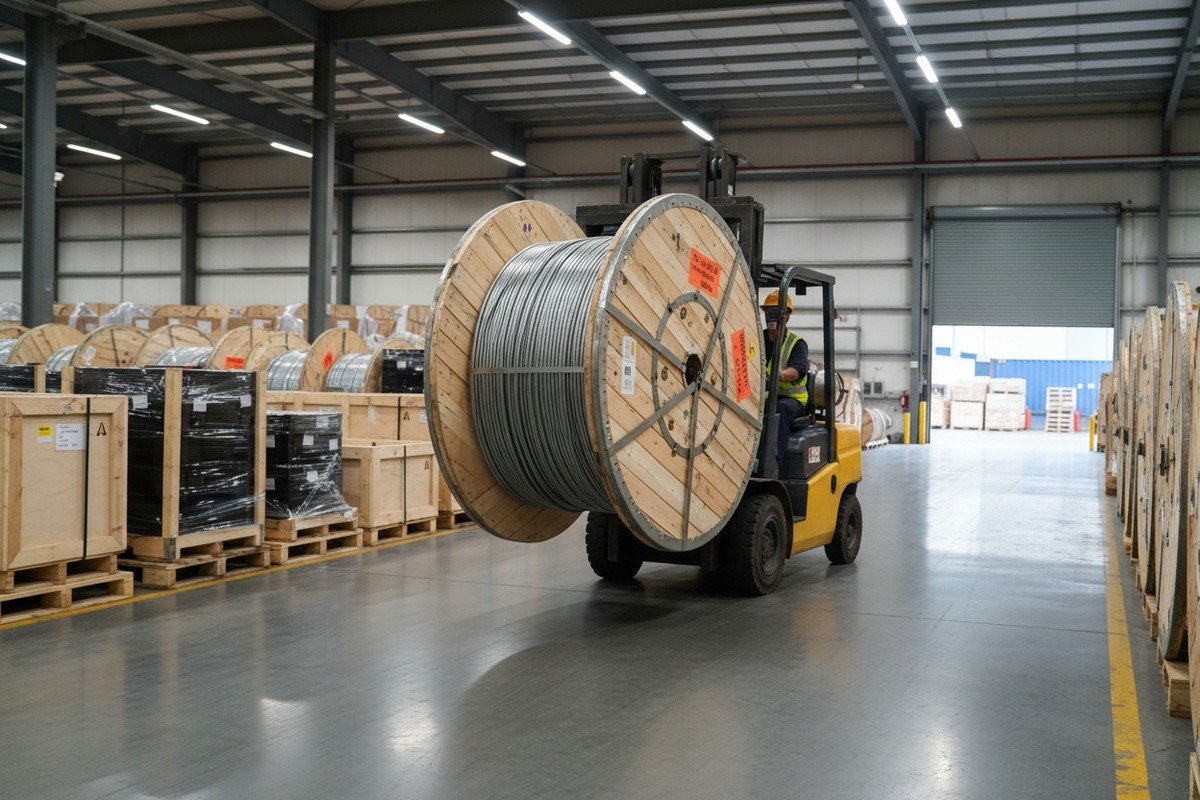
We have shipped ADSS cable reels to over 30 countries, and we learned early on that a collapsed wooden drum during a 40-day ocean voyage can turn a perfectly good cable into an expensive pile of scrap.
Your contract should specify reel construction standards (fumigated hardwood, minimum plank thickness, steel-reinforced flanges), require photographic evidence of packing before loading, and clearly assign damage liability based on the agreed Incoterm — with marine cargo insurance mandatory.

Why Packaging Failures Are So Costly
ADSS cables have a minimum bending radius — typically 30 times the cable diameter during storage and transport. If a wooden reel collapses, the cable bends beyond this limit. That causes micro-bending loss in the fibers, which increases attenuation permanently. You cannot repair this damage. The entire reel must be scrapped. For a 4 km reel of 96-fiber ADSS cable, that loss can be thousands of dollars — not counting the project delay.
Reel Specification Clause
Your contract should define the reel itself as a deliverable with its own specification:
- Wood type: Fumigated hardwood compliant with ISPM-15 8 (required for international shipping to avoid quarantine issues).
- Minimum flank thickness: 20 mm for reels under 1,500 mm diameter; 25 mm for larger reels.
- Steel reinforcement: Steel bolts through flange centers and steel strapping around the barrel.
- Lagging boards: Outer cable layer must be protected by wooden lagging nailed to the flanges.
- Wrapping: Entire reel wrapped in stretch film and waterproof woven fabric.
Liability Under Different Incoterms
The Incoterm you choose determines who bears the risk of packaging damage during transit:
| Incoterm | Risk Transfers At | Who Bears Sea Freight Damage Risk | Recommended For |
|---|---|---|---|
| EXW | Supplier's warehouse | Buyer | Experienced importers with freight forwarders |
| FOB | Origin port ship's rail | Buyer (after loading) | Most common for cable imports |
| CIF | Destination port | Buyer (but supplier arranges insurance) | Buyers wanting supplier-managed logistics |
| DDP | Buyer's door | Supplier | Buyers wanting full supplier responsibility |
Under FOB terms, once the reel is loaded onto the vessel, the risk is yours. This means you must arrange marine cargo insurance 9 yourself. Under CIF, the supplier arranges insurance, but the coverage is often minimal (110% of invoice value, Institute Cargo Clauses C). Push for Institute Cargo Clauses A, which provides all-risks coverage.
Pre-Loading Inspection and Photo Evidence
Require the supplier to send timestamped photos of every reel before container loading. Photos should show the reel condition, lagging boards, wrapping, and the cable end sealed with a waterproof cap. Also require a container loading plan that shows how reels are braced inside the container to prevent shifting. Reels must stand upright — never laid flat — to avoid flange damage and cable deformation.
Damage Claims Process
Your contract should outline the exact steps for a damage claim:
- Buyer inspects reels within 5 business days of arrival at destination.
- Buyer photographs all damage and notifies supplier in writing within 7 calendar days.
- Supplier has 14 days to respond with a resolution proposal (replacement, credit, or partial refund).
- If parties cannot agree, the dispute escalates to the arbitration mechanism defined in the contract.
Include a clause that says if more than 10% of reels in a shipment arrive damaged, the buyer may reject the entire shipment and demand full replacement at the supplier's cost. This protects you from accepting a partially usable delivery that still cannot meet your project timeline.
Insurance as a Contract Requirement
Regardless of the Incoterm, make marine cargo insurance a contractual obligation — either for you or the supplier, depending on terms. Specify the minimum coverage amount (typically 110%–120% of CIF value) and the coverage type (Institute Cargo Clauses A preferred). Require that the insurance policy names you as the beneficiary and is issued by a reputable underwriter.
Conclusion
A well-drafted contract is your strongest tool when sourcing ADSS fiber optic cables 10 from China — protect every detail from aramid yarn to wooden reels.
Footnotes
1. Replaced HTTP 404 with an authoritative source on third-party supplier inspections and material quality control. ↩︎
2. Details properties and applications of Kevlar 49 aramid fiber. ↩︎
3. Explains the legal concept of force majeure in contract law. ↩︎
4. Official source for Incoterms rules, defining buyer and seller responsibilities. ↩︎
5. Replaced HTTP 403 with an authoritative legal definition from Cornell Law School. ↩︎
6. Provides a definition and explanation of Optical Time-Domain Reflectometers. ↩︎
7. Official standard for G.652D single-mode optical fiber characteristics. ↩︎
8. Explains the international standard for wood packaging material treatment. ↩︎
9. Defines marine cargo insurance and its coverage for goods in transit. ↩︎
10. Provides a comprehensive definition and overview of ADSS cables. ↩︎