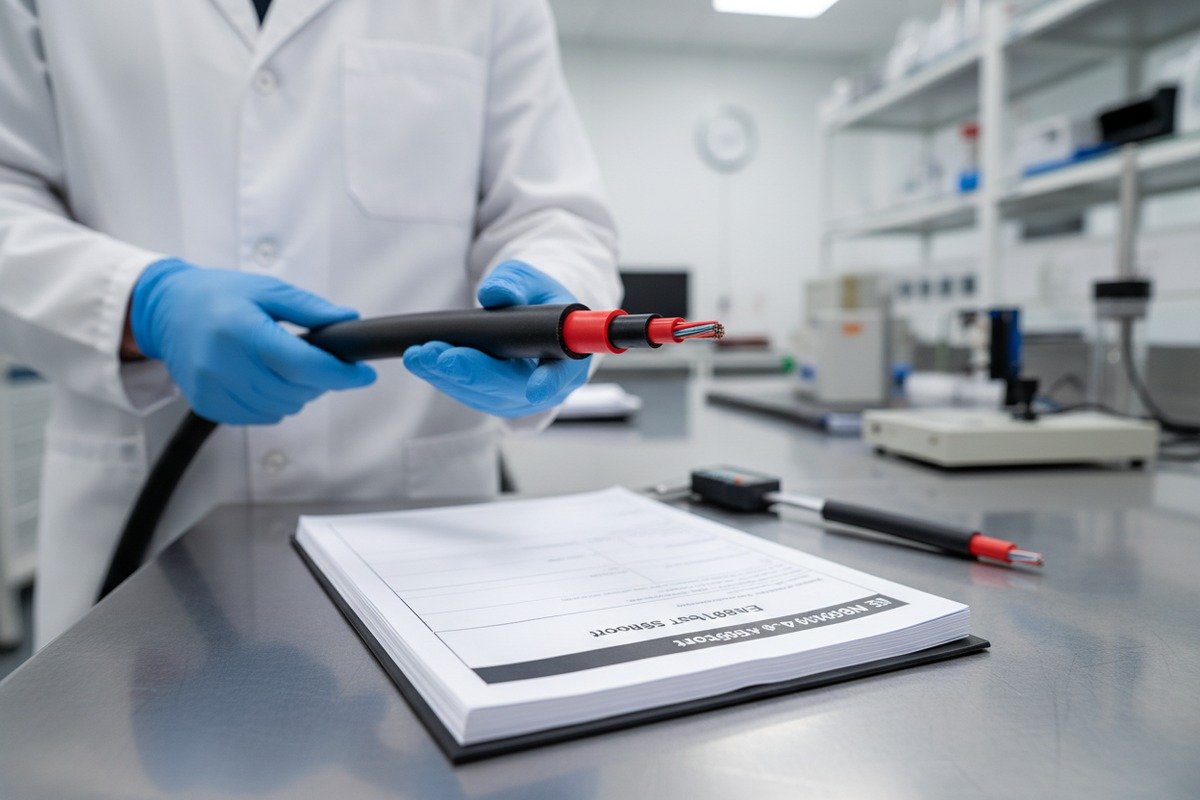
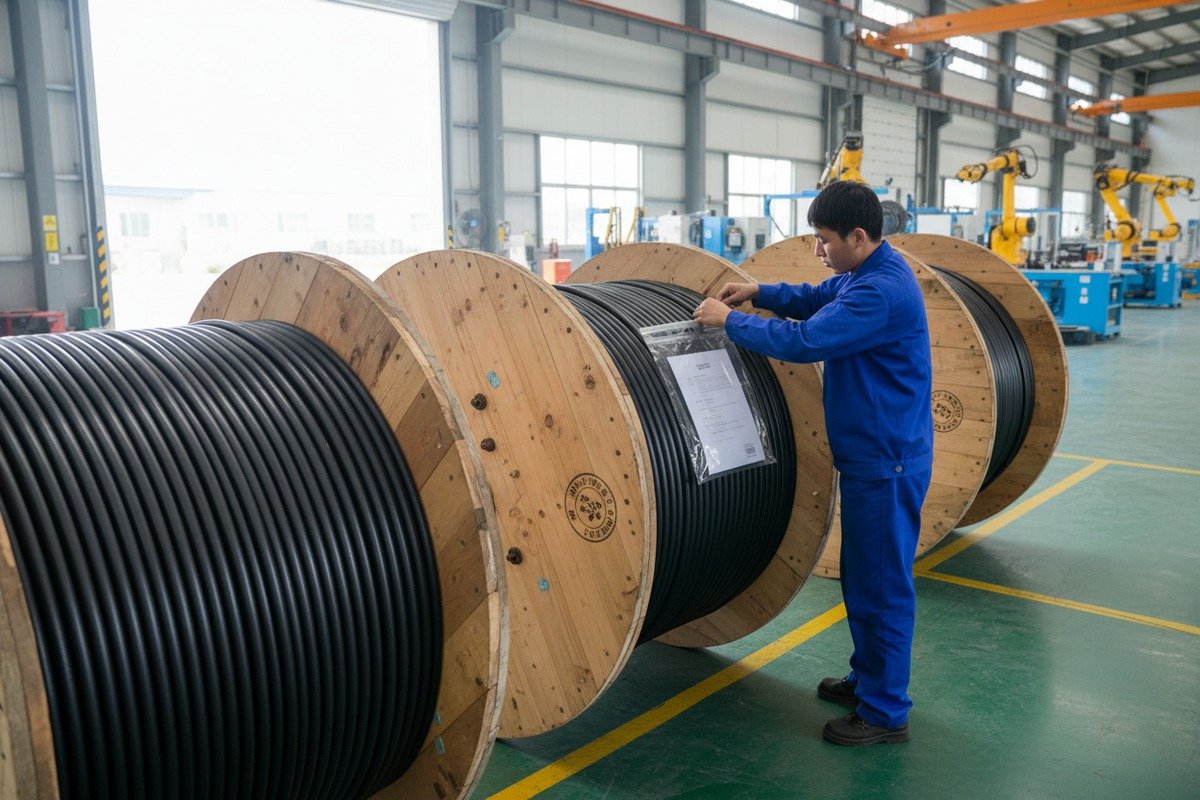
Every year, our logistics team handles thousands of ADSS cable drums leaving our 230,000 m² factory in China, and the one nightmare that keeps buyers up at night is a collapsed reel or kinked fiber arriving at port.
To ensure safe packaging and shipping for ADSS fiber optic cables from China, buyers should demand IPPC-fumigated wooden drums, full container load (FCL) sea freight, sealed cable ends with verified OTDR test reports, and a thorough on-site inspection protocol upon arrival to confirm fiber integrity and packaging compliance.
This guide walks you through every step—from verifying drum strength to clearing customs without delays Certificate of Origin (CO) 1. Let's break it down section by section so you can protect your investment from factory floor to job site.
How can I ensure the wooden reels are durable enough to prevent collapse during my long-distance sea shipment?
We have seen buyers lose entire shipments because the supplier used cheap, untreated plywood drums that buckled under container stacking pressure during a 30-day ocean voyage.
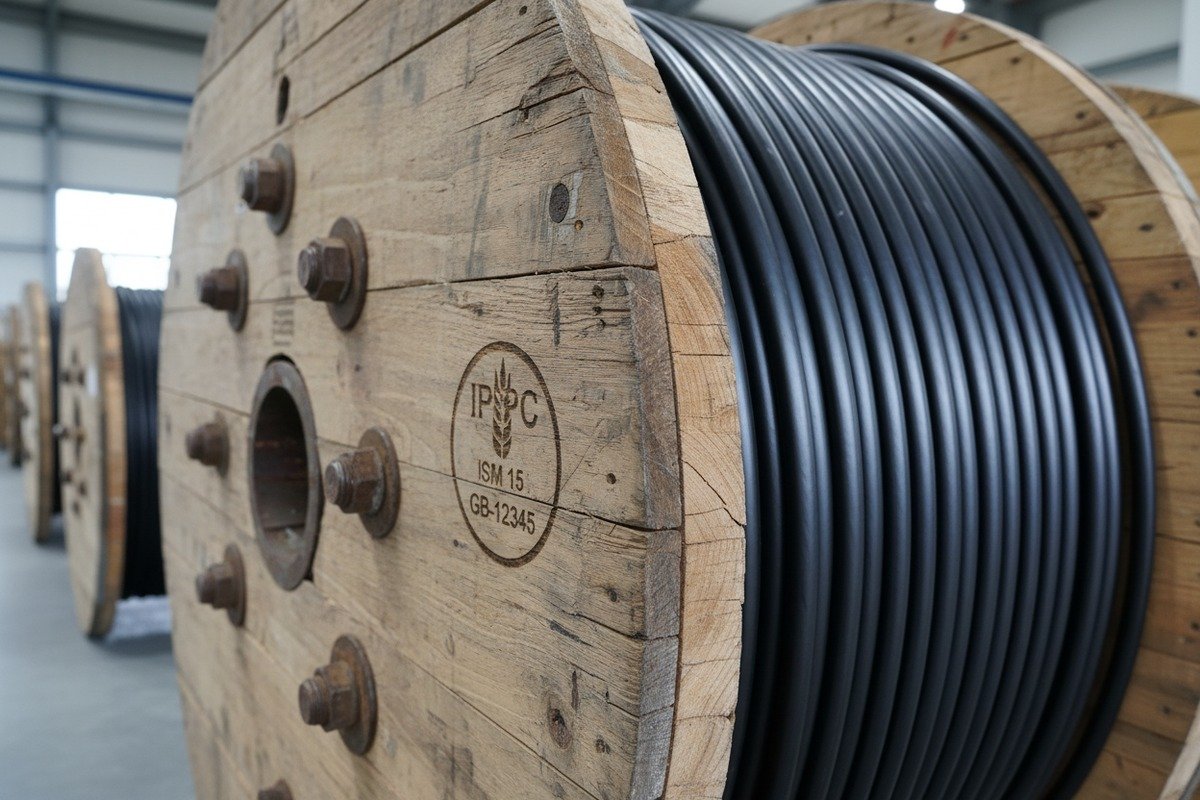
Choose IPPC-fumigated hardwood or iron-wood drums rated for your cable weight, confirm flange thickness exceeds 18 mm, and request photos of loaded drums before container sealing. Weak drums collapse under stacking loads, destroying cable geometry and causing total fiber loss.
Why Drum Quality Matters More Than You Think
ADSS cables look tough on the outside. They have aramid yarn reinforcement, PBT loose tubes, and a rugged PE jacket. But inside those loose tubes sit delicate glass fibers with strict bending radius limits. A collapsed drum flange pushes cable layers inward. This creates micro-bends. Micro-bends cause signal attenuation—or outright fiber breaks. You cannot fix this in the field. The entire drum becomes scrap.
Our production lines wind ADSS cable at controlled tension onto drums built to match the cable's weight and minimum bend radius. We use hardwood flanges with steel reinforcement bolts on drums carrying 4 km lengths, which can weigh over 500 kg. For lighter 2 km drums, standard fumigated pine is acceptable. But the key rule is simple: match drum strength to cable load.
Drum Material Comparison
| Drum Type | Best For | Weight Capacity | IPPC Compliant | Durability Rating |
|---|---|---|---|---|
| Standard Pine (Fumigated) | 1–2 km drums, ≤250 kg | Up to 300 kg | Yes (with stamp) | Medium |
| Hardwood / Iron-Wood | 3–4 km drums, 300–600 kg | Up to 700 kg | Yes (with treatment) | High |
| Bakelite / Steel Frame | Heavy-duty or repeat-use | Up to 1000 kg+ | N/A (no wood) | Very High |
Critical Checks Before Shipping
First, confirm the IPPC stamp is visible on every drum. Without it, customs in the USA, UK, and Australia will reject or quarantine your shipment. This alone can cost weeks of delay and thousands of dollars in demurrage fees.
Second, ask your supplier for the drum's barrel diameter. It must be large enough so the innermost cable layer does not violate the minimum bending radius. For most ADSS cables, this is 20 times the cable outer diameter for static storage.
Third, verify that the drum has no double-length winding. Each drum should hold one continuous length only. Two spliced lengths on one drum is a red flag for quality corners being cut.
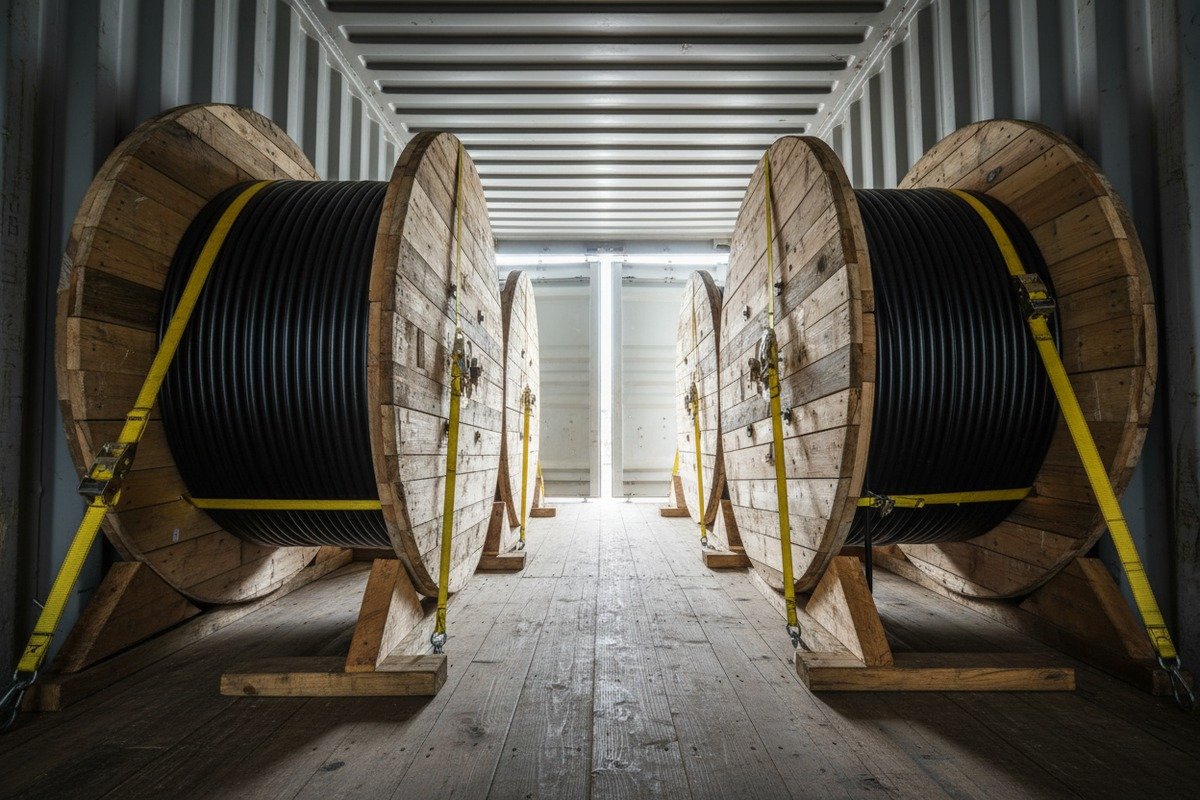
Fourth, look at the drum edges. The flanges should extend at least 50 mm beyond the outermost cable layer. This prevents cable from slipping off during transport vibrations. Our drums include protective lagging boards nailed around the outermost layer to prevent abrasion inside the container.
Finally, request a photo of the loaded container showing how drums are secured. Drums should stand upright, chocked with wooden wedges, and strapped to container walls. Never accept drums laid flat—this invites rolling and flange cracking.
What logistics strategies should I use to minimize shipping costs and avoid delays for my ADSS cable order?
Shipping costs can eat into your project margins fast, especially when you're importing heavy cable drums across the Pacific or through the Suez Canal.
Always choose Full Container Load (FCL) sea freight for ADSS cable orders exceeding 10 km. A 20-foot container holds 20–30 km of cable, dramatically reducing per-meter cost compared to LCL or air freight. Book early, use FOB or CIF terms, and align production with vessel schedules to avoid idle time.
FCL vs. LCL: The Math Is Clear
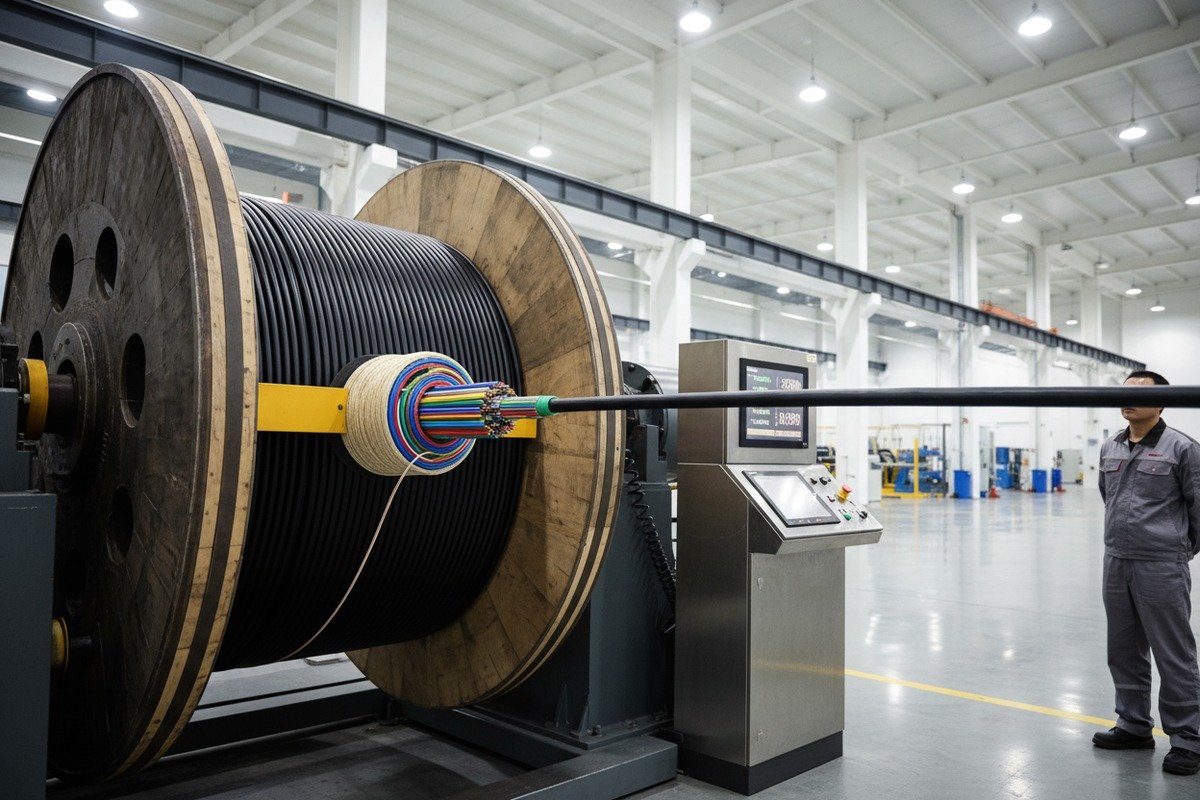
When our export team calculates logistics for buyers, the difference between FCL and LCL is striking. In LCL (Less than Container Load), your drums share space with other cargo. This means handlers move your drums multiple times at consolidation warehouses. Each move is a damage risk. Worse, you pay per cubic meter, and cable drums are bulky. FCL gives you a sealed container from our factory gate to your port. Nobody else touches your cargo.
| Shipping Method | Cost per km (Estimate) | Damage Risk | Suitable Order Size | Transit Control |
|---|---|---|---|---|
| FCL Sea (20 ft) | $1.50–$3.00/km | Low | 20–30 km | Full control |
| FCL Sea (40 ft) | $1.00–$2.50/km | Low | 40–60 km | Full control |
| LCL Sea | $4.00–$8.00/km | High | <10 km | Shared, limited |
| Air Freight | $15–$30+/km | Medium | <2 km (urgent) | Fast but costly |
Choosing the Right Incoterms
FOB (Free on Board) means you take responsibility once the drums cross the ship's rail at the Chinese port. You control the freight forwarder and insurance. CIF (Cost, Insurance, and Freight) means we arrange shipping to your destination port. For first-time importers, CIF is simpler. For experienced buyers who have trusted freight partners, FOB often saves money because you negotiate ocean rates directly.
We ship primarily through Shanghai and Shenzhen ports. Both have frequent sailings to Southeast Asia (7–14 days), the US West Coast (18–25 days), Europe (25–35 days), and Africa/Middle East (20–30 days). Aligning your order confirmation with our 15–20 day production cycle means we can target a specific vessel window and avoid warehousing fees.
Avoiding Common Delay Traps
The biggest delays we see happen at customs—not at sea. Missing documents cause holds. Here is your minimum document checklist:
- Commercial invoice with HS Code 8544.70 4
- Packing list with drum numbers, lengths, and weights
- Bill of Lading (B/L) 5
- Certificate of Origin (CO) for potential tariff reductions
- IPPC fumigation certificate
- OTDR test reports 6 per drum
One often-overlooked tip: if you're importing into a country with a free trade agreement with China (such as RCEP members), the CO can reduce or eliminate import duties. Our documentation team prepares all of these as standard for every export order.
Also, consider booking your container 2–3 weeks before production completes. In peak season (Q3–Q4), vessel space fills fast. A one-week delay in booking can push your shipment back by three weeks.
How do I verify that my supplier has properly secured the cable ends and provided accurate OTDR reports?
One of the most frustrating experiences our buyers describe from previous suppliers is receiving drums with exposed cable ends and test reports that don't match the actual fiber count or attenuation values.
Request sealed cable ends with heat-shrink caps on every drum, demand individual OTDR test reports showing attenuation per fiber at 1310 nm and 1550 nm wavelengths, and cross-check report serial numbers against drum labels. For high-value orders, hire an independent third-party inspector in China to witness testing before shipment.

Why Cable End Sealing Is Non-Negotiable
ADSS cables use water-blocking materials—typically petroleum jelly or dry water-blocking yarn—inside the loose tubes to prevent moisture migration. If cable ends are left open during weeks of sea transit, humid air enters the tubes. Over time, this moisture can reach the fiber surface and cause hydrogen-induced attenuation. The damage is invisible until you run an OTDR test on site and find the fibers are out of spec.
At our facility, every drum gets heat-shrink end caps applied immediately after winding. We also leave a 3-meter reserve length tucked inside the drum flange. This reserve allows field technicians to prepare a clean splice point without wasting cable from the main span.
Reading an OTDR Report Correctly
An OTDR (Optical Time Domain Reflectometer) sends a light pulse down each fiber and measures the backscattered signal. Optical Time Domain Reflectometer (OTDR) 8 The report tells you two critical things: average attenuation (in dB/km) and event locations (splices, connectors, or defects).
For standard G.652D single-mode fiber used in ADSS cables, here are the acceptable values:
| Parameter | 1310 nm Wavelength | 1550 nm Wavelength |
|---|---|---|
| Max Attenuation | ≤0.36 dB/km | ≤0.22 dB/km |
| Typical Attenuation | 0.33–0.35 dB/km | 0.19–0.21 dB/km |
| Fiber Length on Report | Must match drum label ±1% | Must match drum label ±1% |
If your supplier's OTDR report shows attenuation values above these thresholds, reject the drum. Also, check the fiber count. If you ordered 48-core ADSS, the report must show test results for all 48 fibers. Missing fibers on the report often mean they failed testing and the supplier is hoping you won't notice.
Third-Party Inspection: Worth Every Dollar
For orders above 50 km or for first-time supplier relationships, we strongly recommend hiring an independent inspection company. Firms like SGS, Bureau Veritas, or TÜV have offices across China. They can visit our factory (or any factory) during production and witness the OTDR testing in real time. They also verify drum labeling, packaging integrity, and document accuracy.
The cost is typically $200–$500 per inspection day. Compare that to the cost of receiving 30 km of defective cable—tens of thousands of dollars in cable replacement, re-shipping, and construction delays. The math speaks for itself.
We welcome third-party inspectors. In fact, we encourage it. A factory that resists independent inspection is a factory with something to hide. Our ISO 9001 and UL certifications require documented quality control processes, and external verification only strengthens buyer confidence.
Cross-Checking Documentation
Every drum that leaves our factory carries a label with: cable model, fiber count, cable length, drum number, production date, and a unique serial code. This serial code must match the OTDR report header. If the codes don't match, the report may belong to a different drum—or a different order entirely. Always verify this one-to-one match before authorizing shipment.
What are the best ways for me to inspect the packaging and cable integrity once the shipment arrives at my site?
The container doors open, and your drums are sitting there. This is the moment of truth—and the moment many buyers rush through, only to discover problems weeks later during installation.
Inspect every drum for flange cracks, loose lagging, and moisture damage immediately upon delivery. Check cable end seals, verify drum labels against shipping documents, measure cable outer diameter with calipers, and run OTDR spot-checks on at least 10% of drums before signing the delivery receipt.
Step-by-Step Arrival Inspection
Your receiving team needs a clear checklist. Inspection is not just a visual scan—it is a structured process. Here is what our technical support team recommends for every delivery:
Step 1: External drum check. Walk around each drum. Look for cracked or split flanges, broken lagging boards, water stains, and any signs the drum was dropped or rolled. Photograph any damage immediately. These photos are your evidence for insurance claims or supplier disputes.
Step 2: Label verification. Match every drum label to the p
Footnotes
1. Explains the purpose and types of Certificates of Origin in trade. ↩︎
2. Replaced with the official International Plant Protection Convention (IPPC) page for International Standards for Phytosanitary Measures (ISPMs), which includes ISPM 15 on wood packaging. ↩︎
3. Replaced with the official International Plant Protection Convention (IPPC) page for International Standards for Phytosanitary Measures (ISPMs), which includes ISPM 15. ↩︎
4. Official government resource explaining Harmonized System codes. ↩︎
5. Defines Bill of Lading and its importance in shipping. ↩︎
6. Provides a comprehensive explanation of OTDR and its function. ↩︎
7. Explains FCL shipping, its benefits, and comparison with LCL. ↩︎
8. Detailed explanation of OTDR function and components. ↩︎