
Over the years, our production lines have shipped thousands of kilometers of ADSS cable to North American utility projects RUS specifications 1. One recurring lesson stands out clearly: the cable itself rarely causes the biggest headaches. It is what happens after delivery—when installation problems arise, when a storm damages a span, or when an engineer needs a specific test report at 2 a.m.—that truly defines a sourcing relationship.
To evaluate US after-sales service for ADSS optic cables, verify the supplier's technical response time, warranty duration and conditions, damage resolution process, and ability to provide engineering data compliant with US standards like IEEE 1222 and NESC. These four pillars protect your project from costly downtime.
This guide breaks down each pillar into actionable steps. Whether you are a procurement manager importing ADSS for a rural utility build-out or an EPC contractor managing a multi-state fiber deployment, these criteria will help you separate reliable partners from risky suppliers.
How can I verify if my supplier offers immediate technical assistance for ADSS installation issues?
Installation crews working 60 feet above ground on energized power line corridors cannot afford to wait days for a response. When our engineering team receives an urgent call from a US job site, we understand that every hour of idle crew time translates to thousands of dollars in lost productivity and potential safety risk.
Verify immediate technical assistance by requesting the supplier's documented support protocol, including dedicated contact channels, guaranteed response times under four hours, and evidence of English-speaking engineers with field installation experience in ADSS aerial deployments.
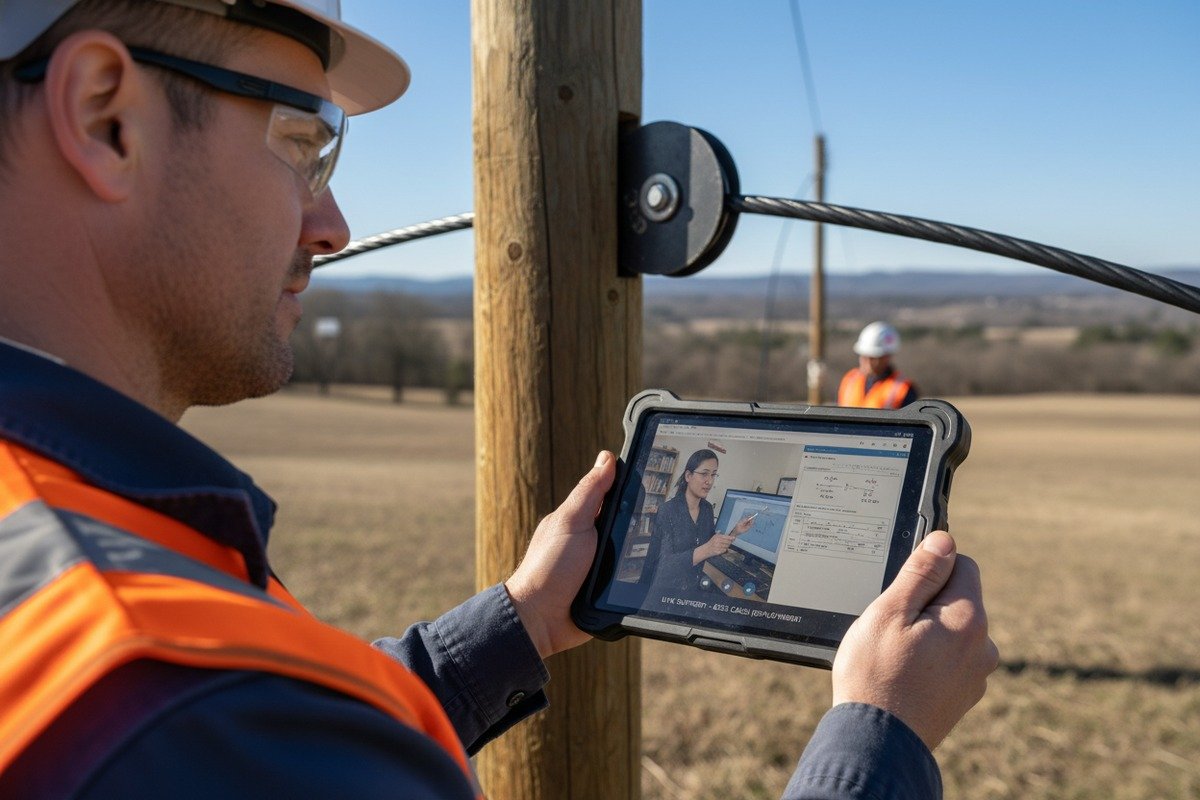
Why Response Time Matters More Than You Think
ADSS cables are All-Dielectric Self-Supporting cables 2 designed for aerial installation on power transmission and distribution structures. They contain no metallic components, which makes them safe near high-voltage lines. But this also means installation requires specialized knowledge about sag-tension calculations 3, MAT (Maximum Allowable Tension), and AAS (Annual Average Stress) parameters—typically 16–25% of rated tensile strength.
When a crew encounters unexpected sag behavior or a clamping issue mid-span, they need answers fast. A supplier who responds in 48 hours is not providing after-sales service. They are providing a liability.
What to Request Before Signing a Contract
Ask your potential supplier for the following items in writing:
- A named technical contact with direct phone and email
- A guaranteed first-response time (ideally under 4 hours during US business hours)
- Access to remote troubleshooting via video call
- Documentation showing prior US project support history
Response Time Benchmark Table
| Support Level | Response Time | Channel | Suitable For |
|---|---|---|---|
| Emergency (installation failure) | Under 4 hours | Direct phone + video call | Active job site issues |
| Standard (parameter clarification) | Under 24 hours | Email + shared documents | Pre-installation planning |
| General inquiry | Under 48 hours | Spare parts, documentation |
Test Them Before You Commit
Here is a practical tip from our own export experience: before placing a large order, send your potential supplier a technical question during off-hours. Ask something specific, like "What is the recommended installation tension for a 350-meter span at 40°C ambient with your 100-fiber ADSS?" If they reply with a generic product sheet, that tells you everything. If an engineer replies with a calculated answer referencing your specific span parameters, you have found a serious partner.
Also check whether the supplier has English-speaking engineers—not just sales staff—available for technical calls. Language barriers during a live installation can cause dangerous misunderstandings. Our team maintains a dedicated export engineering group precisely because we learned this lesson early in our North American projects.
What should I look for in a warranty policy to ensure my long-term project stability is protected?
Warranty documents are often the last thing buyers read carefully—and the first thing they regret ignoring. In our 30 years of manufacturing fiber optic cable, we have seen how a vague warranty clause can leave a buyer completely unprotected when fiber attenuation 4 creeps up at year 15 of a supposedly 25-year cable.
Look for warranties of 25 years or more that clearly define optical performance thresholds (such as maximum attenuation increase), specify environmental coverage including UV and vibration degradation, and outline the exact conditions for claims—particularly whether annual OTDR data submission is required.

The 25-Year Warranty Trap
Many suppliers now offer 25-year or even 40-year warranties on ADSS cables. This sounds impressive. But here is the nuance: most of these warranties require the buyer to submit annual OTDR (Optical Time-Domain Reflectometer) 5 test data. If you miss a single year of reporting, the warranty may become void.
From the supplier's perspective, this is low risk. Field data from North American utilities shows that ADSS fibers typically maintain acceptable performance for 15–18 years before measurable events occur. Rapid degradation usually accelerates after 22–25 years. So a 25-year warranty with annual OTDR requirements protects the supplier more than it protects you—unless you negotiate carefully.
Key Warranty Terms to Compare
| Warranty Element | Strong Policy | Weak Policy |
|---|---|---|
| Duration | 25+ years with clear milestones | "Limited lifetime" without specifics |
| Attenuation threshold | Defined (e.g., added loss <0.02 dB/km at year 20) | No measurable optical criteria |
| Environmental coverage | Explicit UV, vibration, ice load coverage | "Normal conditions" only |
| OTDR requirement | Annual submission with flexible deadlines | Strict deadlines, void if missed once |
| Spare parts guarantee | Committed stock or rapid manufacturing | No spare parts clause |
| Claim process | Defined timeline (e.g., 30-day resolution) | Vague "case-by-case" language |
Build a 20-Year Maintenance Plan into the Contract
The smartest buyers we work with do not just evaluate the warranty—they negotiate a bundled maintenance plan. A proactive 20-year OTDR monitoring plan costs roughly $0.02 per meter. Compare that to emergency repair costs, which can run 10 times higher.
Here is what a solid maintenance plan looks like:
- Years 1–10: Annual OTDR baseline checks. Flag any added loss exceeding 0.05 dB/km.
- Years 10–20: Semi-annual checks. Any added loss exceeding 0.02 dB/km triggers weekly monitoring.
- Years 20+: Quarterly checks with replacement planning initiated.
Also negotiate spare parts upfront. Industry best practice suggests stocking 2% extra cable length and 5% extra hardware as spares. If your supplier does not mention spares in the warranty discussion, that is a red flag.
Domestic vs. Import Warranty Realities
US-based suppliers typically offer easier warranty enforcement because they are subject to domestic legal jurisdiction. However, a well-structured contract with a Chinese manufacturer—backed by third-party inspection reports and clearly defined arbitration terms—can provide equivalent or better protection at a significantly lower cost. Sea freight for ADSS runs approximately $0.01 per meter, making imports economically compelling if the after-sales framework is solid.
How do I evaluate a manufacturer's ability to resolve shipping damages and logistics disputes quickly?
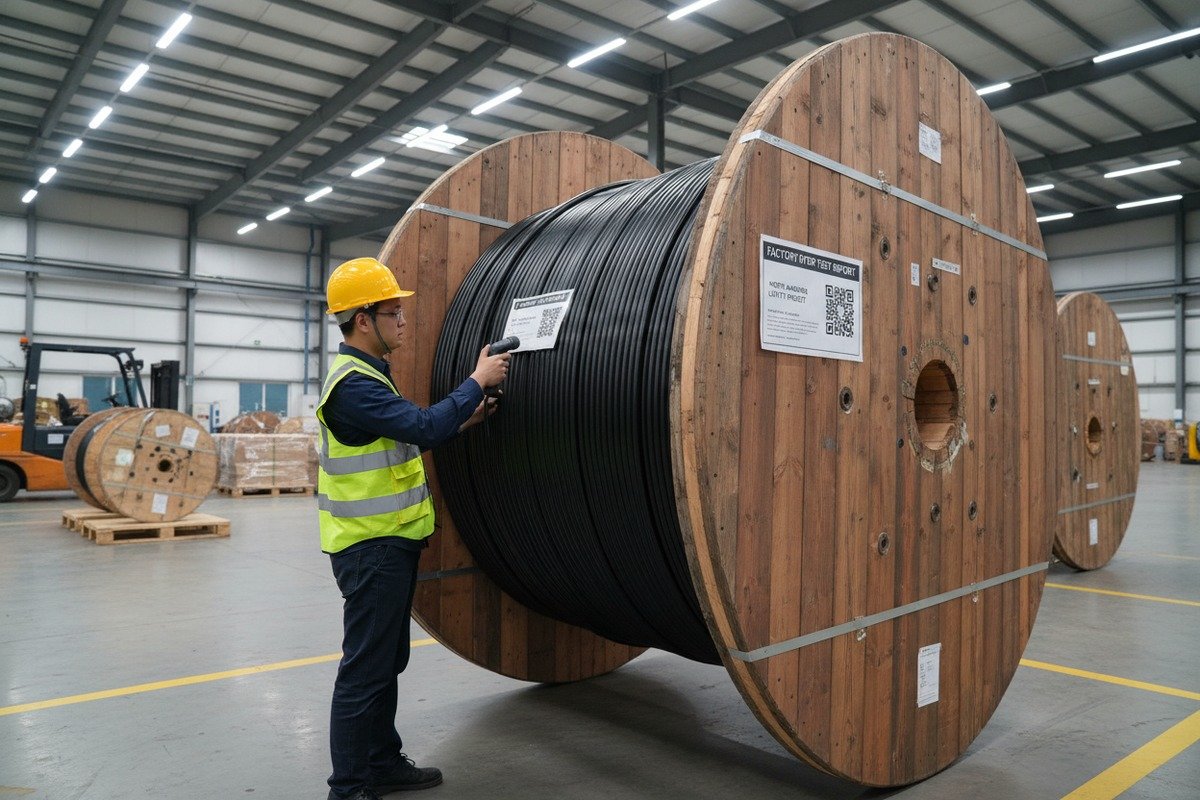
A single collapsed wooden reel during a 30-day ocean voyage can render an entire shipment of ADSS cable unusable. Our logistics team has learned—sometimes the hard way—that packaging standards and dispute resolution protocols are just as critical as the cable specifications themselves.
Evaluate shipping damage resolution by confirming the supplier's packaging standards for ocean freight, their insurance and claims documentation process, replacement lead times for damaged goods, and whether they offer DDP logistics with a single point of accountability for the entire supply chain.
The Hidden Cost of Poor Packaging
ADSS cables are typically shipped on wooden or steel reels inside 40-foot containers. A single container can transport approximately 300 km of cable. When a reel collapses during transit—due to substandard wood, poor bracing, or humidity damage—the cable can kink, causing micro-bends that permanently increase attenuation beyond acceptable limits (the standard threshold is <0.4 dB/km for single-mode fiber).
This is not a theoretical risk. It is one of the most common complaints we hear from US buyers who previously sourced from suppliers with no packaging quality control.
What to Verify Before Shipment
Request documentation and evidence for each of the following:
- Reel construction standards: Hardwood or steel reels rated for ocean freight. Ask for reel load test certificates.
- Container bracing: Photos of bracing and blocking inside the container before sealing.
- Pre-shipment OTDR test: A factory OTDR report for every reel, establishing a baseline attenuation before the cable leaves the warehouse.
- Marine insurance: Confirm the supplier carries adequate cargo insurance and clarify who files claims.
Damage Resolution Timeline Comparison
| Resolution Element | Best Practice | Common Problem |
|---|---|---|
| Damage notification window | 7 days from delivery | No defined window |
| Documentation required | Photos + OTDR comparison vs. factory baseline | Undefined, leading to disputes |
| Insurance claim filing | Supplier files on buyer's behalf | Buyer must navigate foreign insurer |
| Replacement cable lead time | 15–20 days from confirmed claim | 60+ days or "next production run" |
| Partial shipment option | Ship replacement reels immediately | Wait for full replacement order |
| Cost responsibility during dispute | Supplier covers interim costs | Buyer absorbs all costs |
DDP vs. FOB: Who Owns the Problem?
If your supplier ships FOB (Free On Board) 6, ownership and risk transfer to you the moment the cable crosses the ship's rail. That means any damage during the ocean voyage, customs clearance delays, or last-mile trucking issues are entirely your problem.
DDP (Delivered Duty Paid) logistics 7, which we offer to many of our US clients, keeps the supplier accountable for the entire chain. This single point of responsibility dramatically simplifies dispute resolution. When something goes wrong, you make one call—not five.
Ask your supplier whether they have experience with US customs clearance for fiber optic cable, including proper HS code classification and any applicable tariffs. A supplier who fumbles customs documentation can delay your shipment by weeks, leaving your construction crew idle and your project timeline in jeopardy.
Spare Parts and Emergency Stock
Negotiate a small emergency stock held in a US-based warehouse or at a bonded facility. Even 2% of your total cable order, pre-positioned domestically, can save a project from disaster when a reel arrives damaged and you cannot wait 20 days for a replacement.
Can I rely on the factory to provide the detailed engineering data and test reports required by US standards?
When our quality team prepares documentation packages for US-bound shipments, we follow a strict protocol aligned with IEEE 1222 8, RUS specifications, and NESC requirements. But not every manufacturer does. In fact, one of the most frustrating experiences US buyers report is receiving cable that performs well physically—but arrives without the paperwork needed to pass a utility's engineering review.
You can rely on a factory for US-standard engineering data only if they demonstrate familiarity with IEEE 1222, RUS acceptance criteria, and NESC loading requirements, and can provide complete OTDR reports, tensile test data, fiber strain verification, and cable cross-section diagrams before shipment.
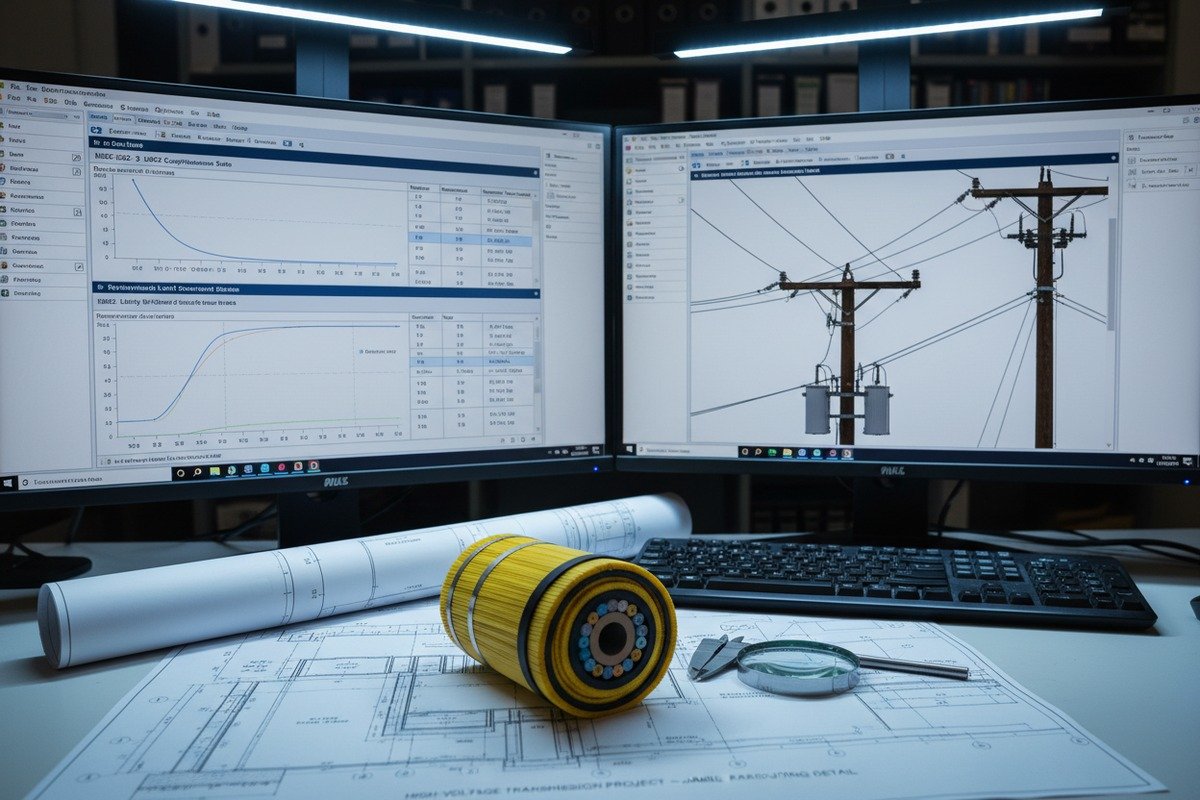
The Documentation US Utilities Actually Require
US power utilities and their contractors do not simply accept a generic product datasheet. They require specific engineering data that proves the ADSS cable meets the mechanical and optical conditions of the actual installation environment. Here is what a typical US utility RFP demands:
- Factory OTDR test report for every reel (bidirectional, at 1310 nm and 1550 nm)
- Tensile test results showing the cable withstands specified loads without fiber strain exceeding 0.5% (central tube) or 0.35% (stranded tube) at rated tensile strength
- Sag-tension calculations specific to the buyer's span lengths and environmental loading conditions
- Cable cross-section diagram with labeled dimensions and material specifications
- Third-party test certificates from accredited labs (UL, CSA, or equivalent)
- Material certifications for aramid yarn, PE jacket, and fiber specifications
Standards Compliance Checklist
| US Standard | What It Covers | What the Supplier Must Provide |
|---|---|---|
| IEEE 1222 | ADSS fiber optic cable design and testing | Mechanical performance data, environmental test results |
| RUS (Rural Utilities Service) | Acceptance criteria for utility-grade cable | Complete type test reports, production test data |
| NESC 9 (National Electrical Safety Code) | Loading conditions for aerial cables | Sag-tension tables for specified weather cases |
| TIA/EIA-455 | Fiber optic test procedures | Attenuation, bandwidth, and geometric measurements |
How to Test the Factory's Engineering Capability
Before placing an order, ask the supplier to provide a sample sag-tension calculation for a hypothetical span—say, 350 meters at a ruling span of 250 meters, with NESC Medium Loading District conditions. A factory with genuine engineering capability will return a detailed calculation including:
- Initial and final sag values
- MAT under design weather conditions
- AAS as a percentage of rated tensile strength (should fall between 16–25% RTS)
- Recommended installation tension at the specified temperature
If they cannot produce this, they are a cable reseller—not a manufacturer with engineering depth.
Third-Party Testing: Trust but Verify
The rise of third-party testing labs for post-sales validation reflects a growing awareness among US buyers. Field data from North American operators shows fiber events typically begin appearing at 15–18 years, with rapid degradation after 22–25 years if no maintenance program is in place. This makes initial factory test data critically important as a long-term reference baseline.
Our recommendation: require your supplier to provide both factory test reports and at least one third-party lab verification from a recognized body. Cross-reference the factory OTDR data with the third-party results. Any significant discrepancy is a disqualifying red flag.
Also ask whether the manufacturer can integrate with proactive monitoring solutions. Some advanced buyers now request compatibility with remote OTDR systems or Distributed Acoustic Sensing (DAS) for real-time fault detection. This is not yet standard practice, but it is a clear indicator of a forward-thinking supplier.
Real Performance Specs to Demand
At minimum, your ADSS cable should meet these optical and mechanical benchmarks:
- Attenuation: <0.35 dB/km at 1310 nm, <0.22 dB/km at 1550 nm for G.652D fiber 10
- Fiber strain at RTS: <0.5% (central tube design), <0.35% (stranded tube design)
- Span capability: up to 700 meters between support structures
- Operating temperature range: -40°C to +70°C
- UV and tracking resistance: verified per IEEE 1222 dry arc and wet aging tests
If a supplier cannot confirm these numbers with documented evidence, move on.
Conclusion
Evaluating after-sales service is not optional—it is essential risk management. Verify technical support speed, warranty depth, logistics accountability, and engineering documentation before you commit to any ADSS supplier for US projects.
Footnotes
1. Details the Rural Utilities Service (RUS) specifications for fiber optic cables. ↩︎
2. Defines All-Dielectric Self-Supporting (ADSS) cables and their key features. ↩︎
3. Discusses the importance and methods of sag and tension calculations for aerial cables. ↩︎
4. Found an authoritative source explaining fiber attenuation. ↩︎
5. Explains the function and principles of an Optical Time-Domain Reflectometer (OTDR). ↩︎
6. Explains Free On Board (FOB) Incoterms and the point of risk transfer in shipping. ↩︎
7. Defines Delivered Duty Paid (DDP) Incoterms and seller's responsibilities in shipping. ↩︎
8. Provides the official IEEE standard for testing and performance of ADSS fiber optic cables. ↩︎
9. Explains the National Electrical Safety Code (NESC) for utility systems in the US. ↩︎
10. Describes the ITU-T G.652D single-mode optical fiber standard and its characteristics. ↩︎