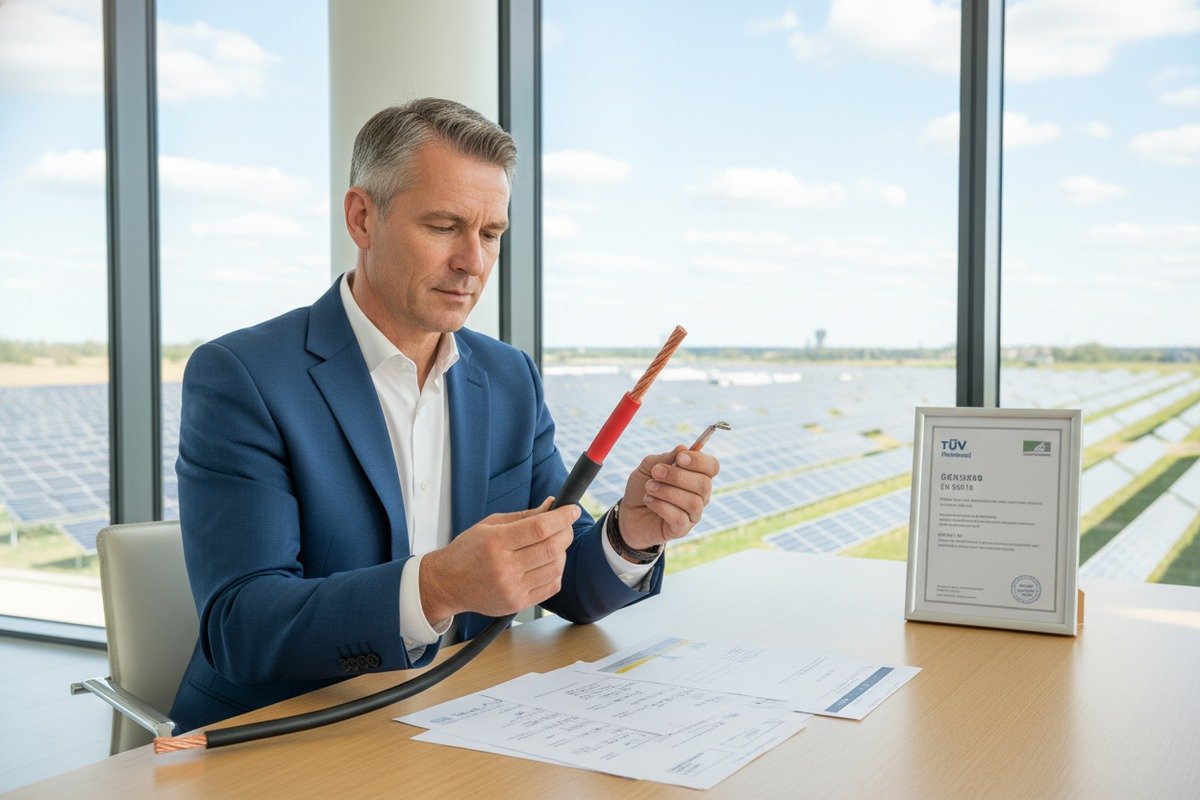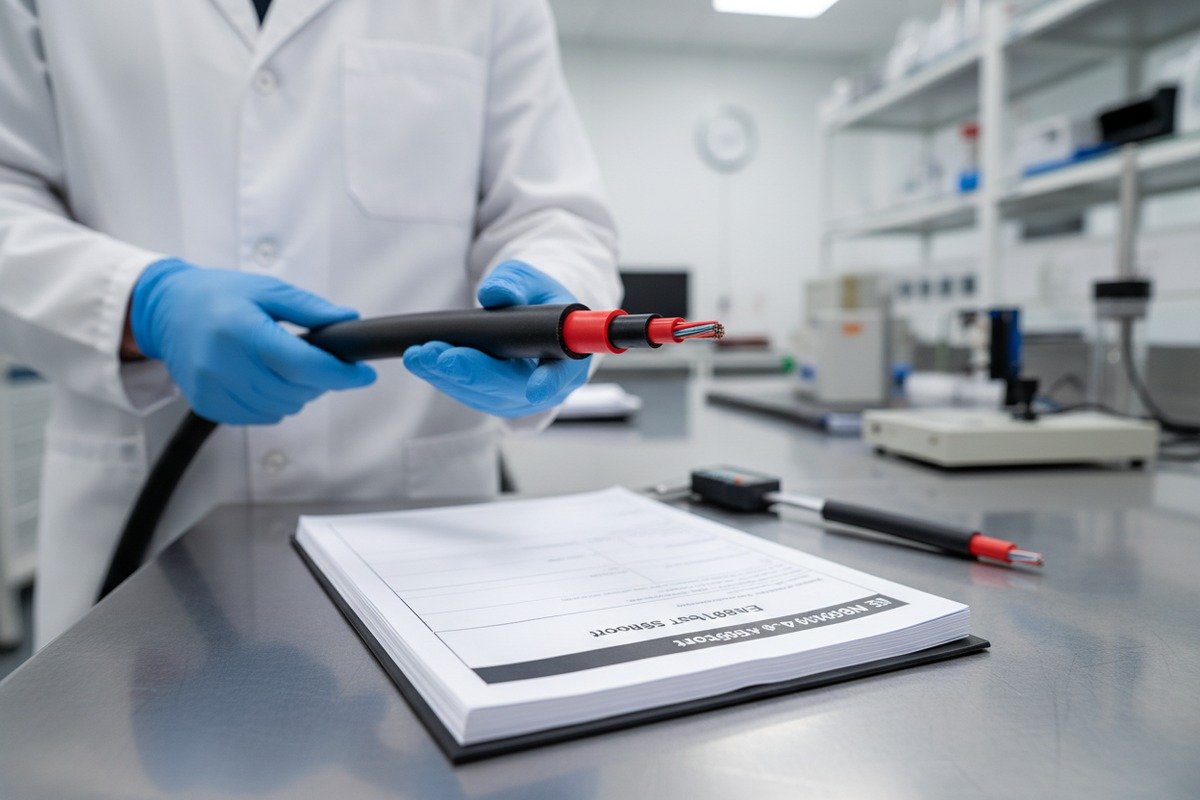

Every year, our customer service team handles dozens of disputes that trace back to one root cause: buyers who accepted ADSS cable shipments 1 without reviewing the right documentation first.
When purchasing ADSS optical cable, you need factory OTDR test reports, mechanical and environmental test data (tensile strength, crush resistance, temperature cycling, UV aging), material traceability certificates for aramid yarn and PE jackets, and third-party quality certifications such as ISO 9001, CE, UL, and RoHS to verify the cable meets IEC 60794 and IEEE 1222 standards.
This article breaks down each document category so you know exactly what to ask for, how to read it, and how to spot red flags before your money leaves the account UL and CSA listings 2. Let's start with the certifications that matter most.
Which international quality certifications should I prioritize when vetting an ADSS cable manufacturer?
Over the past 30 years on our production floor, we have seen certification requirements shift dramatically as telecom networks expand into tougher environments and stricter regulatory zones ITU-T G.652/G.657 specifications 3.
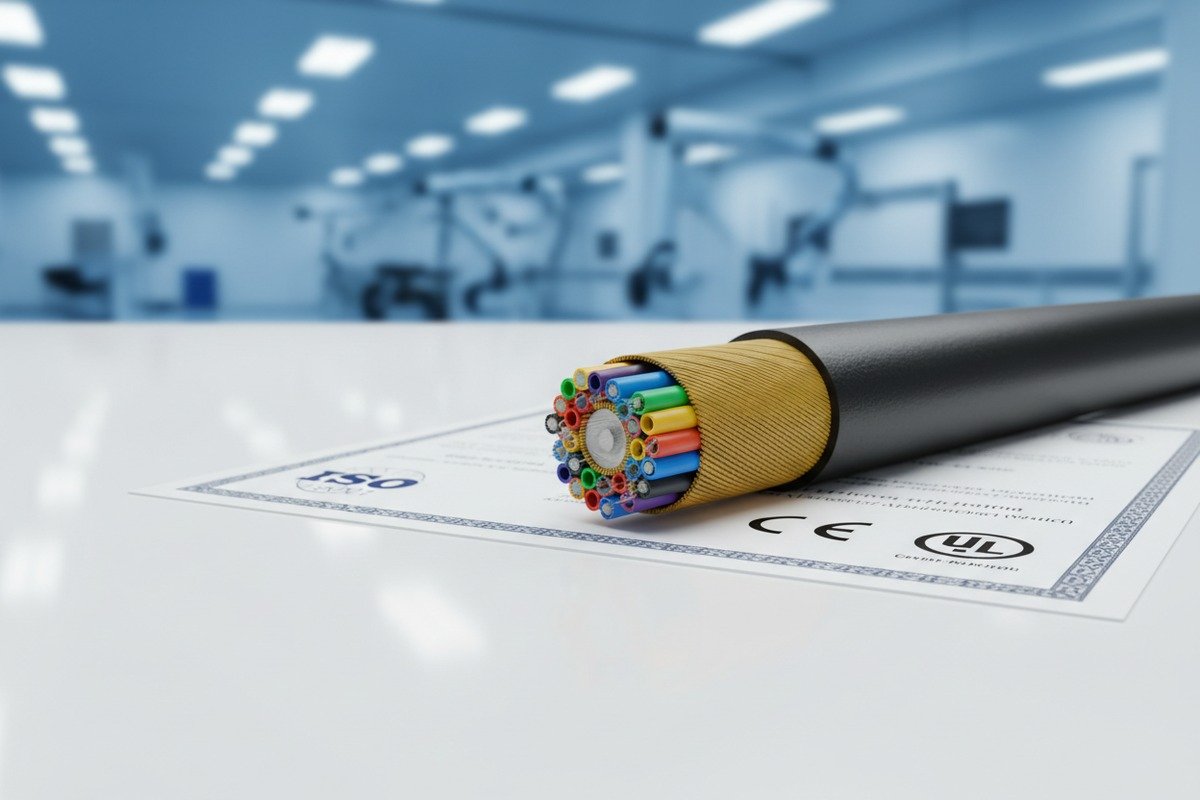
Prioritize ISO 9001 for quality management systems, CE for European compliance, UL or CSA for North American markets, and RoHS for hazardous substance restrictions. Additionally, verify that the manufacturer's products conform to IEC 60794-4-20 and IEEE 1222 standards specific to ADSS cable design and performance.
Why ISO 9001 Comes First
ISO 9001 4 is not just a badge on a website. It proves that a factory follows documented processes for incoming material inspection, in-process quality control, and final product testing. When our auditors visit the production line, they check whether the quality management system actually runs daily — not just during certification renewal. A manufacturer without ISO 9001 has no external pressure to maintain consistent output.
Regional Certifications Matter
Different export markets demand different marks. If you ship to the EU, CE marking 5 is mandatory. For the US and Canada, UL and CSA listings give your local inspectors confidence. RoHS certification 6 confirms the cable jacket and color-coded tubes contain no hazardous substances above threshold limits. Skipping these can cause customs delays or outright rejection at port.
Standards vs. Certifications: Know the Difference
A certification (like ISO 9001) proves a system. A standard (like IEC 60794-4-20 7) defines a product. You need both. The table below clarifies this distinction.
| Document Type | Example | What It Proves | Who Issues It |
|---|---|---|---|
| Quality System Certification | ISO 9001 | Factory follows controlled processes | Accredited third-party body (e.g., SGS, TÜV) |
| Product Safety Certification | UL, CSA, CE | Product meets safety requirements for a specific market | Notified body or testing lab |
| Material Compliance Certificate | RoHS, REACH | Materials are free of restricted substances | Testing laboratory |
| Product Design Standard | IEC 60794-4-20, IEEE 1222 | Cable design and performance meet engineering specs | Referenced by manufacturer, verified by buyer or third party |
Type Test vs. Routine Test Certificates
Type test certificates are issued once for a cable design. They confirm the design passed a full battery of tests — including long-term creep, dry-band arcing, and fatigue analysis. Routine test certificates are issued per production batch. They confirm that the specific drums you are buying passed attenuation, tensile, and dimensional checks. You need both types in your documentation package.
Red Flags to Watch
Be cautious if a supplier shows you expired certificates, certificates from unrecognized bodies, or refuses to provide certificate verification codes. Every legitimate ISO 9001 certificate has a registration number you can verify on the issuing body's website. Our team always encourages buyers to run this simple check — it takes five minutes and can save months of project delays.
How can I verify that the factory OTDR test reports for my ADSS cable are authentic and accurate?
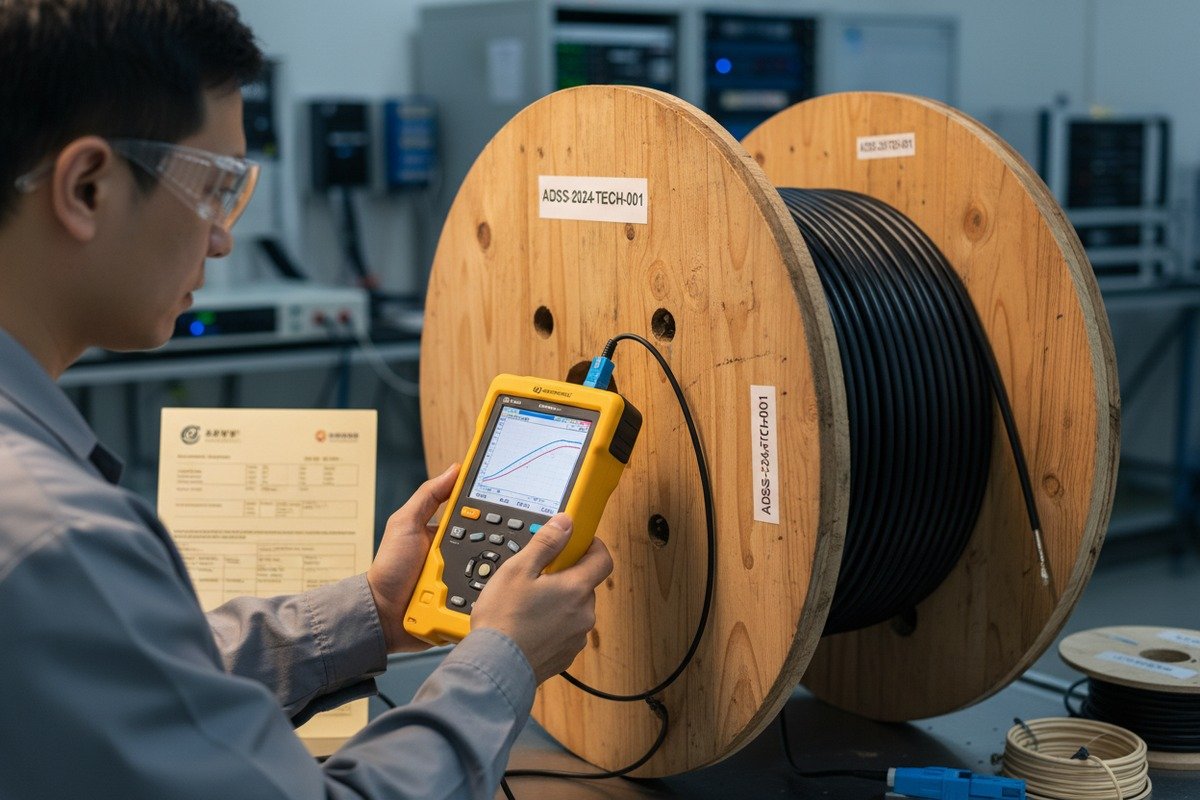
When we deliver OTDR test reports 8 to international buyers, the first question we often hear is: "How do I know these numbers are real?" It is a fair question, and it reflects a real pain point in the industry.
To verify OTDR test reports, cross-check the reported fiber attenuation values against ITU-T G.652/G.657 specifications, confirm the test wavelengths match your operating system (typically 1310 nm and 1550 nm), request raw OTDR trace files (.sor format), and compare drum numbers on reports to the actual drums you receive.

Understanding What an OTDR Report Shows
An OTDR (Optical Time-Domain Reflectometer) sends a pulse of light down each fiber and measures the backscattered signal. The report shows attenuation per kilometer, total link loss, event locations (splices, connectors, breaks), and reflection peaks. For ADSS cable, the attenuation for single-mode fiber should typically be below 0.36 dB/km at 1310 nm and below 0.22 dB/km at 1550 nm.
Key Data Points to Cross-Check
| Parameter | Expected Value (G.652D) | Red Flag |
|---|---|---|
| Attenuation at 1310 nm | ≤ 0.36 dB/km | Values consistently at exactly the spec limit |
| Attenuation at 1550 nm | ≤ 0.22 dB/km | Identical values across all fibers on a drum |
| Cable cutoff wavelength | ≤ 1260 nm | Missing or not reported |
| Fiber length per drum | Matches purchase order | Length shorter than marked on drum |
| Test date | Close to production date | Test date months before or after production |
Request Raw Trace Files
PDF reports can be edited. Raw .sor files are much harder to fabricate. Any legitimate OTDR instrument saves trace data in .sor format, which can be opened in free OTDR viewer software. When our quality team tests each drum, we store both the PDF summary and the .sor trace. Buyers who request these files can independently verify every splice, every connector, and every meter of fiber.
Match Drum Numbers to Reports
Every test report should reference a specific drum serial number. When the shipment arrives, physically check that the drum labels match the report numbers. If a supplier sends 50 drums but only 10 unique OTDR reports, that is a serious warning sign. Each drum should have its own report.
Third-Party OTDR Testing
For large infrastructure projects, consider hiring an independent testing lab to re-test a sample of drums upon arrival. This costs money, but it is far cheaper than discovering fiber faults during installation on a 500-meter span crossing a high-voltage line. Our recommendation is to re-test at least 10% of drums for orders above 100 km of cable.
Common Tricks to Watch For
Some factories test only the best fibers and copy results across multiple drums. Others test at non-standard wavelengths where attenuation naturally appears better. Always confirm the wavelengths match your system design. If your network operates at 1550 nm, a report showing only 1310 nm data is incomplete.
What specific mechanical and environmental test data do I need to see before my order ships?
On our production line, we run over a dozen mechanical and environmental tests before any ADSS cable earns a shipping label. But many buyers only ask about attenuation — and that is a costly oversight.
Before shipment, demand test data for tensile strength (MAT and UTS), crush resistance, impact resistance, temperature cycling (-40°C to +70°C), UV aging resistance, water penetration, and dry-band arcing resistance. These tests should follow IEC 60794-1-2 and IEC 60794-4-20 standards and reflect your project's actual span and loading conditions.
Mechanical Tests: The Backbone of ADSS Reliability
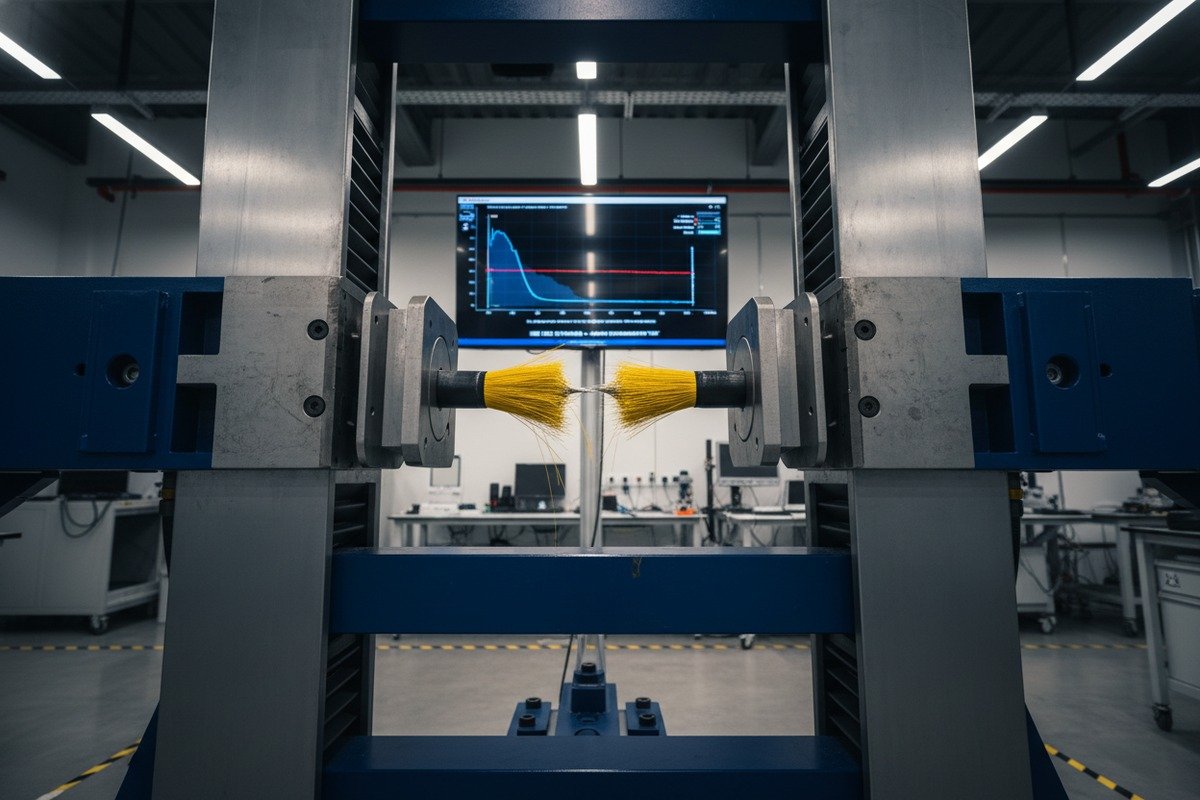
ADSS cables hang unsupported between poles. They face wind, ice, vibration, and their own weight every single day. Mechanical tests confirm the cable survives these forces without fiber damage or excessive sag.
Tensile Strength
Three values matter here:
- MAT (Maximum Allowable Tension): The highest load the cable can carry during installation without permanent deformation.
- UTS/RTS (Ultimate Tensile Strength / Rated Tensile Strength): The breaking point. The cable should never experience this load in service.
- EDS (Every Day Stress): The constant load from cable weight and average wind. Sag calculations depend on this.
Ask the factory to provide test data showing that fiber attenuation does not increase by more than 0.05 dB at MAT load. If attenuation spikes under tension, the cable will fail in the field.
Crush and Impact Resistance
Crush tests simulate a cable being squeezed during installation — for example, when it passes through a clamp. Impact tests simulate a falling object or branch strike. Both tests measure whether fiber attenuation remains within specification after the event.
Environmental Tests: Simulating 25 Years in Minutes
| Test | Standard | What It Simulates | Pass Criteria |
|---|---|---|---|
| Temperature cycling | IEC 60794-1-2 Method F1 | Seasonal extremes over cable lifespan | No attenuation increase > 0.05 dB/km |
| Water penetration | IEC 60794-1-2 Method F5 | Rain, condensation, submersion | No water passage beyond 1 meter in 24 hours |
| UV aging | IEC 60794-1-2 Method E11 | Years of sun exposure on PE jacket | No cracking, chalking, or tensile loss after 720 hours |
| Dry-band arcing | IEEE 1222 | Electric field stress on high-voltage lines | No tracking damage after specified test duration |
| Crush resistance | IEC 60794-1-2 Method E3 | Clamping and mechanical contact | Attenuation change ≤ 0.1 dB at 1550 nm |
| Impact resistance | IEC 60794-1-2 Method E4 | Falling debris or accidental impact | No fiber breakage |
Dry-Band Arcing: The ADSS-Specific Risk
This is the test most buyers forget. ADSS cable runs near high-voltage power lines. The electric field induces surface charges on the cable jacket. When moisture evaporates unevenly, dry bands form. These bands can arc, eroding the jacket over time. For any installation near lines above 110 kV, you must request dry-band arcing test reports. Our factory uses AT (anti-tracking) sheath material for high-voltage environments, and the test data proves its performance.
Long-Term Creep and Fatigue
Aramid yarn 9 is the primary strength member in ADSS cable. Over decades, it experiences creep — a slow, permanent elongation under constant load. The factory should provide creep data showing how much the cable elongates over time and how this affects sag. Without this data, your sag calculations for long spans become unreliable.
Project-Specific Data
Generic test reports are a starting point. But your project has specific span lengths, wind zones, and ice loading conditions. Ask the manufacturer to provide sag-tension calculations tailored to your actual parameters. At our facility, our engineering team runs these calculations for every major project and includes them in the documentation package.
How do I ensure the material certificates for aramid yarn and PE jackets match the actual product I receive?
During a recent factory audit, one of our US-based partners shared a horror story: a competitor's ADSS cable snapped mid-span because the aramid yarn inside was a cheaper substitute with half the rated tensile strength.
Request material traceability certificates from the raw material suppliers (e.g., Kevlar from DuPont, Twaron from Teijin) that list the batch numbers, tensile properties, and elongation data. For PE jackets, demand certificates showing carbon black content (≥2.5% for UV stability), melt flow index, and density. Then cross-reference these batch numbers against the cable production records.
Why Material Traceability Is Non-Negotiable
ADSS cable relies on two critical materials for its mechanical and environmental performance: aramid yarn (the strength member) and the polyethylene (PE) outer jacket. If either material is downgraded, the cable may look identical on the outside but fail catastrophically in service. Material certificates create a paper trail from raw material supplier to finished cable drum.
What Aramid Yarn Certificates Should Include
Aramid yarn — commonly known by brand names like Kevlar (DuPont) or Twaron (Teijin) — is the tensile backbone of ADSS cable. The certificate from the yarn supplier should include:
- Yarn type and denier (linear density)
- Tensile strength per yarn bundle
- Elongation at break
- Batch or lot number
- Date of manufacture
At our facility, we purchase aramid yarn only from verified tier-one suppliers and maintain incoming inspection records that log every batch. When a buyer requests traceability, we can match the yarn lot number in the cable production log to the supplier's certificate.
What PE Jacket Certificates Should Include
The PE jacket protects all internal components from UV, moisture, and mechanical abrasion. A proper PE material certificate includes:
- Resin type (HDPE or MDPE)
- Carbon black content percentage
- Melt flow index (MFI)
- Density
- Tensile strength and elongation at break
- Batch number
Carbon black content is especially critical. A minimum of 2.5% carbon black is the industry standard for UV resistance. Below this threshold, the jacket degrades under sunlight within a few years. Some cost-cutting manufacturers reduce carbon black to save money. The certificate catches this.
How to Cross-Reference Materials Against Production Records
Ask the factory for a production traceability report that links:
- Your purchase order number
- The cable drum serial numbers
- The aramid yarn batch numbers used in those drums
- The PE compound batch numbers used for jacketing
Then compare these batch numbers to the material supplier certificates. If the numbers match, the chain of custody is intact. If the factory cannot produce this documentation, you have a transparency problem.
Physical Verification Methods
Beyond paper documentation, you can verify materials through physical testing:
| Verification Method | What It Checks | Cost Level | When to Use |
|---|---|---|---|
| Visual inspection of yarn cross-section | Correct aramid count and arrangement | Low | Every shipment |
| Carbon black content test (TGA) | PE jacket UV protection level | Medium | Sample basis for large orders |
| Tensile pull test on yarn sample | Actual strength vs. certificate value | Medium | When switching to a new supplier |
| Density measurement of PE jacket | Correct resin grade | Low | Sample basis |
| Third-party lab analysis | Full material composition | High | Dispute resolution or first-time supplier |
A Practical Tip
When placing your first order with any ADSS cable manufacturer, request a factory visit or hire a third-party inspection company to witness production. During our own production runs for export orders, we regularly host buyer representatives who observe incoming material inspection, stranding, jacketing, and final OTDR testing in real time. This single visit often builds more trust than a stack of PDFs.
The Cost of Skipping This Step
Replacing a failed ADSS cable span costs 10 to 50 times more than the cable itself when you factor in crane hire, road closures, power line outages, and labor. A $200 material verification test is the cheapest insurance you can buy.
Conclusion
Getting the right factory test reports and quality certificates before your ADSS cable ships is not bureaucracy — it is project insurance. Verify certifications, demand traceable material records, and never accept a shipment without drum-specific OTDR data.
Footnotes
1. Provides a comprehensive definition and overview of ADSS cable. ↩︎
2. Details CSA Group's role in testing, inspection, and certification for North American markets. ↩︎
3. Provides the official technical specifications for ITU-T G.652 single-mode optical fiber. ↩︎
4. Explains the importance and benefits of ISO 9001 quality management systems. ↩︎
5. Provides official information on CE marking requirements and significance in the EU. ↩︎
6. Explains the EU RoHS Directive, restricting hazardous substances in electronic equipment. ↩︎
7. Provides the official scope and details of the IEC 60794-4-20 standard for ADSS cables. ↩︎
8. Working Wikipedia page providing a comprehensive explanation of Optical Time-Domain Reflectometers. ↩︎
9. Provides an authoritative definition and properties of aramid synthetic polymers. ↩︎
10. Offers a concise and authoritative definition of tensile strength in materials science. ↩︎