
Over the past 30 years on our production floor, we have seen ADSS cables fail catastrophically in the field — not because the fiber was bad, but because someone skipped a compliance step. A single tracking failure on a high-voltage corridor can shut down miles of telecom service and cost hundreds of thousands of dollars. If you are sourcing ADSS cable for US power or telecom projects, the verification process is not optional. It is your insurance policy against liability, downtime, and wasted capital.
To verify ADSS optical cable compliance with US power and telecom standards, you must confirm adherence to IEEE 1222-2019, NESC clearance rules, UL certifications, and IEC 60794 fiber specs. Request factory OTDR test reports, third-party lab certifications, and verify jacket tracking resistance, aramid yarn tensile strength, and dielectric integrity before purchase.
This guide walks you through each critical verification step. We will cover the exact certifications to look for, how to validate material quality, what test reports to demand, and how to ensure your cable jacket survives decades near high-voltage lines. Let's start with the certifications that matter most.
Which UL and IEEE certifications must I verify to ensure my ADSS cable meets US power grid safety standards?
When our engineers prepare shipments bound for US utility projects, the first question every buyer asks is about certifications. It makes sense. Without the right certifications, your cable cannot legally hang on a US power corridor, and no contractor will risk installing it.
You must verify IEEE 1222-2019 compliance for mechanical, electrical, and optical performance. Additionally, confirm UL listing for fire and safety ratings, CSA certification for North American standards, and CE marking. Request the manufacturer's IEEE 1222 test summary and UL certificate number for independent verification.
Understanding IEEE 1222-2019
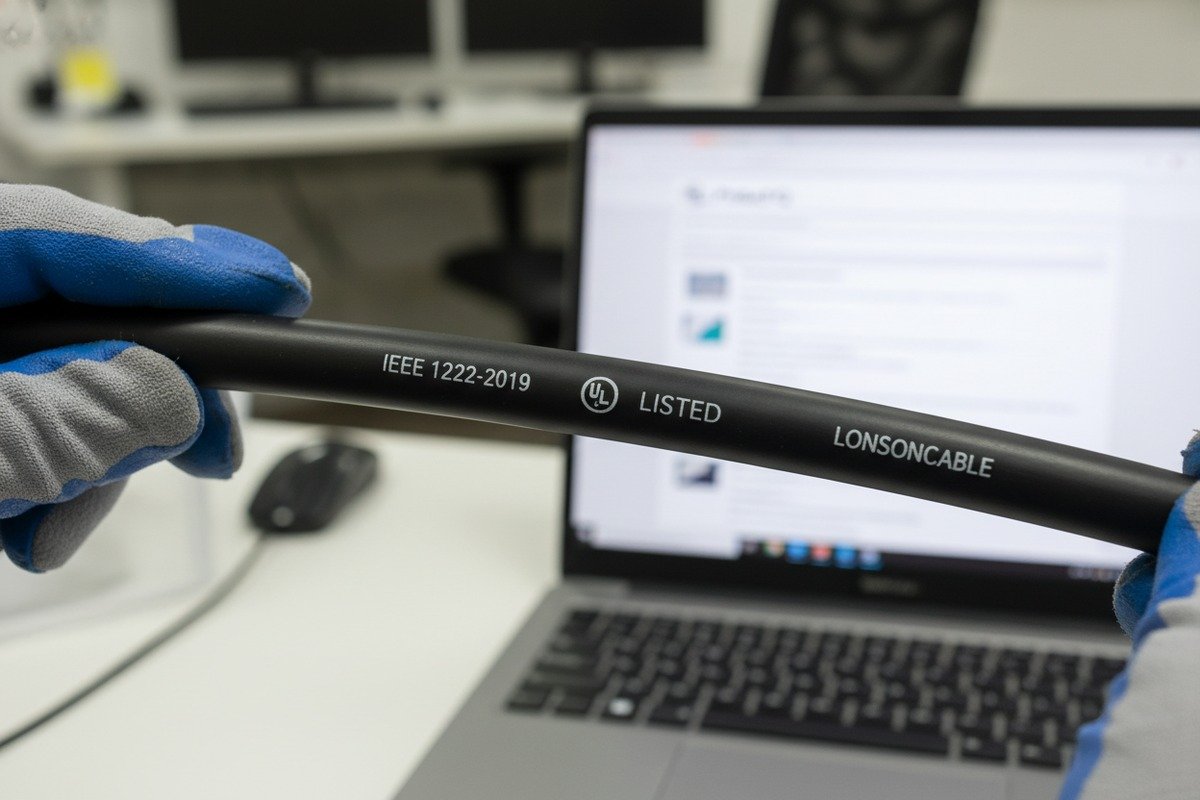
IEEE 1222 is the gold standard for ADSS cable in US power environments. The 2019 version, updated with a 2025 corrigendum, covers everything from cable construction to installation on utility poles. It specifies mechanical performance under wind and ice loads, optical attenuation limits, temperature ranges, and acceptance testing criteria.
This standard is not just a suggestion. US utilities and their engineering contractors treat IEEE 1222 as a hard requirement. If your cable does not meet it, you will face project rejection at inspection.
Key Certifications to Verify
Here is a breakdown of the certifications you should check before placing an order:
| Certification | Governing Body | What It Covers | Why It Matters |
|---|---|---|---|
| IEEE 1222-2019 1 | IEEE | Construction, mechanical, electrical, optical performance, installation | Primary US power grid compliance standard for ADSS |
| UL Listed | Underwriters Laboratories | Fire resistance, safety, material ratings | Required by many US utilities and building codes |
| CSA | Canadian Standards Association | North American safety compliance | Often required alongside UL for cross-border projects |
| ISO 9001 2 | International Organization for Standardization | Quality management system | Proves consistent manufacturing processes |
| IEC 60794 3 | International Electrotechnical Commission | Optical fiber cable general specifications | Covers fiber and cable-level performance globally |
| CE Marking | European Conformity | Product safety for EU markets | Useful for multi-region projects |
How to Actually Verify
Do not just accept a PDF certificate at face value. Here is what we recommend based on our experience shipping to US contractors:
- Ask for the UL file number. You can look it up on the UL Product iQ database 4. If the number does not match the product, walk away.
- Request the IEEE 1222 test summary. This should include tensile load results, sag-tension data, optical attenuation at 1310nm and 1550nm, and temperature cycling outcomes.
- Check the lab name. Tests should come from an accredited third-party lab, not just the factory's internal QC department.
- Verify Buy America Act compliance if the project involves federal funding. Some US infrastructure projects require domestic manufacturing or approved trade-agreement sourcing.
Our facility holds UL, CSA, CE, and ISO 9001 certifications. We provide full test documentation with every shipment. But we always tell buyers: verify independently. It protects both sides.
IEC 60794 vs. IEEE 1222
Some buyers confuse these two. IEC 60794 is a general optical cable standard used worldwide. IEEE 1222 is specifically designed for ADSS cables installed on power utility structures. For US power grid projects, you need IEEE 1222. For general telecom installations, IEC 60794 may suffice. For projects that cross both worlds — fiber on power poles — you need both.
How can I confirm the aramid yarn quality and tensile strength in my order to prevent cable sagging or failure?
Our quality control team inspects aramid yarn 6 on every incoming shipment before it enters the stranding line. We have learned the hard way that even small inconsistencies in yarn grade can lead to catastrophic sag on long spans. The problem is most buyers never think to verify this until something breaks.
To confirm aramid yarn quality, request the yarn manufacturer's certificate of origin (e.g., DuPont Kevlar or Teijin Twaron), verify the rated tensile strength matches IEEE 1222 specifications for your span length, and ask for factory pull-test records showing maximum rated tensile load (MRCL) results.
Why Aramid Yarn Is the Backbone of ADSS Cable
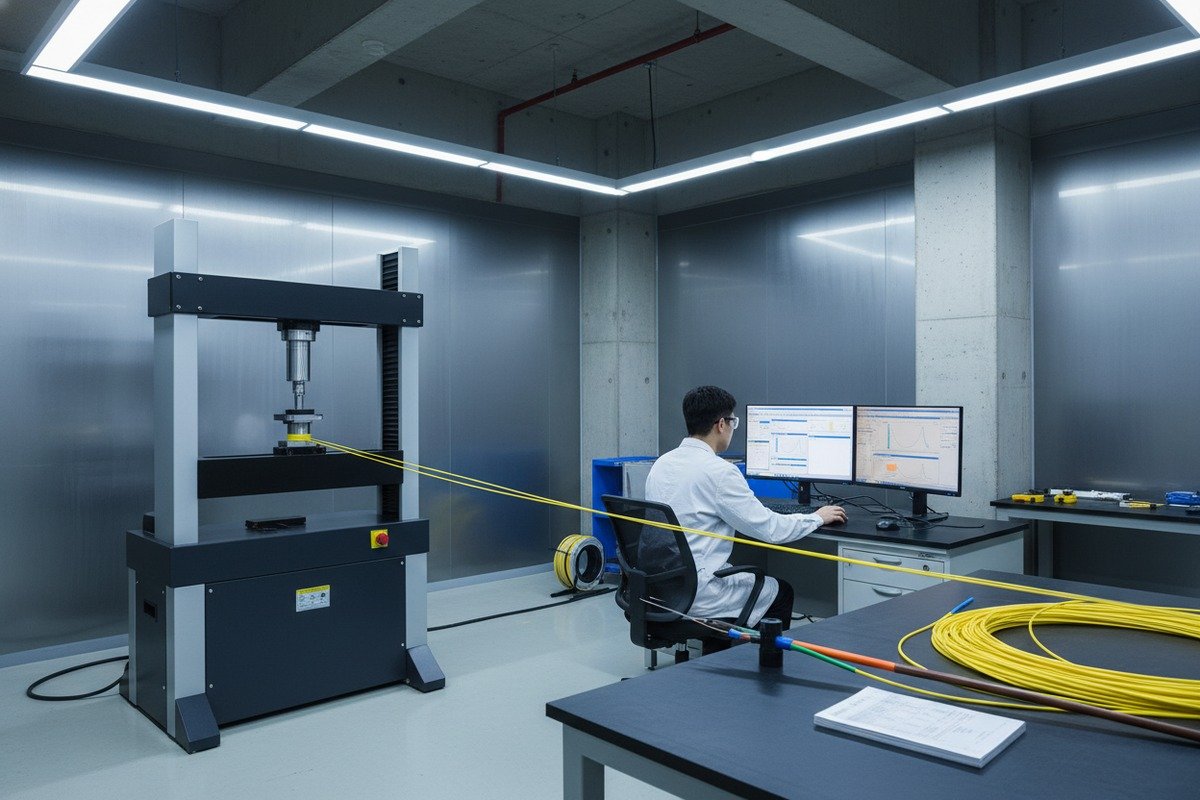
ADSS cable has no metallic strength member. The entire mechanical load — wind, ice, self-weight, and installation tension — is carried by aramid yarn layers. If the yarn is substandard, the cable stretches, sags into unsafe clearance zones, or snaps entirely.
There are two primary aramid yarn brands used globally: DuPont Kevlar 7 and Teijin Twaron. Both are high-performance para-aramid fibers. However, some low-cost manufacturers substitute cheaper aramid blends or reduce yarn count to cut costs. This is one of the most common forms of material downgrading in the ADSS industry.
Tensile Strength Requirements by Span
The required tensile strength depends on your span length, ice/wind loading zone, and cable weight. Here is a general reference table:
| Span Length | Typical Cable Weight | Minimum Tensile Strength | Recommended Yarn Type |
|---|---|---|---|
| 50–100m | 80–120 kg/km | 1,500–3,000N | Standard Kevlar 49 |
| 100–300m | 120–200 kg/km | 3,000–6,000N | High-density Kevlar 49 |
| 300–600m | 200–350 kg/km | 6,000–10,000N | Kevlar 49 + reinforced lay |
| 600–1,200m | 350–600 kg/km | 10,000–15,000N | Premium Kevlar 149 or equivalent |
These values shift based on NESC loading districts (Light, Medium, Heavy). Always run sag-tension calculations using your actual environmental data, not just generic tables.
How to Verify Yarn Quality
- Request the yarn COA (Certificate of Analysis). This document comes from the yarn manufacturer, not the cable manufacturer. It lists the yarn grade, denier, tensile modulus, and breaking strength.
- Ask for the cable's MRCL test report. The Maximum Rated Cable Load test applies a sustained tensile force to a sample length. The cable must hold this load without fiber attenuation increase beyond 0.05 dB.
- Compare yarn count. Ask the supplier how many ends of aramid yarn are used. More ends generally means higher tensile capacity. Cross-reference this with the cable cross-section diagram.
- Watch for substitution red flags. If the quoted price is significantly below market average, suspect yarn downgrading. At our facility, we maintain a transparent yarn sourcing log that buyers can audit.
Sag-Tension Calculations Matter
Even with premium yarn, incorrect sag-tension modeling leads to failure. We provide PLS-CADD compatible sag-tension data for every cable model we produce. If your supplier cannot provide this, they likely have not tested the cable under realistic loading conditions. IEEE 1222 requires sag-tension analysis as part of the acceptance criteria. Do not skip this step.
What specific factory OTDR test reports and third-party certifications should I request from my supplier to guarantee compliance?
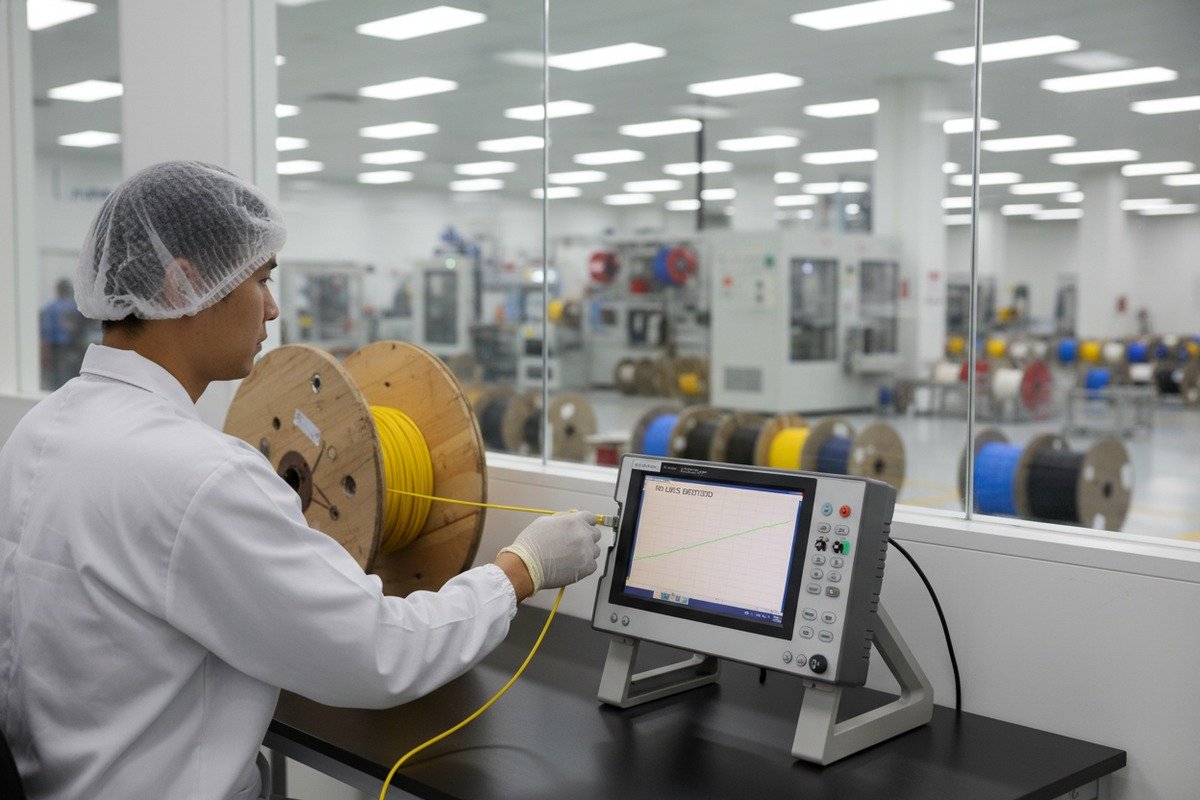
Every reel of fiber optic cable that leaves our factory goes through OTDR testing 8. But here is the problem: not all test reports are created equal. Some suppliers hand over a generic PDF that does not even match your specific order. That is not a test report — that is a liability risk waiting to happen.
Request per-reel OTDR traces at 1310nm and 1550nm showing attenuation, splice events, and total link length. Also demand factory acceptance test (FAT) reports covering tensile, crush, and temperature cycling per IEEE 1222. Third-party certification from a UL, ETL, or CNAS-accredited lab validates all results independently.
What an OTDR Test Report Should Include
OTDR (Optical Time Domain Reflectometer) testing is the standard method for verifying fiber integrity inside the cable. A proper OTDR report for your ADSS cable order should include:
- Test wavelengths: Both 1310nm and 1550nm.
- Attenuation per kilometer: Should be ≤0.35 dB/km at 1310nm and ≤0.22 dB/km at 1550nm for G.652D fiber.
- Event table: Every splice, connector, or anomaly along the fiber length.
- Total fiber length: Must match the reel length within tolerance.
- Reel/drum number: Each report must be traceable to a specific reel.
- Date and operator ID: Proves the test was actually conducted for your order.
If the supplier gives you a report without reel numbers or with mismatched dates, reject it. On our production line, every OTDR trace is digitally archived and linked to the reel barcode. Buyers can request the raw .sor files for independent analysis.
Factory Acceptance Testing (FAT) Checklist
Beyond OTDR, a complete FAT for ADSS cable per IEEE 1222 should cover: Factory Acceptance Testing 9
| Test Category | Specific Tests | Pass Criteria |
|---|---|---|
| Mechanical | Tensile load, crush resistance, sheave test, vibration | No attenuation increase >0.05 dB at rated load |
| Optical | OTDR, insertion loss, return loss | Attenuation ≤0.35 dB/km (1310nm), ≤0.22 dB/km (1550nm) |
| Environmental | Temperature cycling (-40°C to +85°C), UV exposure, water penetration | No fiber breakage, no attenuation degradation |
| Electrical | Dielectric strength, tracking resistance (for AT jacket) | No flashover, no surface tracking at rated voltage |
| Dimensional | Outer diameter, jacket thickness, yarn count | Within ±5% of specification |
Third-Party Lab Certifications
Factory self-testing is necessary but not sufficient. You should also request results from an independent, accredited testing laboratory. Look for labs accredited by:
- UL (Underwriters Laboratories) — widely recognized in the US.
- ETL (Intertek) — an alternative to UL, accepted by most US utilities.
- CNAS — China National Accreditation Service, recognized internationally under ILAC mutual recognition.
The third-party report should cover at minimum: tensile strength, optical attenuation, temperature cycling, and dielectric integrity. If the supplier resists providing third-party test data, consider it a major red flag.
Witnessing FAT in Person
For large orders, we recommend buyers or their appointed agents witness the FAT at the factory. Our facility in Hainan welcomes buyer inspections. Witnessing the tensile pull test, OTDR measurement, and temperature cycling in real time gives you confidence that the results are genuine. Many of our US-based clients send third-party inspection agents from companies like SGS or Bureau Veritas.
How do I ensure my ADSS cable jacket meets the NESC tracking resistance standards for high-voltage environments?
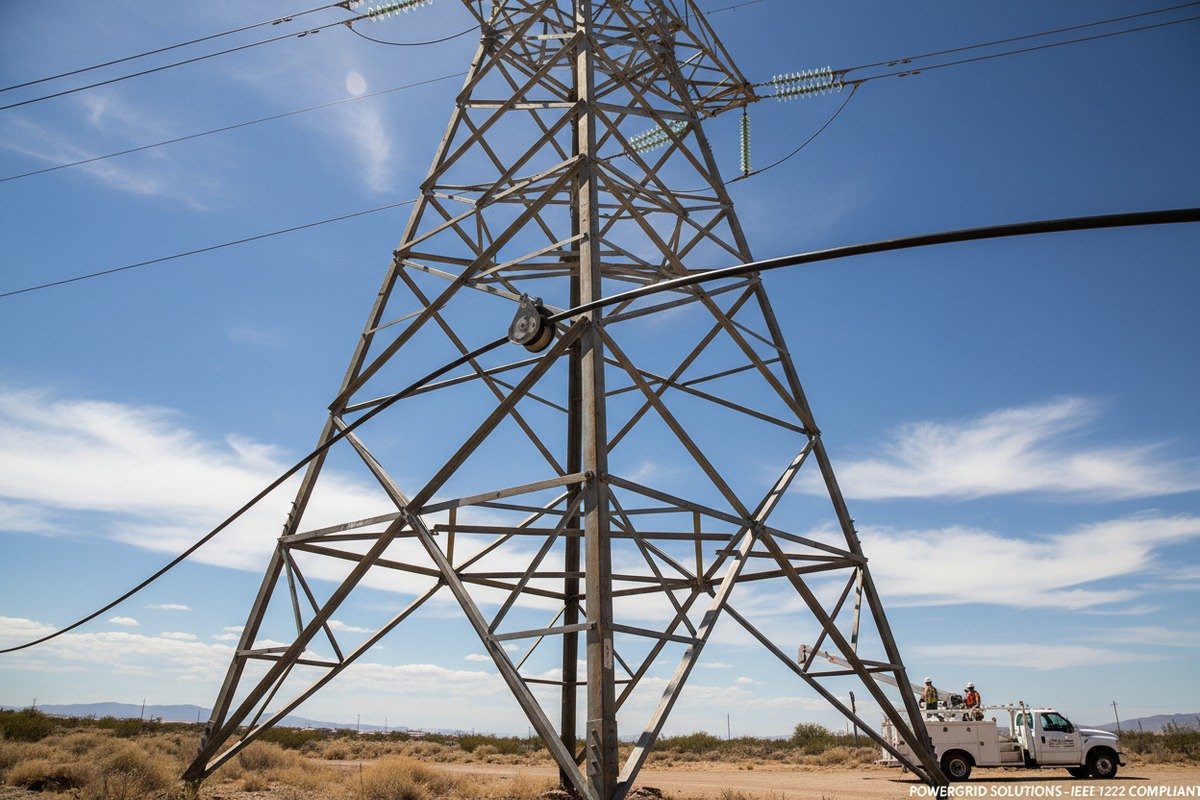
During a project review last year, our technical team analyzed a field failure where an ADSS cable jacket eroded within 18 months on a 230kV corridor. The root cause was simple: the installer used a standard PE jacket cable in a high-voltage, high-pollution zone. The tracking damage was irreversible.
To ensure NESC tracking resistance compliance, specify an AT (Anti-Tracking) or TRPE (Tracking-Resistant Polyethylene) outer jacket for any ADSS cable installed near lines ≥100kV. Verify the jacket material passes IEEE 1222 tracking and erosion tests, and request third-party lab reports confirming 25kV inclined plane tracking resistance.
What Is Electrical Tracking and Why Does It Destroy ADSS Cable?
Electrical tracking is a surface degradation phenomenon. When an ADSS cable hangs in the electric field near high-voltage conductors, contaminants like dust, salt, and moisture accumulate on the jacket surface. These contaminants create a conductive film. Dry-band arcing occurs when sections of this film dry unevenly, causing small electrical discharges along the cable surface.
Over time, these discharges carbonize the jacket material, forming permanent conductive paths — tracks. Once tracking starts, it accelerates. The jacket erodes, exposing the aramid yarn and eventually the fiber tubes. The cable fails mechanically and optically.
This is not a hypothetical risk. It is one of the most common causes of premature ADSS cable failure on high-voltage corridors worldwide.
PE vs. AT Jacket: When to Use Each
The jacket material choice is driven by the voltage of the adjacent power line and the environmental pollution level:
| Voltage Level | Pollution Level | Recommended Jacket | Jacket Material |
|---|---|---|---|
| ≤110kV | Low (rural, clean air) | Standard PE | High-density polyethylene |
| ≤110kV | High (coastal, industrial) | AT / TRPE | Tracking-resistant polyethylene |
| 110kV–230kV | Any | AT / TRPE | Tracking-resistant polyethylene |
| 230kV–500kV | Any | Double-jacket AT | Inner PE + outer AT sheath |
| >500kV | Any | Not recommended for ADSS | Consider OPGW alternative |
The NESC (National Electrical Safety Code) establishes clearance requirements and environmental loading zones. NESC clearance rules 10 While NESC itself does not specify jacket materials by name, it defines the electrical environment that drives the material selection. IEEE 1222 fills in the gap by specifying tracking resistance test procedures and pass criteria for ADSS jackets.
How to Verify Tracking Resistance
- Request the inclined plane tracking test report. This test, based on IEC 60587 methodology and referenced in IEEE 1222, applies a voltage to the cable jacket surface while a conductive solution drips down it. The jacket must resist tracking and erosion for a defined duration at the specified voltage level.
- Check the voltage rating. For 230kV environments, the jacket should pass at least a 4.5kV inclined plane test. For 500kV corridors, higher ratings are needed.
- Verify the jacket is AT, not just labeled AT. Some manufacturers apply a thin AT coating over standard PE. This wears off quickly. True AT jackets use tracking-resistant compounds throughout the entire sheath thickness. Ask for the material data sheet (MDS) from the compound supplier.
- Consider double-jacket designs. For the highest voltage environments, our engineers recommend a double-jacket cable: an inner PE jacket for moisture protection and an outer AT jacket for tracking resistance. This design provides redundancy and extends service life to 25–30 years.
Site-Specific Microclimate Assessment
General NESC loading zones are a starting point, but they do not capture local conditions. A coastal site 2km from the ocean in Texas faces very different salt-fog exposure than an inland site in Nebraska, even if both are in the same NESC loading district.
We recommend buyers conduct a site-specific pollution assessment before selecting the jacket type. Factors to evaluate include:
- Proximity to saltwater, industrial emissions, or agricultural dust.
- Prevailing wind patterns that carry contaminants to the cable.
- Altitude and humidity levels.
- Historical data on dry-band arcing in the region.
This microclimate analysis, combined with the correct jacket specification, is the most reliable way to prevent tracking failure. Our technical team provides jacket selection guidance for every project when buyers share their site conditions.
Conclusion
Verifying ADSS cable compliance is not a one-step process — it requires checking certifications, materials, test reports, and jacket specifications against IEEE 1222, NESC, and your specific site conditions. Do the work upfront, and your cable will serve reliably for decades.
Footnotes
- Standard for ADSS cable in power environments. ↩︎
- Quality management system for consistent manufacturing. ↩︎
- Global standard for optical fiber cable specifications. ↩︎
- Online platform to verify UL certifications. ↩︎
- Required for fire and safety ratings in US projects. ↩︎
- Primary strength member in ADSS cables. ↩︎
- Leading brand of aramid fiber for strength. ↩︎
- Standard method for verifying fiber integrity. ↩︎
- Comprehensive testing before equipment delivery. ↩︎
- Defines safety clearances for electrical installations. ↩︎