
Every week, our sales team fields calls from US buyers who compare cable prices but forget about freight, duties, and handling fees — then get blindsided when the real cost hits their books. ADSS optic cables 1
To calculate total landed cost for ADSS optic cables from China to US warehouses, sum the factory gate price, ocean freight, cargo insurance, US import duties (HTS-based plus Section 301 tariffs), customs brokerage fees, port handling charges, and inland drayage to your warehouse. Normalize the total by dividing by meters ordered.
Below, we break down each cost layer so you can build an accurate budget before your next purchase order. Let's walk through freight, duties, hidden fees, and how a DDP quote can simplify the entire process.
How do I calculate the freight and logistics costs for shipping ADSS cables to my US warehouse?
When we prepare export shipments from our 230,000 m² facility, freight is the cost component buyers most often underestimate — and it swings wildly based on shipment size, cable drum dimensions, and destination port.
Freight costs for ADSS cables from China to US warehouses typically range from $0.05 to $0.20 per meter depending on order volume, port pair, and shipping method. A 500 km order shipped by ocean from Shanghai to Los Angeles adds roughly $0.09/m, including basic marine cargo insurance.
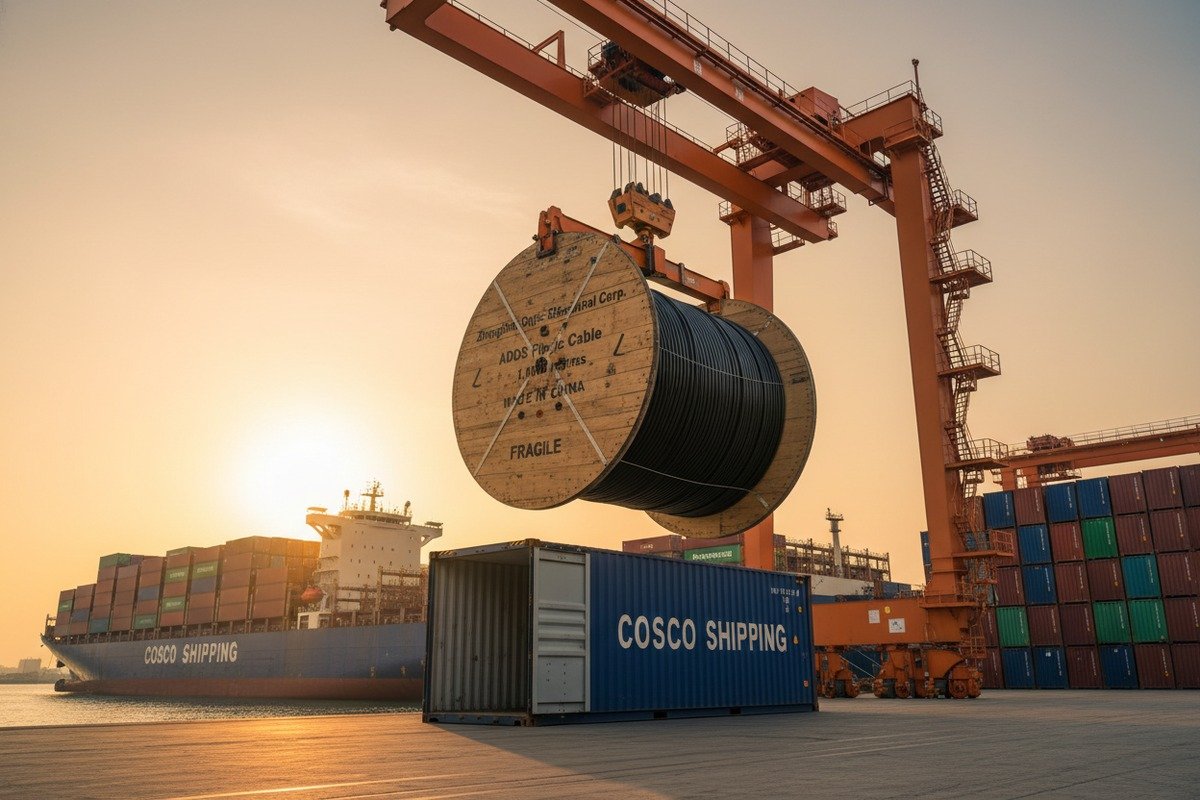
Breaking Down Ocean Freight Pricing
Ocean freight for fiber optic cables 2 is quoted by volume (cubic meters) or weight (metric tons), whichever yields the higher charge. ADSS cables are wound on large wooden or steel drums. A single drum of 4 km cable can weigh 150–300 kg and occupy 0.8–1.2 CBM. Carriers charge per container (FCL) or per CBM (LCL).
For most mid-size orders (200–500 km), a 20-foot container is sufficient. A 40-foot container handles 800–1,500 km depending on fiber count and drum size. Consolidating your order into a full container always lowers your per-meter freight cost.
Freight Cost by Shipment Size
| Order Volume | Container Type | Approx. Freight (China → LA) | Per-Meter Cost |
|---|---|---|---|
| 100 km | LCL (shared) | $1,200–$1,800 | $0.12–$0.18/m |
| 500 km | 20' FCL | $3,500–$4,500 | $0.07–$0.09/m |
| 1,000 km | 40' FCL | $5,000–$7,000 | $0.05–$0.07/m |
Insurance Costs
Marine cargo insurance 3 typically costs 1–3% of the declared cargo value. On a $0.68/m cable, that is roughly $0.007–$0.020 per meter. We always recommend All-Risk coverage because ADSS drums can suffer damage from rough seas or improper stacking. One collapsed drum means an entire reel is unusable. The small insurance premium is worth the protection.
Port Selection Matters
Choosing the right US port changes your total freight math. West Coast ports like Los Angeles and Long Beach offer shorter transit times (14–18 days from Shanghai) and lower ocean freight. But if your warehouse sits in Georgia or Virginia, you still need inland transport. East Coast ports like Savannah or Charleston add 7–10 days of ocean transit but cut your inland drayage significantly. Run the numbers both ways before you commit.
Transit Time vs. Cost Trade-Off
| Route | Ocean Transit | Ocean Freight (20' FCL) | Inland to Atlanta |
|---|---|---|---|
| Shanghai → Los Angeles | 14–18 days | $3,500–$4,500 | $2,800–$3,500 |
| Shanghai → Savannah | 25–30 days | $4,200–$5,500 | $400–$800 |
In some cases, the Savannah route is cheaper overall despite the higher ocean freight because inland trucking from LA to Atlanta costs more than the extra ocean leg. Always calculate the door-to-door total, not just the port-to-port rate.
Packaging Considerations
Our factory ships ADSS cables on reinforced wooden drums built to ISTA 3A standards. Poor packaging is a hidden freight risk. If drums collapse during transit, the cable bends beyond its minimum bend radius, and the entire reel becomes scrap. We reinforce corners and add moisture barriers because a damaged drum doesn't just cost you the cable — it costs you weeks of project delay while replacements ship.
What US import duties and customs tariffs should I expect for fiber optic cables from China?
Duties and tariffs are the cost component that catches buyers off guard the most. Our export documentation team works with US customs brokers daily, and we see duty miscalculations delay shipments and blow budgets regularly.
ADSS fiber optic cables from China typically fall under HTS code 8544.70.00 or related subheadings, carrying a base duty rate of 3.5–6.5%. However, Section 301 tariffs on Chinese goods can add an additional 7.5–25%, making the effective duty rate anywhere from 11% to over 31% of declared value.
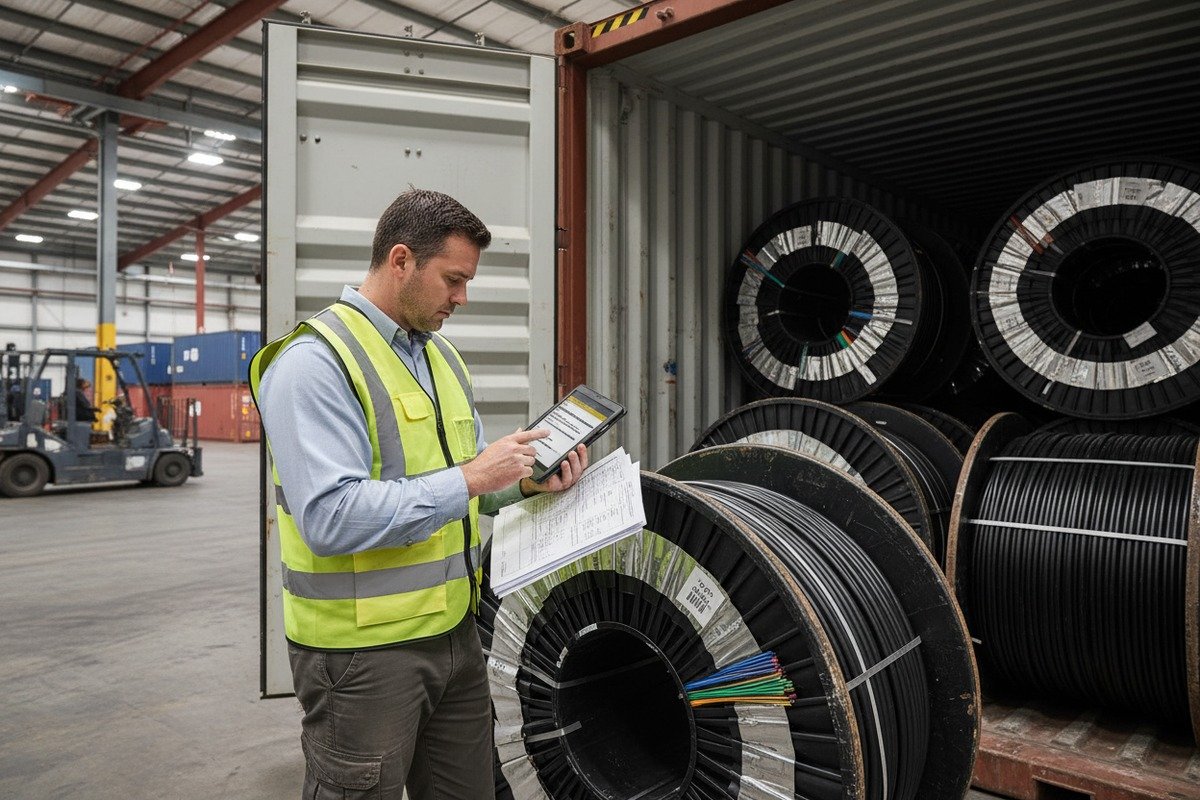
Getting the HTS Code Right
The Harmonized Tariff Schedule 4 classification determines everything. ADSS cables are all-dielectric, meaning they contain no metallic elements. This distinguishes them from armored cables like GYTA53 models that have steel tape. The correct HTS code depends on:
- Whether the cable contains only optical fibers (no copper conductors)
- Whether it is individually sheathed
- The cable's primary application (telecommunications vs. power utility)
Misclassifying your cable can result in overpaying duties or, worse, underpaying and facing penalties. Work with a licensed customs broker who has specific experience with fiber optic products.
Duty Rate Breakdown
| Tariff Layer | Rate | Basis |
|---|---|---|
| Column 1 (MFN) duty | 3.5–6.5% | Declared customs value (CIF) |
| Section 301 tariff (List 3/4A) | 7.5–25% | Declared customs value |
| Merchandise Processing Fee (MPF) | 0.3464% | Min $31.67, max $614.35 |
| Harbor Maintenance Fee (HMF) | 0.125% | Cargo value |
The Section 301 tariff rate depends on which list your specific HTS code falls under. As of recent policy shifts, rates have fluctuated. Some fiber optic cable categories sit on List 4A at 7.5%, while others have been escalated. Always verify the current rate before placing an order.
Calculating Duty on a Real Order
Let's say you order 500 km of 48-fiber ADSS cable at $0.58/m. Your declared value is $290,000. Add ocean freight of $4,000 and insurance of $2,900. Your customs value (CIF basis) is $296,900.
- MFN duty at 6%: $17,814
- Section 301 at 7.5%: $22,268
- MPF: $614.35 (capped)
- HMF: $371.13
Total duties and fees: approximately $41,067, or about $0.082 per meter.
This is a significant cost, but even with it, the landed price of $0.73/m remains far below the $1.78/m domestic alternative. The key is to model these costs accurately before you sign a contract, not after.
Strategies to Reduce Duty Impact
Some buyers explore Foreign Trade Zones 5 (FTZs) near their warehouse. Goods stored in an FTZ defer duty payment until the product enters US commerce. This helps cash flow on large inventory orders. Others work with customs brokers to ensure they claim every legitimate tariff exclusion or reduction available. We provide detailed commercial invoices, packing lists, and certificates of origin to support clean customs entries.
Over the years, our logistics coordinators have tracked every ancillary charge that hits between the ship's rail and the buyer's warehouse door. These "hidden" costs are not truly hidden — they are just easy to overlook until they appear on an invoice.
Hidden costs including port terminal handling ($200–$600), chassis fees ($50–$100/day), customs broker fees ($300–$800), container drayage ($300–$2,500), warehouse receiving charges, and demurrage/detention penalties can add $0.02–$0.10 per meter to your landed cost depending on order size and logistics efficiency.
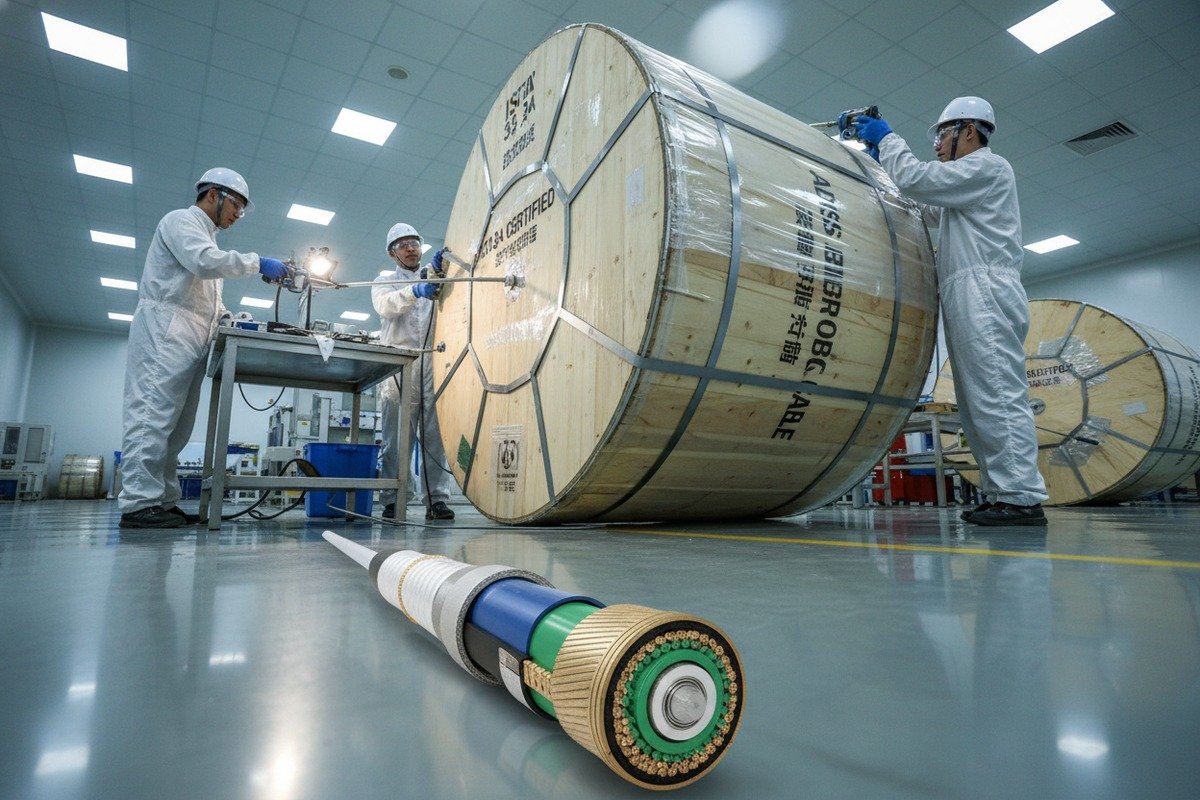
The Ancillary Cost Checklist
Most buyers budget for the cable, freight, and duty. Then a cascade of smaller charges adds up. Here is what to watch for:
Terminal Handling Charges (THC): The port charges a fee to unload your container from the vessel and move it to the yard. This runs $200–$600 per container at most US ports.
Customs Broker Fees: A licensed broker files your entry documents, pays duties on your behalf, and handles classification disputes. customs brokerage fees 8 Expect $300–$800 per shipment. Complex entries with multiple HTS codes cost more.
Container Drayage: This is the truck move from the port terminal to your warehouse or a transload facility. It varies enormously by distance. A short dray from the Port of Los Angeles to a warehouse in Carson might cost $300–$500. A longer haul from the port to a warehouse in Phoenix could run $1,800–$2,500.
Chassis Rental and Per Diem: If you don't return the container chassis quickly, you pay daily rental fees of $50–$100. Delays at your warehouse receiving dock can trigger these charges fast.
Demurrage and Detention: The Silent Budget Killers
Demurrage is a charge from the port terminal when your container sits in the yard too long (typically free for 3–5 days). After that, fees of $150–$300 per day kick in. Detention is charged by the shipping line when you hold their container too long after it leaves the port. Combined, a one-week delay can cost $1,000–$2,000 — money that serves zero productive purpose.
The solution is simple: have your customs broker pre-clear the shipment, arrange drayage in advance, and schedule warehouse receiving before the vessel arrives. Our team provides advance shipping notices with all documentation 7–10 days before port arrival so buyers can prepare.
Sample Hidden Cost Breakdown for a 500 km Order
| Cost Item | Estimated Range | Per-Meter Impact |
|---|---|---|
| Terminal handling (THC) | $350–$500 | $0.001 |
| Customs broker fee | $400–$700 | $0.001 |
| Container drayage (port → warehouse) | $500–$2,500 | $0.001–$0.005 |
| Chassis rental (3 extra days) | $150–$300 | $0.0003–$0.0006 |
| Warehouse receiving/unloading | $200–$400 | $0.0004–$0.0008 |
| Demurrage (if delayed 3 days) | $450–$900 | $0.001–$0.002 |
| Inspection/exam fees (if selected) | $0–$1,500 | $0–$0.003 |
| Total ancillary costs | $2,050–$6,800 | $0.004–$0.014 |
These numbers look small on a per-meter basis, but on a $290,000 order, $6,800 in avoidable fees is real money. More importantly, delays from poor logistics planning cause project timeline disruptions that cost far more than the fees themselves.
Currency Exchange — A Cost You Cannot Ignore
If your Chinese supplier quotes in CNY, the USD/CNY exchange rate becomes a variable cost. A 5% movement in the rate changes your cable cost by roughly $0.03/m on a $0.58/m base price. That is $15,000 on a 500 km order. Some buyers lock in rates using forward contracts through their bank. Others request USD-denominated quotes. We offer pricing in both currencies and can lock pricing for 30–60 days to give buyers time to finalize financing.
Quality-Related Hidden Costs
A cable that fails in the field costs far more than any logistics fee. If aramid yarn is downgraded or the PE jacket is thin, your ADSS cable may not survive ice loading or wind vibration. Re-pulling cable on a utility span costs $5,000–$15,000 per incident. We provide OTDR test reports, third-party lab certifications (UL, CSA, CE), and pre-shipment inspection options to prevent these scenarios. Factoring in a $2,000–$5,000 third-party inspection into your landed cost is a wise investment when ordering hundreds of kilometers.
Should I request a DDP quote from my supplier to lock in my total landed cost?
Many of the procurement managers we work with ask us for DDP (Delivered Duty Paid) pricing because they want one number — no surprises. It is a smart approach, but it comes with trade-offs that deserve careful consideration.
Requesting a DDP quote from your Chinese ADSS cable supplier transfers all shipping, customs, duty, and delivery costs to the supplier, giving you a single per-meter price delivered to your US warehouse. This simplifies budgeting and eliminates hidden cost risks, but typically includes a 5–15% risk margin built into the supplier's quote.
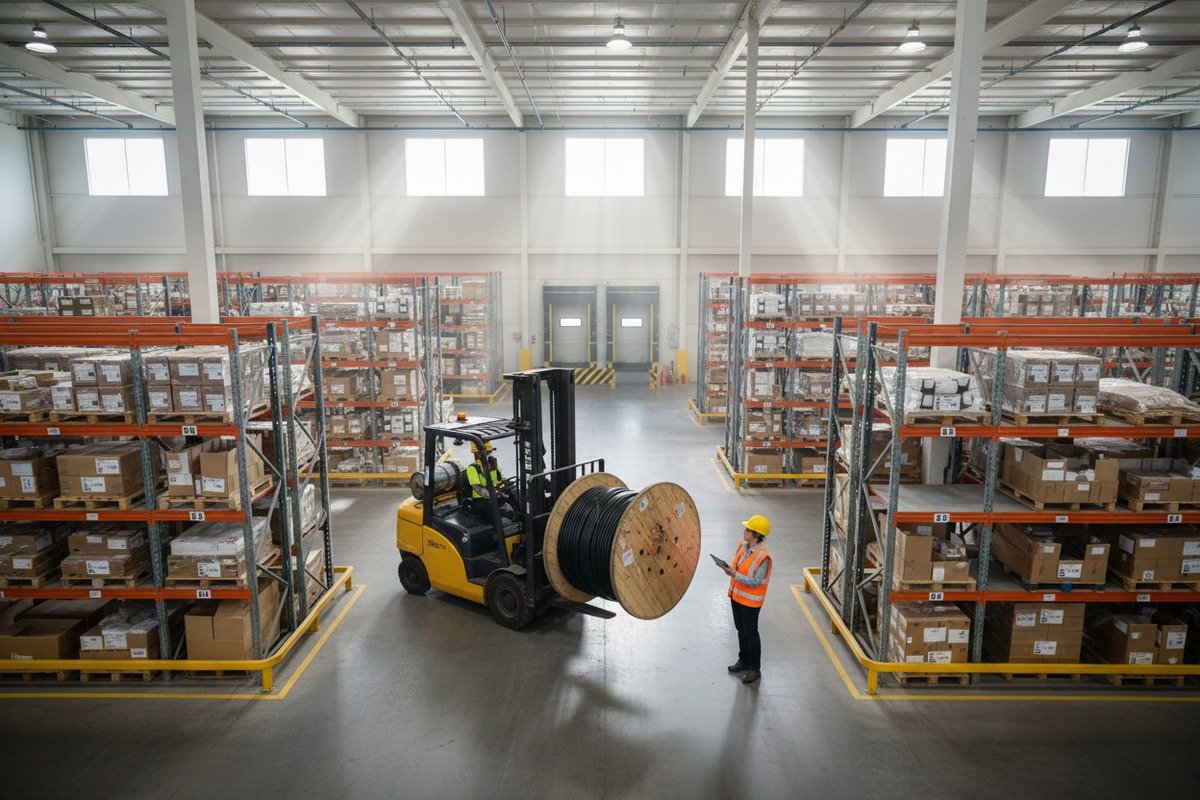
What DDP Actually Means
Under Incoterms 2020 10, DDP means the seller bears all costs and risks of delivering goods to the named destination. The supplier handles export customs, ocean freight, marine insurance, US import duties, customs clearance, and inland delivery to your warehouse dock. You simply receive the cable and pay the agreed price.
This sounds ideal. And for many buyers, it is. But you should understand what happens behind the scenes.
The Risk Margin Issue
When a supplier quotes DDP, they must estimate freight rates, duty rates, and drayage costs weeks or months in advance. To protect themselves, they add a buffer — usually 5–15% above their actual expected costs. If freight rates drop or duties are lower than projected, the supplier keeps the difference. If costs spike, the supplier absorbs the loss.
For you as the buyer, this means your DDP price is almost always higher than what you would pay if you managed logistics yourself. The question is whether the convenience and cost certainty are worth the premium.
DDP vs. FOB: A Side-by-Side Comparison
| Factor | FOB (Buyer Manages Logistics) | DDP (Supplier Manages Everything) |
|---|---|---|
| Cost transparency | High — you see every line item | Low — one bundled price |
| Budget certainty | Lower — costs can vary | High — fixed per-meter price |
| Buyer effort | Significant — need freight forwarder, broker | Minimal — supplier handles all |
| Cost efficiency | Usually 5–15% lower total | Includes supplier's risk margin |
| Control over logistics | Full control | No control |
| Liability for delays | Shared/buyer bears most | Supplier bears all |
When DDP Makes Sense
DDP works best when you are placing your first order with a new supplier and want to minimize risk. It also works well for smaller orders where the logistics overhead of managing your own freight forwarder, customs broker, and drayage is disproportionately high. If your order is 100–200 km and you do not have established logistics relationships, the convenience of DDP easily justifies the 5–15% premium.
When FOB or CIF Is Better
For large, recurring orders (500+ km), managing your own logistics chain typically saves money. You build relationships with freight forwarders who give you volume discounts. Your customs broker learns your HTS codes and files entries faster. Your drayage carrier knows your warehouse dock schedule. Over time, these efficiencies compound.
Our recommendation to most US buyers is to start with DDP for the first one or two orders. Use that time to verify cable quality, build trust, and understand the logistics flow. Then transition to FOB or CIF terms for ongoing orders and manage the supply chain yourself — or through a trusted third-party logistics provider.
How We Handle DDP at Lonsoncable
Our logistics team has established partnerships with freight forwarders, US customs brokers, and inland carriers across major US ports. When we quote DDP, we provide a detailed cost breakdown so you can see exactly how the price is constructed — cable cost, freight, insurance, duties, and delivery. This transparency is unusual in the industry, but we believe it builds trust. If you later decide to switch to FOB, you already know what each cost component looks like and can negotiate effectively with your own logistics partners.
We also offer a hybrid approach: we handle export and ocean freight (CIF terms), and you take over at the US port. This splits the logistics workload and gives you control over the domestic leg while we handle what we do best — manufacturing, quality control, packaging, and ocean shipping.
Conclusion
Calculating total landed cost for ADSS cables from China requires adding freight, duties, handling, drayage, and ancillary fees to your factory price — then comparing that complete number against domestic alternatives.
Footnotes
1. Provides a general definition and overview of All-Dielectric Self-Supporting (ADSS) cables. ↩︎
2. Provides a general definition and explanation of fiber optic cables and their function. ↩︎
3. Explains marine cargo insurance, its purpose, and what it typically covers. ↩︎
4. Official source for the Harmonized Tariff Schedule of the United States. ↩︎
5. Official information from U.S. Customs and Border Protection on Foreign Trade Zones. ↩︎
6. Official information from the USTR regarding Section 301 tariffs on Chinese goods. ↩︎
7. Defines total landed cost and its importance in understanding the true cost of a product. ↩︎
8. Details the components and factors influencing customs brokerage fees for importers. ↩︎
9. Clarifies the differences and implications of demurrage and detention charges in shipping. ↩︎
10. Official publication from the International Chamber of Commerce (ICC) on Incoterms 2020 rules. ↩︎