
Every year, our quality team reviews dozens of field failure reports from solar projects around the world. The pattern is always the same: cables that looked fine on paper failed under real operating conditions because nobody verified ampacity during procurement. It is a costly mistake that can delay grid connection, trigger safety hazards, and destroy project ROI.
To verify solar PV cable ampacity during procurement, request TUV or UL test reports, cross-check the manufacturer's rated ampacity against your system's maximum circuit current with all derating factors applied, confirm conductor material purity, and validate voltage drop calculations before placing any order.
This guide walks you through every step. We will cover standards compliance, temperature derating, conductor quality, and the exact test reports you should demand from any supplier. Let's start with the foundation: standards verification.
How do I verify that the manufacturer's ampacity ratings comply with TUV EN50618 standards?
When we run production batches of our EN50618 solar cable at our Hainan facility, every single reel goes through a strict internal audit before it earns a TUV mark. TUV EN50618 standards 1 But not every factory operates the same way, and that gap is where procurement risk lives.
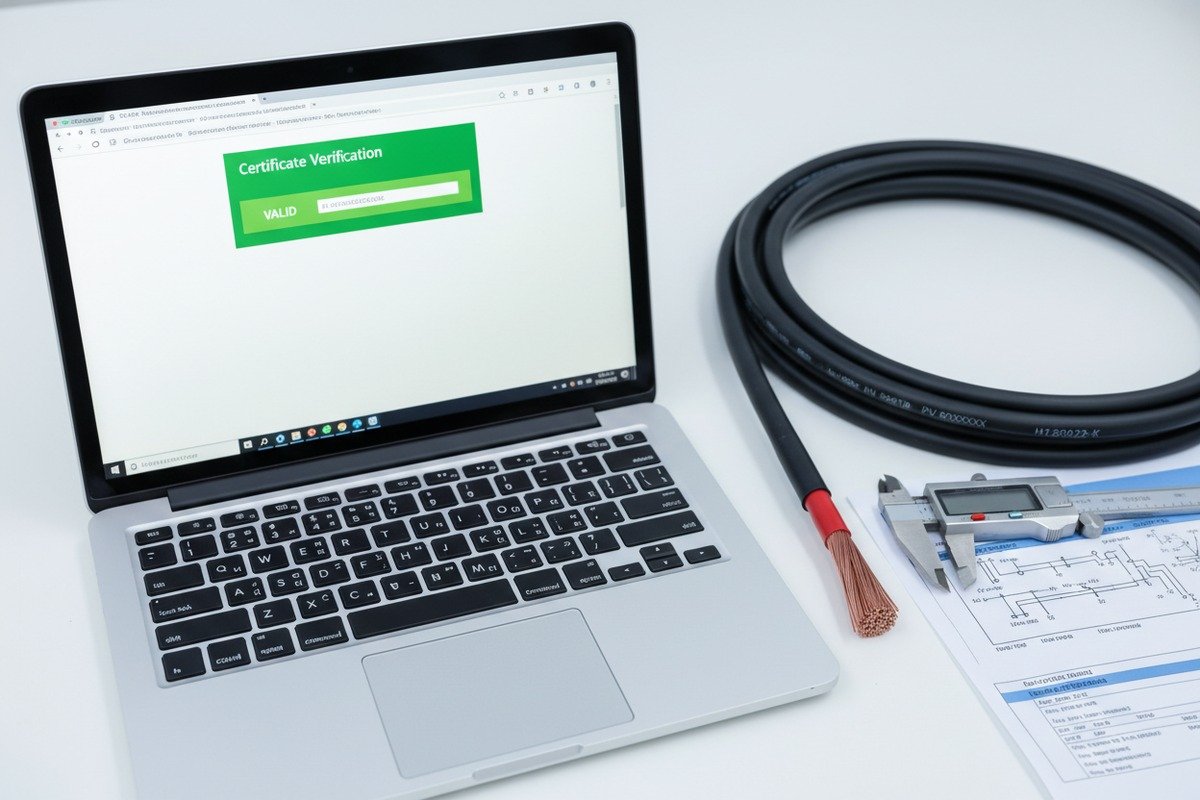
To verify TUV EN50618 compliance, request the original TUV certificate with a valid certificate number, cross-reference it on the TUV Rheinland or TUV SUD online database, and confirm that the cable's rated voltage, temperature class, and ampacity match the certificate scope exactly.
What Does EN50618 Actually Require?
EN50618 is the European harmonized standard 2 for solar PV cables. It replaced the older TUV 2PFG 1169 standard and sets requirements for cables rated 1.5 kV DC. The standard defines conductor size, insulation material (typically electron-beam cross-linked polyolefin or XLPO), flame retardancy, UV resistance, and — critically — the conditions under which ampacity is rated.
A cable rated at 40A under EN50618 means it can carry 40A continuously at a specific ambient temperature (usually 30°C in free air) without the conductor exceeding its maximum operating temperature of 90°C or 120°C depending on the insulation class.
How to Audit a TUV Certificate
Many buyers simply accept a PDF certificate from the supplier. That is not enough. Here is what you should do:
- Get the certificate number. Every legitimate TUV certificate has a unique number.
- Search the TUV online database. Both TUV Rheinland and TUV SUD maintain public portals. TUV Rheinland or TUV SUD online database 3 Enter the certificate number and confirm the manufacturer name, factory address, and product scope match.
- Check the expiry date. TUV certificates require annual factory audits. An expired certificate means the product may no longer comply.
- Match the product scope. A certificate for 4 mm² cable does not cover 6 mm² cable. Verify that your exact cross-section and voltage rating are listed.
Key Parameters to Cross-Check
| Parameter | EN50618 Requirement | What to Verify on Certificate |
|---|---|---|
| Rated Voltage | 1.5 kV DC (1.0 kV AC) | Must match your system voltage class |
| Temperature Rating | 90°C continuous (some 120°C) | Ampacity is tied to this rating |
| Conductor Material | Tinned copper (Class 5 flexible) | Confirm class and tinning |
| Insulation | Electron-beam XLPO | Check material code on datasheet |
| UV Resistance | Passes EN 50618 Clause 8.1 | Must state UV test compliance |
| Flame Retardancy | EN 60332-1-2 | Single vertical flame test required |
Red Flags During Procurement
Watch for these warning signs. If a supplier cannot provide the TUV certificate number for online verification, walk away. If the datasheet lists ampacity values significantly higher than industry norms for the same conductor size, question the testing conditions. Our engineering team has seen cases where competitors rate ampacity at 20°C ambient instead of 30°C — this inflates the number by roughly 10% and gives a false sense of safety margin.
Also, be cautious of certificates issued to trading companies rather than factories. The certificate must name the actual manufacturing facility. If your cable comes from a different factory than the one on the certificate, the certification is void.
What temperature derating factors must I apply to my system design to prevent cable overheating?
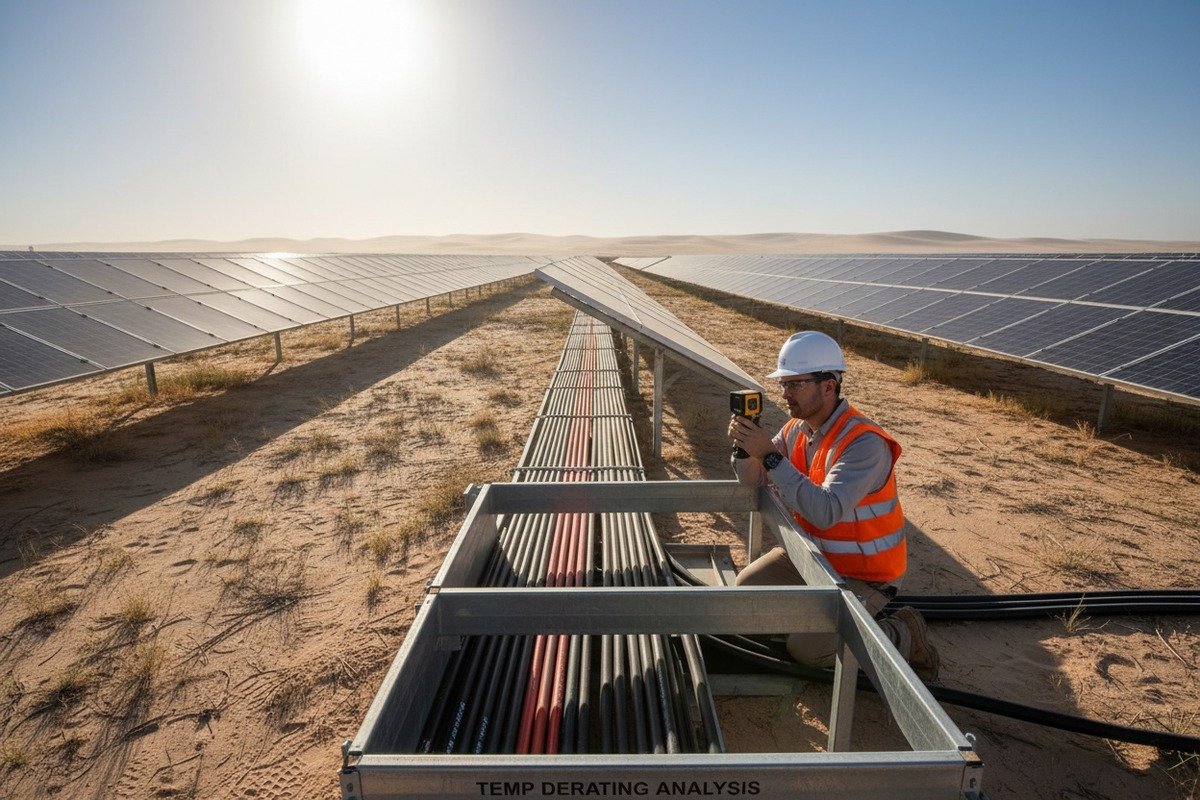
On our production floor, we test cables at 90°C and 120°C conductor temperatures. But a rooftop in Saudi Arabia or a ground-mount array in Spain will push ambient temperatures well beyond the 30°C baseline. If you do not derate, you are gambling with fire.
You must apply temperature derating factors from EN50618 or NEC 310.15(B)(3)(c) based on your site's maximum ambient temperature. For example, a cable rated at 30°C ambient loses 29% of its ampacity at 46–50°C ambient. Ignoring derating is the leading cause of cable overheating in solar installations.
Why Derating Matters More Than You Think
Ampacity ratings on datasheets assume ideal conditions: 30°C ambient air, single cable in free air, no solar radiation loading. Real solar installations are different. Cables run across hot rooftops, inside conduits exposed to direct sunlight, or bundled together in cable trays. Each of these conditions reduces the cable's ability to dissipate heat, and the ampacity must be reduced accordingly.
NREL data 4 suggests over 30% of solar installations experience performance issues linked to poor cable sizing. Temperature derating errors are the most common root cause.
Standard Temperature Derating Factors
The table below shows derating factors for 90°C rated copper PV cable. NEC 310.15(B)(3)(c) 5 These factors multiply against the base ampacity to give you the actual usable current capacity.
| Ambient Temperature (°C) | Derating Factor (90°C Cable) | Example: Base 40A Cable |
|---|---|---|
| 26–30 | 1.00 | 40.0A |
| 31–35 | 0.94 | 37.6A |
| 36–40 | 0.91 | 36.4A |
| 41–45 | 0.82 | 32.8A |
| 46–50 | 0.71 | 28.4A |
| 51–55 | 0.58 | 23.2A |
| 56–60 | 0.41 | 16.4A |
At 50°C ambient — common on a dark rooftop in summer — your 40A cable becomes a 28.4A cable. If your string current is 10A and you applied the NEC 125% safety factor (12.5A minimum), you still have margin. But if you are running a higher-current system or bundling cables, that margin disappears fast.
Additional Derating for Bundled Cables
When cables are grouped together in a tray or conduit, heat cannot escape as easily. You must apply a second derating factor on top of the temperature correction. For example, NEC Table 310.15(C)(1) specifies:
| Number of Current-Carrying Conductors | Bundling Derating Factor |
|---|---|
| 1–3 | 1.00 |
| 4–6 | 0.80 |
| 7–9 | 0.70 |
| 10–20 | 0.50 |
So if you have 8 conductors in a tray at 45°C ambient, your total derating is 0.82 × 0.70 = 0.574. A 40A cable now carries only 23A safely. This is why our technical support team always asks clients for installation drawings before recommending a cable size. The installation method changes everything.
The NEC 125% Rule
NEC Article 690 requires that PV circuit conductors be sized to at least 125% of the maximum circuit current (Isc). This accounts for continuous load operation (over 3 hours). So for a string with Isc of 10A:
- Minimum ampacity = 10A × 1.25 = 12.5A
- Then apply temperature derating
- Then apply bundling derating
- The cable's adjusted ampacity must exceed the final number
Many procurement teams skip the compounding derating steps. Do not make that mistake.
How can I ensure the conductor material is high enough quality to avoid voltage drops in my project?
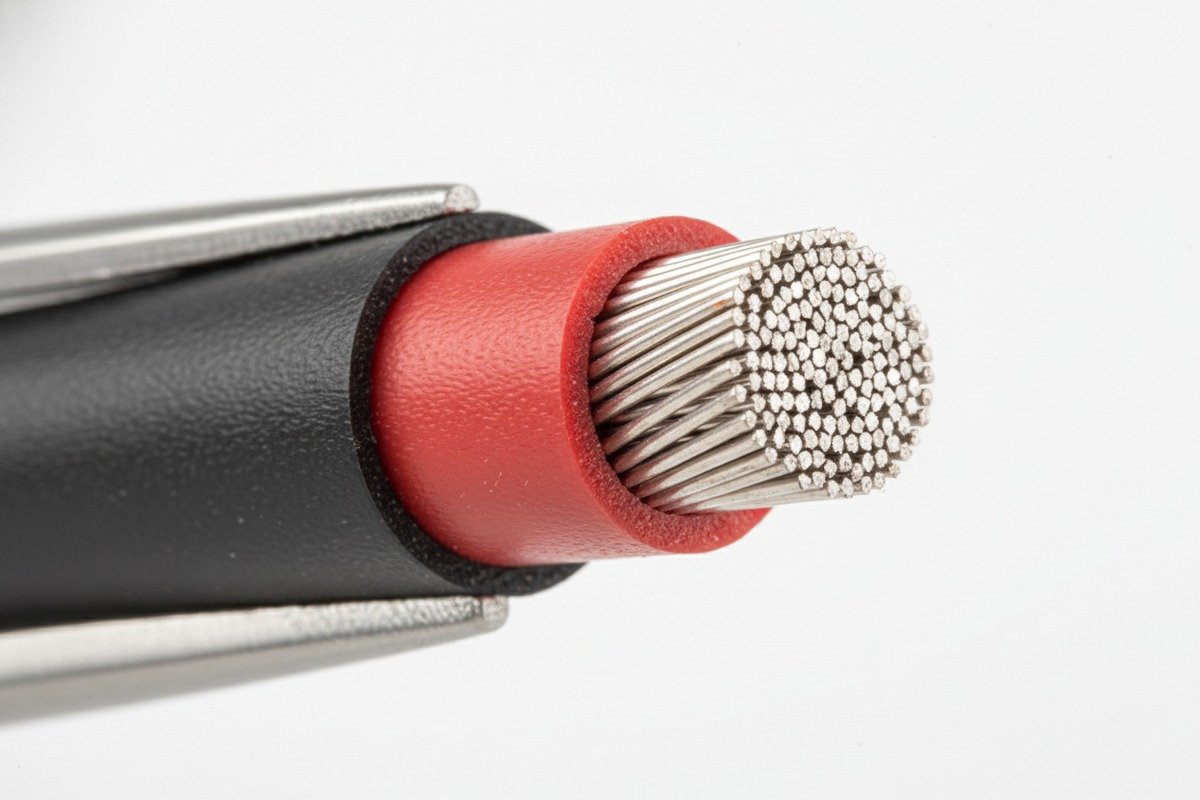
We source our copper from certified smelters and run conductivity tests on every incoming batch. Even a small drop in copper purity — from 99.97% to 99.5% — increases resistance enough to cause measurable voltage drop 6 across long cable runs. For utility-scale projects, that translates directly into lost energy and revenue.
To ensure conductor quality, demand mill certificates confirming copper purity ≥99.97% (or aluminum ≥99.5%), verify the conductor meets IEC 60228 Class 5 flexibility standards, and calculate voltage drop using actual resistance values from the supplier's test data rather than generic tables.
Why Conductor Purity Affects Your Bottom Line
Voltage drop is the silent killer of solar PV system efficiency. Every meter of cable between your panels and inverter introduces resistance. That resistance converts your generated power into waste heat instead of usable electricity. The industry recommends keeping voltage drop below 2% from array to combiner box, and below 3% for the total DC side.
Copper purity directly determines electrical resistance. IEC 60228 specifies maximum resistance values per conductor size. IEC 60228 Class 5 flexibility standards 7 A cable that barely meets these limits will have higher voltage drop than one that comfortably exceeds them.
How to Check Conductor Quality During Procurement
Here is what we recommend based on three decades of cable manufacturing:
- Request the copper mill certificate. This document states the purity, origin, and batch number of the copper rod used. It should show ≥99.97% purity for electrolytic tough pitch (ETP) copper 8.
- Ask for DC resistance test reports. The supplier should provide measured resistance values per kilometer at 20°C. Compare these against IEC 60228 maximums.
- Verify tinning quality. Tinned copper conductors resist oxidation and maintain low contact resistance over 25+ years. Ask for tin coating thickness data (typically 1–3 μm).
- Check strand count and flexibility. Class 5 flexible conductors have more strands than Class 2 rigid conductors. More strands mean easier installation and fewer micro-cracks over time.
Voltage Drop Calculation Example
For a 50-meter cable run carrying 10A on 4 mm² copper conductor:
- DC resistance of 4 mm² copper at 20°C: approximately 4.95 Ω/km
- Resistance for 50m (one way, so 100m round trip): 4.95 × 0.1 = 0.495 Ω
- Voltage drop: 10A × 0.495 Ω = 4.95V
- For a 600V DC system: 4.95 / 600 = 0.83% — within the 2% limit.
Now consider a cable with impure copper where resistance is 10% higher (5.45 Ω/km):
- Voltage drop: 10A × 0.545 Ω = 5.45V
- Percentage: 5.45 / 600 = 0.91% — still within limits for this short run, but on longer runs or higher currents, the gap compounds significantly.
For a 200-meter run at 30A, the difference between pure and impure copper could mean the difference between a compliant and non-compliant installation.
Copper vs. Aluminum: A Procurement Decision
| Factor | Copper Conductor | Aluminum Conductor |
|---|---|---|
| Conductivity | 100% IACS reference | ~61% IACS |
| Weight | Heavier (8.9 g/cm³) | Lighter (2.7 g/cm³) |
| Size for Same Ampacity | Smaller cross-section | ~1.6x larger cross-section |
| Cost per Meter | Higher | 40–60% lower |
| Corrosion Resistance | Good (excellent if tinned) | Requires anti-oxidant treatment |
| Best Use Case | Rooftop, short runs, high current | Utility-scale, long runs, cost-sensitive |
Our factory produces both copper and aluminum solar cables. For European EPC projects where space is tight and reliability is paramount, copper is the standard choice. For utility-scale installations in Africa and Latin America where cable runs exceed 500 meters, aluminum often delivers better ROI — but it demands careful attention to connector compatibility and termination methods.
Which specific test reports should I demand from a supplier to validate their ampacity claims?
Throughout our 30 years of producing solar PV cables, the single most common question from German and Dutch EPC clients is: "What documentation can you provide to prove these numbers are real?" It is the right question. Datasheets are marketing documents. Test reports are evidence.
Demand these specific reports: IEC 60228 conductor resistance test, IEC 62930 or EN50618 type test report from a CNAS/ILAC-accredited lab, TUV or UL product certification with factory audit records, and routine production test results including spark test, insulation resistance, and high-voltage withstand data.

The Difference Between Type Tests and Routine Tests
Type tests are performed once on a representative sample when a product is first designed or certified. IEC 62930 type test report 9 They validate the cable design against the full scope of the standard — including accelerated aging, fire resistance, mechanical properties, and long-term ampacity performance.
Routine tests are performed on every production batch. They confirm that the manufacturing process has not deviated from the approved design. Both are essential for procurement verification.
Complete Test Report Checklist
Here is the minimum set of documents you should request from any solar PV cable supplier:
Type Test Reports (One-Time Design Validation):
- Conductor resistance per IEC 60228
- Insulation thickness and material verification
- Voltage test (AC and DC withstand)
- Insulation resistance at elevated temperature
- Bending test (cold bend and repeated flexing)
- UV resistance test per EN 50618 or UL 4703
- Flame retardancy per EN 60332-1-2
- Thermal aging (e.g., 20,000 hours at rated temperature)
- Ozone resistance test
Routine Test Reports (Per Production Batch):
- Spark test (100% of cable length)
- Conductor resistance measurement
- High-voltage withstand test
- Visual and dimensional inspection
- Insulation thickness verification
What an Accredited Lab Report Looks Like
Not all test reports carry equal weight. A report from a CNAS-accredited or ILAC-recognized lab is internationally accepted. A report from the manufacturer's own internal lab is useful but not sufficient for critical procurement decisions.
When reviewing third-party test reports, verify:
- The lab's accreditation number and scope
- The test standard referenced (EN 50618, UL 4703, etc.)
- The sample description matching your order specification
- Test date within the last 2–3 years
- Clear pass/fail conclusions for each tested parameter
Supplier Audit Beyond Paperwork
Documents alone do not guarantee quality. For high-value projects, consider these additional verification steps:
- Factory audit: Visit or send a third-party auditor to inspect production lines, raw material storage, and quality control processes. At our facility, we welcome buyer audits and maintain an open-door policy for our ISO 9001-certified production lines.
- Sample testing: Request production samples and send them to an independent lab for verification. Compare measured resistance and insulation thickness against the supplier's claims.
- Batch traceability: Ask whether the supplier can trace every reel of cable back to its raw material batch, production date, and test results. Our factory uses barcode-based traceability on every drum.
Quick Reference: Standards by Market
| Target Market | Cable Standard | Certification Body | Key Test Standard |
|---|---|---|---|
| Europe | EN 50618 / H1Z2Z2-K | TUV Rheinland / TUV SUD | IEC 62930, EN 60332-1-2 |
| USA | UL 4703 (PV Wire) | UL (Underwriters Laboratories) | UL 4703, NEC 690 |
| Canada | RPVU90 / RWU90 | CSA Group | CSA C22.2 No. 271 |
| Australia | AS/NZS 5000.1 | SAA | AS/NZS 3008.1 |
| International | IEC 62930 | IECEE CB Scheme | IEC 62930 |
When you are sourcing cables for a German solar farm, your TUV EN50618 certificate and type test report are non-negotiable. For a project in Brazil, you may need INMETRO recognition. Always confirm which certification your local Authority Having Jurisdiction (AHJ) requires before you issue a purchase order.
Future-Proofing Your Procurement
The solar industry is shifting toward what some call "ampacity passports" — digital records that travel with each cable reel, containing full traceability from copper mine to installation site. We are already implementing QR-code-based batch tracking for our European clients. This trend will only accelerate as project finance companies and insurers demand more granular proof of cable quality.
Also consider future system expansion. If there is any chance the array capacity will increase or battery storage will be added, specify cables with a 15–20% ampacity margin above current requirements. The cost of slightly larger cable today is far less than the cost of re-cabling later.
Conclusion
Verifying solar PV cable ampacity 10 during procurement protects your project from overheating failures, efficiency losses, and costly delays. Demand certified test reports, apply proper derating, verify conductor quality, and never accept unverified claims.
Footnotes
1. Provides an overview of the EN 50618 standard requirements for solar PV cables. ↩︎
2. Explains what European harmonized standards are and their role in EU legislation. ↩︎
3. Direct link to TÜV Rheinland's official certificate database for verification of products. ↩︎
4. Provides an overview of NREL's research into photovoltaic technologies and system performance. ↩︎
5. Details the National Electrical Code section for derating factors for raceways and cables on rooftops. ↩︎
6. Explains voltage drop, its causes, effects, and significance in solar energy systems. ↩︎
7. Explains IEC 60228 standard, including conductor classes and flexibility requirements. ↩︎
8. Describes the properties, purity, and applications of Electrolytic Tough Pitch (ETP) copper. ↩︎
9. UL Solutions offers photovoltaic (PV) cable testing and certification, explicitly mentioning IEC 62930 type-test reports. ↩︎
10. Explains ampacity, wire sizing, and factors affecting current-carrying capacity in solar systems. ↩︎