
Every year, our quality team rejects cable samples that look perfect on paper but fail basic accelerated aging tests 1 within months. A solar PV system 2 is a 25-year investment.
To verify a 25-year service life for solar PV cables, procurement teams must cross-check TÜV or UL certifications against live databases, demand accelerated aging test reports (thermal, UV, humidity), audit factory material traceability, and confirm XLPO or XLPE insulation is electron-beam cross-linked—not just chemically processed—to guarantee genuine long-term outdoor durability.
This guide walks you through exactly what to check, what to ask, and what to avoid. Each section below covers a specific verification step, complete with test benchmarks, red flags, and practical tables you can use during your next supplier evaluation.
How do I verify that the TUV EN50618 certification is authentic and valid for 25 years?
When our export team ships cables to European EPC clients, the first document they request is always the TÜV certificate. But a PDF alone proves nothing. Fake or expired certificates circulate widely in global supply chains.
To verify TÜV EN50618 authenticity, check the certificate number directly on the TÜV issuing body's online database (e.g., TÜV Rheinland's Certipedia or TÜV SÜD's product registry), confirm the certificate holder matches the factory, and ensure the validity period and tested product models align with your purchase order.
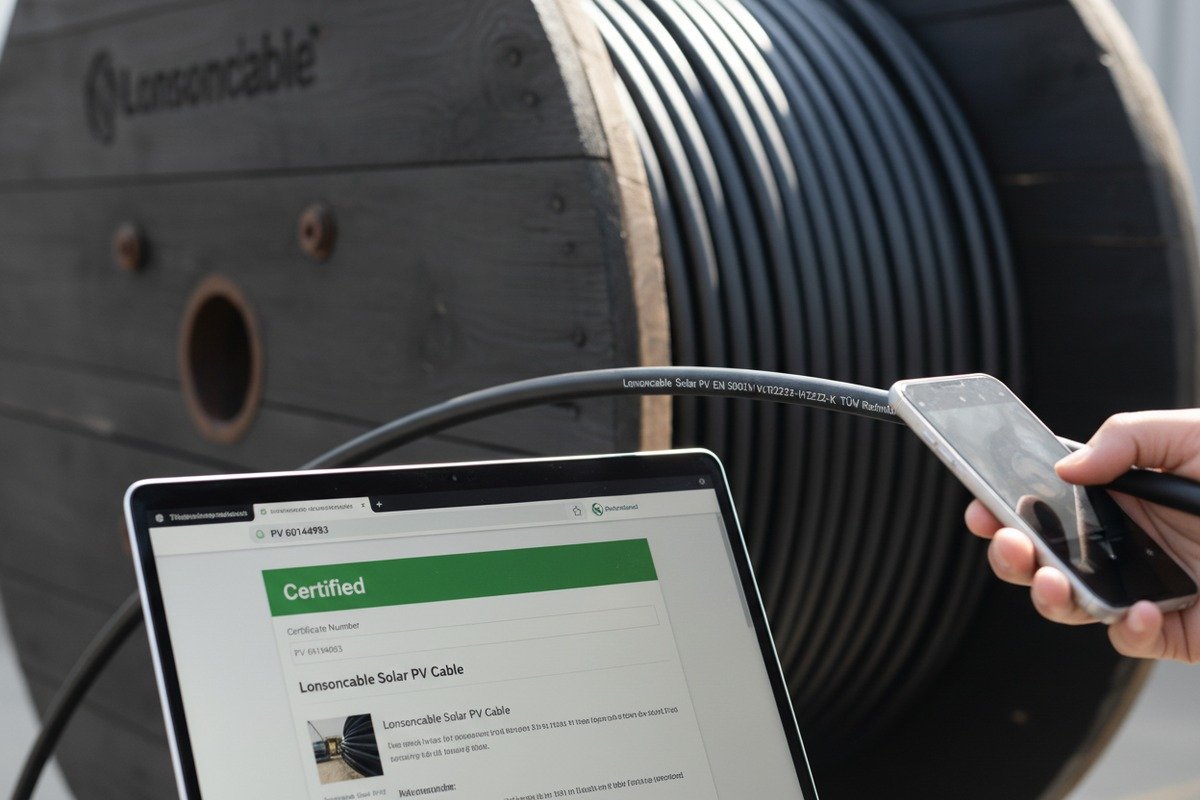
Why EN 50618 Matters for 25-Year Claims
EN 50618 3 is the harmonized European standard specifically written for photovoltaic cables. It replaced the older TÜV 2 PfG 1169 standard and sets minimum performance benchmarks that directly support a 25-year outdoor service life. These benchmarks include thermal endurance, UV resistance, ozone resistance, and mechanical strength. A cable certified to EN 50618 has passed tests designed to simulate decades of real-world exposure in compressed timelines.
However, the certificate itself is only as good as its verification. In our 30 years of manufacturing, we have seen cases where competitors present certificates belonging to a different factory, or certificates that expired years ago. This is why direct database verification is non-negotiable.
Step-by-Step Verification Process
- Get the certificate number and issuing body. Ask the supplier for the original certificate PDF. Note the certificate number, the name of the TÜV body (Rheinland, SÜD, NORD, etc.), and the exact cable models listed.
- Search the online registry. Go to the TÜV body's public database. For TÜV Rheinland 4, use Certipedia (www.certipedia.com). Enter the certificate number. The result must show the supplier's legal name, factory address, and the cable models covered.
- Match the details. The factory address on the certificate must match the actual production facility. If the supplier uses a trading company name but the certificate belongs to a different manufacturer, demand clarification.
- Check validity dates. TÜV certificates have expiration dates and require annual surveillance audits. An expired certificate means the cable is no longer certified.
- Confirm scope. The certificate must list the exact cable type, voltage rating, and cross-section sizes you are purchasing. A certificate for a 4mm² cable does not cover a 6mm² variant unless explicitly listed.
Key Certificate Details to Cross-Check
| Verification Item | What to Look For | Red Flag |
|---|---|---|
| Certificate Number | Matches TÜV online database exactly | Number not found or returns different company |
| Factory Name & Address | Matches your supplier's actual production site | Trading company name, not factory |
| Cable Model Numbers | Covers exact models in your purchase order | Generic or missing model references |
| Validity Period | Current date falls within validity range | Expired or no surveillance audit records |
| Standard Reference | Explicitly states EN 50618 | Only references older TÜV 2 PfG 1169 |
| Voltage & Temperature Ratings | Matches your project specs (e.g., 1500V DC, -40°C to +90°C) | Lower ratings than claimed in sales docs |
A Practical Tip from the Production Floor
When clients visit our 230,000 m² facility in Hainan, we walk them through our TÜV audit history. Every year, TÜV auditors visit for surveillance. They pull random samples from our production line and send them to independent labs. If any sample fails, the certificate is suspended. This ongoing process is what gives the EN 50618 mark its real weight—not just the initial test, but continuous compliance. Ask your supplier for their last surveillance audit date. If they cannot provide one, that is a problem.
What accelerated aging test reports should I request to prove my cables' long-term durability?
Our R&D lab runs accelerated aging tests on every new cable formulation before it enters mass production. These tests compress decades of environmental stress into weeks or months, and they are the closest thing the industry has to a crystal ball.
Request thermal aging reports (per IEC 60811-401 at 150°C for 240+ hours), UV weathering test data (per ISO 4892-2 or ASTM G154 for 720+ hours), humidity resistance tests, ozone exposure results, and mechanical retention tests post-aging—all performed by an accredited third-party lab, not the manufacturer's own facility.

Understanding Accelerated Aging Science
Accelerated aging works by exposing cable samples to extreme conditions—high heat, intense UV light, concentrated ozone, and humidity—at levels far beyond normal outdoor use. By applying the Arrhenius equation 6 (for thermal aging) or standardized weathering cycles, labs can estimate how the cable material will behave over 25 or 30 years. The key word here is "estimate." No test perfectly replicates real-world conditions. But these tests are the industry's best tool, and certified labs follow strict protocols to ensure consistency.
The Essential Test Reports You Need
Here is a breakdown of the critical tests and what each one tells you about long-term cable survival:
| Test Type | Standard | Conditions | What It Proves | Minimum Pass Criteria |
|---|---|---|---|---|
| Thermal Aging | IEC 60811-401 | 150°C for 240 hours | Insulation won't crack or harden in hot climates | Tensile strength retention ≥ 70% |
| UV Weathering | ISO 4892-2 / ASTM G154 | 720 hours UV-B exposure | Jacket and insulation resist sun degradation | No cracking, color change within limits |
| Ozone Resistance | EN 50618, Annex | 96 hours at elevated ozone | Material won't degrade from atmospheric ozone | No visible cracks at 20x magnification |
| Humidity / Damp Heat | IEC 60068-2-78 | 85°C / 85% RH for 1000 hours | Moisture won't penetrate and degrade insulation | Insulation resistance ≥ specified threshold |
| Cold Bend | IEC 60811-504 | -40°C bend test | Cable stays flexible in extreme cold | No cracking after bending at -40°C |
| Mechanical Retention | IEC 60811-501 | Post-aging tensile and elongation | Material maintains physical integrity after stress | Elongation at break ≥ 100% post-aging |
Why Third-Party Lab Reports Matter
When we complete a production batch destined for a German or Dutch EPC project, we send samples to independent labs like SGS, Bureau Veritas, or TÜV's own testing centers. A report from the manufacturer's in-house lab is useful for internal quality control, but it does not carry the same weight for procurement decisions. Third-party reports are harder to falsify, and the lab's accreditation (ISO/IEC 17025 7) is itself auditable. Always check that the lab listed on the test report is accredited and independent from the cable manufacturer.
How to Read the Report
Look beyond "pass" or "fail." Check the actual measured values. A cable that barely passes thermal aging with 71% tensile strength retention is very different from one that scores 92%. The margin above the minimum threshold gives you confidence that the cable has headroom for real-world variability. Also confirm the sample description in the report matches the cable model and batch you are purchasing. A test report from 2019 on a different cable variant does not validate your 2026 order.
How can I be sure the XLPO insulation material will survive decades of intense UV exposure?
UV degradation is the silent killer of PV cables. On our production lines, we have tested dozens of XLPO formulations over three decades, and the difference between a properly stabilized compound and a cheap alternative is dramatic—sometimes visible within just 500 hours of lab exposure.
Ensure XLPO insulation survival under decades of UV by confirming the material uses electron-beam cross-linking (not just chemical cross-linking), contains high-grade UV stabilizers and carbon black at ≥2.5% concentration, and has passed ISO 4892-2 weathering tests exceeding 720 hours without cracking, chalking, or significant tensile strength loss.
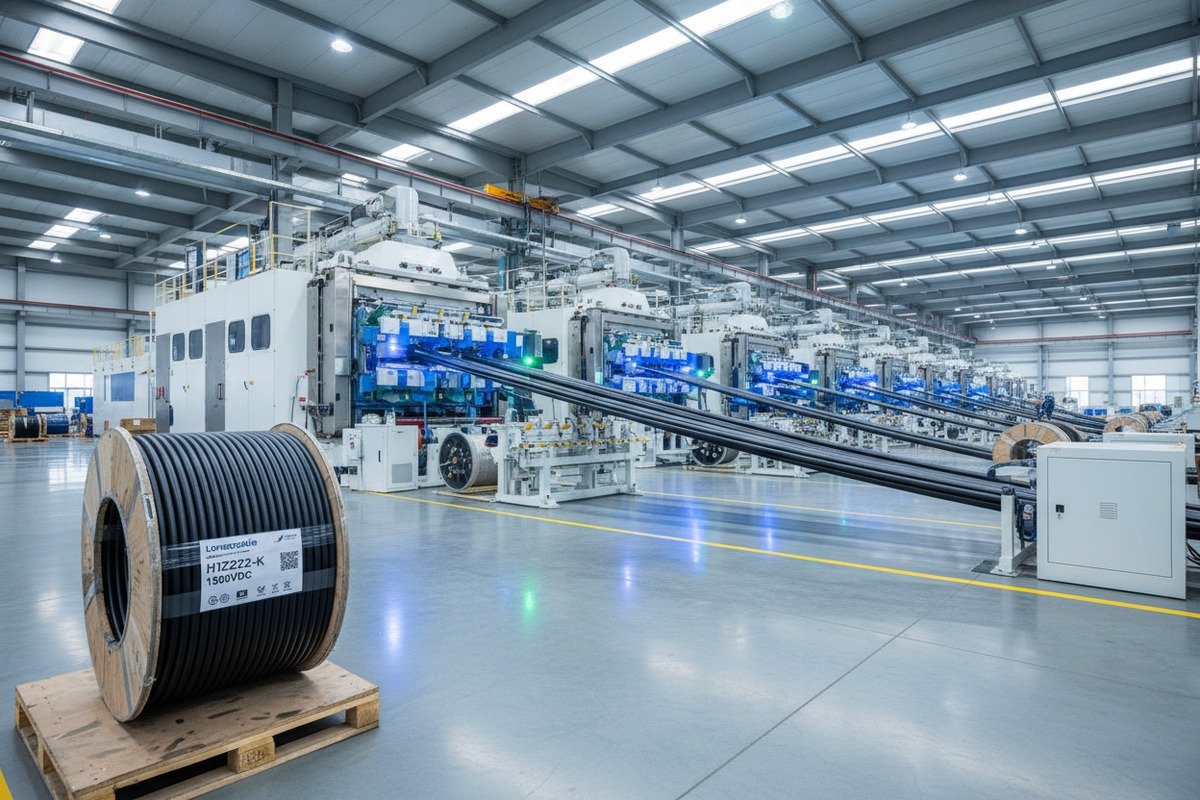
What Is XLPO and Why Does Cross-Linking Method Matter?
XLPO stands for cross-linked polyolefin. Cross-linking is the process that transforms ordinary polyolefin into a thermoset material—one that won't melt or flow when heated. There are two main methods: chemical cross-linking (using peroxide or silane) and electron-beam (e-beam) cross-linking.
E-beam cross-linking produces a more uniform molecular network. electron-beam cross-linking 8 The result is a material with superior mechanical properties, better heat resistance, and more consistent UV performance across the entire cable length. Chemical cross-linking can leave uneven cure zones, especially in thick insulation layers. For a cable expected to sit in direct sunlight for 25 years, this uniformity matters.
When we upgraded our facility to include e-beam cross-linking lines, the difference in long-term weathering test results was measurable. Our post-720-hour UV samples showed 15-20% better tensile retention compared to chemically cross-linked alternatives from the same base polymer.
The Role of UV Stabilizers and Carbon Black
The XLPO compound itself is only part of the equation. UV stabilizers—typically hindered amine light stabilizers (HALS)—absorb or neutralize the UV radiation before it breaks polymer chains. Carbon black 9, when dispersed evenly at concentrations of 2.5% or higher, acts as a physical UV shield. Together, these additives form a defense system.
Ask your supplier for the material data sheet (MDS) of their XLPO compound. It should list:
- The type of base polymer
- Cross-linking method
- UV stabilizer type and loading
- Carbon black concentration
- The compound manufacturer (e.g., Borealis, Dow, or equivalent)
If the supplier cannot provide this level of detail, the material traceability is weak.
Real-World UV Exposure vs. Lab Tests
A common question from our European clients—especially those building solar farms in southern Spain or Greece—is whether lab tests really predict field performance. Here is a rough comparison:
| Location | Average Annual UV Dose (MJ/m²) | Equivalent Lab Hours (ISO 4892-2) per Year | 25-Year Equivalent Lab Hours |
|---|---|---|---|
| Northern Germany | ~3.5 | ~100 | ~2,500 |
| Southern Spain | ~5.5 | ~160 | ~4,000 |
| Middle East (UAE) | ~7.0 | ~200 | ~5,000 |
| Southeast Asia (Philippines) | ~6.0 | ~175 | ~4,375 |
A cable that passes 720 hours of UV-B testing in the lab has roughly demonstrated survival equivalent to 7 years in northern Europe or about 4 years in the Middle East. This is why we often push our samples to 2,000 hours or beyond for high-irradiance markets. If your project site receives intense UV, ask for extended UV test data—not just the minimum EN 50618 requirement.
Checking the Compound Supplier Chain
Quality XLPO compounds come from a short list of reputable chemical companies. If the cable manufacturer buys from an unknown compounder to save costs, the long-term UV performance is unpredictable. During your supplier audit, ask to see purchase orders or delivery receipts from the compound supplier. This is standard practice for serious EPC procurement, and any transparent manufacturer will share it.
What red flags should I look for during my factory audit to prevent premature cable failure?
We welcome factory audits—in fact, we encourage them. Over the years, clients who visited our Hainan facility before placing large orders built the strongest, longest-lasting business relationships with us. But not every factory is as open, and the audit itself needs structure.
During a factory audit, watch for inconsistent raw material labeling, missing incoming quality control records, absent or non-functional cross-linking equipment, no traceability from copper rod to finished cable, untrained operators, poor cable storage conditions, and reluctance to show real-time production line testing—any of these signals a high risk of premature cable failure.
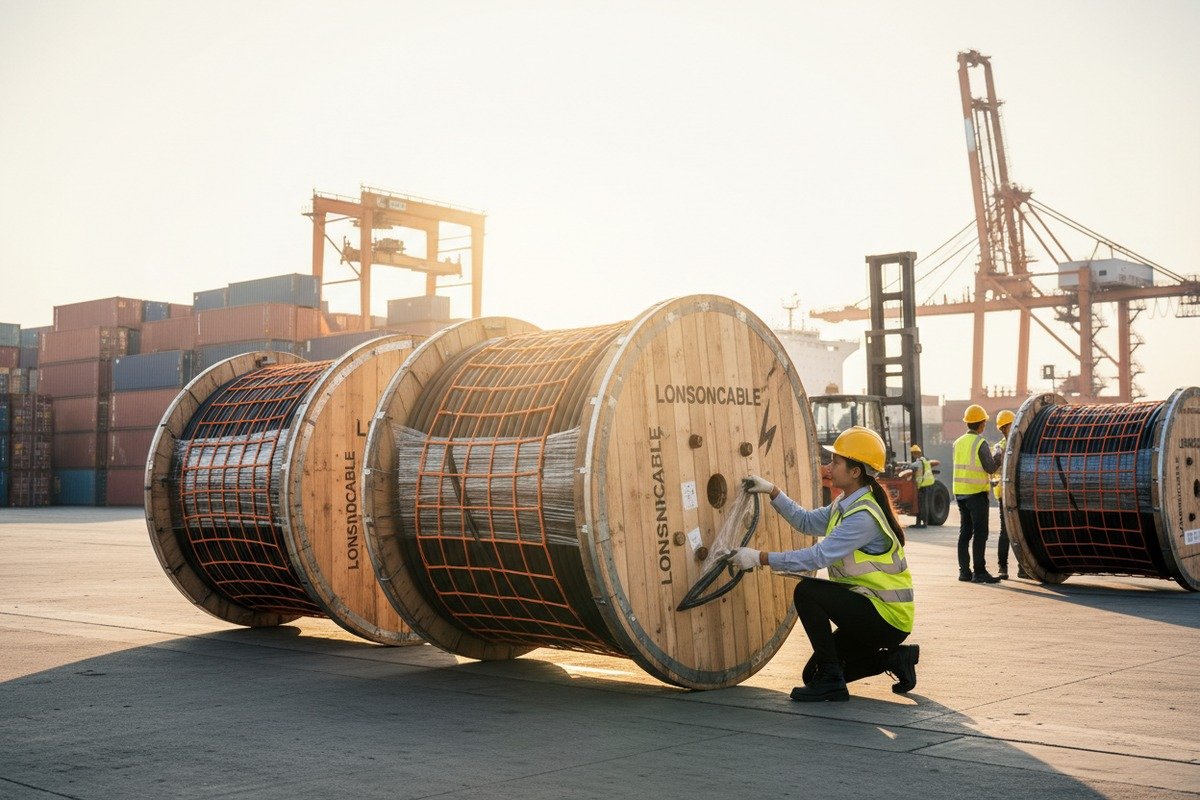
The Audit Mindset: What You Are Really Looking For
A factory audit is not a courtesy visit. You are trying to answer one question: "Can this factory consistently produce the same cable quality that was tested and certified?" Certification tests are performed on samples. Your order will include thousands of meters. The gap between a perfect sample and real production output is where failures hide.
Critical Areas to Inspect
Raw Material Warehouse
Walk into the raw material storage area. Check the labeling on copper rod bundles, XLPO compound bags, and additive containers. Every item should have a batch number, supplier name, and date of receipt. Ask to see the incoming inspection records. A well-run factory tests copper conductivity and compound melt flow index on arrival. If the warehouse is disorganized or labels are missing, the material traceability is broken.
Cross-Linking Line
If the factory claims e-beam cross-linking, you should see the e-beam equipment on site. It is large, expensive, and hard to fake. Ask the operator to show you the cross-linking degree test results (gel content test per ASTM D2765). The gel content for XLPO insulation 10 should be ≥ 65%. If they use chemical cross-linking instead, they should have continuous vulcanization (CV) lines with proper temperature monitoring. Ask for the temperature profile records of the last production run.
In-Line Testing
Every meter of cable should pass through a spark tester (also called a high-voltage withstand tester) during extrusion. This catches pinholes and thin spots in the insulation in real time. Check that the spark tester is powered on and set to the correct voltage. Some factories turn it off to increase line speed. Also look for conductor resistance testing at the end of each drum. Without it, you have no proof the copper cross-section is correct.
Finished Goods Storage
PV cables should be stored on proper cable drums, in a dry and shaded area. Cables left in direct sunlight or piled on the floor without drums can suffer jacket damage before they even leave the factory. For European-bound shipments, check that drum dimensions fit standard cable-laying equipment. Oversized or flimsy drums cause on-site handling problems that can bend or kink the cable.
Factory Audit Checklist Summary
| Audit Area | What to Check | Acceptable | Unacceptable |
|---|---|---|---|
| Raw Materials | Batch labels, incoming QC reports, supplier traceability | All materials labeled with test records on file | Unlabeled bags, no incoming QC |
| Cross-Linking | Equipment present, gel content records ≥ 65% | E-beam or CV line operational with documented results | No cross-linking equipment visible |
| Spark Testing | Machine powered on during extrusion, correct voltage setting | Active and calibrated on every line | Machine off or bypassed |
| Conductor Testing | Resistance test per drum, tinning thickness verification | Records match IEC or EN specs | No conductor testing done |
| Finished Storage | Drums in covered area, proper stacking, no UV exposure | Clean, organized, drums intact | Cables on bare floor, exposed to sun |
| Certification Docs | TÜV surveillance audit records, ISO 9001 current | All current and displayed | Expired or unavailable |
| Staff Training | Operators know quality procedures, can explain processes | Trained and responsive | Confused or evasive answers |
The Biggest Red Flag of All
If a factory is reluctant to let you see any area—the warehouse, the cross-linking line, the testing station—treat it as a disqualifying red flag. Transparency is the baseline. In our experience shipping to over 40 countries, the clients who conduct thorough audits never face premature cable failure surprises. The few minutes spent checking a spark tester setting or reading a gel content report can save millions in replacement costs over a 25-year project lifespan.
Conclusion
Verifying a 25-year PV cable lifespan requires checking live certification databases, demanding third-party aging test reports, confirming XLPO cross-linking methods, and conducting rigorous factory audits before signing any purchase order.
Footnotes
1. Replaced with a Wikipedia article providing a general overview of accelerated aging tests. ↩︎
2. Explains what PV technology is and how it converts sunlight into electrical energy. ↩︎
3. Defines EN 50618 as the European standard for photovoltaic cables, specifying requirements for safety and performance. ↩︎
4. Replaced with the official TÜV Rheinland US homepage. ↩︎
5. TÜV Rheinland's online platform for checking product, service, and system certifications. ↩︎
6. Replaced with a Wikipedia article explaining the Arrhenius equation. ↩︎
7. Defines ISO/IEC 17025 as the international standard for laboratory competence, impartiality, and consistent operation. ↩︎
8. Replaced with a Wikipedia article section on electron-beam processing for crosslinking. ↩︎
9. Explains how carbon black absorbs UV radiation in polymers to prevent degradation and improve weatherability. ↩︎
10. Defines XLPO as cross-linked polyolefin insulation, highlighting its halogen-free and high-temperature resistance properties. ↩︎