
Every year, our production lines ship thousands of kilometers of ADSS cable 1 to the US market—and every year, we hear the same frustration from buyers. The permitting process stalled. The cable specs didn't match the local code. The pole attachment agreement fell through. These problems don't start on the job site. They start with a lack of clarity about the regulatory landscape.
Understanding US state regulations for aerial ADSS fiber optic cable installation requires navigating a layered system of federal baseline codes like the NESC and OSHA, state-specific permitting and pole attachment rules, local ordinances, and manufacturer specifications for sag, tension, and clearance that all must be satisfied simultaneously before any cable goes up.
This guide breaks down the four biggest regulatory questions we get from US-based contractors, distributors, and procurement managers OSHA 2. Each section targets a specific compliance hurdle so you can plan your project with confidence.
How do I determine which state-specific permits are required for my aerial ADSS deployment?
Permitting confusion is the number one cause of project delays we see among our US customers. A contractor in Texas faces a completely different approval path than one in Massachusetts, and the differences are rarely obvious upfront.
To determine state-specific permits for aerial ADSS deployment, you must contact your state public utility commission, local municipality, and any relevant environmental agencies. Requirements vary widely and typically include right-of-way permits, environmental reviews, pole attachment applications, and construction permits that must all be secured before installation begins.
The Multi-Layer Permit Structure
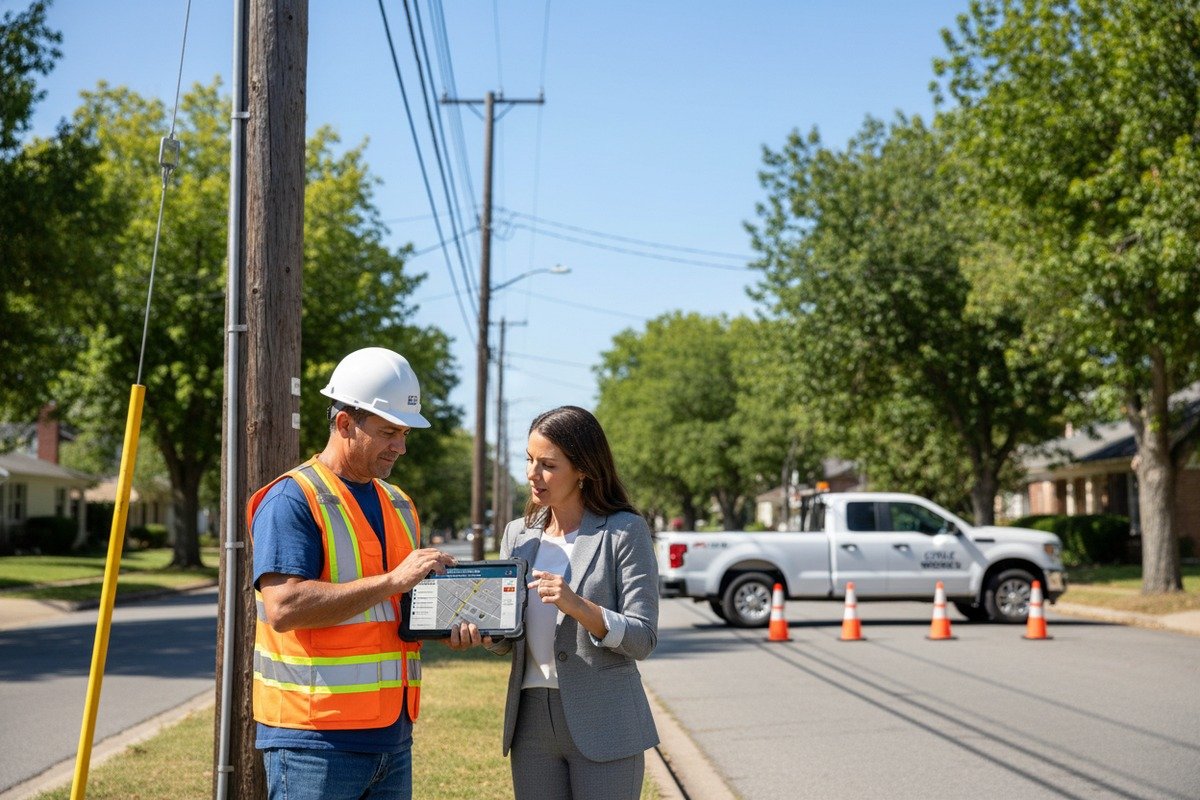
There is no single permit that covers an aerial ADSS installation in the United States. Instead, you deal with layers. At the top sits federal regulation. Below that, your state utility commission sets its own rules. Then your county or city adds local ordinances. If your project crosses railroad corridors, tribal land, or federal property, even more agencies get involved.
Here is a simplified breakdown of the typical permit layers:
| Permit Layer | Issuing Authority | Common Requirements |
|---|---|---|
| Federal | FCC, USDA RUS, NEPA agencies | Environmental review, historic preservation clearance, spectrum coordination |
| State | Public Utility Commission (PUC) | Utility registration, pole attachment tariffs, state environmental compliance |
| County / City | Local planning or public works dept. | Right-of-way encroachment permits, construction permits, traffic control plans |
| Utility-Specific | Pole owners (e.g., electric co-ops) | Pole attachment agreements, make-ready engineering, joint-use inspections |
Right-of-Way and Easement Permits
Before you string a single meter of cable, you need legal permission to occupy the space. Right-of-way permits grant access to public roads, shoulders, and corridors. Easements cover private land. Some states have streamlined "dig once" or "build once" policies that make ROW access easier for broadband projects. Others require individual negotiations with every landowner along the route.
Environmental and Historic Preservation Reviews
If your project receives any federal funding—such as through the BEAD program 3—you will need to comply with the National Environmental Policy Act 4. Even without federal funding, many states have their own environmental review processes. Wetlands, endangered species habitats, and historic sites can all trigger additional review periods that add weeks or months to your timeline.
Practical Steps to Identify Your Permits
Start by contacting your state's PUC or broadband office. Many states now publish broadband deployment guides that list required permits. Next, reach out to the local municipality for construction and encroachment permits. Finally, contact the pole owner directly. Do all of this before you order cable—not after. Our team routinely helps customers verify cable specifications against local requirements before shipment, because discovering a mismatch after the cable arrives at the job site is costly and avoidable.
The accelerated demand for 5G backhaul and rural broadband is pushing many states to streamline permitting. But "streamlined" does not mean "eliminated." You still need to do the homework.
How can I ensure my ADSS cable specifications comply with NESC safety standards across different US states?
When our engineering team designs an ADSS cable for a US project, the National Electrical Safety Code is always the starting reference. But we have learned—sometimes the hard way—that NESC 5 compliance alone does not guarantee acceptance in every jurisdiction.
To ensure ADSS cable specifications comply with NESC safety standards across US states, verify that your cable meets NESC Rule 235 clearance requirements, appropriate loading district parameters for ice and wind, and any state-specific additions to the base code. Always confirm with the local utility or authority having jurisdiction, as some states adopt modified versions of the NESC.

What the NESC Actually Requires for ADSS
The NESC, published by the IEEE as ANSI C2 6, sets minimum safety standards for utility infrastructure across the US. For aerial ADSS cable, the most relevant sections address:
- Clearances: Minimum vertical and horizontal distances between the cable and the ground, buildings, roads, railroads, waterways, and electrical conductors.
- Loading conditions: The mechanical loads (ice, wind, temperature) the cable must withstand based on its geographic loading district.
- Strength requirements: The structural integrity of the cable and its supporting hardware under combined loading.
A critical distinction is that ADSS cable is all-dielectric, meaning it contains no metallic elements. This allows it to be installed in the "power space" on a utility pole—above the communication zone—when handled by qualified personnel. However, this also means the clearance requirements can differ from those of traditional telecom cables installed in the communication space.
NESC Loading Districts
The NESC defines three primary loading districts 7—Heavy, Medium, and Light—based on expected ice and wind conditions. Your cable must be engineered to handle the worst-case loads for its installation location.
| Loading District | Radial Ice Thickness | Wind Pressure | Temperature | Typical Regions |
|---|---|---|---|---|
| Heavy | 12.5 mm (0.50 in) | 190 Pa (4 psf) | -18°C (0°F) | Northern states, Great Lakes |
| Medium | 6.4 mm (0.25 in) | 190 Pa (4 psf) | -9°C (15°F) | Mid-Atlantic, central states |
| Light | 0 mm | 430 Pa (9 psf) | -1°C (30°F) | Southern states, coastal areas |
Some states and utilities impose conditions beyond these minimums. For example, areas prone to hurricanes or extreme ice storms may require additional safety factors. Wildfire-prone regions in California may require fire-resistant jacketing or increased clearance from vegetation.
State Modifications to the NESC
Not every state adopts the NESC as-is. Some adopt it by reference in their utility code, some adopt specific editions with amendments, and a few have their own parallel codes. Before you finalize cable specifications, confirm which edition of the NESC your state enforces and whether any local amendments apply. This is something we advise every customer to verify with the authority having jurisdiction before we begin production.
Manufacturer Specifications as Compliance Documents
Here is a point many buyers overlook: NESC compliance is not just about the cable itself. It extends to the installation hardware, the sag and tension design, and the clearance calculations for each specific span. When we ship ADSS cable, we provide detailed specification sheets that include maximum rated cable tension, minimum bend radius, recommended span lengths, and temperature-dependent sag tables. These documents are part of your compliance package. Keep them accessible for inspectors.
Our cables carry UL and ISO 9001 certifications, which give US inspectors confidence in the manufacturing quality. But certification alone does not replace the need to verify that the cable parameters match the project's specific NESC loading district and clearance requirements.
What do I need to know about state-level pole attachment regulations before installing my fiber optic lines?
Pole attachment agreements are where many of our customers hit unexpected roadblocks. We have seen projects delayed by six months or more because the pole owner's make-ready process took far longer than anticipated.
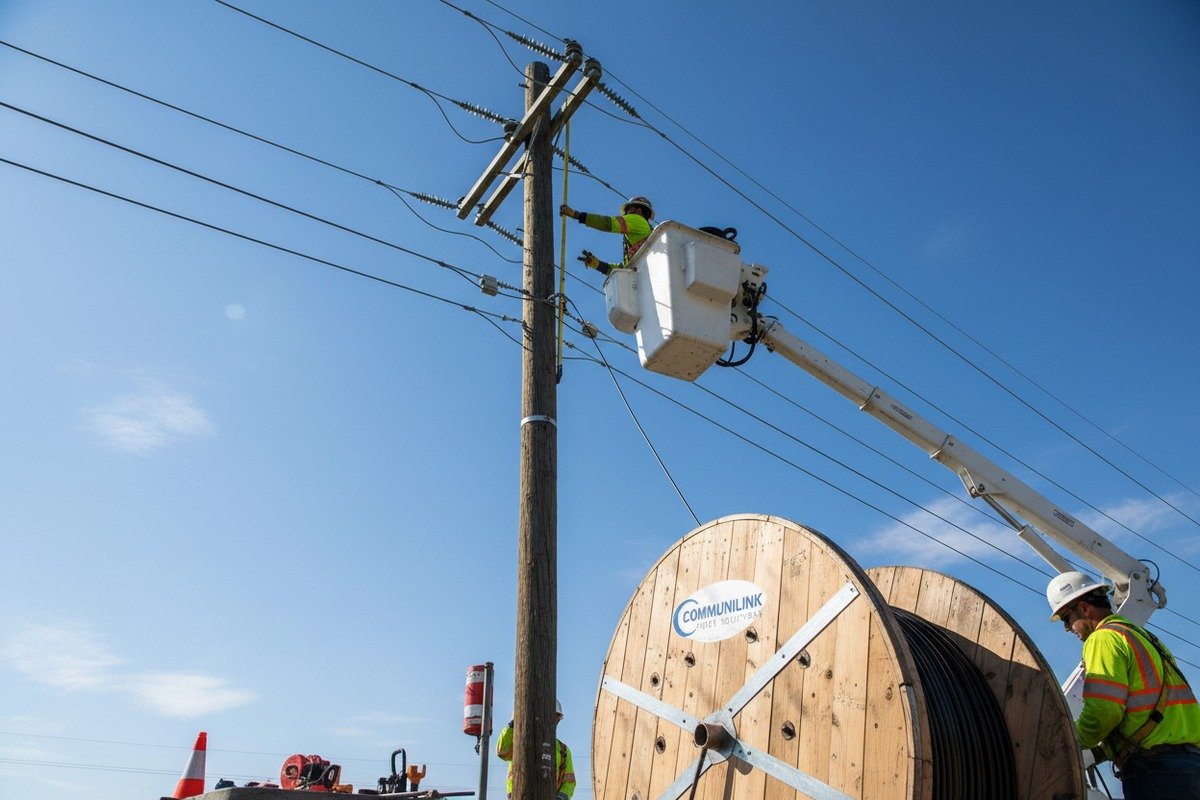
Before installing fiber optic lines on existing poles, you need to understand that pole attachment regulations are governed either by the FCC (for investor-owned utilities) or by individual state commissions (for states that have opted out of federal jurisdiction). You must secure a formal pole attachment agreement, pay for make-ready engineering, and comply with the pole owner's specific construction standards.
FCC vs. State Jurisdiction
Under Section 224 of the Communications Act 8, the FCC regulates pole attachment rates and terms for investor-owned utilities. However, roughly 20 states have certified to the FCC that they regulate pole attachments at the state level. In these states, the state public utility commission 9 sets the rates, timelines, and dispute resolution processes.
This distinction matters enormously. FCC-regulated states 10 follow federal timelines for make-ready work. State-regulated states may have faster or slower processes, different rate structures, and different complaint procedures.
The Make-Ready Process
"Make-ready" refers to the physical modifications needed on a pole before your ADSS cable can be attached. This can include:
- Moving existing cables to create space
- Replacing poles that lack structural capacity
- Installing new hardware or crossarms
- Trimming vegetation for clearance
Make-ready costs are typically borne by the new attacher—that means you. Costs can range from a few hundred dollars per pole to several thousand, depending on complexity. On a route with hundreds of poles, this adds up fast.
Key Pole Attachment Requirements by Regulatory Framework
| Requirement | FCC-Regulated States | State-Regulated States |
|---|---|---|
| Rate basis | FCC formula (telecom vs. cable TV rates) | Varies by state PUC |
| Make-ready timeline | 60 days survey + 60 days make-ready (typical) | Varies widely |
| Dispute resolution | FCC complaint process | State PUC complaint process |
| Municipal/co-op poles | Generally exempt from FCC rules | May or may not be covered |
| One-touch make-ready | Available for simple moves in comm. space | Depends on state adoption |
ADSS-Specific Pole Considerations
Because ADSS cable is self-supporting and all-dielectric, it does not require a separate messenger wire. This simplifies installation and reduces the load on the pole. However, it also means the cable must be properly dead-ended at each pole with appropriate ADSS hardware—not generic clamps designed for messenger-lashed systems. Our factory produces cables compatible with standard US dead-end and suspension hardware, and we can provide hardware specifications to match most pole configurations.
One important detail: ADSS cable should occupy the uppermost available communications space on the pole. This maximizes clearance from power conductors above and other telecom cables below. When the cable is approved for the power space, clearance analysis becomes even more critical.
Coordination with Pole Owners
The pre-installation route survey should include representatives from the pole owner, the local utility, and any other existing attachers. Approval from all parties must be secured before detailed engineering begins. This coordination step is required by both the NESC and most pole attachment agreements. Skipping it or rushing it is a common mistake that leads to costly rework later.
When our customers order ADSS cable for US projects, we encourage them to share the pole survey data with us. Knowing the span lengths, pole heights, and loading conditions allows our engineers to recommend the optimal cable design—the right fiber count, the right tensile rating, and the right jacket thickness for the job.
How do I verify that my imported ADSS cable meets the local sag and tension requirements for my specific project site?
This question comes up in nearly every conversation we have with US buyers. And it is the right question to ask. Sag and tension performance is where cable design meets real-world physics—and where a mismatch can cause failures that are expensive and dangerous.
To verify that imported ADSS cable meets local sag and tension requirements, request the manufacturer's sag-tension tables for your specific span lengths, loading district, and temperature range. Cross-reference these tables against NESC clearance minimums and the pole owner's construction standards. Conduct a stringing analysis before installation and verify with field measurements during tensioning.

Why Sag and Tension Matter
Every aerial cable sags under its own weight. Temperature changes cause the cable to expand and contract, altering sag throughout the year. Add ice and wind loads, and the forces on the cable increase significantly. If the cable is strung too tight, it may snap under cold-weather contraction or ice loading. If it is strung too loose, it may sag below minimum clearance heights, creating a safety hazard and a code violation.
Industry standards generally limit sag to less than 2% of span length and maximum tension to less than 30% of the cable's minimum breaking strength. But these are guidelines. The actual acceptable values depend on the specific span, loading district, and local code.
What to Request from Your Cable Supplier
When you source ADSS cable from any manufacturer—including our factory—you should receive the following documentation:
- Sag-tension tables for the cable's specific weight, diameter, and tensile rating, calculated for your loading district
- Maximum rated cable tension (MRCT) under various loading conditions
- Everyday tension (the tension at average temperature with no ice or wind)
- Minimum breaking strength and the recommended maximum working tension as a percentage of that value
- Temperature-dependent elongation data
At our facility, we generate these tables using the cable's actual mechanical properties, which we verify through in-house testing on every production run. We also provide OTDR test reports for optical performance and can supply third-party lab certifications when required.
How to Perform a Basic Sag-Tension Check
Here is a simplified workflow for verifying sag and tension compliance:
- Gather site data: Span lengths, pole heights, attachment heights, loading district, temperature range, and terrain.
- Obtain manufacturer sag-tension tables for the specific cable model.
- Run a stringing analysis: Use software like PLS-CADD or Alcoa SAG10 to model the cable behavior across each span under all loading conditions.
- Verify clearances: Compare the maximum sag values against NESC minimum clearance requirements for roads, railroads, waterways, pedestrian areas, and adjacent utilities.
- Confirm with field measurements: During installation, use a dynamometer or sag scope to verify that the cable is tensioned to the designed value.
Common Sag and Tension Pitfalls
One problem we see frequently is buyers selecting a cable based on fiber count alone, without considering the mechanical design. Two ADSS cables with the same fiber count can have very different weights, diameters, and tensile ratings depending on the aramid yarn quantity and jacket design. A cable designed for 200-meter spans will not perform correctly on 400-meter spans.
Another pitfall is ignoring the "creep" factor. Over time, the aramid strength members in ADSS cable elongate slightly under sustained load. This increases sag. Our engineering team accounts for 10-year creep in our sag-tension calculations, but not all manufacturers do. Ask for it explicitly.
Matching Cable Design to Project Conditions
When our customers share their project parameters, we can recommend the right ADSS cable configuration. For short spans in light loading districts, a lighter cable with less aramid saves cost without sacrificing performance. For long spans in heavy loading districts, a heavier cable with higher tensile rating is essential. Here is a general reference:
| Span Length | Loading District | Recommended Min. Tensile Rating | Typical Cable OD |
|---|---|---|---|
| Up to 200 m | Light | 8 kN | 10–12 mm |
| 200–400 m | Medium | 12–16 kN | 12–14 mm |
| 400–700 m | Heavy | 20–30 kN | 14–18 mm |
| Over 700 m | Any | Custom engineering required | Custom |
These are starting points, not final specifications. Every project requires its own analysis. But having this conversation with your supplier early in the process prevents problems later.
We also pack our ADSS cable on heavy-duty wooden reels engineered for ocean freight. We know that a collapsed reel can destroy an entire shipment, so we reinforce our packaging to withstand the stresses of international shipping. This is part of delivering a cable that arrives ready to install—not ready for a warranty claim.
Conclusion
Navigating US state regulations for aerial ADSS installation demands careful attention to permits, NESC compliance, pole attachment rules, and sag-tension verification. Plan early, verify locally, and work with a manufacturer who understands these requirements.
Footnotes
1. Provides a comprehensive definition of ADSS cable. ↩︎
2. Official source for occupational safety and health regulations. ↩︎
3. Official information on the Broadband Equity, Access, and Deployment program. ↩︎
4. Replaced with an authoritative .gov link from the U.S. Environmental Protection Agency (EPA) providing comprehensive information on NEPA. ↩︎
5. Official source for the National Electrical Safety Code. ↩︎
6. Clarifies the relationship between IEEE, ANSI C2, and NESC. ↩︎
7. Provides technical details on NESC loading districts. ↩︎
8. Provides the official text of Section 224 of the Communications Act. ↩︎
9. Explains the functions of state public utility commissions. ↩︎
10. Explains FCC's role in pole attachment regulation. ↩︎