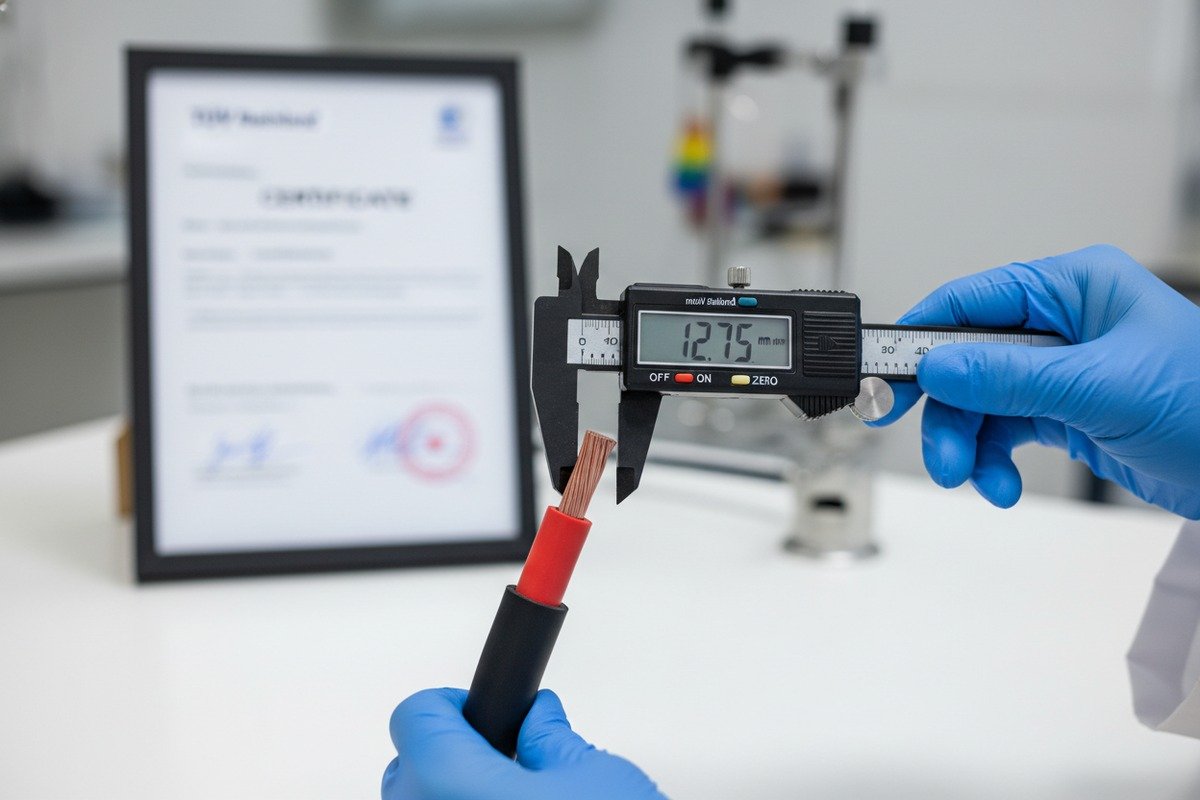

Every week, our sales team fields calls from overseas buyers who lost money on a previous fiber optic cable order — not because the product was wrong, but because the payment structure left them exposed third-party inspections 1. ADSS fiber optic cable 2
To reduce risk when buying ADSS fiber optic cable from China, structure your payments in phased milestones — typically 30% deposit, 40% after factory quality verification, and 30% before shipment — backed by Letters of Credit, third-party inspections, and clearly documented Incoterms in your purchase contract.
This guide breaks down exactly how to set up each payment phase, what verification checkpoints to demand, and which contract tools protect your investment in today's volatile market Incoterms 3. Let's walk through it step by step.
What are the safest payment terms I can negotiate to protect my ADSS cable investment?
When our export team sits down with new buyers, the first question is almost always about payment safety — and it should be, especially with 104% US tariffs and raw material prices changing weekly fiber attenuation data 4.
The safest payment terms combine a low deposit (20–30%), milestone payments tied to verified production stages, and a final balance released only after third-party inspection or confirmed shipment, ideally secured through a Letter of Credit or escrow service.

Negotiating payment terms is not just about percentages. It is about building a structure that protects you at every stage — from the moment you wire a deposit to the day your ADSS cable arrives on the job site. Here is how to think about it.
Start With the Deposit — Keep It Low, Keep It Conditional
A deposit signals commitment. But it should never exceed 30% of the total order value. On our production floor, 30% typically covers raw material procurement 5 — the fiber, aramid yarn, and PE jacketing. Anything above that shifts too much risk onto the buyer.
For first-time orders, consider starting at 20%. This gives you negotiating room and keeps the supplier motivated to perform.
Define Your Milestone Payments Clearly
The middle payment — usually 30% to 40% — should be tied to a tangible, verifiable event. That event is typically completion of production with factory test reports (OTDR, tensile, crush). We will cover this in detail in the next section.
Structure the Final Payment Around Delivery
The last 30% should only be released when you can confirm:
- Goods are packed on qualified wooden reels (fumigated, with steel edge protection).
- Shipping documents match the order (packing list, bill of lading, test reports).
- The container is loaded and a copy of the B/L is in your hands.
Comparison of Common ADSS Cable Payment Structures
| Payment Structure | Deposit | Mid-Payment Trigger | Final Balance Trigger | Risk Level for Buyer |
|---|---|---|---|---|
| Conservative (Low Risk) | 20% | 30% on production proof + inspection | 50% after B/L copy received | Low |
| Balanced (Standard) | 30% | 40% on factory OTDR + photos | 30% before shipment | Medium |
| Aggressive (High Risk) | 50% | — | 50% before shipment | High |
| Framework Agreement | 10% per batch | 40% on batch QC pass | 50% on delivery at destination | Very Low |
Tips for First-Time Buyers
If you have never imported ADSS cable from China before, here are a few rules to follow:
- Never pay 100% upfront, regardless of how attractive the price looks. Scarcity in the fiber market has pushed some suppliers to demand full prepayment, but reputable manufacturers like us do not require it.
- Always pay to a verified corporate bank account. Personal accounts are a red flag.
- Use Alibaba Trade Assurance or PayPal for orders under $10,000. For larger orders, switch to L/C or T/T with escrow.
- Get every payment term in writing inside the proforma invoice and the signed sales contract.
The goal is simple: keep your cash exposure low at each stage and release funds only when you have proof that the supplier has performed.
How can I tie my payment schedule to factory OTDR reports and quality verification?
On our production lines, every drum of ADSS cable goes through OTDR testing, tensile testing, and visual inspection before it leaves the facility — but the real question is whether your payment contract actually requires proof of those results before money changes hands.
Tie your mid-stage payment (typically 30–40% of order value) directly to the supplier's submission of factory OTDR test reports, fiber attenuation data, and photographic evidence of production completion, verified ideally by a third-party inspection agency before funds are released.

Quality verification is where most international ADSS cable deals either build trust or fall apart. Here is how to make it a contractual payment trigger — not just a nice-to-have.
What Is an OTDR Report and Why Does It Matter?
An OTDR (Optical Time-Domain Reflectometer 6) report measures the attenuation, splice loss, and continuity of each fiber inside the cable. It is the single most important document that proves the fiber inside your ADSS cable is real, properly spliced, and meets specification.
When we complete production on a batch of ADSS cable, our QC team runs OTDR tests on every fiber of every drum. The reports include wavelength-specific attenuation values (typically at 1310nm and 1550nm), event maps showing splice points, and overall link length. These reports should match the specifications in your purchase order exactly.
What Documents Should Trigger the Mid-Payment?
Do not release your second payment based on a phone call or a WhatsApp photo alone. Require a formal document package:
| Document | What It Proves | Who Should Provide It |
|---|---|---|
| OTDR Test Report (per drum) | Fiber attenuation, splice loss, link continuity | Manufacturer QC lab |
| Tensile Strength Test Report | Aramid yarn / FRP strength meets spec | Manufacturer QC lab |
| Crush Resistance Test Certificate | Cable withstands rated mechanical load | Manufacturer QC lab |
| Production Photos (timestamped) | Cable on drums, jacket color, markings visible | Manufacturer + inspector |
| Third-Party Inspection Report | Independent confirmation of all above | SGS 7, Bureau Veritas, or equivalent |
How to Use Third-Party Inspection as a Payment Gate
Hiring an independent inspector — such as SGS, Bureau Veritas, or a local Chinese inspection firm — is the gold standard. The inspector visits the factory, witnesses testing, checks drum counts, and verifies markings against your order. Their report becomes your green light to release payment.
Our recommendation: build the inspection cost into your contract. It typically runs $300–$800 per visit depending on factory location and order size. That cost is trivial compared to the risk of receiving 20 km of cable with substandard fiber or incorrect attenuation values.
Beware of Fraudulent Test Reports
One painful reality in the market: some suppliers generate fake OTDR reports. They copy data from a previous order, change the header, and send it to the buyer. To protect yourself:
- Require that each OTDR trace file (.sor format) be sent alongside the PDF report. SOR files are much harder to fabricate.
- Ask for the serial number of the OTDR equipment used and cross-check it.
- Have your third-party inspector witness the testing live.
At our facility, we provide raw .sor files upon request and welcome buyer-appointed inspectors on the production floor. Any manufacturer that refuses this level of transparency should raise serious concerns.
Match Reports to Your Specs — Not Just "Pass"
A common trap: the supplier sends a report marked "PASS" but does not specify against which standard. Your contract should state the exact specifications — for example, ITU-T G.652D fiber 8 with maximum attenuation of 0.35 dB/km at 1310nm. The OTDR report must show values at or below that threshold for every fiber tested.
Should I use a Letter of Credit to mitigate the risk of material downgrading in my order?
Material downgrading — swapping premium aramid yarn for a cheaper alternative, using recycled PE jacket compound, or substituting G.657A fiber for the specified G.652D — is one of the most damaging risks buyers face. Our engineering team has seen competitors' cables fail in the field because of exactly these shortcuts.
Yes, a Letter of Credit (L/C) is one of the most effective tools to prevent material downgrading because it requires the supplier to present verified shipping documents, inspection certificates, and test reports to the bank before receiving payment, creating an enforceable quality gate.
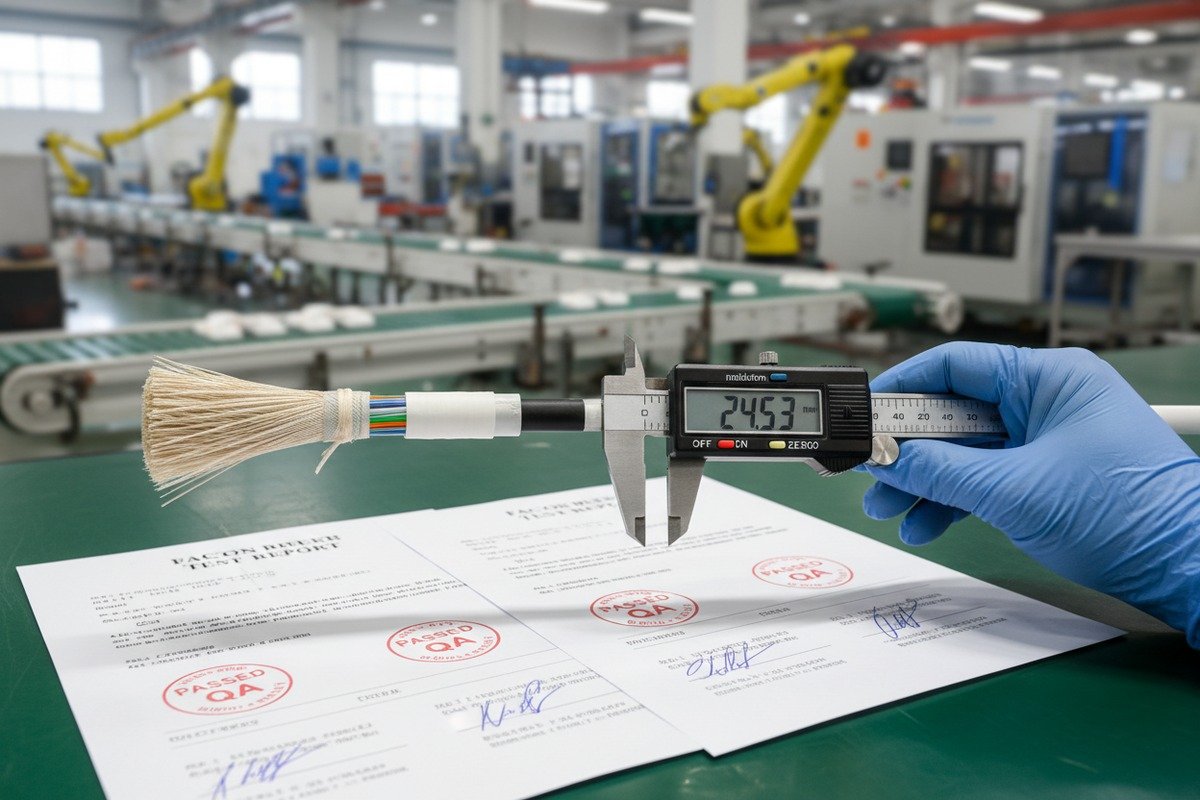
A Letter of Credit does more than guarantee payment. When structured correctly, it becomes a quality enforcement mechanism. Here is how to use it specifically for ADSS cable procurement.
How an L/C Protects Against Material Downgrading
When you open an L/C with your bank, you define a list of documents the supplier must present to receive payment. If any document is missing, incorrect, or inconsistent, the bank will not release the funds. This gives you enormous leverage.
For ADSS cable orders, include these documents in your L/C terms:
- Commercial invoice matching the proforma invoice exactly (fiber type, count, cable model, quantity in km).
- Full OTDR test report per drum with values within the specified range.
- Material certificates for aramid yarn (or FRP rod), PE jacket compound, and optical fiber — stating manufacturer, grade, and lot number.
- Third-party inspection certificate confirming material and dimensional compliance.
- Packing list with drum numbers, lengths, and gross/net weights.
- Bill of Lading (clean, on-board).
L/C vs. T/T: A Risk Comparison for ADSS Cable Buyers
| Factor | Letter of Credit (L/C) | Telegraphic Transfer 9 (T/T) |
|---|---|---|
| Bank guarantee | Yes — bank enforces document compliance | No — relies on trust between parties |
| Material downgrading protection | High — documents must prove material specs | Low — buyer verifies after payment |
| Cost to buyer | L/C opening fee (0.5–2% of order value) | Wire transfer fee only ($20–$50) |
| Speed of payment | Slower (5–15 business days for document review) | Fast (1–3 business days) |
| Supplier preference | Many smaller suppliers resist L/C due to complexity | Most suppliers prefer T/T |
| Best for | Orders above $50,000 or first-time suppliers | Repeat orders with trusted suppliers |
When Is an L/C Worth the Cost?
The L/C opening fee and bank charges can add 1–2% to your order cost. For a $200,000 ADSS cable shipment, that is $2,000 to $4,000. Compare that to the cost of receiving 50 km of cable with downgraded fiber that fails your network's attenuation budget — the rework, re-ordering, and project delays can easily exceed $50,000.
Use an L/C when:
- It is your first order with a new supplier.
- The order value exceeds $50,000.
- You are sourcing high-fiber-count ADSS (48F, 96F, 144F) where material costs are significant.
- Your project has strict compliance requirements (e.g., utility-grade installations up to 220kV).
For repeat orders with a supplier you trust — and where you have already verified their quality through multiple shipments — switching to T/T with milestone payments can save time and cost.
Practical Tips for Your L/C Terms
Keep your L/C document requirements specific but realistic. If you list 15 obscure documents, the supplier may struggle to comply even if the product is perfect, causing unnecessary delays. Stick to the core verification documents listed above. Also, specify that partial shipments and transshipment are allowed or not allowed — this affects logistics flexibility.
At our company, we work with L/C terms regularly and can advise buyers on document formatting that passes bank scrutiny smoothly. A well-drafted L/C protects both sides.
How do I structure my final balance payment to ensure on-time delivery and secure packaging?
Our logistics coordinator has a saying: "The last 30% buys more than cable — it buys peace of mind on the ocean." That final payment is your strongest lever for ensuring the shipment arrives intact and on schedule.
Structure your final balance (typically 25–30%) so it is released only after you receive photographic proof of secure reel packaging, a clean Bill of Lading, and confirmation that all shipping documents match your order — this ensures the supplier prioritizes your shipment and protects cargo integrity.

The final payment stage is where many ADSS cable buyers lose leverage — and where packaging failures and delivery delays often happen. Here is how to structure it right.
Why Packaging Quality Matters for ADSS Cable
ADSS cable is wound on large wooden or steel reels, loaded into containers, and shipped across oceans for 20 to 45 days. If the reel collapses, the cable can kink, crush, or tangle — rendering an entire drum useless. We have seen buyers lose $5,000 to $15,000 per drum because of substandard packaging.
At our factory, every reel is fumigated (ISPM-15 compliant), reinforced with steel edge plates, and wrapped in stretch film plus woven fabric. We also bolt reels to the container floor using steel brackets. These are the standards you should require — and tie your final payment to them.
What to Verify Before Releasing the Final Payment
Before you wire that last installment, demand the following from your supplier:
- Packaging photos: Clear images of each reel showing cable winding pattern, edge protection, wrapping, and reel condition. Photos should include drum numbers that match the packing list.
- Container loading photos: Images showing how reels are secured inside the container — brackets, bracing, dunnage bags.
- Clean Bill of Lading: "Clean" means the shipping line has not noted any damage or irregularity. If the B/L has remarks like "reel damaged" or "packaging insufficient," do not pay.
- Full document set: Commercial invoice, packing list, certificate of origin, OTDR reports, and any other documents specified in your contract or L/C.
Delivery Timeline Enforcement
Late delivery costs money — idle crews, missed utility outage windows, penalty clauses from your own client. Build a delivery deadline into your contract with clear consequences:
| Delivery Scenario | Payment Action | Consequence |
|---|---|---|
| On-time delivery (within agreed lead time) | Release final 30% upon B/L receipt | Normal transaction |
| Delay of 1–7 days | Release final 30% upon B/L receipt | Supplier pays $X per day liquidated damages |
| Delay of 8–21 days | Withhold 10% of final payment until delivery | Buyer may cancel remaining unshipped portion |
| Delay beyond 21 days | Right to cancel order | Full refund of deposits or L/C claim |
These terms should be negotiated upfront and written into the sales contract. In our experience, a clear penalty clause motivates the production team to prioritize your order — especially during peak season when factory capacity is stretched.
Secure Your Incoterms to Match Your Payment Logic
Your chosen Incoterm affects when risk transfers from seller to buyer. For ADSS cable shipments, the most common options are:
- FOB (Free On Board): Risk transfers when cable is loaded on the vessel. Your final payment should be tied to the clean on-board B/L. This is the most common term we use with overseas buyers.
- CIF (Cost, Insurance, Freight): The supplier arranges and pays for shipping and insurance. Final payment can be tied to arrival or B/L, depending on negotiation.
- DDP (Delivered Duty Paid): The supplier handles everything including customs and duties. Final payment is typically released upon confirmed delivery at your warehouse. This carries the highest cost but lowest hassle for the buyer.
For US-bound shipments in the current tariff environment, many of our clients prefer FOB so they can control the freight forwarder and customs broker, especially when navigating the 104% tariff on Chinese optical fiber products.
A Note on Reels and Markings
Specify reel dimensions, material, and cable markings in your order. Standard wooden reels should be a minimum of 25mm plank thickness. Every drum should have a weatherproof label showing cable type, fiber count, drum length, drum number, production date, and your project reference. If the markings do not match your specification, hold the final payment until corrected.
Conclusion
Structuring your ADSS cable payment schedule around verified milestones, quality gates, and clear delivery terms is the most reliable way to protect your investment when sourcing from China.
Footnotes
1. Found a detailed article defining third-party inspections, their process, benefits, and preparations, aligning with the original content. ↩︎
2. Provides a comprehensive guide to ADSS fiber optic cables. ↩︎
3. Official source for international commercial terms (Incoterms). ↩︎
4. Explains how OTDRs measure fiber attenuation, a key characteristic. ↩︎
5. Defines and explains the process of raw material procurement. ↩︎
6. Provides a detailed explanation of an Optical Time-Domain Reflectometer. ↩︎
7. Official website of a leading inspection, verification, testing, and certification company. ↩︎
8. Official ITU-T recommendation for G.652D single-mode optical fiber. ↩︎
9. Explains the definition and process of a Telegraphic Transfer. ↩︎
10. Offers a legal definition and explanation of Letters of Credit. ↩︎