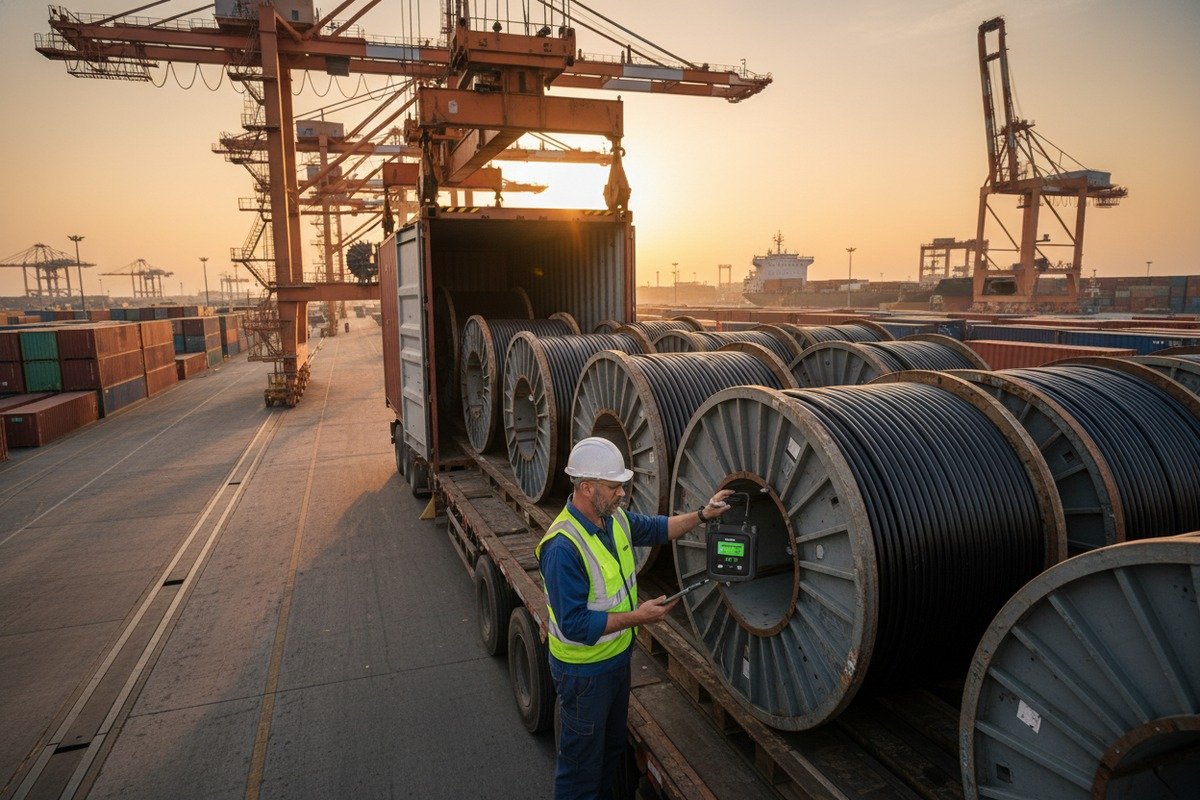
Every year, our logistics team reviews damage claims from overseas buyers, and crushed cable reels remain the single most frustrating issue we see repeated across ocean freight routes.
To protect solar PV cable reels from crushing damage when sourcing from China, buyers must specify steel reel construction, require detailed container loading plans with proper bracing, mandate pre-shipment packaging inspections, and use real-time shock-monitoring trackers throughout the shipping journey to ensure cables arrive intact.
This guide breaks down each protection step in detail steel reel construction 1. Whether you run a European EPC operation or distribute cables across multiple project sites, the sections below will give you a practical, proven checklist to follow before your next purchase order leaves the factory floor.
How can I ensure the wooden cable drums from my Chinese supplier are strong enough to withstand stacking in a container?
We have shipped tens of thousands of cable reels from our 230,000 m² facility, and the truth is, not all wooden drums are built equal — many buyers discover this only after opening a crushed container at their warehouse container loading plans 2.
To ensure wooden cable drums withstand stacking, require your Chinese supplier to use hardwood flanges with a minimum 18 mm thickness, cross-braced barrel construction, and provide a load-bearing certification proving each drum can support at least 2.5 times the weight of the heaviest reel stacked above it.
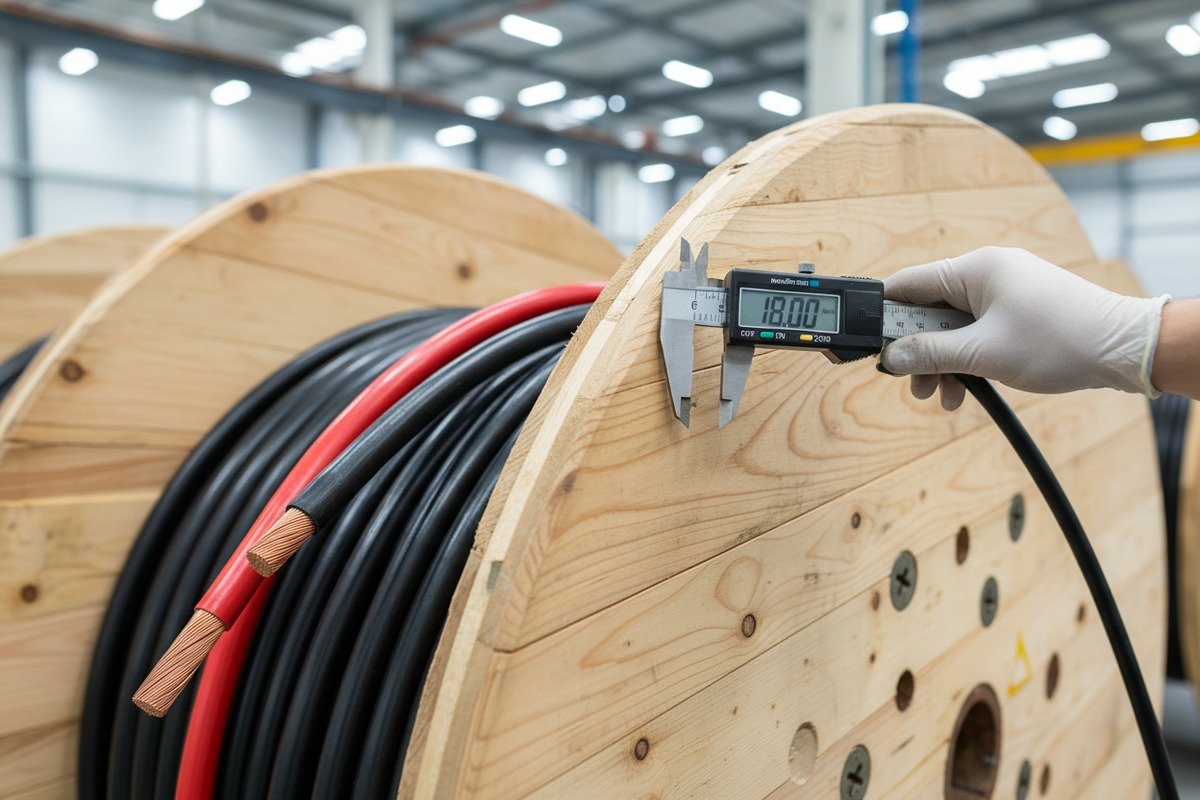
Why Wooden Drums Fail in the First Place
Most crushing incidents trace back to one root cause: the supplier used softwood or thin plywood to cut costs pre-shipment packaging inspections 3. A standard 40-foot container leaving Ningbo or Shanghai can hold multiple tiers of cable reels. The bottom tier bears the full weight of everything above it real-time shock-monitoring trackers 4. If flanges are only 12 mm thick or made from low-density pine, they crack under sustained pressure during a 30-day ocean voyage.
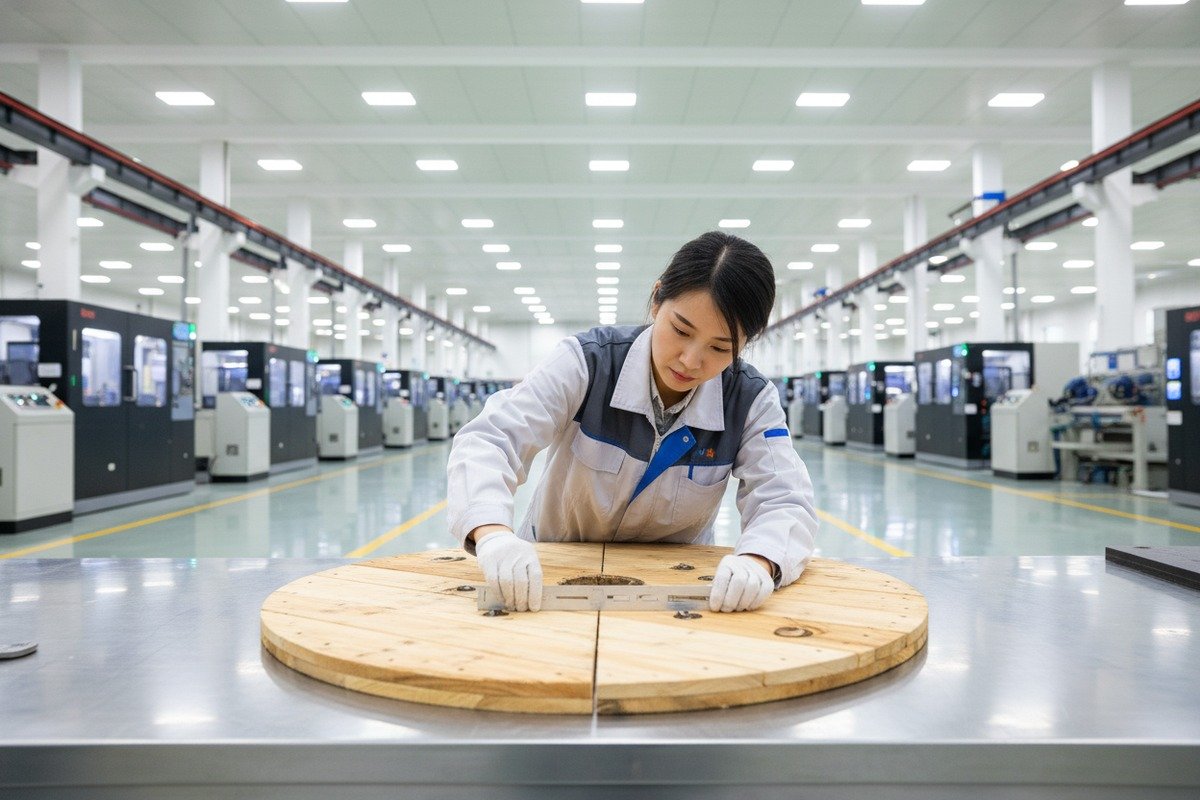
At our production lines, we test every drum batch before winding begins European EPC operation 5. We place a static load on the flanges that simulates a worst-case three-tier stack and hold it for 72 hours. Drums that flex more than 3 mm get rejected. This is a simple test any buyer can request.
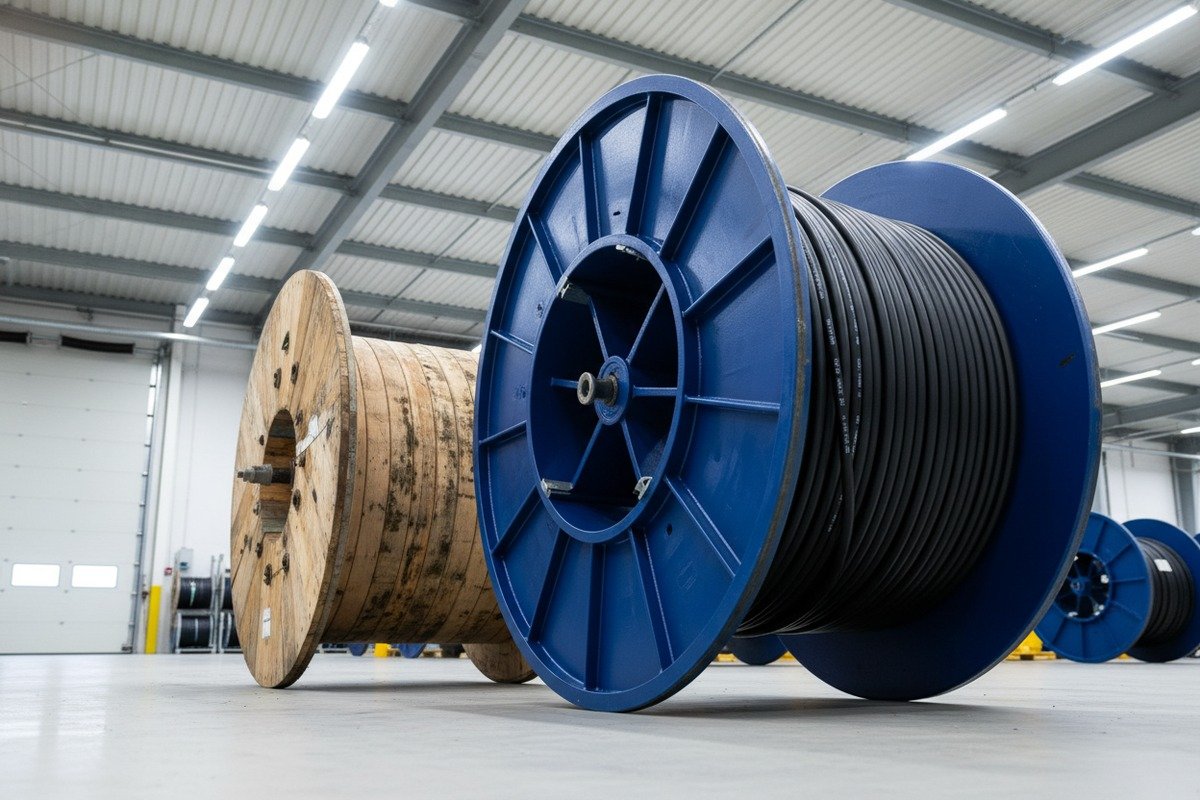
Wood vs. Steel: A Practical Comparison
Many buyers default to wooden drums because they are cheaper. But the total cost picture often tells a different story.
| Feature | Wooden Drum | Steel Drum |
|---|---|---|
| Unit cost | $8–$15 | $25–$50 |
| Crush resistance | Medium (depends on wood type) | High |
| Reusability | 1–2 uses | 10+ uses |
| Weight | Lighter | Heavier (adds freight cost) |
| Moisture sensitivity | High — swells and weakens | Low |
| Suitability for long-haul ocean freight | Acceptable if hardwood + braced | Preferred |
For buyers like Klaus who source H1Z2Z2-K or EN 50618 cables 6 for large European solar farms, the math favors steel reels on repeat orders. The upfront premium pays for itself after two or three shipment cycles through lower damage rates and reel reuse.
What to Specify in Your Purchase Order
Be explicit. Do not rely on "standard packaging" language. Instead, write these line items into your PO:
- Flange material: hardwood (birch, oak, or equivalent) with minimum 18 mm thickness.
- Barrel construction: cross-braced, not single-layer plywood.
- Load rating: certified to support ≥2.5× the maximum stacking weight.
- Moisture treatment: drums must be kiln-dried or treated to below 12% moisture content.
- Photo documentation: supplier must send photos of empty drums before winding.
If your supplier pushes back on any of these, that is a red flag. Reputable manufacturers — including our own facility — welcome these specs because they reduce disputes later.
Pre-Winding Inspection Checklist
Before cable is even wound onto a drum, inspect the empty reel. Look for warping on the flanges, cracks along the barrel, and loose nails or staples. A single weak point becomes a failure point under a 500 kg stack. Our quality team uses a simple go/no-go gauge for flange flatness: if you can slide a 2 mm feeler gauge under the flange rim on a flat surface, it fails.
What specific bracing and palletization methods should I require to prevent my PV cable reels from shifting and crushing?
In our experience exporting to Europe and the Americas, the cable reel itself can be perfectly strong, yet the shipment still arrives damaged because nothing stopped the reels from moving inside the container.
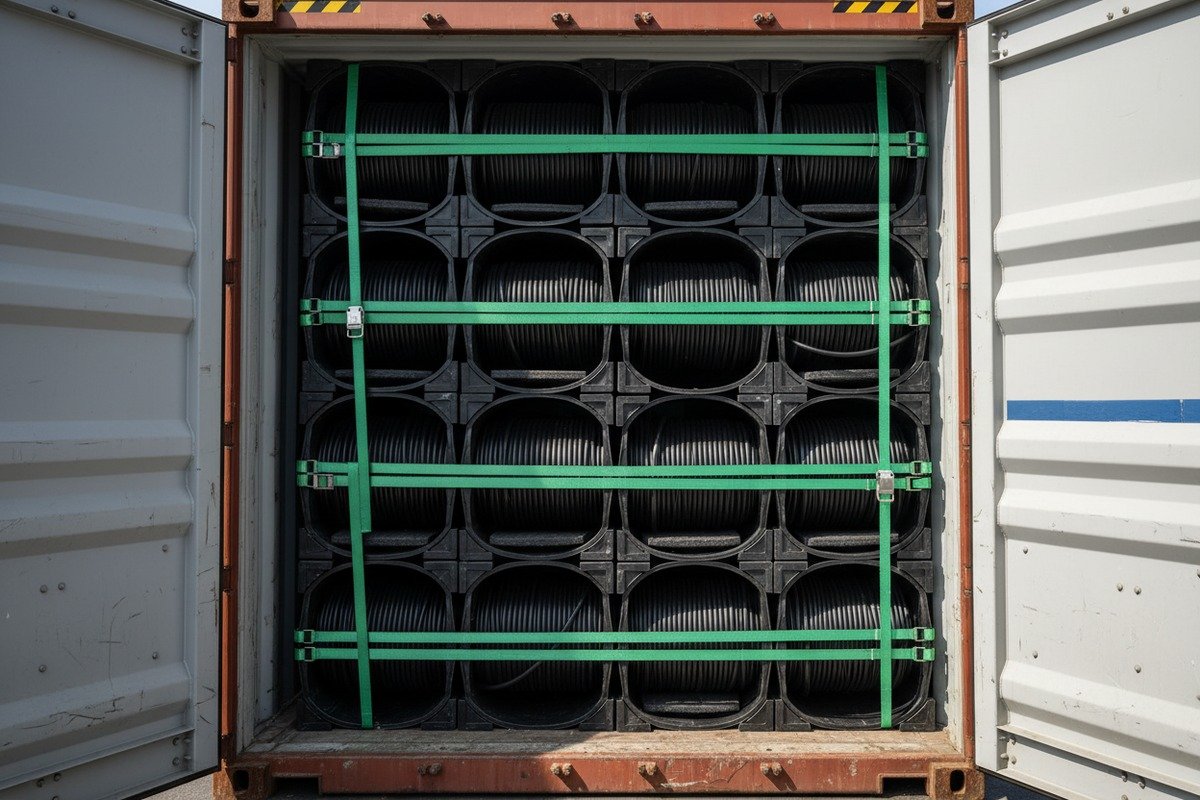
Require corner strapping with polyester bands, edge protectors on all reel flanges, anti-slip mats between stacked tiers, and a detailed container loading plan showing weight distribution, maximum two-tier stacking, and chocking blocks to prevent lateral rolling during rough seas.
The Physics of Container Movement
A 40-foot container on an ocean vessel experiences forces up to 1.8g laterally during storms. That means a 300 kg reel effectively becomes a 540 kg battering ram sliding sideways. Without bracing, it collides with adjacent reels, walls, or other cargo. The flanges crack, the cable layers deform, and insulation gets pinched.
The fix is mechanical: stop movement before it starts.
Strapping and Edge Protection
Strapping should go near the corners of the reel flanges, not across the center. Corner straps hold the reel against its pallet or container floor anchor points. Center straps just compress the cable layers without preventing lateral motion.
Use woven polyester straps 8 (minimum 32 mm width, 1,000 kg break strength) rather than thin polypropylene bands. Add rigid cardboard or plastic edge protectors at every point where a strap contacts a flange. Without protectors, straps cut into wood under tension and lose grip.
Container Loading Plan: What It Should Include
Every shipment should come with a loading diagram. Here is what to demand:
| Element | Specification |
|---|---|
| Maximum stack height | 2 tiers (unless steel reels with rated stacking lugs) |
| Orientation | Flanges vertical (axle horizontal) to reduce stress on cable layers |
| Chocking blocks | Hardwood wedges nailed to container floor on both sides of each reel |
| Anti-slip mats | Rubber or textured polymer sheets between tiers and under bottom tier |
| Void fill | Airbags or foam blocks in gaps larger than 150 mm between reels |
| Weight limit per tier | Bottom tier: max 70% of container floor load rating |
| Distance from container doors | Heaviest reels nearest to container walls, not doors |
We send this diagram to our freight forwarder and the container loading crew. Both parties sign off before the doors close. This single step has cut our in-transit damage claims by over 60% in the past three years.
Palletization for Smaller Reels
For reels under 50 kg, palletization is more practical than individual chocking. Group four to six reels on a single Euro pallet, strap them together as a unit, and then strap the pallet to the container floor. Wrap the group in stretch film for additional hold. This method also speeds up forklift unloading at the destination, which matters if your site crews are working against grid-connection deadlines.
Vertical vs. Horizontal Stacking
There is an ongoing debate here. Vertical stacking (flanges upright) reduces axial pressure on the cable layers. Horizontal stacking (flanges flat) uses container space more efficiently. Our engineering team recommends vertical for any reel over 100 kg. The cable winding stays intact, the reel bears load through its strongest axis (the flanges), and the risk of the reel rolling is eliminated.
For lighter reels, horizontal stacking is acceptable if anti-roll chocks and tier separators are used.
How do I verify the quality of the packaging materials before my solar cables are shipped to avoid on-site handling delays?
When we calibrate packaging for a new export route, we always start with the end user's unloading equipment. A reel that looks fine in the factory can become a nightmare if its dimensions do not match the buyer's forklift or cable-laying drum stand.
Verify packaging quality by requiring your supplier to submit material certificates for drums and strapping, conducting a third-party pre-shipment inspection at the factory, and confirming reel dimensions match your on-site handling equipment before the container is sealed and dispatched.
Why Pre-Shipment Inspection Is Non-Negotiable
Data from importers across Europe and the Americas consistently shows that 15–30% of cable shipments from China arrive with some form of packaging deficiency when no pre-shipment audit is performed. The deficiencies range from cracked flanges to missing edge protectors to reels wound too loosely. Each one causes delays on site.
A pre-shipment inspection costs between $200 and $500 depending on the batch size and inspector location. Compare that to the cost of a single day of construction delay on a solar farm — easily $5,000 to $20,000 in crew idle time and penalty clauses.
What the Inspector Should Check
Here is a practical checklist we share with buyers who use third-party inspection firms like SGS, Bureau Veritas, or local QC agencies in Jiangsu and Zhejiang provinces:
| Inspection Item | Pass Criteria |
|---|---|
| Flange thickness | ≥18 mm hardwood or steel gauge per PO |
| Barrel integrity | No cracks, splits, or loose fasteners |
| Cable winding tension | Uniform layers with no crossovers or gaps >5 mm |
| Strap material | Woven polyester, ≥32 mm, with break strength certificate |
| Edge protectors | Present at all strap contact points |
| Reel dimensions | Core diameter, flange diameter, and width match buyer's equipment specs |
| Moisture content (wood) | ≤12% (measured with pin meter) |
| Labeling | Cable type, length, lot number, weight — all legible and weatherproof |
| Foil/wrap | Moisture barrier film intact, no tears |
Matching Reel Specs to Your Equipment
This is the step most buyers skip, and it causes the most frustration on site. Automated cable-laying machines and motorized drum stands accept specific core diameters and flange widths. If your Chinese supplier winds cable onto a reel with a 200 mm core but your machine requires 250 mm, you cannot mount it. You are now cutting cable off the reel by hand and feeding it manually — costing hours of labor per reel.
Send your equipment spec sheet to the supplier before the first production run. At our factory, we maintain a database of common drum-stand dimensions used by European and American EPC contractors. This lets us match the reel to the machine before winding begins.
Material Certificates to Request
Ask for:
- Wood species certificate with density and moisture data.
- Strap break-strength test report from the strap manufacturer.
- Steel reel mill certificate (if using steel) showing grade and wall thickness.
- Foil wrap specification sheet confirming UV and moisture resistance.
These documents take minutes to produce but save weeks of dispute resolution if something goes wrong.
The IoT Monitoring Option
For high-value shipments, consider attaching an IoT shock and tilt tracker to one or two reels inside the container. These battery-powered devices record g-force impacts, temperature, humidity, and tilt angle throughout the journey. If a port crane drops your container or a truck driver takes a sharp turn, you have timestamped evidence. This data is increasingly accepted by insurance underwriters and freight carriers for damage claims. The cost per tracker is typically $50–$150, a fraction of the cable value at stake.
What steps can I take to confirm that the cable reels will arrive intact and ready for my automated laying machines?
Our engineers have worked directly with European EPC teams who run Plumett and Bagela cable-laying machines. We know from firsthand experience that a reel that cannot mount cleanly onto the drum stand halts an entire installation crew.
Confirm reel compatibility by sharing your machine's drum-stand specifications with the supplier before production, requesting a trial reel for fitment testing, requiring crane-only unloading protocols at every handling point, and tracking the container with shock sensors throughout transit.
Start With the Machine, Not the Cable
Most procurement teams focus on cable specifications — cross-section, voltage rating, insulation type — and treat the reel as an afterthought. But if the reel does not fit the machine, the cable specifications are irrelevant until someone manually re-spools everything. This can cost an entire day per reel on a large utility-scale project.
Before placing your order, send the supplier:
- Core (arbor) hole diameter of your drum stand.
- Maximum and minimum flange diameter the stand accepts.
- Maximum reel width the stand accepts.
- Maximum reel weight the stand's bearings support.
- Axle type: keyed, smooth, or flanged.
At our facility, we keep a library of the most common drum-stand configurations used in Germany, the Netherlands, Spain, and the United States. If your machine is not in our database, we ask for a simple sketch and adapt the reel tooling.
Trial Reel Program
For first-time buyers or new machine setups, we strongly recommend ordering a single trial reel before committing to the full batch. Wind it with a short length of cable (50–100 m), ship it by air freight, and test the fit on your machine. This $150–$300 investment eliminates the risk of discovering a mismatch across a 20-container order.
Crane-Only Unloading Protocol
Direct pushing of cable reels off trucks or out of containers is the most common cause of mechanical damage to cable insulation after the reel leaves the factory. The cable layers shift, the bottom layer gets pinched against the barrel, and insulation cracks form that may not be visible but will fail under voltage stress years later.
Specify in your logistics contract:
- All reels over 50 kg must be lifted by crane or forklift with a reel-lifting bar.
- No rolling of reels across uneven ground without a reel trailer.
- Slopes may only be used with a controlled winch descent, never gravity-fed.
- Unloading crew must photograph each reel upon removal from the container.
End-to-End Transit Protection Summary
Here is a consolidated view of the protection chain from factory to site:
| Stage | Key Action | Responsible Party |
|---|---|---|
| Factory — before winding | Inspect empty drums; verify reel dimensions vs. machine specs | Supplier + buyer QC agent |
| Factory — after winding | Apply strapping, edge protectors, moisture wrap; attach IoT tracker | Supplier |
| Container loading | Follow signed loading plan; use chocks, anti-slip mats, void fill | Supplier + freight forwarder |
| Ocean transit | Monitor shock/tilt/humidity via IoT dashboard | Buyer (remote) |
| Port unloading | Crane-only; photograph each reel; note any visible damage immediately | Port agent / buyer representative |
| Inland transport | Secure reels on flatbed with ratchet straps; avoid stacking on truck | Trucking company |
| Site arrival | Fitment test on drum stand; visual insulation check before laying | Installation crew |
Incoterms and Risk Transfer
Your choice of Incoterms 9 determines who bears the financial risk at each stage. For maximum control, negotiate DAP (Delivered at Place) or DDP (Delivered Duty Paid). Under FOB, risk transfers to you the moment cargo crosses the ship's rail in China — meaning any port or ocean damage is your problem. Under DAP or DDP, the supplier retains responsibility until the reels reach your named destination. This gives them a direct financial incentive to pack and brace correctly.
Many German EPC buyers we work with prefer DDP to a European warehouse, which also simplifies VAT and customs handling. We coordinate this through our logistics partners who specialize in solar component freight on China-Europe routes.
What Happens When Things Go Wrong
Even with every precaution, damage can occur. The key is documentation speed. Within 24 hours of delivery, photograph all reels, note serial numbers, and log any dents, cracks, or deformations. Cross-reference with IoT tracker data to identify when and where the damage occurred. File your claim with the carrier and insurer simultaneously. Having the loading plan, inspection report, and tracker data in hand cuts claim resolution time from months to weeks.
Conclusion
Protecting solar PV cable 10 reels starts with clear specifications, continues through disciplined inspection, and depends on proper bracing, monitoring, and machine-matched reel design from factory to field.
Footnotes
1. Provides a comprehensive overview of steel cable reels and their construction from an authoritative source. ↩︎
2. Offers comprehensive best practices for securely loading and distributing cargo in shipping containers. ↩︎
3. Explains the purpose, process, and benefits of pre-shipment inspections for quality control. ↩︎
4. Discusses the role of IoT devices, including sensors, in real-time logistics tracking and condition monitoring. ↩︎
5. Defines Engineering, Procurement, and Construction (EPC) in the context of solar energy projects. ↩︎
6. Provides the official scope and requirements of the European standard for photovoltaic cables. ↩︎
7. Explains the characteristics and uses of hardwood, known for its density and strength. ↩︎
8. Details the strength, flexibility, and impact resistance of woven polyester strapping. ↩︎
9. Direct link to the official Incoterms® 2020 rules page on the International Chamber of Commerce (ICC) website, the authoritative source. ↩︎
10. Explains the key IEC standards and requirements for photovoltaic cables. ↩︎