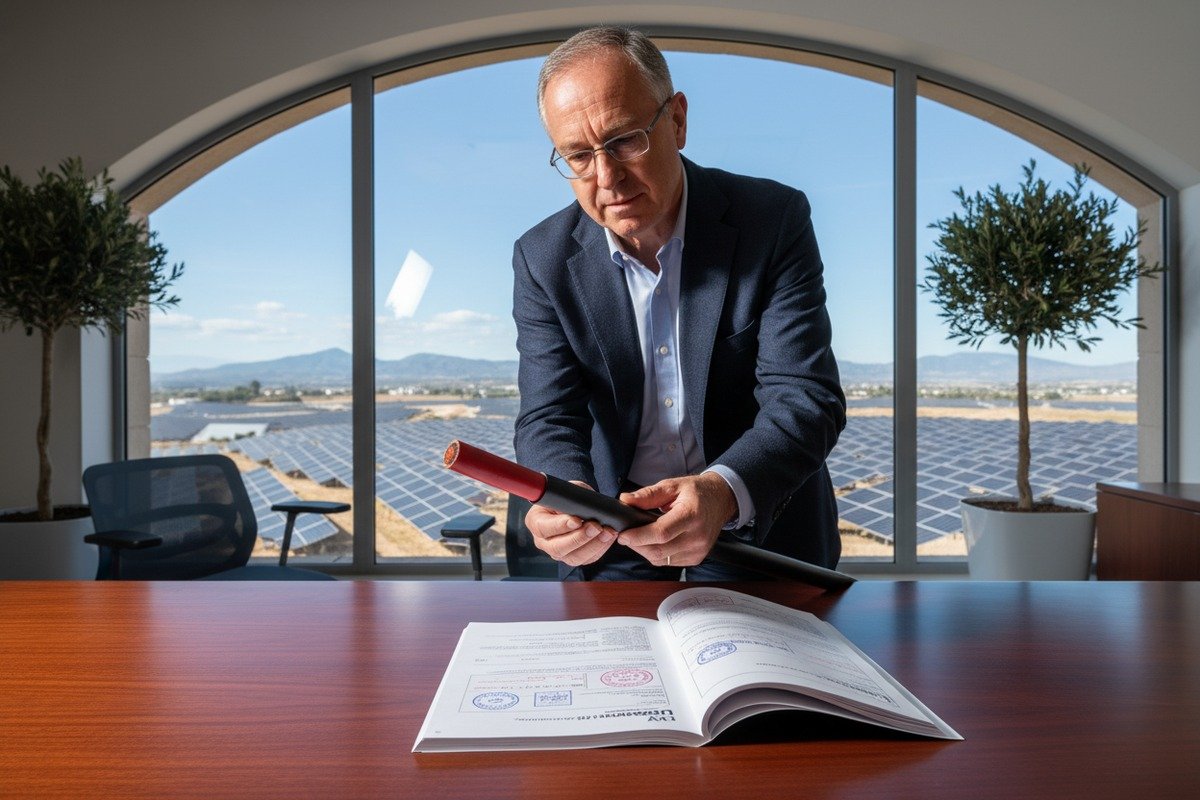

Every week, our sales team fields calls from frustrated procurement managers who just lost months waiting on a supplier that couldn't deliver BEAD-fueled demand 1. ADSS Optical Cable 2 The pain is real—BEAD-fueled demand has pushed US Tier-1 factories to 30–50 week lead times, and smaller utilities get bumped when big telecoms cut in line. One wrong supplier choice means idle construction crews, blown budgets, and projects that miss their funding deadlines.
To evaluate an ADSS optical cable supplier for bulk procurement, verify their actual production capacity through factory audits, request certified technical documentation matching your span and tension requirements, inspect raw material quality—especially aramid yarn—and confirm logistics capabilities including packaging durability and realistic delivery timelines.
This guide breaks down each evaluation step with practical checklists, comparison tables, and insider tips drawn from 30 years on the production floor Dupont Kevlar or Teijin Twaron 3. Let's walk through it section by section.
How can I verify if a factory has the actual production capacity to handle my bulk ADSS order?
Running our 230,000 m² production facility has shown us one painful truth: many buyers only discover a supplier's capacity problem after signing the contract. Deposits get locked up, timelines slip, and the project suffers.
Request a factory audit—either in person or via third-party inspection—and cross-check the supplier's claimed monthly output against actual production line counts, equipment age, raw material inventory, and current order backlog before committing to any bulk purchase.
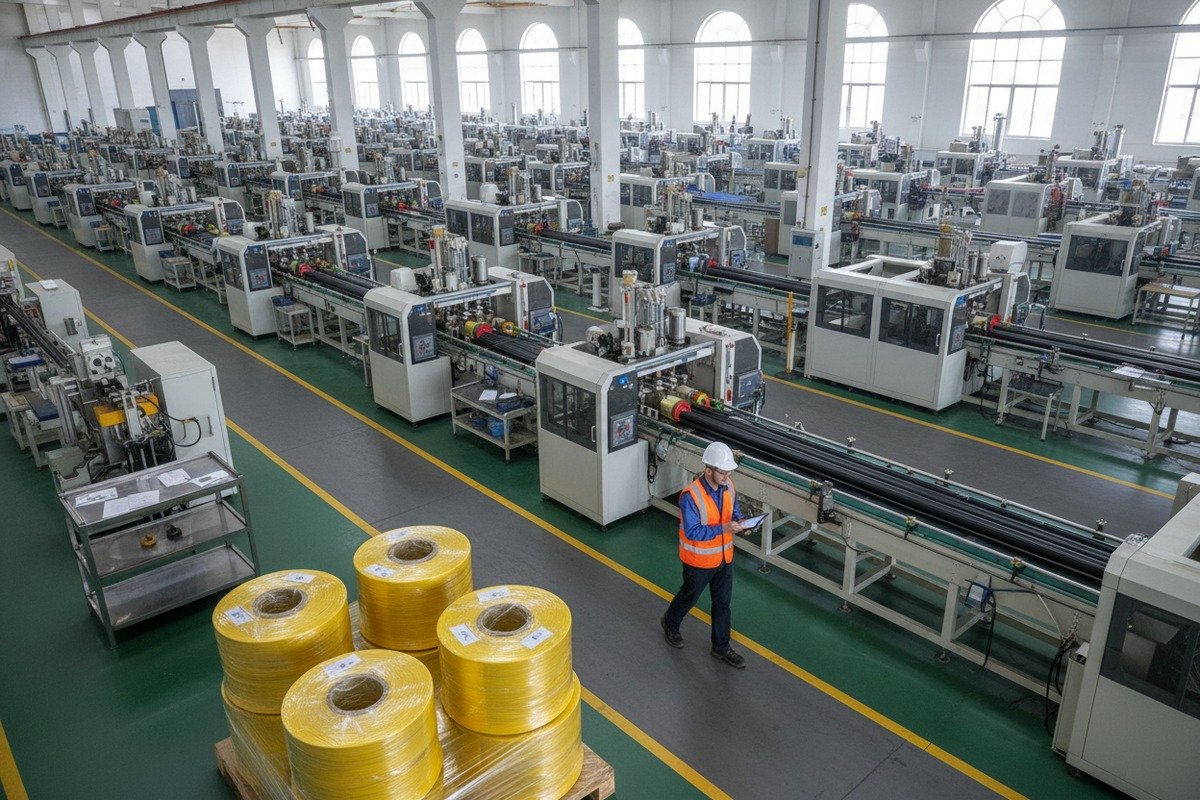
Why Claimed Capacity Often Doesn't Match Reality
A supplier might advertise "1,000 km/month capacity" on their website. But capacity on paper and capacity available for your order are two different things. If 80% of their lines are running domestic orders, your 200 km export order sits in a queue. When we plan production schedules at our facility, export orders receive dedicated line allocation precisely to avoid this conflict. You should ask any potential supplier: "What percentage of your current capacity is committed, and what is the realistic start date for my order?"
The Factory Audit Checklist
You don't need to be a cable engineer to run a basic capacity check. Here's what to look for:
| Audit Item | What to Check | Red Flag |
|---|---|---|
| Production lines | Count active ADSS lines vs. total lines | More than 50% idle or repurposed |
| Equipment age | Year of manufacture on stranding and jacketing machines | Equipment older than 15 years with no upgrades |
| Raw material stock | Aramid yarn 4, PE compound, and fiber inventory on-site | Near-zero stock; relies on just-in-time purchasing |
| Current backlog | Ask for a redacted production schedule | Fully booked 8+ weeks with no flexibility |
| Workforce | Number of skilled operators per shift | Single-shift operation for a "high capacity" claim |
| Quality lab | In-house tensile testing, OTDR, and environmental chambers | No lab or outsourced testing only |
Third-Party Verification Options
If you can't visit the factory, hire a third-party inspection firm. Companies like SGS, Bureau Veritas, or TÜV 5 can conduct a pre-production audit in China within 5–7 business days. The cost typically runs $300–$800, which is a small price compared to the risk of a failed bulk order. You can also request live video tours—our team does this regularly for North American and European buyers who need visual confirmation before placing orders.
Compare Supplier Types
Understanding where your supplier sits in the supply chain matters enormously for capacity evaluation.
| Supplier Type | Typical Capacity | Lead Time | Best For |
|---|---|---|---|
| US Tier-1 Manufacturer 6 (AFL, Corning) | Very high, but backlogged | 30–50 weeks | Large carriers with long planning horizons |
| US Distributor (stocked) | Limited to common counts | 6–8 weeks | Urgent small orders (6–288 fiber) |
| Chinese Export Factory (Lonsoncable, etc.) | 500–1,000+ km/month | 2–4 weeks | Bulk custom orders >20 km |
| Trading Company | No own capacity | Variable | Avoid for bulk procurement |
The key takeaway: always verify. Never trust a brochure. A $500 audit today can save you $50,000 in project delays tomorrow.
What technical documentation should I request to ensure the ADSS cable meets my specific span and tension requirements?
Our engineering team has seen orders go sideways because a buyer specified "200-meter span ADSS" without defining the ice load, wind speed, or installation tension. The cable arrived, got strung up, and sagged beyond acceptable limits within the first winter.
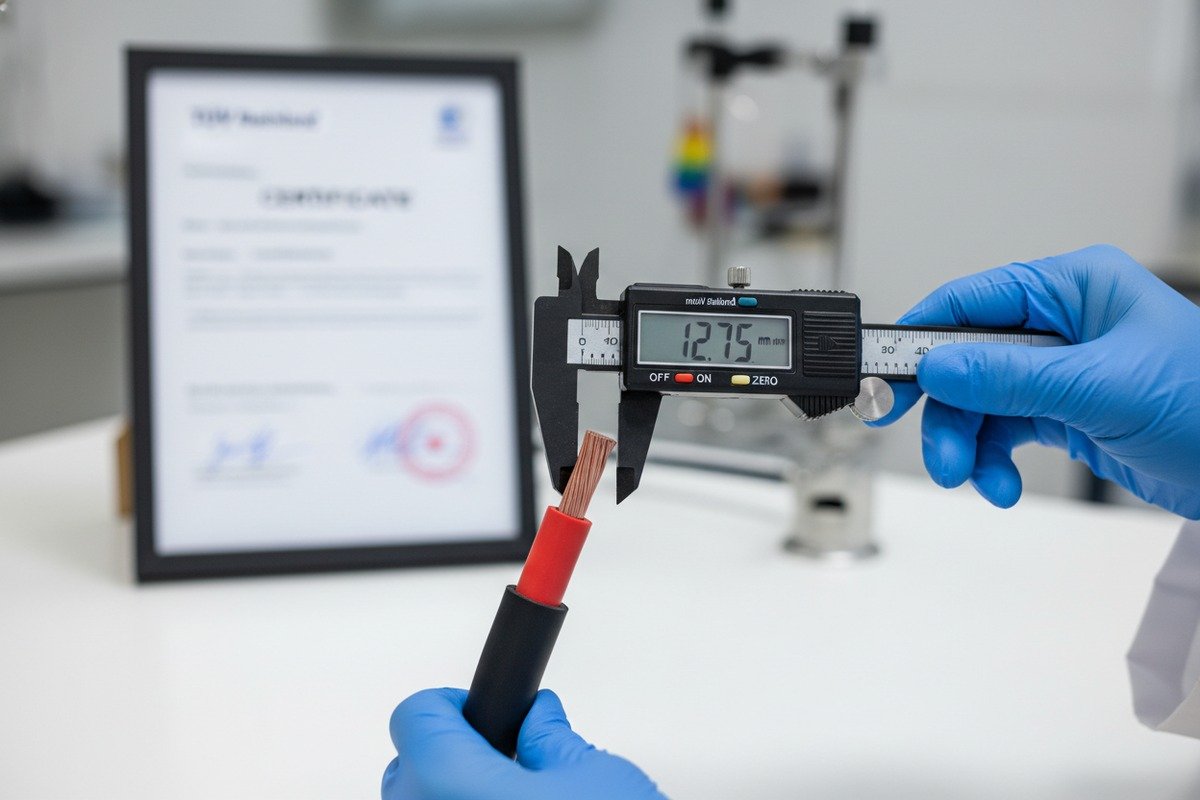
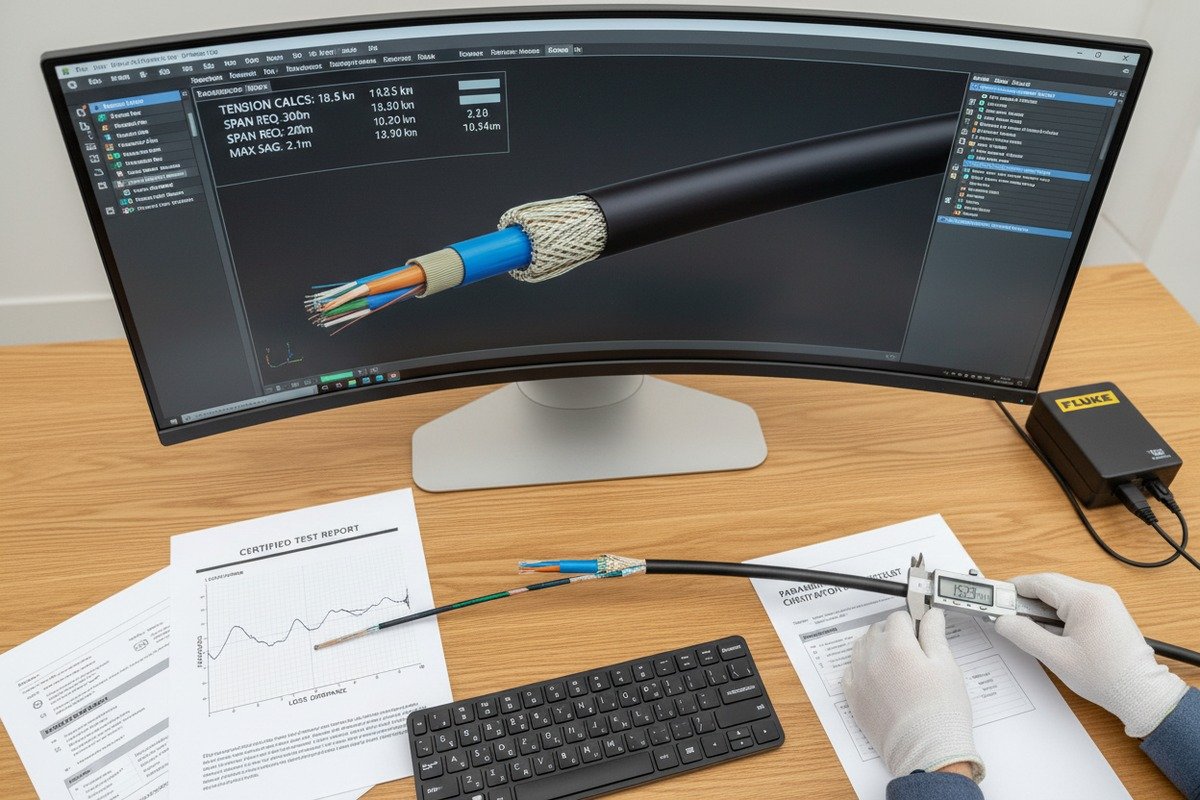
Request the cable's cross-section diagram, mechanical calculation report (sag-tension tables for your specific span), type test reports per IEC or Telecordia GR-20, material certificates for aramid and fiber, and ITU-T G.652D/G.657A compliance documentation before approving any ADSS cable for your project.
The Core Documents You Need
Not all technical documents carry equal weight. Here's a priority list:
- Cable Cross-Section Diagram — Shows the exact layer structure: fiber count, loose tube arrangement, aramid yarn volume, water-blocking tape, and PE jacket thickness. If the supplier can't produce this, walk away.
- Sag-Tension Calculation Report — This must be customized to your span length, local wind speed, ice loading zone, and installation temperature. A generic datasheet is not enough.
- Type Test Report — Covers tensile strength, crush resistance, temperature cycling (−40°C to +70°C), UV aging, and tracking resistance (for high-voltage crossings). Must reference IEC 60794 8 or Telecordia GR-20.
- Fiber Specification Sheet — Confirms the fiber type (G.652D for standard single-mode, G.657A for bend-insensitive), attenuation values, and PMD. ITU-T G.652D/G.657A compliance 9
- Factory OTDR Test Report — Every reel should come with an individual OTDR trace showing end-to-end attenuation and splice/connector losses.
Match the Cable to Your Span
ADSS cables are not one-size-fits-all. The span dictates the mechanical design. Here is a simplified guide:
| Span Category | Typical Span Length | Key Design Factor | Recommended Rated Tensile Strength (RTS) |
|---|---|---|---|
| Short span | 40–200 m | Low wind/ice load; urban areas | 4–8 kN |
| Medium span | 200–500 m | Moderate exposure; distribution lines | 8–16 kN |
| Long span | 500–1,000 m | High wind/ice; transmission corridors | 16–30 kN |
| Extra-long span | 1,000–1,800 m | River/valley crossings; extreme terrain | 30–60+ kN |
When we prepare a quotation, we ask buyers for at least these parameters: span length, ruling span, maximum wind speed, ice thickness, installation temperature range, and the voltage of adjacent power lines (to determine tracking-resistant sheath needs). Without this data, any cable recommendation is just guesswork.
Why Generic Datasheets Fail
A common mistake is accepting a supplier's standard PDF datasheet as proof of suitability. That datasheet might show performance at a 300 m span, but your project requires 700 m. The aramid yarn quantity, the maximum allowable tension, and the sag behavior all change dramatically. Insist on project-specific mechanical calculations. A competent manufacturer will run these calculations using software like PLS-CADD or equivalent tools and provide you with a signed report.
Certifications That Actually Matter
For the US market, Telecordia GR-20 10 compliance is the gold standard for outside plant cables. For international projects, look for IEC 60794-1-2 and IEC 60794-4 type test reports. UL listing adds another layer of credibility. If a supplier claims compliance but cannot produce the actual test report from an accredited lab—not just a self-declaration—treat that as a serious red flag.
How do I identify if a supplier is using high-quality aramid yarn instead of cutting corners on my ADSS cable?
During production audits at our facility, visiting buyers often head straight to the raw material warehouse. They want to see the aramid yarn spools with their own eyes. That instinct is correct—aramid yarn is the single most expensive component in an ADSS cable, and it's the first place a dishonest manufacturer will cut costs.
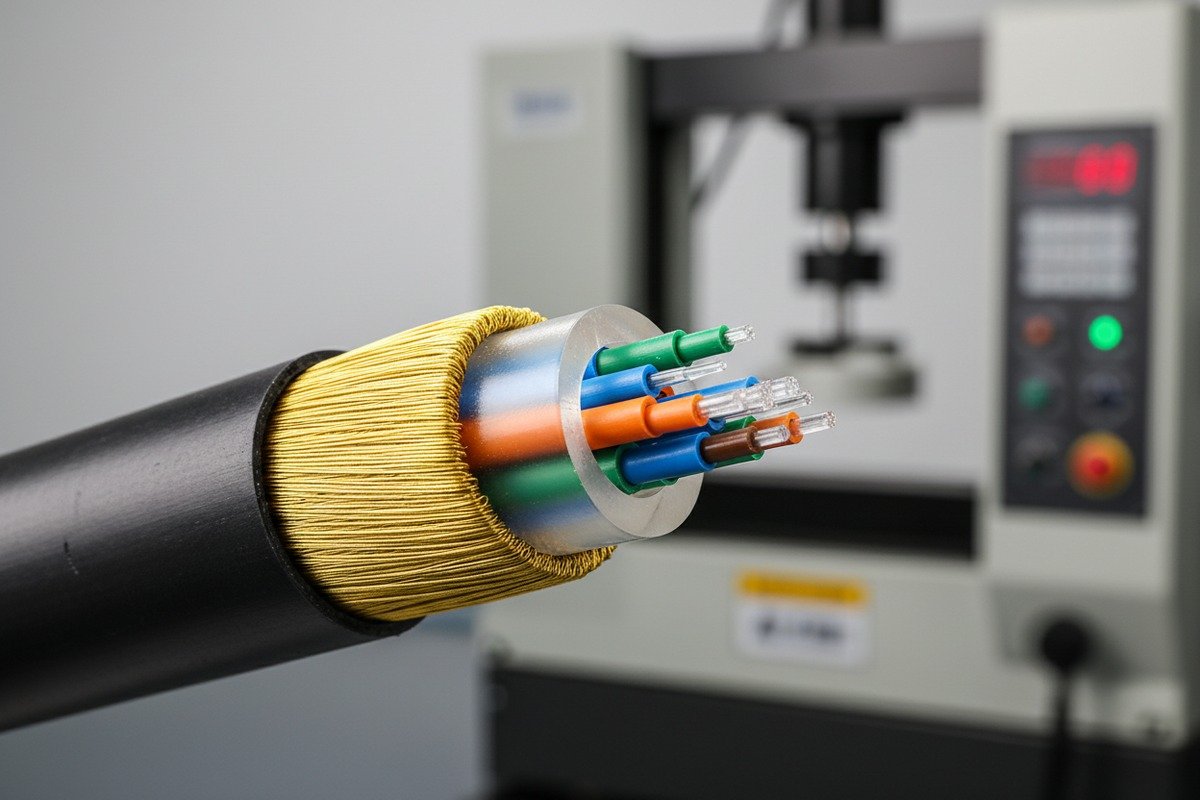
Inspect the aramid yarn brand labels on-site (Dupont Kevlar or Teijin Twaron are industry standards), request the supplier's incoming material inspection records, and commission a third-party tensile test on a cable sample to confirm the rated tensile strength matches the specification before approving mass production.
Why Aramid Yarn Quality Is Non-Negotiable
Aramid yarn is what makes ADSS cable self-supporting. It carries the entire mechanical load—wind, ice, cable weight, and installation tension. If a supplier substitutes lower-grade yarn, reduces the yarn count, or blends in cheaper fillers like fiberglass roving, the cable's tensile strength drops. On a 500 m span exposed to winter ice loading, that shortcut can lead to cable failure, fiber breakage, and a complete network outage.
How Corner-Cutting Happens
There are several common methods unscrupulous suppliers use:
- Brand substitution: Using generic or recycled aramid instead of Kevlar or Twaron. The yarn looks similar but has lower tensile modulus and worse creep performance over 30 years.
- Reduced yarn count: The specification calls for 24 strands of aramid, but only 18 are actually stranded into the cable. This is nearly impossible to detect without destructive testing.
- Blending with fiberglass: Mixing cheaper FRP (Fiber Reinforced Plastic) rods or glass yarn with aramid to maintain weight while reducing cost. The cable feels right but fails under sustained load.
- Thinner PE jacket: Reducing the outer sheath thickness from 2.0 mm to 1.4 mm saves material and speeds up production, but degrades UV resistance and tracking performance.
Your Verification Toolkit
Here's what a serious buyer should do:
- Demand brand-name material certificates: Every spool of Kevlar or Twaron comes with a lot number and certificate of conformity from Dupont or Teijin. Ask to see these documents. Photograph the spool labels during a factory visit.
- Order a pre-production sample: Before mass production begins, request 100–200 meters of sample cable from the actual production run (not a showroom sample). Send it to an independent testing lab.
- Destructive tensile test: Have the lab pull-test the cable to failure. Compare the actual breaking strength against the rated tensile strength (RTS) on the specification sheet. The actual value should be at least 95% of RTS.
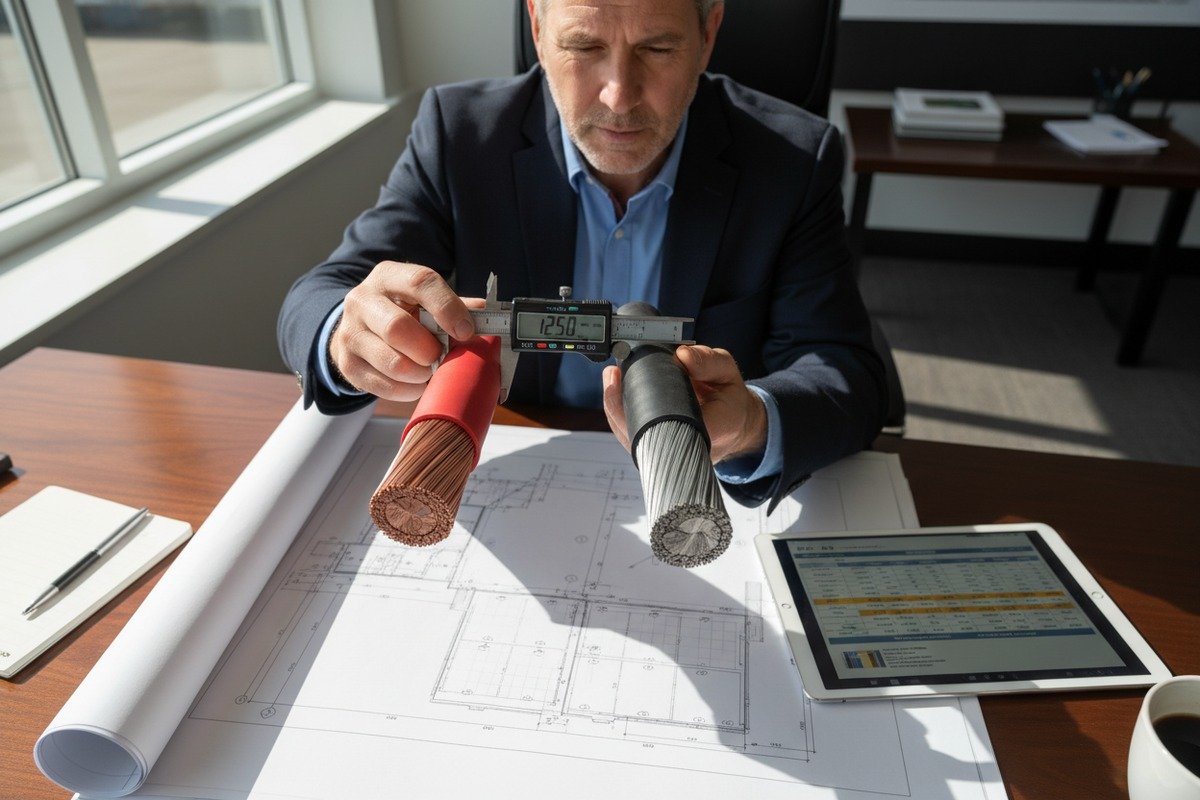
- Cross-section inspection: Cut the cable and count the aramid yarn bundles. Compare against the cross-section diagram you were provided.
- Check the cable weight: An ADSS cable with full aramid loading has a predictable weight per kilometer. If the cable is suspiciously light, investigate further.
The Cost of Cutting Corners
A legitimate ADSS cable with proper aramid yarn for a 400 m span might cost $1,200–$1,800 per kilometer depending on fiber count. If a supplier offers the same spec at $700/km, something is wrong. Our pricing reflects genuine Kevlar, full-count stranding, and UL-certified PE compound. We're transparent about material sources because we know that a cable failure costs our buyer far more than the savings from cheap materials. Always evaluate price in the context of the bill of materials, not in isolation.
What steps can I take to guarantee my bulk shipment arrives on time and with durable packaging for sea freight?
We learned this lesson the hard way years ago when a 40-foot container of cable arrived in Southeast Asia with two collapsed wooden reels. The cable itself was perfect—but the packaging failure turned good product into scrap. Since then, our logistics team has redesigned our reel specifications and container loading procedures from the ground up.
Confirm the supplier's reel construction standards (iron-wooden or steel reels for sea freight), require container loading photos and fumigation certificates, lock in a production and shipping timeline with penalty clauses, and use a freight forwarder experienced in heavy cable shipments to avoid delays and damage.
Packaging That Survives the Ocean
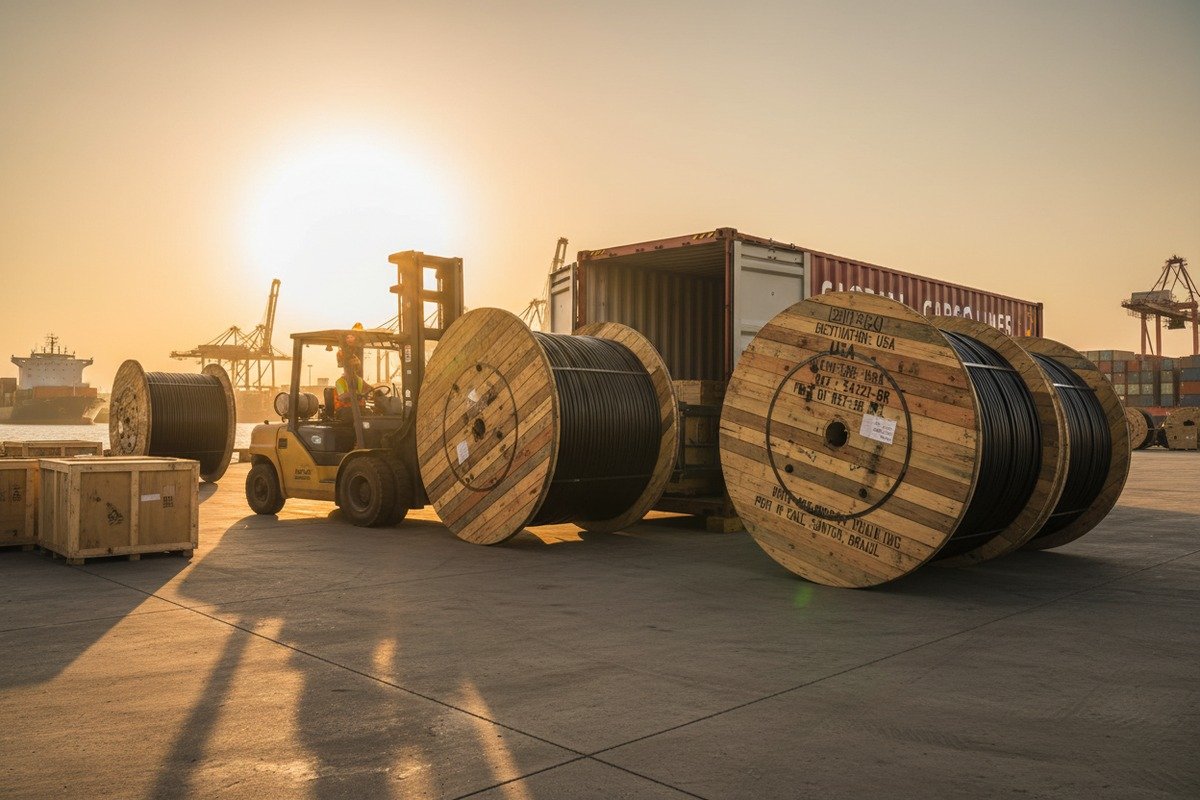
ADSS cable travels on reels, and those reels endure weeks of vibration, humidity, and stacking pressure inside a shipping container. The wrong reel choice is catastrophic.
| Reel Type | Material | Best For | Sea Freight Suitability |
|---|---|---|---|
| Wooden reel (light duty) | Pine/plywood | Short domestic trucking | Poor — prone to collapse under stacking |
| Iron-wooden reel | Steel flanges + wood barrel | Standard export shipments | Good — handles stacking and humidity |
| Full steel reel | Welded steel | Heavy cables, repeat use | Excellent — highest cost, reusable |
| Plywood drum (small) | Plywood | Short lengths < 2 km | Acceptable for LCL shipments |
For bulk ADSS shipments of 20 km or more, we strongly recommend iron-wooden reels with a minimum flange thickness of 20 mm and steel bolt reinforcement. Each reel should be wrapped in stretch film and secured with steel banding inside the container. We also provide ISPM-15 fumigation treatment on all wooden packaging, which is mandatory for import into the US, EU, and Australia.
Locking Down Your Timeline
Delivery delays in 2026 are not just inconvenient—they're expensive. Construction crews sitting idle cost thousands of dollars per day. Here's how to protect your timeline:
- Get a written production schedule: The supplier should commit to a start date, a completion date, and a shipping date. This should be part of the purchase contract.
- Include a penalty clause: A 1–2% penalty per week of delay (capped at 10%) is standard in international cable procurement. It focuses the supplier's attention.
- Request weekly production updates: Photos of stranding, jacketing, and testing in progress. Our team sends these automatically via email or WhatsApp.
- Book freight early: Container shortages still affect major routes. Book your container at least 2 weeks before the estimated production completion date.
- Use a cable-experienced forwarder: Not all freight forwarders understand heavy reel loading. An experienced one will ensure proper weight distribution and bracing inside the container.
Pre-Shipment Inspection
Before the container doors close, conduct a pre-shipment inspection (PSI). This is your last chance to catch problems. Check the following: reel condition, cable length markings match packing list, OTDR test reports are included, export packaging meets ISPM-15, and the container is clean and dry. If you can't be there in person, a third-party inspector can handle this for $200–$400 per container.
Realistic Lead Times for Export Orders
From our production facility, a typical bulk ADSS order follows this timeline: order confirmation and material procurement (3–5 days), production (7–12 days depending on volume), testing and packaging (2–3 days), and inland transport to port (1–2 days). Total factory-to-port is 15–20 days. Ocean freight to the US West Coast adds 18–25 days, and East Coast via Panama adds 28–35 days. Planning for a total of 6–8 weeks from order to delivery is realistic for most bulk ADSS procurement from China.
Conclusion
Evaluating an ADSS cable supplier for bulk procurement comes down to four pillars: verified production capacity, project-specific technical documentation, transparent material quality, and reliable logistics with durable packaging.
Footnotes
1. Official government source detailing the Broadband Equity, Access, and Deployment (BEAD) Program. ↩︎
2. Replaced with a working Wikipedia page for All-Dielectric Self-Supporting cable. ↩︎
3. Official DuPont page for Kevlar, a leading brand of aramid fiber. ↩︎
4. Explains what aramid fibers are, their properties, and common uses. ↩︎
5. Details the supplier audit and certification services offered by SGS, a leading inspection firm. ↩︎
6. Showcases optical fiber and cable products from a major US manufacturer, Corning. ↩︎
7. Explains the concept, purpose, and types of factory audits in manufacturing. ↩︎
8. Provides an overview of the IEC 60794 standard for optical fiber cables. ↩︎
9. Official ITU-T Recommendation for characteristics of a single-mode optical fiber and cable. ↩︎
10. Describes the generic requirements for optical fiber and cable in outside plant environments. ↩︎