Every week, our export team fields urgent questions from European buyers worried about one thing: carbon border costs on their next cable shipment EU MRV standards 1. EU CBAM compliance 2
To ensure EU CBAM compliance when sourcing solar PV cables from China, importers should proactively collect embedded emissions data from their supplier, verify it against EU MRV standards, monitor the expected CBAM scope expansion to downstream solar products, and establish quarterly documentation workflows—even before cables are formally covered by the regulation.
The regulatory landscape is shifting fast. While finished solar cables are not yet within CBAM's formal scope, the European Solar Manufacturing Council is pushing hard to include downstream solar products Scope 1 direct emissions 3. Preparing now is not optional—it is a competitive advantage. Let us walk through each critical step.
What specific carbon emission data must I request from my Chinese solar cable supplier to satisfy EU reporting?
Many of our German and Dutch EPC clients have started asking for data points that, frankly, most cable factories have never been asked to produce before Scope 2 indirect emissions 4.
You must request Scope 1 direct emissions (fuel combustion, process heat), Scope 2 indirect emissions (grid electricity carbon intensity), raw material origin data for copper and XLPO insulation, and per-unit embedded CO₂ figures expressed in tonnes of CO₂ equivalent per tonne of finished cable product.
Why This Data Matters Now
Even though finished solar PV cables—like our H1Z2Z2-K and EN 50618 lines—are not currently listed under the six CBAM product categories, the raw materials inside them are ISO 14067 certification 5. Copper conductors, aluminium sheathing, and steel armouring all fall under CBAM-covered material groups. The EU Commission's autumn 2026 review could bring downstream solar products into scope. If that happens, you need data already in hand.
Breaking Down the Data Categories
Here is exactly what to request from your cable supplier:
| Data Category | What It Covers | Why CBAM Requires It |
|---|---|---|
| Scope 1 Emissions | Fuel burned on-site (natural gas, diesel for extrusion lines, curing ovens) | Direct manufacturing emissions are the primary CBAM metric |
| Scope 2 Emissions | Electricity purchased from the grid (coal vs. renewables mix) | China's grid is still ~60% coal-powered; this is often the largest emission source |
| Raw Material Origin | Country and plant where copper rod, XLPO compound, and aluminium are produced | Embedded emissions in upstream materials carry through to the final product |
| Transport Emissions | Inland logistics from raw material source to cable factory | May be required in future CBAM phases |
| Per-Unit CO₂e | Tonnes of CO₂ equivalent per tonne of finished cable | The figure you will actually report in your CBAM declaration |
How to Frame the Request
We have found that the best approach is to send a formal data request template—aligned with the EU's Implementing Regulation format—directly to the supplier's quality or environmental compliance department. Do not just ask for "carbon data." Be specific. Ask for the fuel consumption logs for the extrusion and cross-linking lines. Ask for the electricity bills showing the grid source. Ask for the material certificates from the copper rod supplier.
At our Hainan facility, we began compiling this data proactively in early 2025 because several long-term European partners flagged it during contract renewals. Not every Chinese manufacturer has done this. If your supplier cannot produce Scope 1 and Scope 2 breakdowns, that is a red flag—not necessarily about their product quality, but about their readiness for regulatory change.
Default Values vs. Actual Data
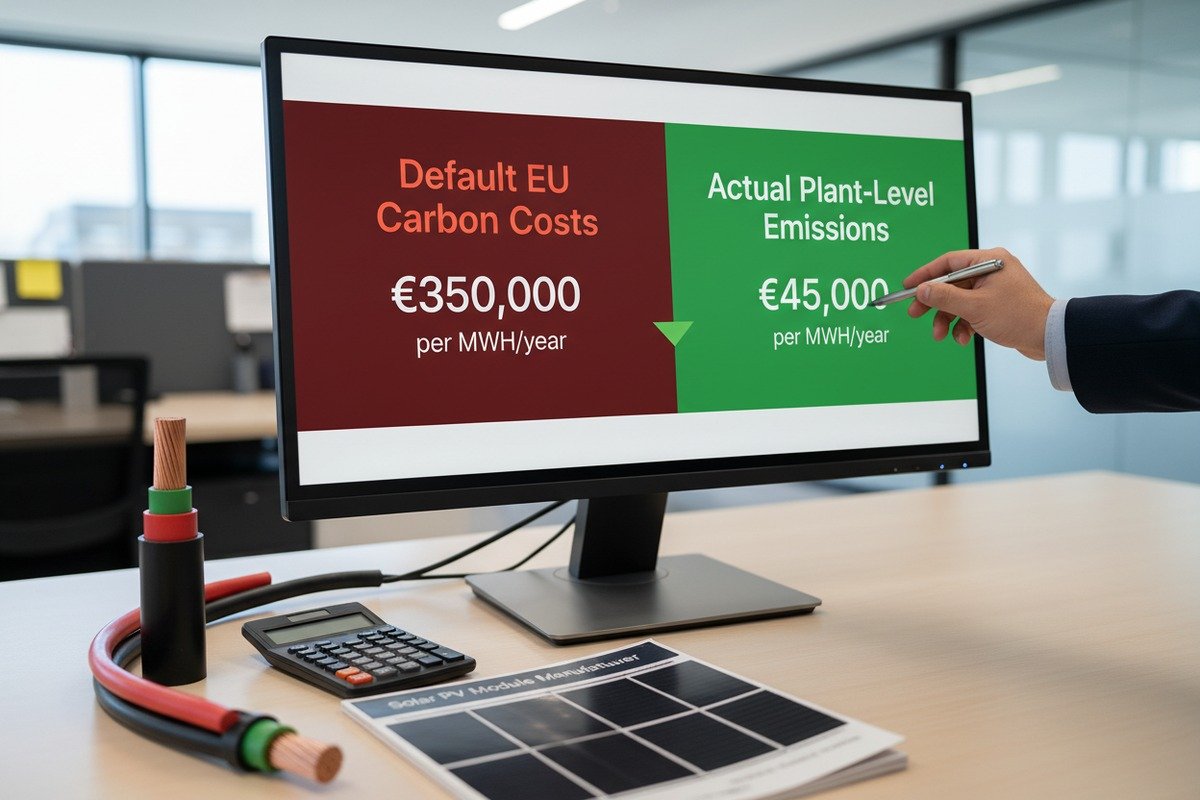
The CBAM framework allows importers to use EU-assigned default values for a given country if actual data is unavailable. However, China's default values are set conservatively high because of the coal-heavy energy mix. This means you will likely overpay on CBAM certificates if you rely on defaults instead of actual plant-level data. Investing time in collecting real numbers from your supplier will almost always save money.
How can I verify that my manufacturer's embedded emissions data for H1Z2Z2-K cables is accurate and verifiable?
When our quality team runs internal audits on our H1Z2Z2-K production lines, we cross-reference energy consumption logs against output tonnage—a simple but powerful check that any importer can request.
You can verify embedded emissions accuracy by requiring third-party verification from an EU-accredited body, cross-checking energy bills against production volumes, requesting ISO 14064 or ISO 14067 certification, and comparing reported figures against published industry benchmarks for comparable cable products.
The Verification Challenge
Carbon data is only useful if it is trustworthy. European importers—especially compliance-driven procurement managers in Germany, the Netherlands, and Scandinavia—cannot afford to submit questionable data to their national CBAM authority. If the data is later found to be inaccurate, the importer faces penalties, not the Chinese supplier.
Three Layers of Verification
Think of verification in three layers:
Layer 1: Internal consistency checks. Ask the supplier for monthly electricity bills and natural gas invoices alongside monthly production output in tonnes. If they claim 0.8 tonnes CO₂e per tonne of H1Z2Z2-K cable, but their electricity consumption suggests a much higher figure, something is wrong. Our engineers do this calculation quarterly and share the methodology with clients who request it.
Layer 2: Third-party certification. The gold standard is an audit by an EU-accredited verification body under the EU ETS Monitoring, Reporting, and Verification (MRV) framework. Alternatively, ISO 14064 6 (organizational-level greenhouse gas accounting) or ISO 14067 (product carbon footprint) certifications provide strong credibility. Not many Chinese cable factories hold these yet, but the number is growing.
Layer 3: Benchmark comparison. Compare your supplier's reported emissions against industry averages. Here is a rough benchmark table:
| Cable Type | Typical Embedded CO₂e (per tonne of cable) | Low-Carbon Benchmark | High-Carbon Red Flag |
|---|---|---|---|
| H1Z2Z2-K (copper conductor, XLPO insulation) | 3.5–5.0 t CO₂e | < 3.0 t CO₂e (renewable-powered factory) | > 6.0 t CO₂e (coal-heavy grid, no efficiency measures) |
| EN 50618 (similar construction) | 3.2–4.8 t CO₂e | < 2.8 t CO₂e | > 5.5 t CO₂e |
| Aluminium solar cable | 5.0–8.0 t CO₂e | < 4.5 t CO₂e | > 9.0 t CO₂e (primary aluminium from coal smelters) |
If your supplier's numbers fall well below the low-carbon benchmark without a credible explanation—such as rooftop solar on the factory or a direct renewable energy purchase agreement—be cautious.
Digital Tools for Transparency
Some forward-thinking manufacturers are investing in digital twins and blockchain-based carbon tracking. At our facility, we have started piloting a digital tracking system that links energy meter readings directly to production batch numbers. This creates an immutable record that can be shared with European importers. The technology is still maturing, but it signals a supplier's genuine commitment to transparency.
What If Your Supplier Resists?
If a supplier refuses to provide verifiable emissions data, that tells you something important. It may not mean they are hiding high emissions—they may simply lack the internal systems to measure and report. Either way, it creates compliance risk for you as the EU importer. Consider this a key criterion during supplier qualification, alongside TUV certification and CPR fire safety ratings.
Will the new CBAM regulations significantly increase my total landed cost when importing bulk solar cables from China?
Our commercial team recently modeled CBAM cost scenarios for a 500-tonne H1Z2Z2-K shipment to Hamburg—and the results surprised even us.
If CBAM expands to cover finished solar cables, expect a cost increase of approximately €250–€360 per tonne of cable at the current certificate price of €72/tonne CO₂, translating to a 2–5% increase in total landed cost depending on your supplier's carbon intensity and whether you use actual or default emission values.
The Cost Math, Step by Step
Let us break this down with real numbers. The CBAM cost for any imported product equals:
CBAM Cost = Embedded CO₂e (tonnes) × CBAM Certificate Price (€/tonne) – Any Carbon Price Already Paid in Origin Country
China's national ETS 8 currently prices carbon at roughly €10–€15/tonne—far below the EU's €72/tonne. So the differential is significant.
Scenario Modeling for H1Z2Z2-K Solar Cable
| Scenario | Embedded CO₂e per Tonne of Cable | CBAM Certificate Price | China ETS Offset | Net CBAM Cost per Tonne | % Impact on €8,000/t Cable |
|---|---|---|---|---|---|
| Actual data, renewable-powered factory | 2.8 t CO₂e | €72 | €12 offset | €168 | ~2.1% |
| Actual data, standard grid mix | 4.5 t CO₂e | €72 | €12 offset | €270 | ~3.4% |
| Default country values (China) | 5.5 t CO₂e | €72 | €12 offset | €336 | ~4.2% |
| Worst case: high-carbon, no offset claimed | 6.0 t CO₂e | €72 | €0 | €432 | ~5.4% |
These numbers assume a landed cable cost of approximately €8,000 per tonne (including CIF, duties, and handling). The percentage impact looks modest in isolation, but at scale it compounds quickly. A €300 per tonne CBAM surcharge on a 500-tonne order equals €150,000 in additional costs.
Why Default Values Are Expensive
Notice the gap between "actual data, renewable-powered factory" and "default country values." That gap—€168 versus €336 per tonne—represents €84,000 on a 500-tonne order. This is the direct financial reward for working with a supplier who can provide verified, plant-level emissions data.
The Bigger Picture: Rising Certificate Prices
The current €72/tonne price is expected to rise. EU ETS prices 9 have historically trended upward as free allowances are phased out. Some analysts project prices exceeding €100/tonne by 2028. If that happens, every scenario above becomes significantly more expensive.
How to Mitigate Cost Impact
There are practical steps to keep CBAM costs manageable:
- Choose suppliers with verified low-carbon production. At our factory, we have invested in energy-efficient extrusion lines and are expanding rooftop solar. These investments directly reduce the embedded emissions you would report.
- Claim China's ETS carbon price offset. You are entitled to deduct any carbon price already paid by the manufacturer in China. Make sure your supplier provides proof of ETS compliance.
- Negotiate pricing transparency. Build CBAM cost-sharing into your supply contracts. Some of our European partners have already done this, linking the FOB price to a verified emissions report.
- Plan for price escalation. Factor in annual CBAM certificate price increases when budgeting multi-year solar farm projects.
How do I ensure my Chinese partner is prepared to provide the quarterly documentation required for my CBAM declarations?
When we first started preparing quarterly emissions reports for our European clients, the biggest challenge was not the data itself—it was building internal systems to produce it consistently, on time, every quarter.
Ensure your Chinese supplier's readiness by establishing a formal data-sharing agreement, defining quarterly reporting deadlines aligned with EU CBAM declaration cycles, requiring designated compliance contacts at the factory, and conducting an annual on-site audit to validate the reporting process and underlying data systems.
Understanding the CBAM Reporting Cycle
Under the definitive CBAM phase that began January 1, 2026, authorized CBAM declarants in the EU must submit annual declarations and purchase certificates. However, the underlying data must be collected and validated on a rolling basis. Most importers organize this quarterly to align with internal procurement and financial reporting cycles.
Your Chinese supplier needs to deliver, at minimum, the following documents every quarter:
- Production volume report for your specific orders (tonnes of cable produced)
- Energy consumption breakdown (electricity in kWh, fuel in litres or m³)
- Grid electricity carbon intensity certificate or renewable energy certificates
- Raw material bills showing origin and embedded emissions of copper, aluminium, and insulation compounds
- Any updates to China ETS compliance payments
Building a Compliance-Ready Partnership
This is not just about paperwork. It requires a cultural and operational shift at the factory level. Here is what we have learned works:
Designate a single point of contact. At our facility, we assigned a dedicated compliance coordinator who speaks both English and understands EU environmental regulations. This person is your direct line for all emissions-related queries. If your supplier cannot name a specific person responsible for CBAM data, that is a warning sign.
Integrate reporting into production workflows. Emissions data should not be compiled retrospectively from scattered records. It should be captured in real time—energy meters linked to production batches, material consumption logged per order. We invested in upgrading our production tracking software specifically for this purpose.
Set contractual deadlines. Include CBAM reporting obligations directly in your supply agreement. Specify that the supplier must deliver quarterly emissions reports within 15 business days of quarter-end. Tie compliance to payment milestones if necessary.
What a Quarterly Report Should Look Like
A well-structured quarterly emissions report from your supplier should include these sections:
| Report Section | Contents | Format |
|---|---|---|
| Executive Summary | Total production volume, total embedded CO₂e, key changes from prior quarter | 1-page PDF |
| Detailed Emissions Breakdown | Scope 1 and Scope 2 by source (electricity, gas, diesel, materials) | Spreadsheet with formulas visible |
| Raw Material Certificates | Origin certificates for copper rod, XLPO compound, aluminium | Scanned originals |
| Energy Documentation | Electricity bills, renewable energy certificates, fuel purchase records | Scanned originals |
| China ETS Compliance | Proof of carbon price payment, if applicable | Official ETS receipt |
| Methodology Statement | Explanation of calculation methods, emission factors used, boundaries | 1-2 page PDF |
Preparing for Audits and Spot Checks
EU national authorities may conduct audits on CBAM declarations. If they do, the data trail must lead back to the source—your Chinese supplier's factory floor. This means your supplier must retain original records for at least five years. During our own internal audits, we keep digital copies of every energy bill, material certificate, and production log. We recommend you ask your supplier to do the same and confirm this in writing.
The Long-Term View
The EU has signalled that CBAM is not going away—it will expand and
Footnotes
1. Official EU information on Monitoring, Reporting, and Verification for emissions. ↩︎
2. Official EU information on the Carbon Border Adjustment Mechanism. ↩︎
3. Wikipedia definition of Scope 1 emissions in GHG accounting. ↩︎
4. Wikipedia definition of Scope 2 emissions in GHG accounting. ↩︎
5. Official ISO standard for product carbon footprint certification. ↩︎
6. Official ISO standard for organizational greenhouse gas accounting. ↩︎
7. Official EU guidance on calculating embedded emissions for CBAM. ↩︎
8. World Bank article on China's national Emissions Trading System. ↩︎
9. Official EU information on the EU Emissions Trading System and its pricing. ↩︎