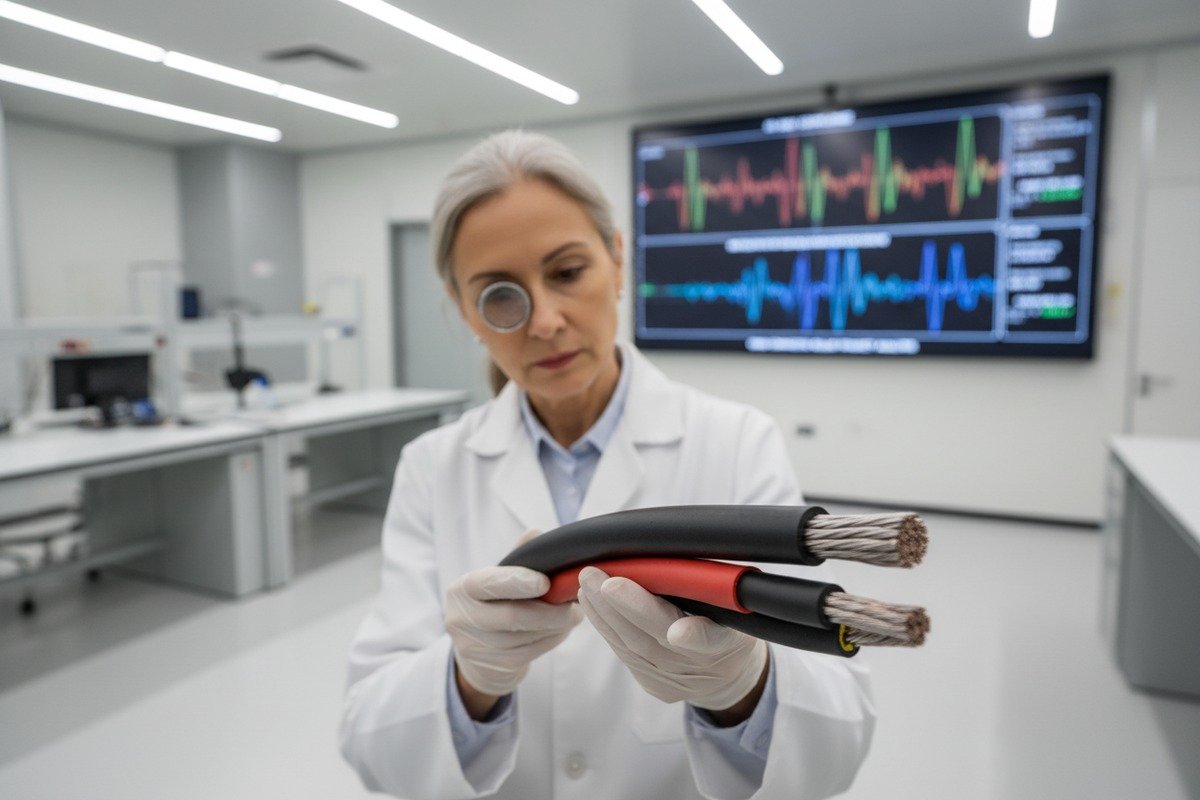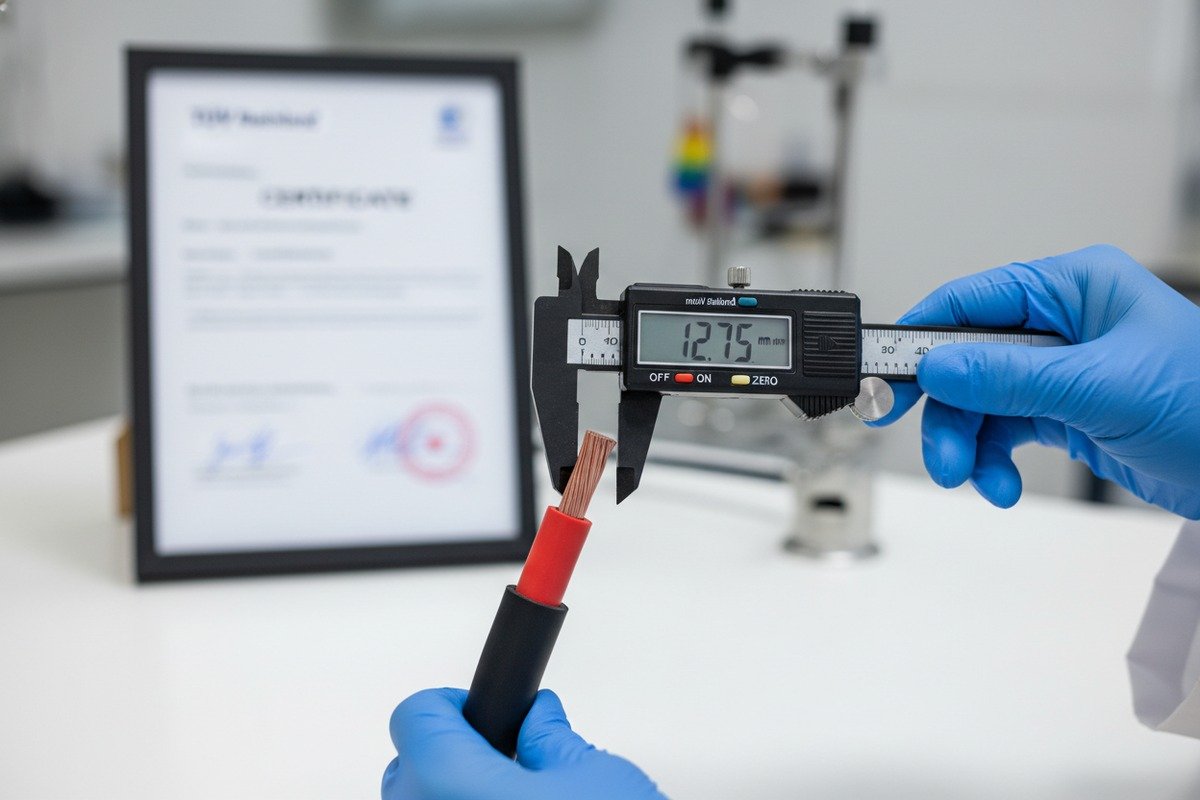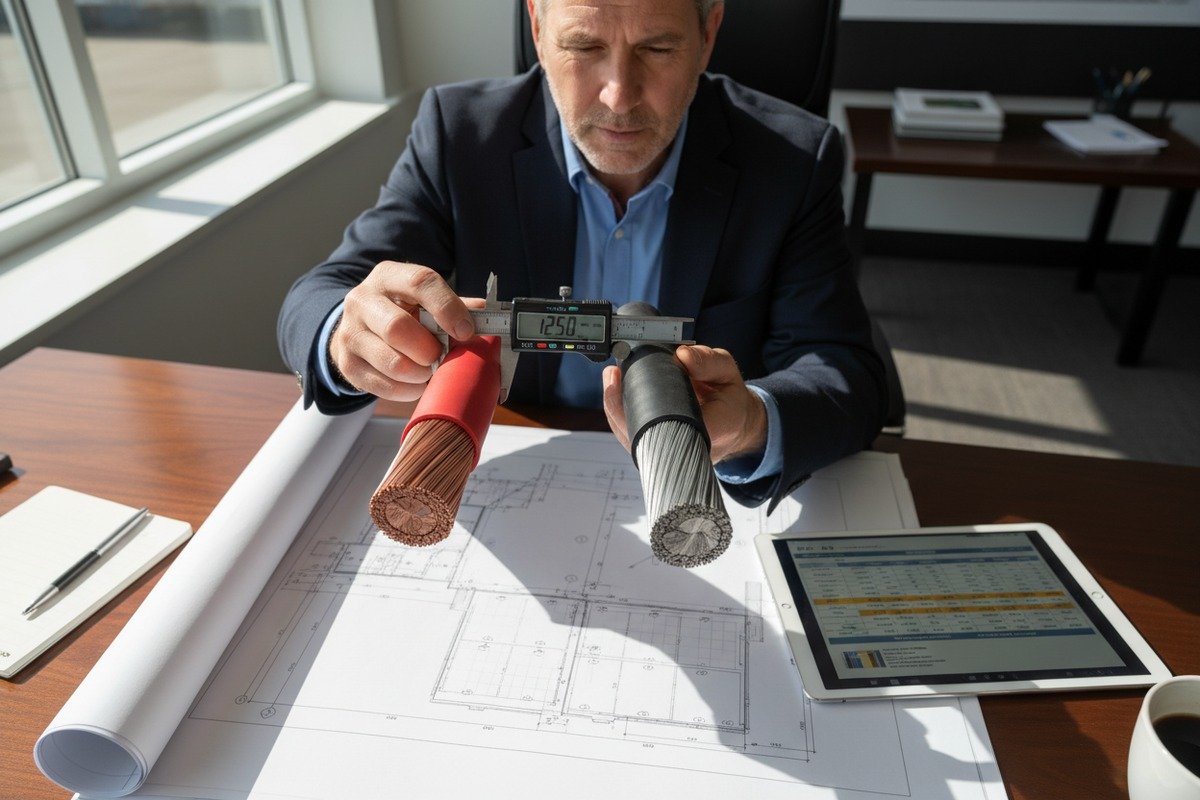
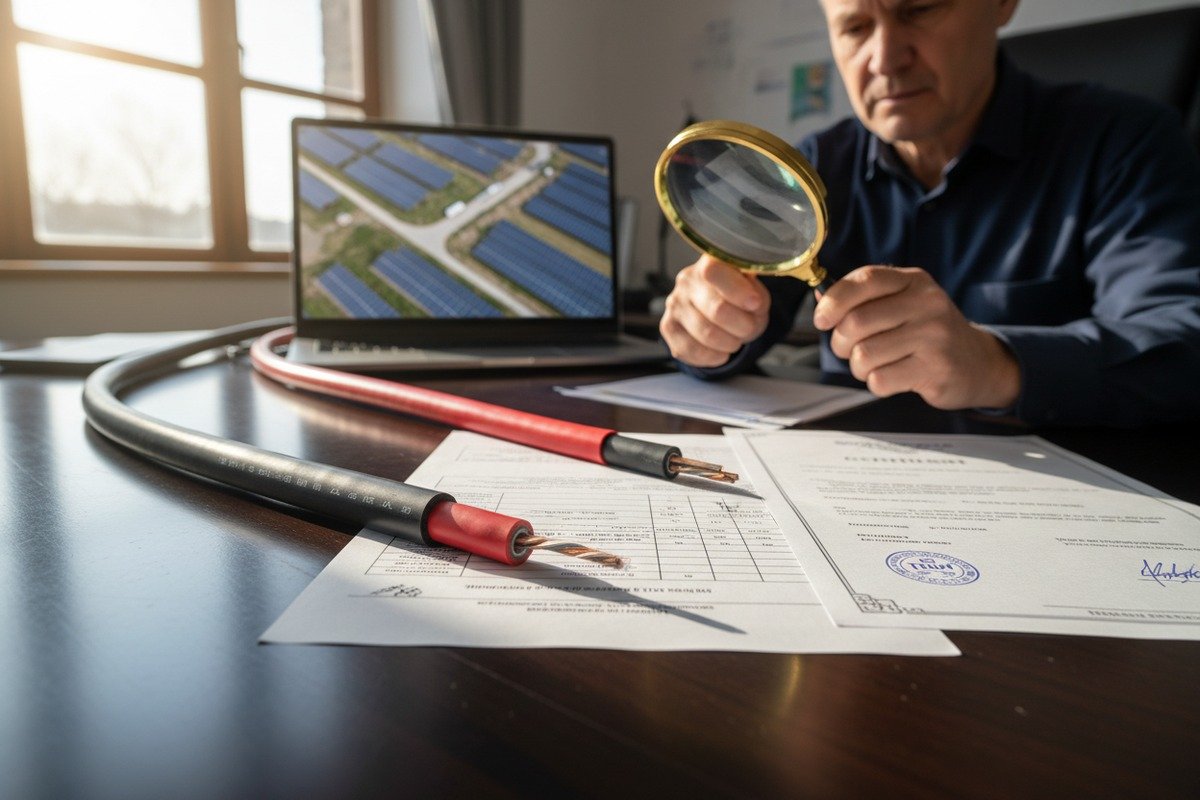
Every year, our quality team sees procurement mistakes that cost solar projects months of delay and thousands in penalties batch-specific test reports 1. A cable marked "1500V" on the datasheet might not actually hold up to that voltage in the field. And a temperature rating printed on a jacket means nothing if it was never independently tested high-voltage withstand test results 2. These are not hypothetical risks — they are real problems our export clients in Germany, the Middle East, and Latin America bring to us regularly.
To confirm solar PV cable voltage and temperature ratings during procurement, you should cross-check TUV or UL certification documents against cable jacket markings, request batch-specific test reports from the manufacturer, verify insulation material type and thickness, and evaluate ratings against your project's actual environmental and electrical conditions.
This guide walks you through the exact steps — from verifying certifications to requesting lab reports — so you can be confident every cable coil on your job site meets the ratings it claims. Let's break it down by the most common questions procurement teams ask us.
How do I verify that the TUV EN50618 certification matches the actual voltage rating on my order?
We have shipped EN50618-certified solar cable to over 40 countries, and the number one question we get from European EPC buyers is about certificate authenticity. TUV EN50618 certification 3 The fear is real: fake or expired TUV certificates are circulating in the market, and a single mismatch between the certificate and the delivered cable can get your shipment blocked at customs.
To verify TUV EN50618 certification matches your order's voltage rating, request the original TUV certificate number, cross-reference it on TUV's online database, and physically inspect the cable jacket markings upon delivery to confirm the printed voltage rating, standard number, and manufacturer name align with the certificate.
Why Certificate-to-Cable Matching Matters
A TUV EN50618 certificate is issued for a specific product — a specific construction, insulation material, conductor size range, and voltage rating. It is not a blanket approval for everything a factory produces. If your order specifies a 1500V DC cable but the certificate only covers 1000V DC, you have a compliance gap. This gap can result in rejected grid inspections, voided insurance, and construction delays.
Step-by-Step Verification Process
Here is a practical workflow our procurement partners use:
- Request the certificate before placing the order. Ask for a scanned copy of the TUV certificate. It should clearly state EN 50618, the voltage rating (e.g., 1500V DC or 1.5kV DC), temperature rating, and the manufacturer's name and factory address.
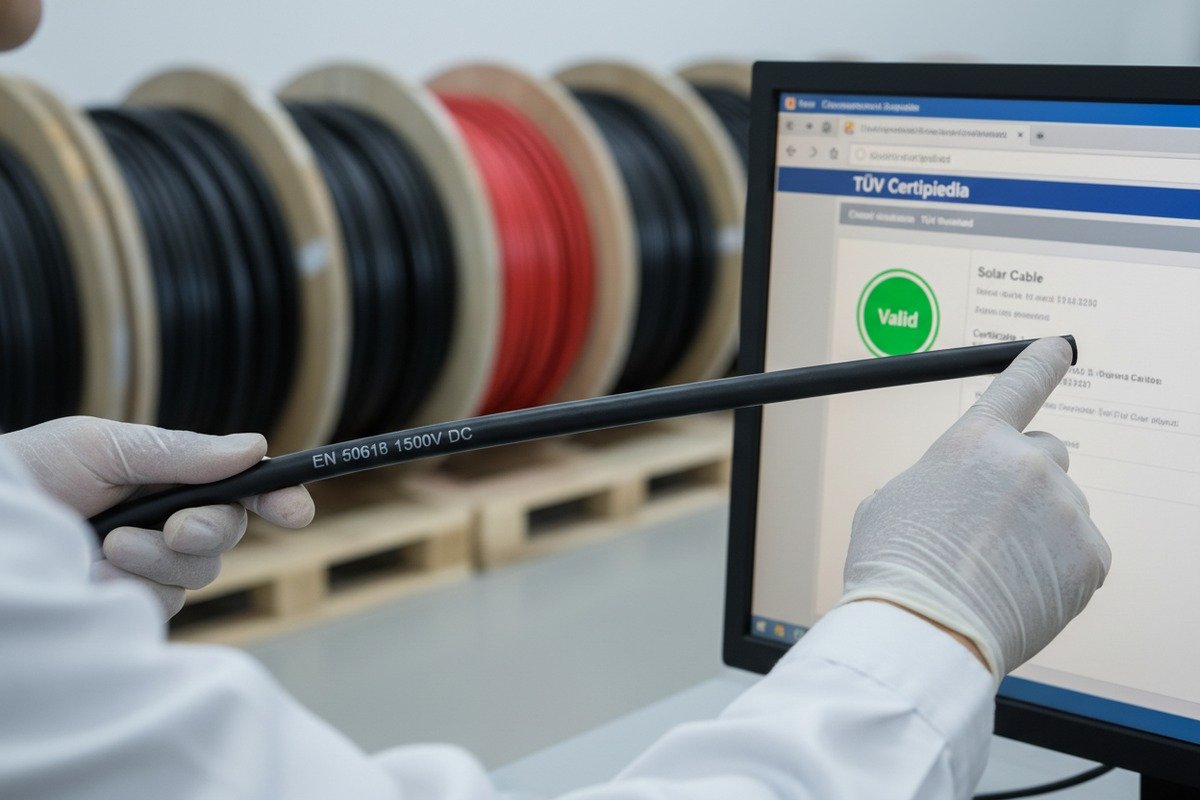
- Check the TUV online database. Go to the TUV Rheinland or TUV SUD Certipedia website. Enter the certificate number. TUV online database 4 Confirm the certificate is active, not expired, and matches the product description on your purchase order.
- Compare certificate details to the datasheet. The voltage class, conductor sizes, and insulation type on the certificate must match the technical datasheet you received during quotation.
- Inspect cable jacket markings on delivery. Every meter of quality solar cable should have laser-printed markings showing the standard (EN 50618), voltage rating, temperature rating, manufacturer name, and production date or batch code.
Common Certificate Red Flags
| Red Flag | What It Means | What to Do |
|---|---|---|
| Certificate number returns no results on TUV database | Likely a forged certificate | Reject the supplier immediately |
| Certificate is expired (check validity date) | Product may no longer meet current standards | Request a renewed certificate before ordering |
| Voltage rating on certificate differs from datasheet | The specific product you ordered may not be certified | Ask for a certificate that covers your exact specification |
| Factory address on certificate doesn't match supplier's claimed factory | Possible third-party sourcing from an uncertified facility | Request a factory audit or third-party inspection |
| No batch code or production date on cable jacket | Makes traceability impossible | Insist on full jacket markings per EN 50618 requirements |
Physical Inspection Tips
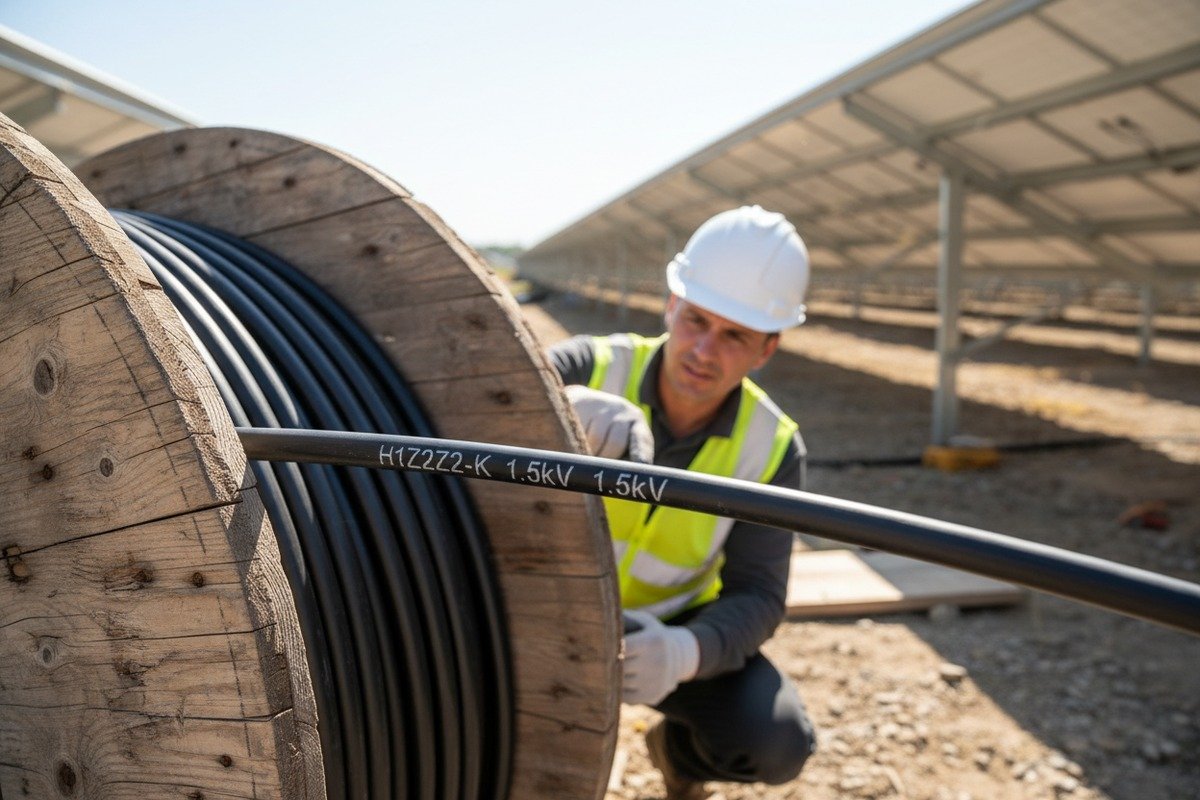
When the cable arrives at your warehouse or project site, pull a sample from the coil. Check that the jacket markings are permanent — they should not rub off with your thumb. Compare the printed voltage rating to your purchase order. If the markings say "1000V" but you ordered "1500V," do not install the cable. Contact the supplier and hold the shipment.
Our production lines use laser printing that is embedded into the jacket surface, making it resistant to abrasion and UV fading. This is a detail worth asking about — some low-cost manufacturers use ink printing that fades within months of outdoor exposure, making future audits impossible.
What steps should I take to ensure the cable's temperature rating will withstand extreme UV exposure in my project location?
When our engineering team designs cables for projects in the Middle East or sub-Saharan Africa, we know that ambient air temperature is only part of the story. The real danger comes from cumulative heat — solar radiation hitting a black cable jacket on a rooftop, combined with the heat generated by current flowing through the conductor. Many procurement managers overlook this layered heat effect.
To ensure your cable's temperature rating withstands extreme UV exposure, verify the insulation material is XLPE or XLPO with documented UV resistance, confirm the rated temperature provides sufficient margin above your site's worst-case cumulative temperature (ambient plus solar gain plus I²R heating), and request accelerated aging test data from the manufacturer.
Understanding Cumulative Heat on Solar Cables
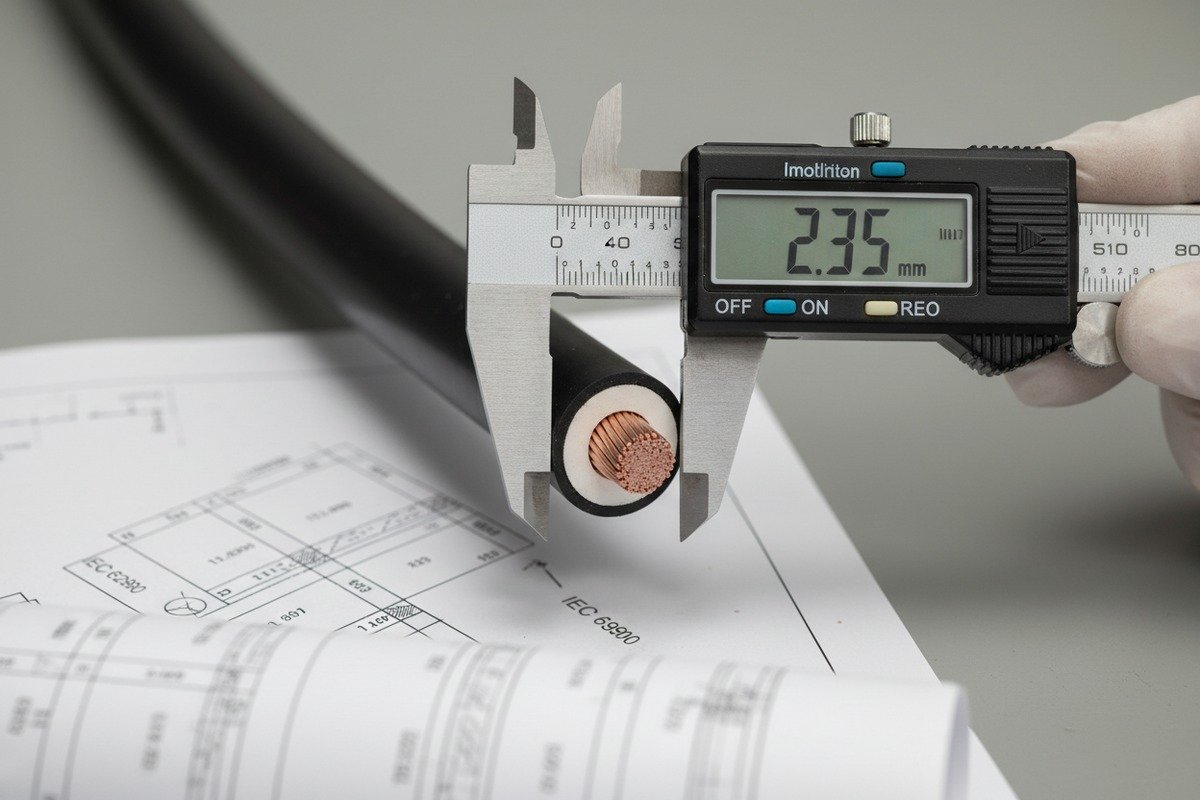
A cable's temperature rating — typically 90°C — refers to the maximum temperature the conductor can safely reach during continuous operation. But this is not just about air temperature. You must add together several heat sources:
- Ambient temperature: The air temperature around the cable.
- Solar radiation gain: Direct sunlight hitting the cable jacket can add 10–20°C above ambient.
- I²R heating: Current flowing through the conductor generates heat proportional to resistance and the square of the current.
- Reflected heat: Nearby surfaces (rooftop membranes, metal mounting structures) reflect heat onto the cable.
In a desert environment where ambient temperature reaches 50°C, solar radiation adds another 15°C, and current flow adds 10°C, the conductor could reach 75°C. A 90°C-rated cable still has a 15°C margin. But install that same cable inside a conduit with poor ventilation, and you lose that margin quickly.
How UV Exposure Degrades Insulation Over Time
UV radiation does not just heat the cable — it breaks down polymer chains in the insulation material. Over 25 years, this degradation can cause cracking, reduced dielectric strength, and eventually insulation failure. This is why material choice matters enormously.
| Insulation Material | UV Resistance | Typical Temperature Rating | Expected Lifespan (Outdoor) |
|---|---|---|---|
| XLPE (Cross-linked Polyethylene) | Excellent | 90°C (up to 120°C for some grades) | 25–30 years |
| XLPO (Cross-linked Polyolefin) | Excellent | 90°C–120°C | 25–30 years |
| PVC (Polyvinyl Chloride) | Moderate | 70°C–90°C | 10–15 years (outdoor) |
| Standard PE (Polyethylene) | Poor | 70°C | Not recommended for solar |
XLPE and XLPO 5 are the industry standards for solar PV cables. They resist UV degradation far better than PVC or standard polyethylene. At our factory, we use electron-beam cross-linked polyolefin, which creates a denser molecular structure that holds up under years of intense UV exposure.
What to Request from Your Supplier
Ask for accelerated aging test results. These tests simulate years of UV exposure in a compressed timeframe — typically 720 hours or more in a UV weathering chamber per IEC or UL protocols. accelerated aging test data 6 The results should show that tensile strength and elongation at break remain within acceptable limits after aging.
Also request thermal cycling test data. This test subjects the cable to repeated temperature swings — for example, from -40°C to 90°C — to confirm the insulation does not crack or delaminate. For projects in regions with extreme day-night temperature differences, this data is critical.
Site-Specific Considerations
Consider whether your cables will be in free air, in conduit, or direct-buried. Cables in conduit have less heat dissipation. Cables on dark rooftops absorb more solar radiation. Even the color of the cable jacket matters: black absorbs more heat than lighter colors, though black is standard for UV resistance. If your project is in a region with ambient temperatures consistently above 40°C, consider requesting cables with a 105°C or 120°C dry rating for extra margin.
How do I confirm if a 1500V DC rating is truly sufficient for my large-scale solar farm's electrical requirements?
During the design review phase for a recent 200MW project in the Middle East, our technical team found that the client's original cable specification was based on standard test conditions — not the actual open-circuit voltage at low temperatures. This oversight nearly resulted in a cable that was underrated by more than 100V. It is a mistake we see often.
To confirm a 1500V DC rating is sufficient, calculate your system's maximum open-circuit voltage (Voc) at the lowest expected ambient temperature, add a safety margin of 10–15%, and verify this total does not exceed 1500V. If it does, you need a higher-rated cable or must reduce the number of panels per string.
Why Open-Circuit Voltage Changes with Temperature
Solar panels produce higher voltage in cold conditions. The Voc printed on a panel's nameplate is measured at Standard Test Conditions (STC) 8 — 25°C cell temperature. In winter, when ambient temperatures drop to -10°C or lower, the actual Voc per panel can increase significantly. The temperature coefficient for Voc 9 (typically -0.27% to -0.35% per °C for crystalline silicon) determines how much.
For example, if a panel has a Voc of 49.5V at STC and the temperature coefficient is -0.30%/°C, at -10°C (a 35°C drop from STC), the Voc increases by:
49.5V × 0.30% × 35 = 5.2V
So the cold-weather Voc per panel is approximately 54.7V. If you have 28 panels in a string, the string Voc becomes:
54.7V × 28 = 1,531.6V
This exceeds 1500V. Your cable — and your inverter — would be operating beyond their rated voltage.
Calculation Checklist
| Parameter | How to Determine | Example Value |
|---|---|---|
| Panel Voc at STC | From panel datasheet | 49.5V |
| Temperature coefficient of Voc | From panel datasheet | -0.30%/°C |
| Lowest expected ambient temperature | From local meteorological data | -10°C |
| Temperature difference from STC (25°C) | 25°C minus lowest ambient | 35°C |
| Adjusted Voc per panel | Voc × (1 + coeff × ΔT) | 54.7V |
| Number of panels per string | From system design | 28 |
| Maximum string Voc | Adjusted Voc × panels per string | 1,531.6V |
| Cable voltage rating needed | Must exceed maximum string Voc | ≥1,532V (use 1500V with margin, or reduce string length) |
What If Your Calculation Exceeds 1500V?
You have two options. First, reduce the number of panels per string. In the example above, dropping from 28 to 27 panels gives a string Voc of 54.7 × 27 = 1,476.9V, which is within the 1500V rating. Second, source a cable rated above 1500V — some manufacturers offer 1800V or 2000V options, though availability and cost increase.
Our production line supports cables rated at 1500V DC per EN 50618 and UL 4703. For clients whose calculations are borderline, we always recommend reducing string length rather than operating at the absolute limit of the cable's rating. A safety margin of at least 10% below the rated voltage is good engineering practice.
System-Level Voltage Matching
Beyond the cable itself, ensure that your inverter input voltage range, combiner box ratings, fuses, and connectors are all rated for the same system voltage. A 1500V cable connected to a 1000V-rated connector creates a weak point in the system. Every component in the DC circuit must be rated at or above the maximum system voltage.
Can I request specific batch test reports to prove the XLPO insulation meets the promised temperature limits?
One of our long-term partners in Germany — a senior procurement director at a major EPC firm — once told us that he trusts certifications but verifies with batch data. His exact words were: "A certificate tells me what the factory could do once. A batch report tells me what they did this time." That philosophy has shaped how we handle quality documentation for every shipment.
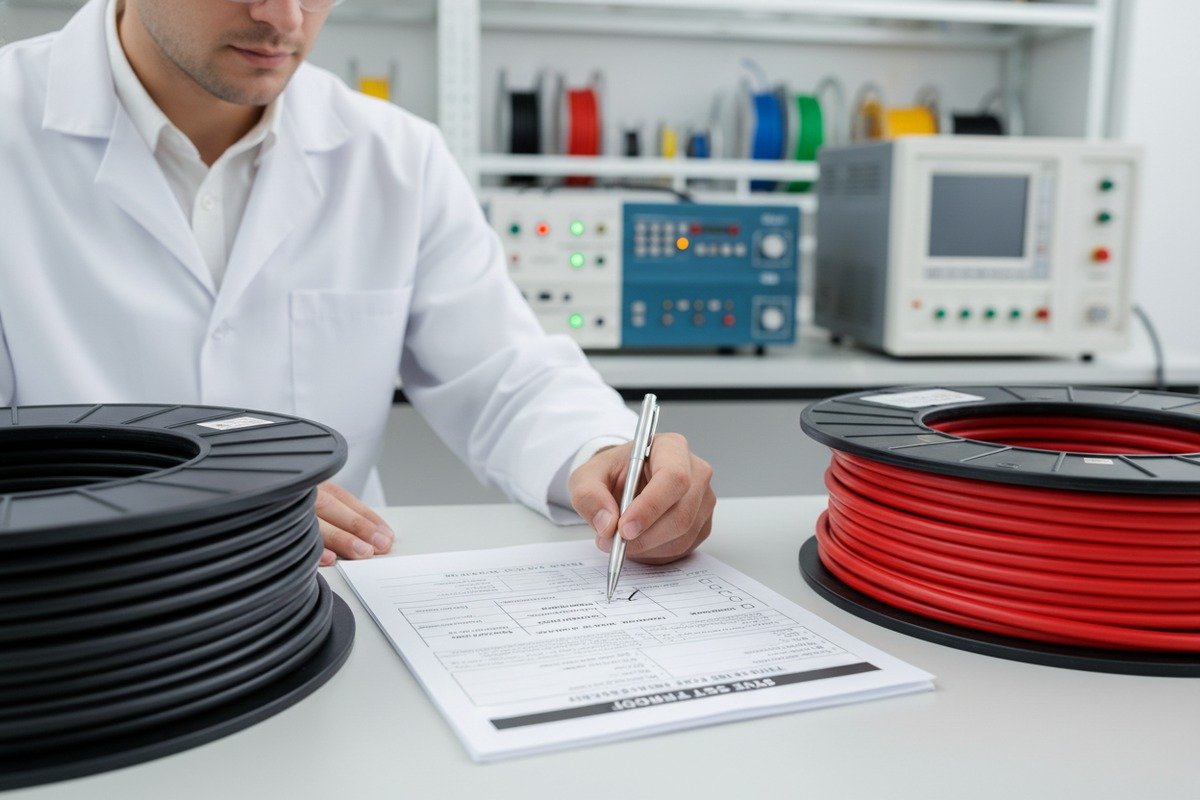
Yes, you can and should request batch-specific test reports. These reports should include high-voltage withstand test results, insulation resistance measurements, tensile strength and elongation data before and after aging, and thermal cycling performance — all tied to the specific production lot number matching your delivery.
What Should a Batch Test Report Include?
A complete batch test report for XLPO-insulated solar PV cable goes beyond just pass/fail. It should provide measured values for each test, the test method used (referencing EN 50618, IEC 62930, or UL 4703), the sample size, and the production lot or batch number.
Key Tests to Look For
Here are the critical tests that prove XLPO insulation meets its temperature promises:
High-voltage withstand test (dielectric strength): The insulation is subjected to a voltage significantly higher than the rated voltage. For a 1500V DC cable, this typically means applying 6.5kV AC or an equivalent DC voltage for a specified duration. The insulation must not break down.
Thermal aging test: Samples are placed in an oven at the rated temperature (e.g., 90°C) for 168 hours (7 days) per UL 4703 or the equivalent EN 50618 protocol. After aging, tensile strength and elongation at break are measured. The results must remain within defined limits compared to pre-aging values.
Hot set test: This is specific to cross-linked insulation. A sample is suspended with a weight in an oven at 200°C. The elongation under load must not exceed 175%, and after cooling, the permanent set (permanent deformation) must not exceed 15%. This test confirms the degree of cross-linking — poorly cross-linked XLPO will fail this test.
Cold bend test: The cable is cooled to -40°C and then bent around a mandrel. No cracking of the insulation is allowed. This confirms low-temperature flexibility.
How to Match Batch Reports to Your Delivery
Every cable drum or coil should be labeled with a production lot or batch number. This number must match the batch number on the test report. If the numbers don't match, the test report is meaningless for your specific delivery.
At our facility, we assign a unique batch code to every production run. When a client requests batch test reports, we provide them tied to the exact lot numbers shipping to their project. We also maintain these records for a minimum of 10 years, which supports warranty claims and regulatory audits.
Red Flags in Batch Test Reports
Watch for these warning signs:
- Generic reports without batch numbers. These may be template documents not tied to any actual production.
- Missing test method references. A legitimate report cites the specific standard clause (e.g., EN 50618 Clause 8.3.2).
- Results that are suspiciously identical across multiple batches. Real test data shows slight variations from batch to batch. Identical numbers suggest the data was copied.
- No third-party witness or lab accreditation. For highest confidence, request reports from an accredited third-party lab (e.g., TUV, SGS, Bureau Veritas), not just the manufacturer's internal lab.
Going Beyond Standard Batch Reports
For projects with the highest reliability requirements — such as utility-scale solar farms with 25-year power purchase agreements — consider requesting extended aging data. Some manufacturers, including our R&D team, conduct long-term material degradation studies that simulate 10, 15, and 25 years of service. This data gives you confidence that the XLPO insulation will maintain its temperature performance for the full system lifespan, not just at the time of delivery.
You can also arrange for a pre-shipment inspection (PSI) through a third-party agency. The inspector visits the factory, verifies batch numbers, witnesses sample tests, and issues an independent report. This adds cost but provides an unbiased verification layer that is especially valuable for first-time supplier relationships.
Conclusion
Confirming solar PV cable voltage and temperature ratings is not optional — it is the foundation of a safe, compliant, and long-lasting solar installation. Verify certifications, inspect markings, calculate real-world conditions, and demand batch-specific proof.
Footnotes
1. Discusses the importance of individual quality control and testing during cable production. ↩︎
2. Explains the dielectric withstand test, also known as high-voltage withstand test, for insulation safety. ↩︎
3. Official TUV Rheinland page explaining Certipedia and certifications. ↩︎
4. Direct link to TUV Rheinland's Certipedia database for certificate verification. ↩︎
5. Comparison of XLPE and XLPO insulation materials for solar cables, detailing properties. ↩︎
6. NREL document discussing accelerated aging tests for PV cables. ↩︎
7. Explains I²R heating in the context of electrical systems and solar panels. ↩︎
8. Defines Standard Test Conditions for photovoltaic panels, crucial for understanding ratings. ↩︎
9. Replaced 404 link with a blog post from Yup Solar that explains the temperature coefficient of voltage (Voc) in solar panels. ↩︎
10. Details the hot set test for cross-linked materials, verifying insulation integrity. ↩︎