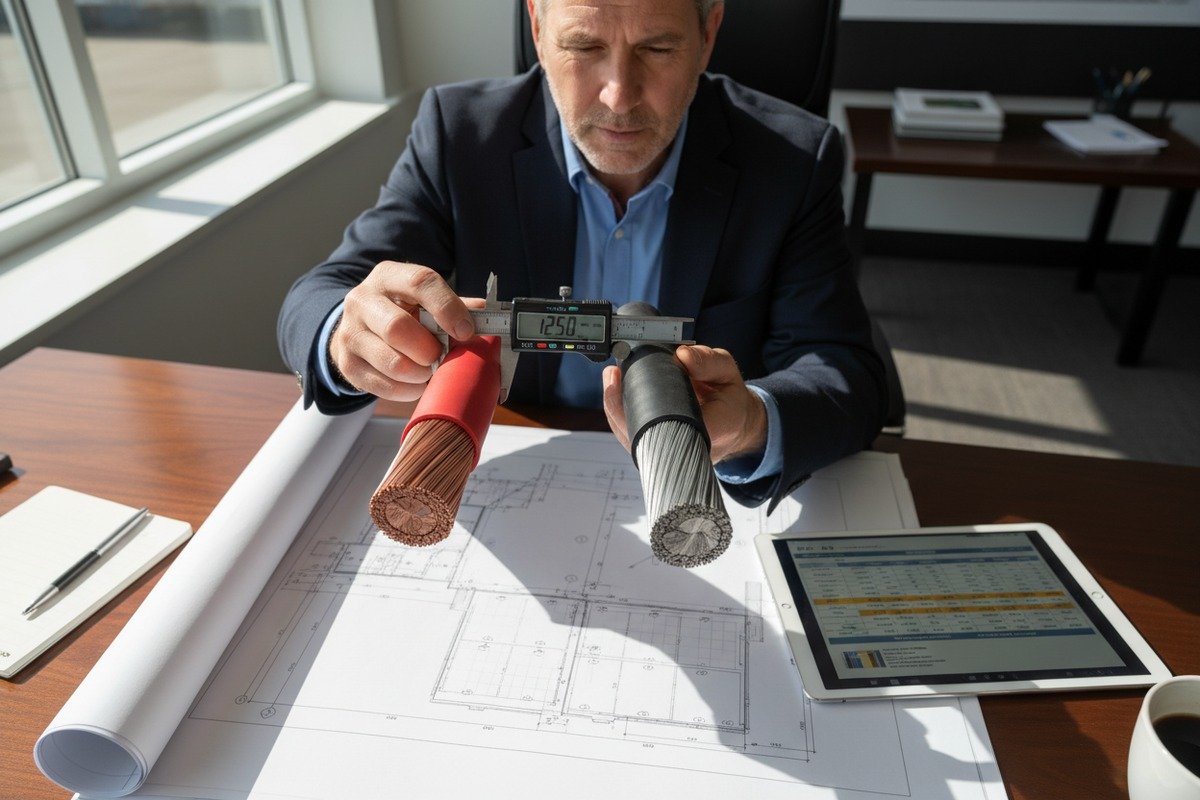

Every year, our production lines process thousands of tons of both bare copper and tinned copper conductors for solar PV cables 1 shipped worldwide. One question keeps coming back from procurement teams: which conductor type actually delivers better value for their specific project site?
To compare copper vs tinned copper conductor performance for solar PV cables, evaluate resistivity (0.0172 vs 0.0178 Ω·mm²/m), corrosion resistance, expected lifespan, environmental exposure, and total cost of ownership. Tinned copper outperforms bare copper in harsh outdoor environments, while bare copper offers marginally better conductivity at lower upfront cost for protected installations.
This guide breaks down every factor you need to weigh before choosing a conductor type. We will walk through cost justification, corrosion performance, standards verification, and real performance trade-offs. Let's get into it.
How do I determine if tinned copper is worth the extra cost for my solar farm project?
When we quote projects for EPC contractors in Europe and Southeast Asia, the cost conversation always starts the same way. Budget pressure is real, especially with copper prices 2 fluctuating. But the upfront price tag only tells half the story.
Tinned copper is worth the extra cost when your solar farm faces outdoor exposure, humidity above 60%, coastal salt air, or requires a 25-year cable warranty match. The 10–20% price premium pays for itself by eliminating mid-life cable replacements and reducing maintenance costs across the system's operating life.

The Real Cost Equation: Upfront vs Lifetime
Most buyers focus on the per-meter cable price. That is understandable. But solar farms are designed to operate for 25 to 30 years. A cable failure at year 8 means trenching, labor, downtime, and lost generation revenue. We have seen project owners spend three times the original cable cost on a single replacement cycle.
Here is a simple framework. If your project is indoors, dry, and well-ventilated, bare copper works fine. If your project faces any of these conditions—coastal proximity, tropical humidity, desert temperature swings, or rooftop exposure—tinned copper is the safer bet.
Cost Comparison: Bare Copper vs Tinned Copper Over 25 Years
| Cost Factor | Bare Copper | Tinned Copper |
|---|---|---|
| Upfront cable cost (per km) | Baseline | 10–20% higher |
| Expected outdoor lifespan before degradation | 3–5 years surface oxidation | 25+ years stable |
| Mid-life replacement probability (harsh environment) | High | Very low |
| Maintenance and inspection frequency | Higher | Lower |
| Total cost of ownership 3 (25-year horizon) | Higher in harsh environments | Lower in harsh environments |
When Bare Copper Makes Sense
Bare copper is not a bad product. Our factory produces both types in high volumes. For battery storage rooms, indoor inverter connections, or dry-climate ground-mount systems with robust cable trays, bare copper delivers excellent conductivity at a lower price point. The key is matching the conductor to the environment.
The Coastal Solar Farm Example
One of our clients in the Philippines initially specified bare copper for a 50 MW coastal project. Within 18 months, junction box connections showed green oxidation. The resistance at those points increased, creating hot spots. They retrofitted with tinned copper cables and have had zero conductor issues since. The retrofit cost far exceeded what tinned copper would have added at the start.
So the answer is not "always choose tinned." It is "always calculate the full lifecycle cost for your specific site conditions."
Will choosing tinned copper instead of bare copper improve my system's long-term corrosion resistance?
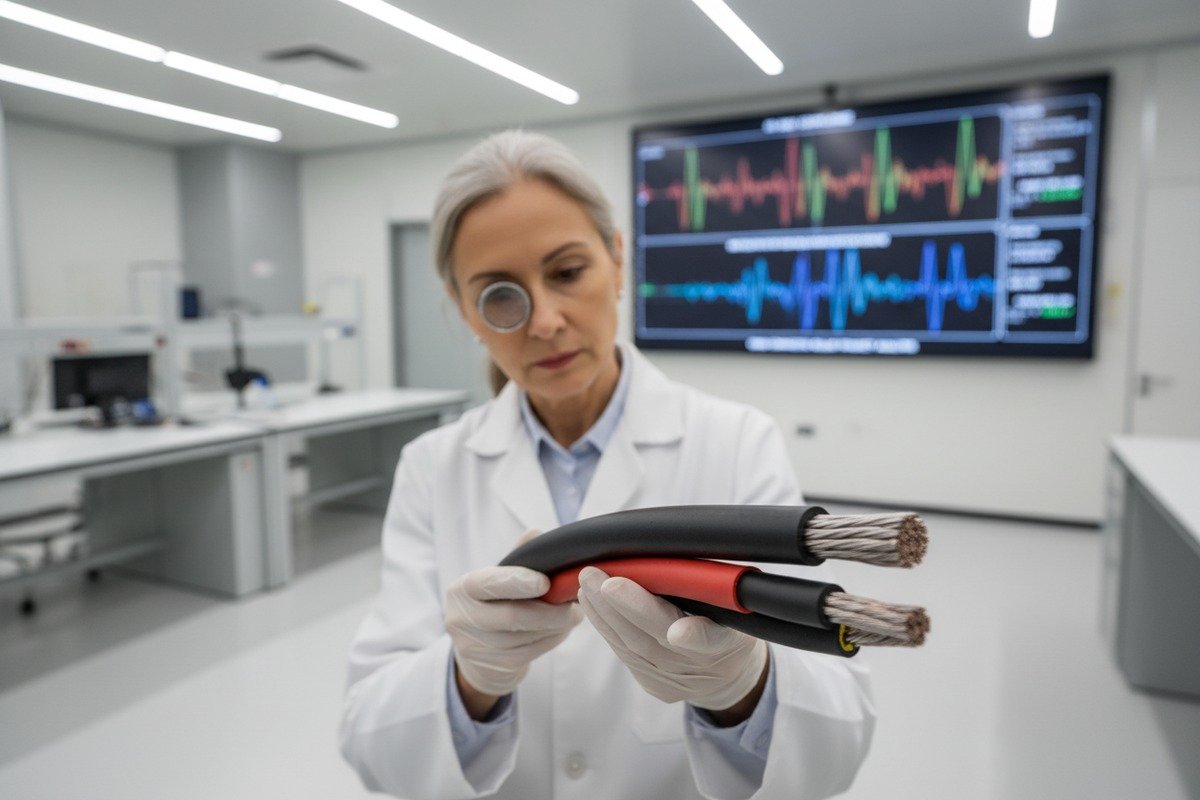
Our engineers have tested conductor samples pulled from field installations across climate zones—from Middle Eastern deserts to Indonesian coastal farms. The difference in corrosion behavior between bare and tinned copper after just five years outdoors is dramatic.
Yes, tinned copper significantly improves long-term corrosion resistance. The tin layer acts as a sacrificial barrier against oxidation, sulfidation, and salt-spray attack. Bare copper exposed outdoors can degrade within 3–5 years, while tinned copper maintains stable conductivity and connection integrity for 25 years or more.

How Corrosion Attacks Bare Copper
Copper is often described as having "excellent" corrosion resistance 4. That is true compared to steel or aluminum. But in real-world solar installations, bare copper faces three main threats:
- Oxidation. Copper reacts with oxygen to form copper oxide. This dark layer increases surface resistance.
- Sulfidation. In industrial or agricultural areas, sulfur compounds attack copper surfaces.
- Salt spray. Coastal sites accelerate corrosion dramatically. Chloride ions penetrate oxide layers and cause pitting.
Over time, these reactions increase contact resistance at termination points. Higher resistance means more heat. More heat means faster insulation degradation. It is a chain reaction.
How Tin Protects the Conductor
The tin coating on tinned copper is typically 1 to 3 microns thick. Tin forms a stable, self-limiting oxide layer that does not grow or flake like copper oxide. This means the conductor surface stays electrically consistent for decades.
Corrosion Resistance Comparison by Environment
| Environment | Bare Copper Performance | Tinned Copper Performance |
|---|---|---|
| Indoor / dry | Excellent, minimal degradation | Excellent, marginal benefit |
| Temperate outdoor | Good for 5–10 years, then surface oxidation | Excellent for 25+ years |
| Tropical / high humidity | Moderate, oxidation within 3–5 years | Excellent for 25+ years |
| Coastal / salt air | Poor, pitting and green patina within 1–3 years | Excellent for 25+ years |
| Industrial / chemical exposure | Moderate to poor, sulfidation risk | Very good, tin resists sulfur compounds |
Connection Point Vulnerability
The most critical corrosion risk is not along the cable run itself. It is at the termination points—connectors, junction boxes, and combiner boxes. These are where bare copper surfaces are exposed during crimping. If those surfaces oxidize, you get high-resistance joints. High-resistance joints cause hot spots. Hot spots cause fires.
Tinned copper keeps those crimped surfaces stable. Even if a connector is not perfectly sealed, the tin layer prevents the rapid oxidation that bare copper would experience. This is why many MC4 connector manufacturers 5 now recommend or require tinned copper conductors.
The 25-Year Warranty Alignment
Most Tier 1 solar modules carry 25-year performance warranties. If your cables fail at year 10, the modules are fine but the system is down. Tinned copper aligns cable lifespan with module lifespan. This is not a luxury. It is system engineering.
How can I verify that my supplier is using high-quality tinned copper that meets EN 50618 standards?
We have received calls from frustrated buyers who discovered too late that their "tinned copper" cables were actually copper-clad aluminum (CCA) 6 with a thin tin wash. This is one of the most dangerous sourcing pitfalls in the solar cable market, and it happens more often than people think.
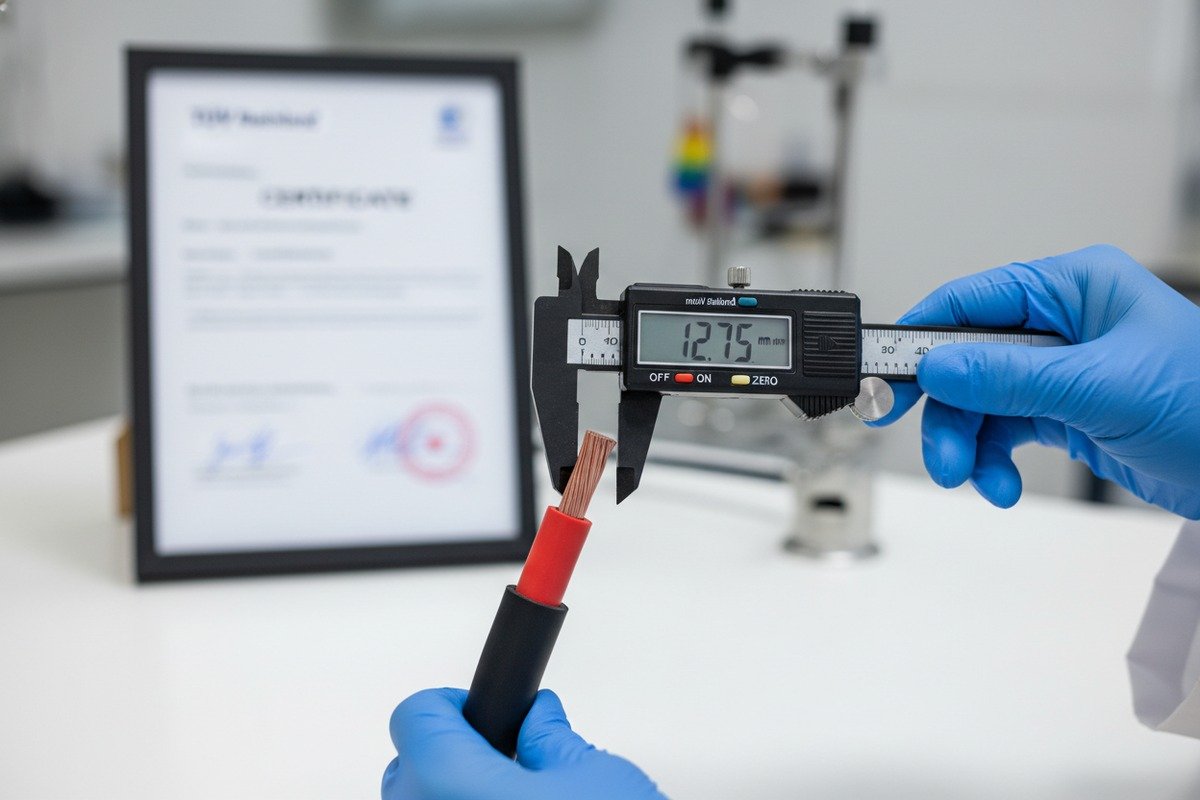
To verify high-quality tinned copper meeting EN 50618, request the supplier's TUV or third-party test certificate confirming conductor material, resistivity (≤0.0178 Ω·mm²/m), tin coating thickness, and strand count. Cross-check with independent lab testing, demand a factory audit, and physically inspect samples for weight, color, and flexibility before placing bulk orders.

Step 1: Request Authentic Certification
EN 50618 7 is the European standard for solar PV cables. It specifies conductor requirements, insulation properties, and performance under UV, ozone, and temperature stress. A legitimate supplier will provide:
- TUV certificate with the cable model and production facility listed
- IEC 60228 compliance 8 for the conductor class (typically Class 5 flexible)
- Test reports showing DC resistance per kilometer at 20°C
If a supplier hesitates to provide these documents, that is a red flag.
Step 2: Physical Sample Inspection
Before committing to a large order, request physical samples. Here is what to check:
| Inspection Point | What to Look For | Red Flag |
|---|---|---|
| Conductor color | Uniform silver-grey (tinned) | Reddish tint visible beneath coating |
| Weight per meter | Matches copper density (~8.9 g/cm³) | Noticeably lighter (suggests CCA or aluminum) |
| Strand count | 19+ strands for flexibility (Class 5) | Low strand count, stiff wire |
| Tin coating adhesion | No flaking when bent 180° | Coating peels or cracks |
| Insulation marking | Printed with standard, voltage, manufacturer | No markings or generic text |
| Cross-section cut | Solid copper color throughout each strand | Silver outside, grey/white core (CCA) |
Step 3: The Magnet and Weight Test
This is a quick field test. CCA has a slightly different weight profile. Weigh a 1-meter sample on a precision scale and compare it to the theoretical weight for that cross-section. Pure copper at 4 mm² should weigh approximately 35.6 g/m. If it is significantly lighter, you may have CCA.
A magnet test can rule out steel-core fakes, though these are rare in solar cables.
Step 4: Independent Lab Verification
For large orders—especially for EPC projects with grid-connection deadlines—send samples to an independent lab like TUV Rheinland 9, SGS, or Bureau Veritas. Request:
- Conductor material analysis (XRF or chemical analysis)
- DC resistance measurement
- Tin coating thickness measurement
- Insulation XLPO cross-linking degree
This costs a few hundred dollars but can save millions in project delays and safety incidents.
Step 5: Factory Audit
When we welcome procurement teams to our facility in Hainan, they walk the production line from copper rod drawing to final coiling. They see the tinning bath, the extrusion line, and the quality control checkpoints. A credible manufacturer will invite you in. If a supplier refuses factory visits or only shows a trading office, proceed with caution.
The CCA Danger
Copper-clad aluminum (CCA) is sometimes sold as "tinned copper" on trading platforms. CCA has roughly 60–70% of pure copper's conductivity. In a solar PV system, this means higher voltage drop, more heat generation, and potential connector failures. Some CCA cables have caused fires. Always demand pure copper verification. Do not rely solely on supplier claims.
What are the specific performance trade-offs I should expect when comparing these two conductor types?
Through three decades of manufacturing both bare and tinned copper solar cables, our quality team has accumulated extensive data on how each conductor type behaves in the field. The differences are real but often misunderstood.
The main performance trade-offs are: tinned copper has slightly higher resistivity (0.0178 vs 0.0172 Ω·mm²/m), resulting in marginally higher voltage drop, but offers dramatically superior corrosion resistance and connection longevity. Bare copper provides the best raw conductivity and lower cost but degrades faster in exposed environments. Both share similar tensile strength and flexibility.

Conductivity and Voltage Drop
The resistivity 10 difference between bare copper (0.0172 Ω·mm²/m) and tinned copper (0.0178 Ω·mm²/m) is about 3.5%. In practical terms, this is almost negligible for most solar cable runs.
Let's calculate. For a 100-meter DC cable run at 10A using 4 mm² conductor:
- Bare copper voltage drop: (2 × 100 × 10 × 0.0172) / 4 = 0.86 V
- Tinned copper voltage drop: (2 × 100 × 10 × 0.0178) / 4 = 0.89 V
The difference is 0.03 V. On a 600 V DC string, that is 0.005%. This is not a meaningful difference for any real-world system design.
Full Performance Comparison Table
| Performance Parameter | Bare Copper | Tinned Copper | Practical Impact |
|---|---|---|---|
| Resistivity (Ω·mm²/m) | 0.0172 | 0.0178 | Negligible difference in voltage drop |
| Density (g/cm³) | 8.96 | 8.9 | Nearly identical cable weight |
| Tensile strength | High | High | Both handle installation stress well |
| Flexibility (Class 5) | Excellent | Excellent | Both suitable for tight routing |
| Corrosion resistance (outdoor) | Moderate, degrades 3–5 years | Excellent, 25+ years | Major difference for exposed cables |
| Solderability | Good when fresh, degrades with oxidation | Excellent, stable over time | Tinned preferred for field connections |
| Melting point (conductor) | 1,085°C (copper) | 232°C (tin layer), 1,085°C (core) | Tin melts first but core remains intact |
| Fire behavior | Depends on insulation | Depends on insulation | No meaningful conductor difference |
| Compatibility with MC4 connectors | Good | Excellent | Tinned resists fretting corrosion |
| Upfront cost | Lower | 10–20% higher | Budget-sensitive projects prefer bare |
Mechanical Properties
Both conductor types use the same base material: electrolytic tough pitch (ETP) copper. The tinning process does not reduce mechanical strength. Stranding patterns (typically 19 strands or more for Class 5 flexibility) are identical. Bend radius, pull tension limits, and installation handling are the same.
The slight density difference (8.96 vs 8.9 g/cm³) is due to the tin layer replacing a tiny amount of surface copper. In practice, you will not notice any weight difference on cable drums.
Electrical Safety and Hot Spot Risk
Over time, bare copper connections can develop increased resistance due to oxidation. This is where the real safety gap appears. A connection that was 0.1 mΩ at installation might become 1.0 mΩ after five years of outdoor exposure. That tenfold increase creates localized heating.
Tinned copper connections maintain their initial resistance values for decades. This is why EN 50618 and many international solar PV cable standards either recommend or require tinned copper for outdoor installations. It is not about raw conductivity. It is about conductivity stability over time.
The Aluminum Question
Some buyers ask about aluminum as a cheaper alternative. Aluminum has a resistivity of 0.0282 Ω·mm²/m—64% higher than copper. It also has connection reliability issues due to cold flow and oxide formation. While aluminum is used in some transmission-scale applications, it is not suitable for standard solar PV cables where connector compatibility and long-term reliability are critical. Over 90% of premium solar cables worldwide use copper or tinned copper conductors.
Future Trends: What We See Coming
In 2025 and 2026, we are seeing accelerating demand for tinned copper in marine-grade PV cables. Off-grid coastal systems, floating solar installations, and agri-PV projects in humid climates are all driving this trend. Some emerging specifications also call for nano-coatings beyond traditional tinning, but these remain experimental. For now, tinned copper remains the gold standard for durable solar PV conductors.
Conclusion
Choosing between bare copper and tinned copper comes down to your site conditions, project lifespan, and total cost of ownership. For harsh outdoor environments, tinned copper is the clear winner. Match the conductor to the environment, verify your supplier's quality, and your solar PV system will perform reliably for decades.
Footnotes
1. Provides an overview of solar PV cable standards and applications. ↩︎
2. Provides current and historical data on copper prices from a major exchange. ↩︎
3. Provides a comprehensive definition of total cost of ownership (TCO). ↩︎
4. Replaced HTTP 404 with an authoritative article on copper corrosion resistance from a materials information platform. ↩︎
5. Provides information about MC4 connectors from the original manufacturer. ↩︎
6. Explains what copper-clad aluminum wire is and its properties. ↩︎
7. Replaced HTTP 404 with a page from iTeh Standards providing information on the EN 50618 standard. ↩︎
8. Replaced HTTP 404 with the official International Electrotechnical Commission (IEC) page for the IEC 60228 standard. ↩︎
9. Replaced HTTP 404 with the official TUV Rheinland USA homepage. ↩︎
10. Defines electrical resistivity as a material property for conducting current. ↩︎