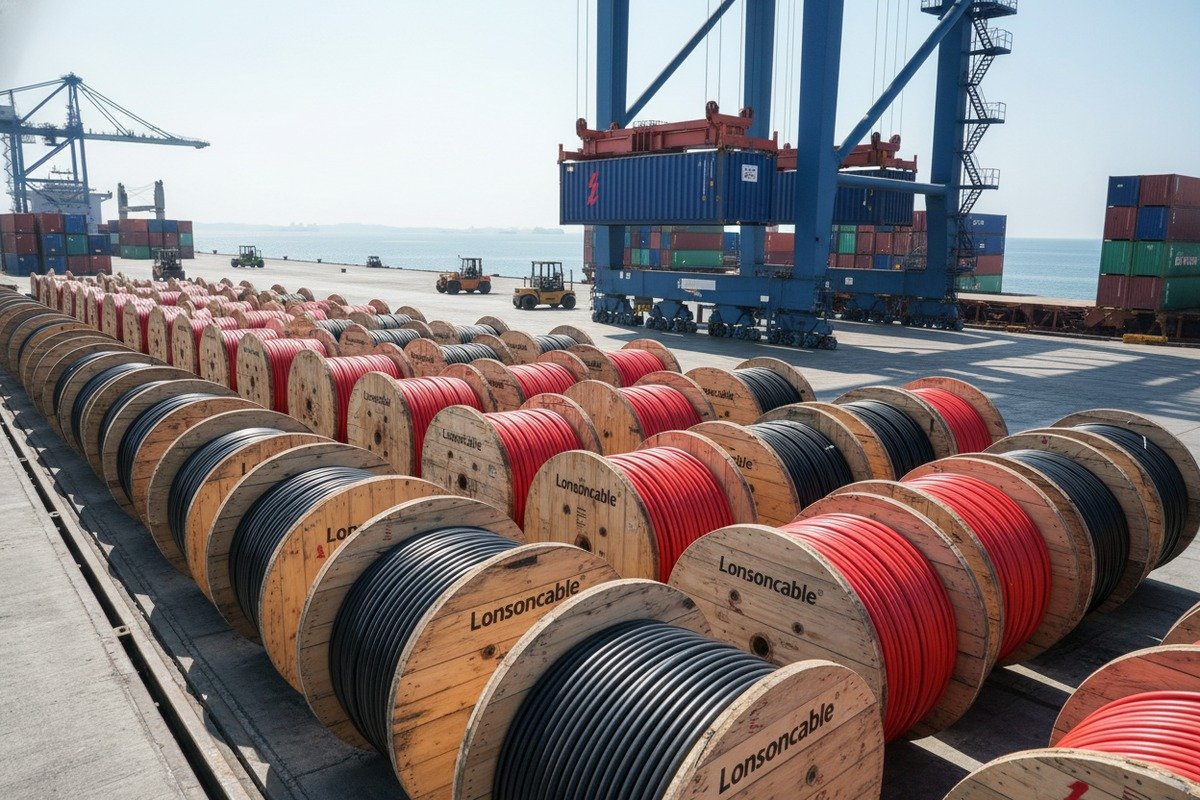
Every year, our production lines in Hainan push out thousands of tons of H1Z2Z2-K 1 and EN50618 solar PV cables bound for Europe, Africa, and the Americas. Yet one question keeps coming back from procurement managers like clockwork: "Which container should I pick?" The wrong choice means you either waste space, blow past weight limits, or pay twice what you should per kilogram maximum payload 2. We have seen importers lose $8,000 or more on a single shipment simply because nobody ran the numbers before booking freight.
To optimize shipping costs for solar PV cables from China, match your order's total weight and volume against container payload limits—choose a 20GP for orders under 20 tonnes, a 40HQ for bulkier loads over 15 tonnes, always prioritize FCL over LCL when fill exceeds 70%, and request container-optimized reel sizes from your supplier.
Below, we break down each decision step by step—container selection, drum loading calculations, FCL vs FCL shipping 3. LCL trade-offs, and total landed cost optimization. Let's get into it.
How do I choose between a 20GP and 40HQ container for my H1Z2Z2-K cable order?
When we ship H1Z2Z2-K cables from our factory, the first thing our logistics team checks is the total order weight versus the reel dimensions Silica gel desiccant packets 4. Getting this wrong is expensive and surprisingly common.
For H1Z2Z2-K cable orders under 18–20 tonnes, a 20GP container is cost-efficient. For orders exceeding 15 tonnes of lighter cross-sections or requiring more than 33 cubic meters, a 40HQ container offers up to 76 cbm of space and keeps your per-kilogram freight cost significantly lower.
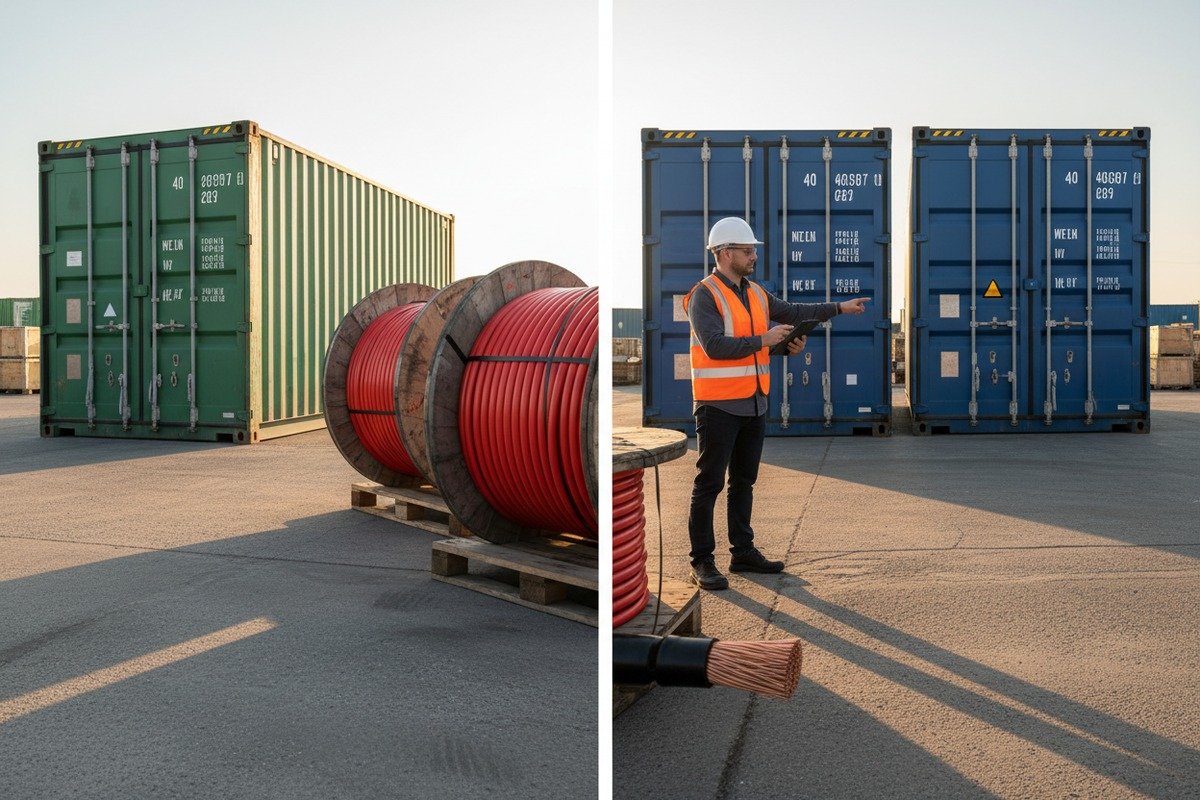
Why Weight Matters More Than Volume for Solar Cables
Solar PV cables are dense. A coiled reel of 6mm² H1Z2Z2-K cable can weigh 500–1,000 kg depending on the length. The density of packed cable reels typically falls between 0.5 and 1.0 tonnes per cubic meter. This means you will almost always hit the container's weight ceiling before you run out of floor space.
A 20GP container 5 has a maximum payload of roughly 28 tonnes, but its internal volume is only about 33 cbm. A 40HQ gives you approximately 76 cbm of space with a similar 28–30 tonne payload limit. So if your cables are heavy (thicker cross-sections like 10mm² or 16mm²), the 20GP might actually be enough in terms of volume. But if you are ordering thinner cables (4mm² or 6mm²), the reels are lighter per unit, and you need more volume to fill the weight allowance.
Container Comparison at a Glance
| Feature | 20GP | 40GP | 40HQ |
|---|---|---|---|
| Internal Volume | ~33 cbm | ~67 cbm | ~76 cbm |
| Max Payload | ~28 tonnes | ~30 tonnes | ~30 tonnes |
| Internal Height | 2.39 m | 2.39 m | 2.69 m |
| Typical Freight (China–Europe) | $2,500–$4,000 | $4,000–$5,500 | $4,500–$6,000 |
| Best For | Heavy, compact reels <20t | Mid-range orders | Bulky reels, tall drums |
When to Pick a 20GP
Choose a 20GP if your total order is between 5 and 18 tonnes, your reels are compact (diameter under 100 cm), and your destination port handles smaller containers without demurrage issues. This is common for African and Southeast Asian routes where port infrastructure favors 20ft boxes. The upfront freight cost is lower—typically $2,500–$4,000 to Europe—and you avoid paying for empty space.
When to Pick a 40HQ
Go with a 40HQ when your order exceeds 15 tonnes of lighter cable, or when your supplier packs cables on large wooden drums (over 100 cm diameter). The extra 30 cm of internal height in the 40HQ compared to a standard 40GP is critical. It allows stacking of smaller reels or fitting taller drums without crushing risk. Our experience shipping to Germany and the Netherlands shows that a single 40HQ replacing two half-filled 20GPs saves importers 25–40% on total freight.
Cash Flow vs. Unit Cost
Smaller importers sometimes prefer the 20GP because the upfront freight bill is roughly $2,000–$3,000 less. But if you look at cost per kilogram, the 40HQ almost always wins for orders above 12 tonnes. A 40HQ at $5,500 freight carrying 20 tonnes of cable works out to $0.275/kg. Two 20GPs at $3,500 each carrying 10 tonnes each equals $0.35/kg. That gap adds up fast on large projects.
How can I calculate the maximum number of EN50618 cable drums that fit in my container?
Our shipping coordinators run loading calculations for every single export order before we confirm packaging specifications. Guessing leads to half-empty containers or, worse, drums that don't fit through the container door.
To calculate drum capacity, measure each drum's outer diameter and width, compute the footprint area, then divide the container's usable floor area by the drum footprint. Always account for a 10% packing loss factor and verify that total weight stays within the container's payload limit.
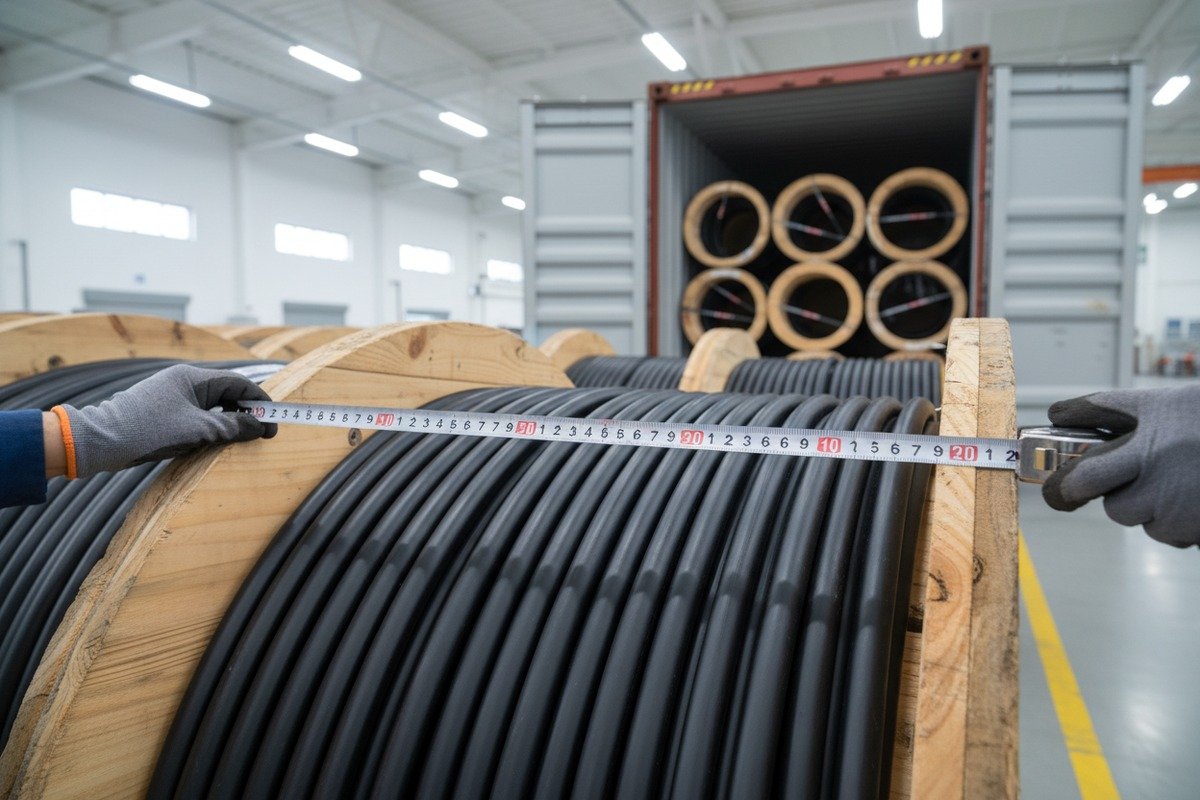
Step-by-Step Calculation Method
Start by getting the exact drum dimensions from your supplier. Standard cable drums for EN50618 solar cables typically range from 80 cm to 120 cm in outer diameter and 50 cm to 100 cm in width. EN50618 solar PV cables 7 Each drum's footprint on the container floor is a rectangle equal to the drum diameter × drum width.
Here is the formula:
- Floor area of one drum = Drum diameter × Drum width
- Usable container floor area = Internal length × Internal width × 0.90 (90% utilization factor)
- Max drums on floor = Usable floor area ÷ Drum footprint
- Stackable layers = Internal height ÷ Drum width (only if drums are rated for stacking)
- Total drums = Drums on floor × Layers
- Weight check = Total drums × Average drum weight ≤ Container max payload
Example Calculation: 40HQ with Standard 1000mm Drums
| Parameter | Value |
|---|---|
| Drum outer diameter | 100 cm (1.0 m) |
| Drum width | 70 cm (0.7 m) |
| Average drum weight | 800 kg |
| 40HQ internal dimensions | 12.03 m × 2.35 m × 2.69 m |
| Usable floor area (90%) | 12.03 × 2.35 × 0.90 = 25.4 m² |
| Drum footprint | 1.0 × 0.7 = 0.70 m² |
| Drums on floor | 25.4 ÷ 0.70 ≈ 36 drums |
| Stackable layers | 2.69 ÷ 0.70 ≈ 3 layers (if stackable) |
| Total drums (if stackable) | 36 × 3 = 108 drums |
| Weight check | 108 × 800 kg = 86,400 kg → exceeds 30t limit |
| Weight-limited max | 30,000 ÷ 800 = 37 drums |
This example shows perfectly why weight dominates. Even though 108 drums could theoretically fit by volume, the weight limit caps you at about 37 drums. This is the reality of shipping dense solar cables.
Practical Tips From the Factory Floor
Always request a packing list with exact drum dimensions and weights before you book a container. At our facility, we can customize drum sizes—for instance, packing 500 kg per drum instead of 800 kg to allow more drums and easier on-site handling. We also offer container loading plans as part of our export documentation, which shows exactly where each drum sits inside the box.
If your order includes mixed cross-sections (say, 4mm² and 10mm² EN50618 cables), the drums will have different weights. Run separate calculations for each type and then combine them in a loading simulation. Free tools like SeaRates or Goodloading can help you visualize the arrangement.
Don't Forget the Door Opening
The container door opening is slightly narrower than the internal width. For a 40HQ, the door opening is about 2.34 m wide and 2.58 m tall. Make sure your largest drum can physically pass through. A drum with a 120 cm diameter on a pallet might stand 140 cm tall—that fits, but just barely if you are using a forklift with overhead clearance needs.
Should I prioritize FCL shipping to avoid the risks of damage to my solar cable drums?
One of the most common complaints we hear from European procurement teams involves damaged cable drums arriving after LCL shipments 8. When drums share container space with other cargo, the risk of crushing, shifting, and moisture exposure goes up dramatically.
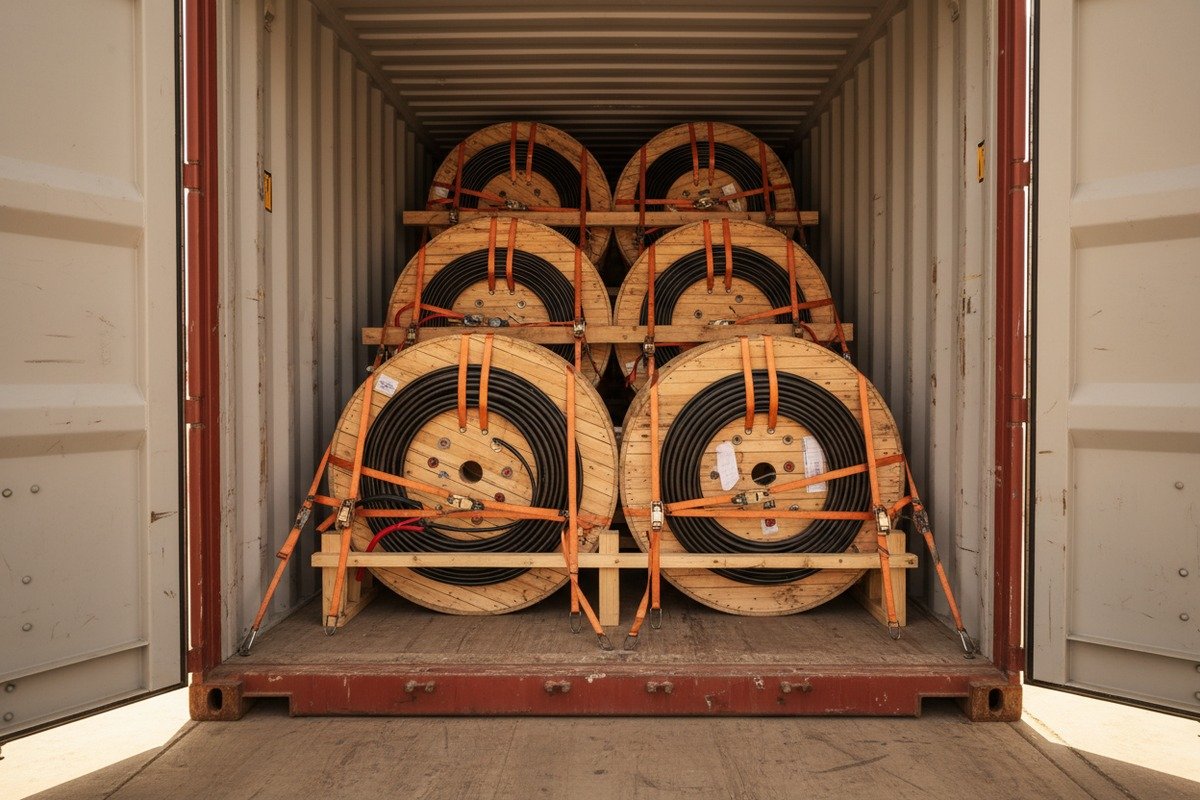
Yes, FCL shipping should be your default choice for solar cable drums. FCL eliminates the multiple handling stages of LCL, reduces damage risk by 60–70%, and gives you full control over loading, bracing, and moisture protection inside the container.
Why LCL Is Risky for Cable Drums
LCL means your drums share space with other shippers' cargo inside a consolidation warehouse. The drums get loaded, unloaded, and reloaded at least two extra times compared to FCL. Each handling event is a chance for forklift damage, drum collapse, or moisture ingress. We have documented cases where clients received drums with cracked flanges after LCL transit—cables were fine, but the drum couldn't mount onto an automated cable-laying machine. That forced expensive manual pulling on-site, adding days to installation schedules.
LCL also adds 7–14 days to transit time due to warehouse consolidation and deconsolidation at both ends. For projects with grid-connection deadlines, that delay alone can trigger financial penalties worth far more than any freight savings.
When LCL Still Makes Sense
LCL can work for sample orders, small trial batches under 3 cbm, or when you are testing a new supplier. If your order is under 5 tonnes and you are not on a tight project timeline, LCL saves 30–50% on freight compared to booking a half-empty 20GP FCL. But protect the drums: insist on wooden crating, moisture-proof wrapping, and "do not stack" labels.
FCL Damage Prevention Best Practices
With FCL, you control the entire container. Here is what we recommend to our clients:
- Wooden pallets or cradles under each drum to prevent rolling.
- Ratchet straps and airbags between drum rows to block shifting.
- Silica gel desiccant packets inside the container to control humidity (especially for shipments to tropical destinations).
- Plastic shrink wrap around each drum as an extra moisture barrier.
- Loading photos and a seal number documented and shared before the container leaves the factory.
Cost Comparison: FCL vs. LCL
| Factor | FCL (20GP) | LCL (Shared 20GP) |
|---|---|---|
| Freight for 8 tonnes | ~$3,500 | ~$2,000–$2,500 |
| Handling stages | 2 (load + unload) | 4–6 (multiple transfers) |
| Transit time (China–EU) | 25–35 days | 35–50 days |
| Damage claim rate | 1–3% | 10–15% |
| Control over loading | Full | None |
| Cost per kg | ~$0.44 | ~$0.28 |
The lower per-kg cost of LCL looks attractive on paper. But factor in the 10–15% damage claim rate and potential project delays, and the real cost often exceeds FCL. One crushed drum that halts a cable-laying crew for two days can cost €5,000+ in labor and penalties.
The Hybrid Approach
Some importers use a hybrid strategy: FCL for their main bulk order and LCL for accessory items like connectors, junction boxes, or cable ties. This keeps the fragile, heavy drums safe while using LCL for items that handle rough treatment better.
How do I optimize my container space to reduce the total landed cost of my solar cables?
Our export team has helped over 200 clients across four continents plan their container loads. The biggest savings never come from just picking the cheapest freight rate—they come from thinking about landed cost as a whole system.
To minimize total landed cost, request container-optimized reel dimensions from your supplier, fill containers to at least 80% capacity, consolidate multi-product orders into single FCL shipments, and factor in customs duties, local trucking, and demurrage fees alongside base freight when comparing options.
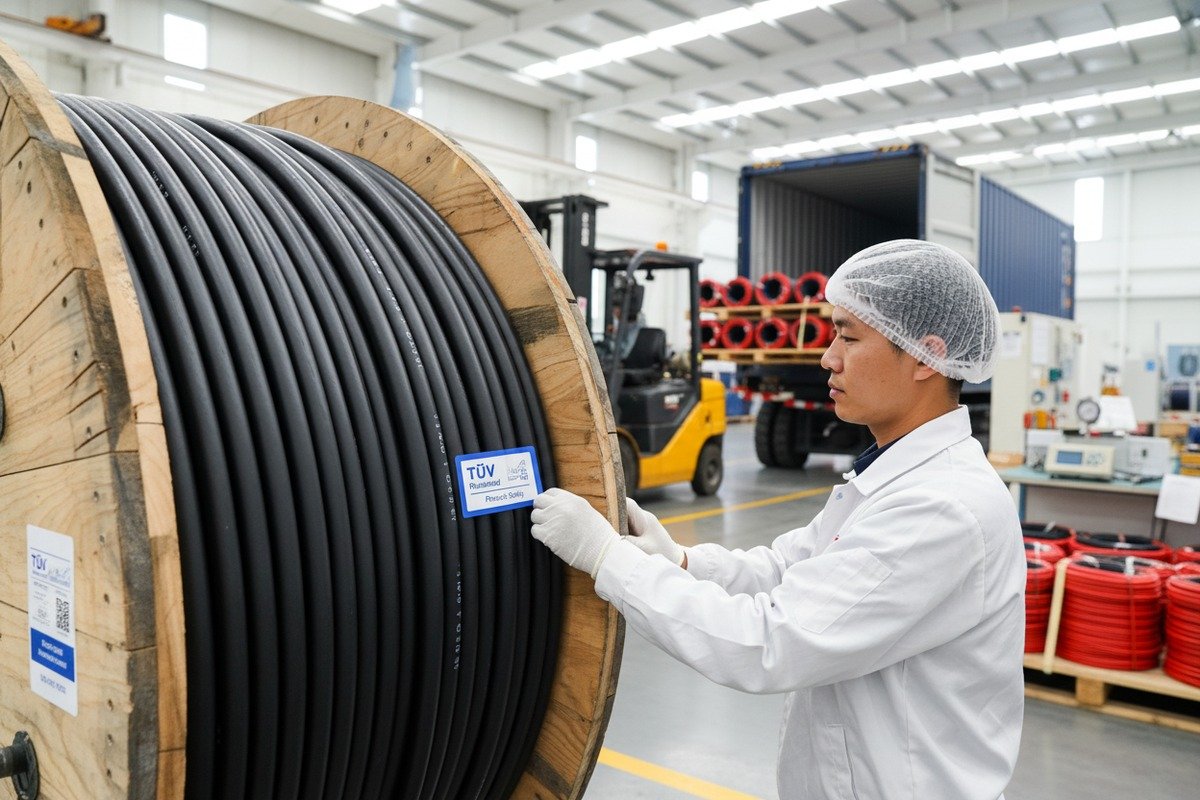
What Is Total Landed Cost?
Total landed cost 9 is everything you pay from the moment cables leave the factory gate in China until they arrive at your warehouse or project site. It includes:
- Factory-gate price of cables
- Inland trucking to port (China side)
- Sea freight
- Port charges and terminal handling
- Customs duties and import VAT
- Local delivery to your site
Many buyers focus only on freight rates and miss the bigger picture. A $500 savings on freight means nothing if poor container utilization forces you to book a second shipment next month.
Container-Optimized Reel Sizes
This is where working closely with your manufacturer pays off. At our factory, we can adjust reel dimensions to match container geometry. For example, a 40HQ has an internal width of 2.35 m. Two drums side by side at 1.1 m diameter each leave a 15 cm gap—workable. But three drums at 80 cm diameter fit at 2.40 m, which is too tight. So we might offer drums at 75 cm diameter, fitting three across with room for bracing material.
We also adjust cable lengths per drum. Instead of a standard 500 m drum, we might wind 450 m or 550 m to hit a target weight that maximizes the container's payload without going over the limit.
Consolidation Strategies
If you are sourcing multiple solar components from China—cables, connectors, mounting rails, junction boxes—consolidating them into a single FCL can slash your per-item shipping cost. Our clients in Germany and the Netherlands frequently combine H1Z2Z2-K cable drums with MC4 connectors and cable trays into one 40HQ. The lighter accessories fill the volume gaps between drums, and total freight per component drops by 20–30%.
Negotiate Incoterms Wisely
Your choice of Incoterms 10 directly affects who controls the container loading and who bears the cost risk.
- FOB (Free on Board): You control shipping from the Chinese port onward. Better for experienced importers who have preferred forwarders.
- CIF (Cost, Insurance, Freight): The supplier arranges shipping. Convenient but less transparent on actual freight costs.
- DDP (Delivered Duty Paid): The supplier handles everything including customs. Highest convenience but you lose visibility into cost breakdown.
For container optimization, FOB gives you the most control. You pick the forwarder, you specify the container type, and you can request specific loading plans.
ROI Benchmark: Real Numbers
Here is a simplified comparison for a 15-tonne H1Z2Z2-K cable order shipped from Ningbo to Hamburg:
| Scenario | Container | Freight | Landed Cost/kg | Savings vs. Worst Case |
|---|---|---|---|---|
| 2 × 20GP (half-filled) | 20GP × 2 | $7,000 | $0.47 | Baseline |
| 1 × 40HQ (well-packed) | 40HQ × 1 | $5,200 | $0.35 | 26% savings |
| 1 × 40HQ + consolidation | 40HQ × 1 | $5,200 | $0.31 | 34% savings |
The third scenario includes connectors and mounting clips filling dead space. The freight cost stays the same, but the total landed cost per kilogram drops because you spread the fixed shipping cost across more product value.
Avoid Common Pitfalls
- Forgetting tare weight. A 40HQ container itself weighs about 3.8–4.0 tonnes. The gross weight limit is about 30.5 tonnes, so your actual cargo payload is roughly 26.5 tonnes.
- Ignoring BAF surcharges. Bunker Adjustment Factor surcharges can add 20–50% to base freight, especially during oil price spikes. Always ask for an all-in quote.
- Poor palletizing. Drums that shift during transit cause damage claims. Budget $200–$500 for proper bracing materials—it pays for itself many times over.
- Demurrage and detention. If you don't unload the container within the free days at the destination port (usually 5–7 days), daily charges of $50–$150 kick in. Plan your receiving logistics before the ship sails.
Conclusion
Choosing the right container size for your solar PV cable shipment is not guesswork—it is math combined with logistics experience. Match weight and volume to container limits, prioritize FCL for drum protection, and always calculate total landed cost. Contact our team at [email protected] for container-optimized packing plans tailored to your next order.
Footnotes
1. Explains the technical standard and application of H1Z2Z2-K solar cables. ↩︎
2. Replaced HTTP unknown link with an authoritative source (Maersk) providing specific cargo weight limits for various container types. ↩︎
3. Explains Full Container Load shipping, its advantages, and suitability for large volumes. ↩︎
4. Explains how silica gel is used to prevent moisture damage during shipping. ↩︎
5. Provides specifications and common uses for a 20-foot general purpose shipping container. ↩︎
6. Describes the dimensions and capacity of a 40-foot high cube shipping container. ↩︎
7. Details the European standard for low smoke halogen-free solar PV cables. ↩︎
8. Describes Less than Container Load shipping, its process, and potential risks. ↩︎
9. Defines the comprehensive cost of a product from origin to final destination. ↩︎
10. Explains international commercial terms defining responsibilities in global trade. ↩︎