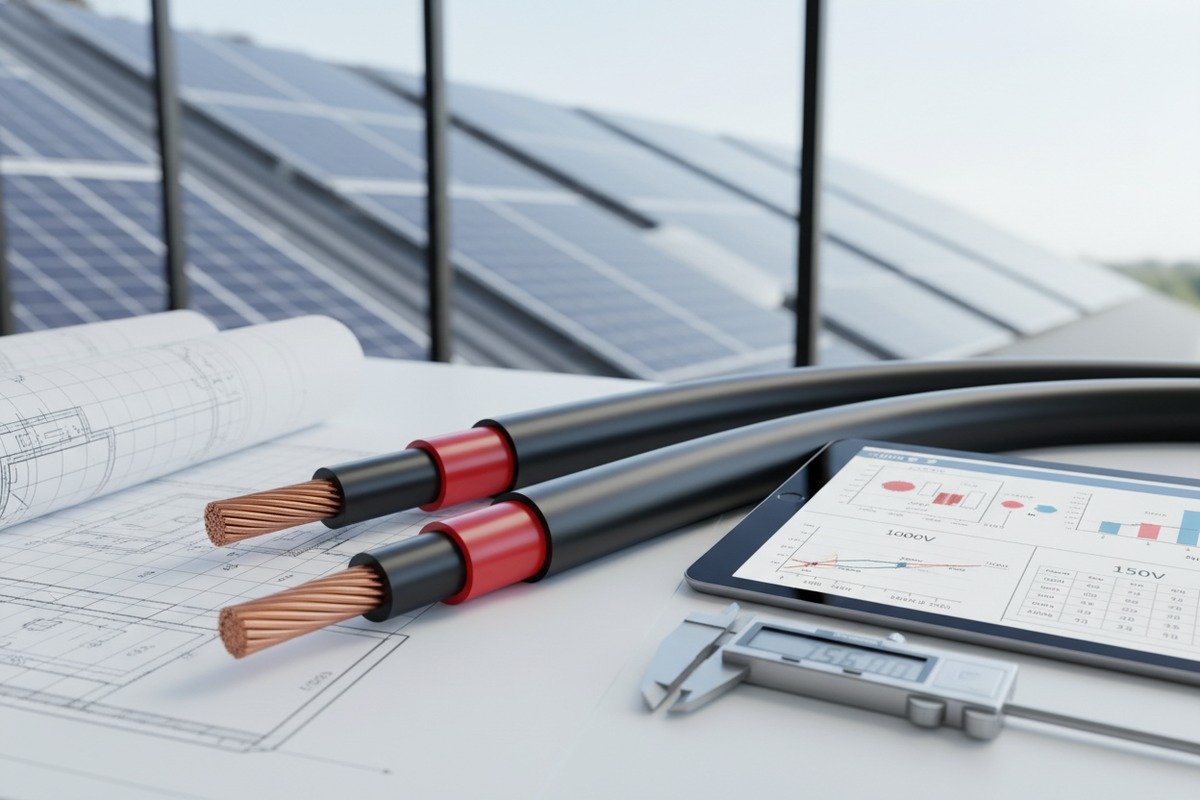
Every week, our sales team fields the same question from EPC buyers across Europe and Latin America: should I go with 1000V or 1500V solar PV cables?
Choose 1000V PV cables (PV1-F) for residential and small commercial systems under 50kW where string voltage stays below 1000V DC. Select 1500V cables (H1Z2Z2-K per EN 50618) for commercial, industrial, and utility-scale projects above 50kW, where longer strings and lower currents reduce balance-of-system costs by 15–20%.
The solar industry has moved fast. What was standard five years ago is now outdated. In this guide, we break down the technical, financial, and safety factors you need to weigh before placing your next cable order. Whether you run a 10kW rooftop or a 100MW solar farm, this article gives you a clear decision framework.
How do I determine if my solar project requires 1000V or 1500V cables to meet system voltage requirements?
Sizing cables to the wrong voltage class is one of the most expensive mistakes we see when auditing customer orders at our Hainan facility.
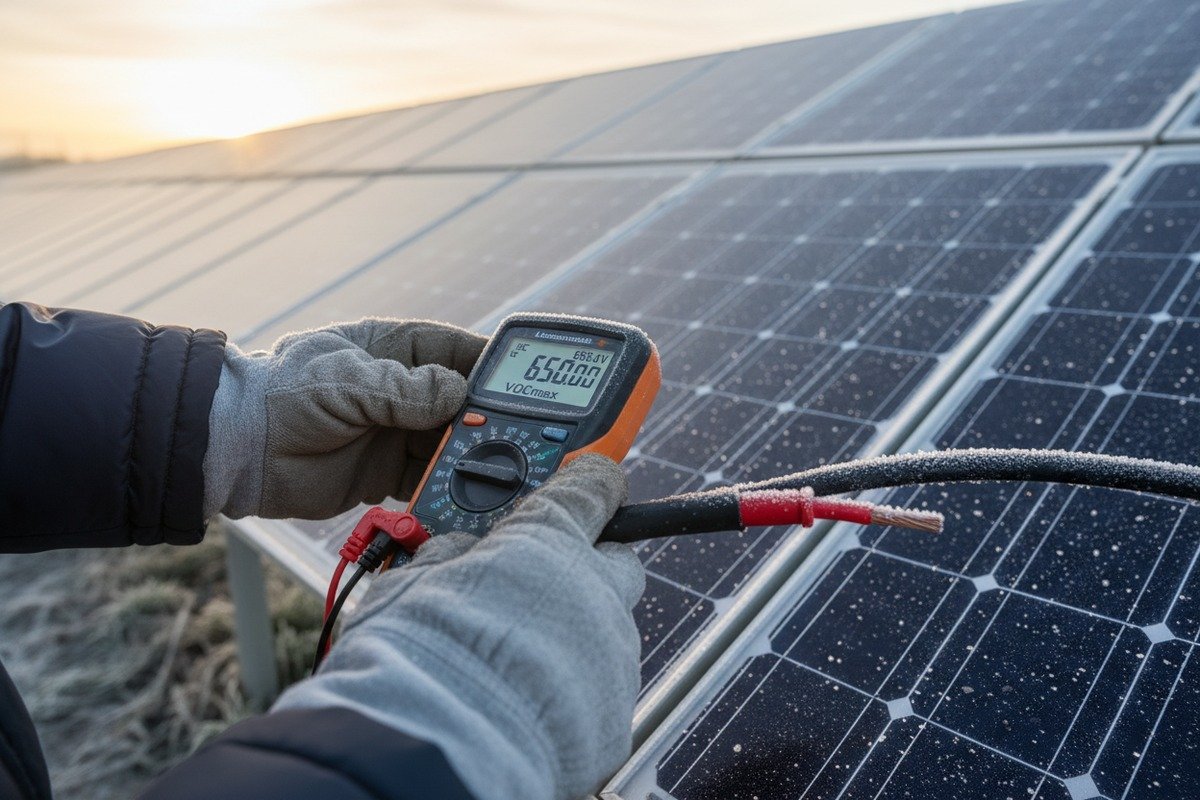
Start by calculating your string's maximum open-circuit voltage (Voc) at the lowest expected temperature. If total string Voc stays under 1000V DC, PV1-F cables rated to 1000V are sufficient. If your design pushes Voc above 1000V—common in strings of 30+ modules—you must use 1500V-rated H1Z2Z2-K cables.
Understanding String Voltage and Voc
The voltage of a PV string equals the sum of every module's open-circuit voltage (Voc). string's maximum open-circuit voltage (Voc) 1 Temperature matters a lot. On cold mornings, Voc rises. A module rated at 40V Voc at standard test conditions 2 could hit 45V or higher at –10°C. Multiply that by 25 modules, and you reach 1125V—well above 1000V.
This is exactly why our engineering team always asks buyers for site temperature data before recommending a cable type. We have seen projects in northern Germany and southern Chile where winter temperatures push string voltages past 1000V even though summer calculations looked safe.
Step-by-Step Decision Process
- List your module Voc from the datasheet (at STC, 25°C).
- Apply the temperature correction coefficient for your site's record low temperature. Most module datasheets include this.
- Multiply corrected Voc by the number of modules in series.
- Compare the result to your cable voltage rating. If it is 1000V or below, PV1-F works. If it exceeds 1000V, you need H1Z2Z2-K rated to 1500V DC.
Quick Reference Table: System Size vs Cable Voltage
| System Size | Typical Application | Modules per String | Likely Max Voc | Recommended Cable |
|---|---|---|---|---|
| 3–10 kW | Residential rooftop | 8–15 | 400–650V | PV1-F (1000V) |
| 10–50 kW | Small commercial | 15–25 | 650–1000V | PV1-F (1000V) |
| 50–500 kW | Large commercial / C&I | 25–38 | 1000–1400V | H1Z2Z2-K (1500V) |
| 1 MW+ | Utility-scale power plant | 30–40+ | 1200–1500V | H1Z2Z2-K (1500V) |
Why This Matters for Procurement
If you are a supply chain director sourcing cables for multiple project tiers—residential installs in the Philippines plus a 50MW farm in Brazil—you need both cable types in your inventory. Our warehouse in Hainan keeps stock of both PV1-F and H1Z2Z2-K in common cross-sections (4mm², 6mm², 10mm², and 16mm²) so we can ship mixed containers within 15–20 days. That flexibility prevents the lead-time delays that cause grid-connection penalties.
Do not guess your voltage class. Calculate it. One wrong assumption can force a full re-cable job on site, costing tens of thousands of euros in labor alone.
Will upgrading to 1500V PV cables help me reduce my total balance of system costs?
When we run cost models for EPC clients planning projects above 50kW, the numbers consistently favor the 1500V architecture. balance-of-system costs 3
Yes. Upgrading to 1500V cables allows 50% longer strings, which cuts the total number of strings by up to 37%. This directly reduces combiner boxes, home-run cabling, connectors, and installation labor, delivering total BOS savings of 15–20% compared to equivalent 1000V designs.
How Longer Strings Save Money
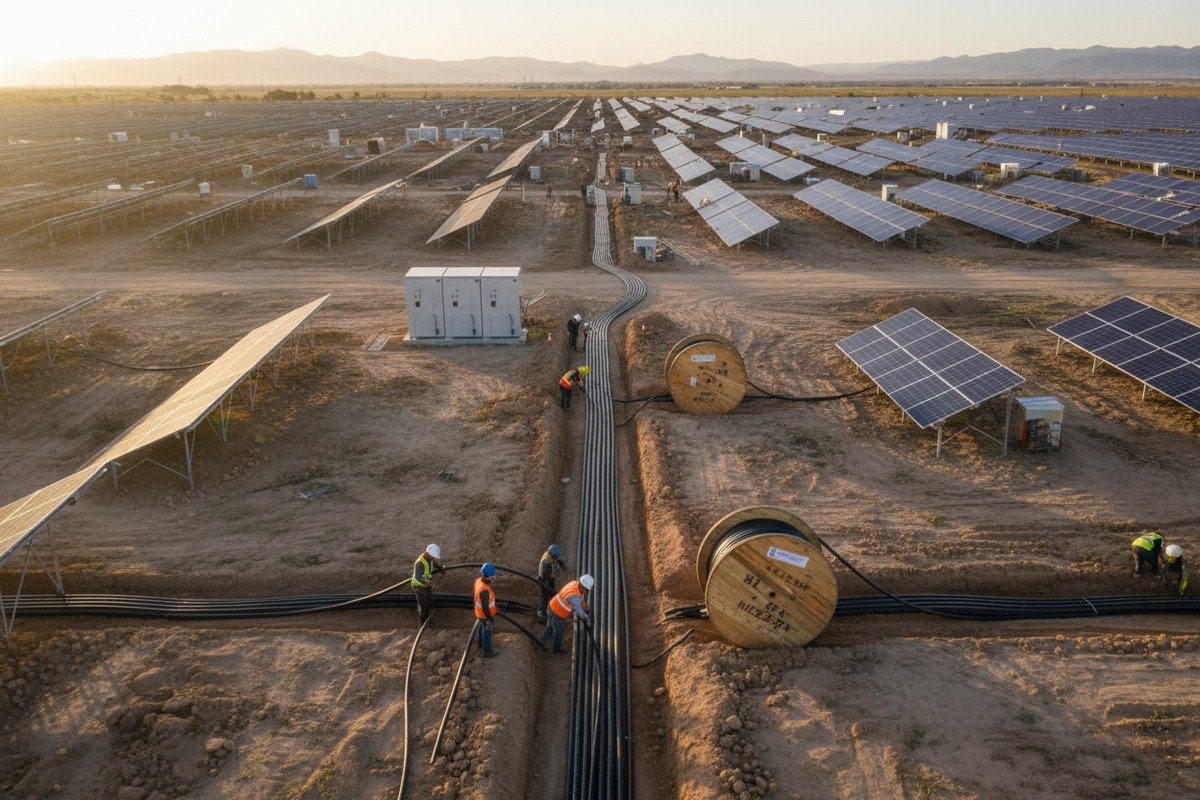
A 1500V system lets you wire more modules in series per string. Where a 1000V system might have 20 modules per string, a 1500V system can handle 30 or more. Fewer strings means fewer string cables, fewer MC4 connectors 4, fewer combiner boxes, and fewer DC fuses.
On a 10MW project, our clients have reported reducing string count from around 1,600 to about 1,050. That is roughly 550 fewer strings. Each string needs its own cable run, fuse, and combiner input. The savings add up fast.
Cost Comparison: 1000V vs 1500V Architecture
| Cost Factor | 1000V System | 1500V System | Savings with 1500V |
|---|---|---|---|
| Modules per string | ~20 | ~30 | 50% longer strings |
| Number of strings (10MW example) | ~1,600 | ~1,050 | ~34% fewer strings |
| Combiner boxes | More units needed | Fewer units needed | 30–37% reduction |
| DC cable total length | Higher | Lower | 20–30% less cable |
| Installation labor hours | Higher | Lower | 15–25% less labor |
| Cable cost per meter (10mm² Cu) | Lower unit price | ~10–15% higher unit price | Offset by volume reduction |
| Total BOS cost impact | Baseline | 15–20% savings | Net positive |
The Current Reduction Advantage
Higher voltage means lower current at the same power level. For a given string power output, a 1500V string carries 31–37% less DC current than a 1000V string. Lower current means lower I²R resistive losses 5 in the cables. This is especially significant on long cable runs—say 500m to 2km from array to inverter—common in utility-scale plants.
At our factory, we produce both copper and aluminum-core H1Z2Z2-K cables. For runs over 500 meters, many of our European and Middle Eastern clients switch to aluminum-core 25mm² or 35mm² cables. The combination of 1500V architecture and aluminum conductors can cut cable material costs by 40% or more versus copper in a 1000V layout.
When the Upgrade Does Not Make Sense
For residential systems under 10kW with short cable runs under 30 meters, the per-meter premium of H1Z2Z2-K over PV1-F is not justified. The BOS savings are minimal because there are only a few strings anyway. Stick with PV1-F in those cases. The crossover point is typically around 50kW—above that, 1500V pays for itself.
How can I verify that my 1500V solar cables comply with TUV EN50618 or UL 4703 standards?
Certification fraud is a real and growing problem. Our quality control team has encountered counterfeit TUV certificates from competing suppliers more than once during trade-show audits.
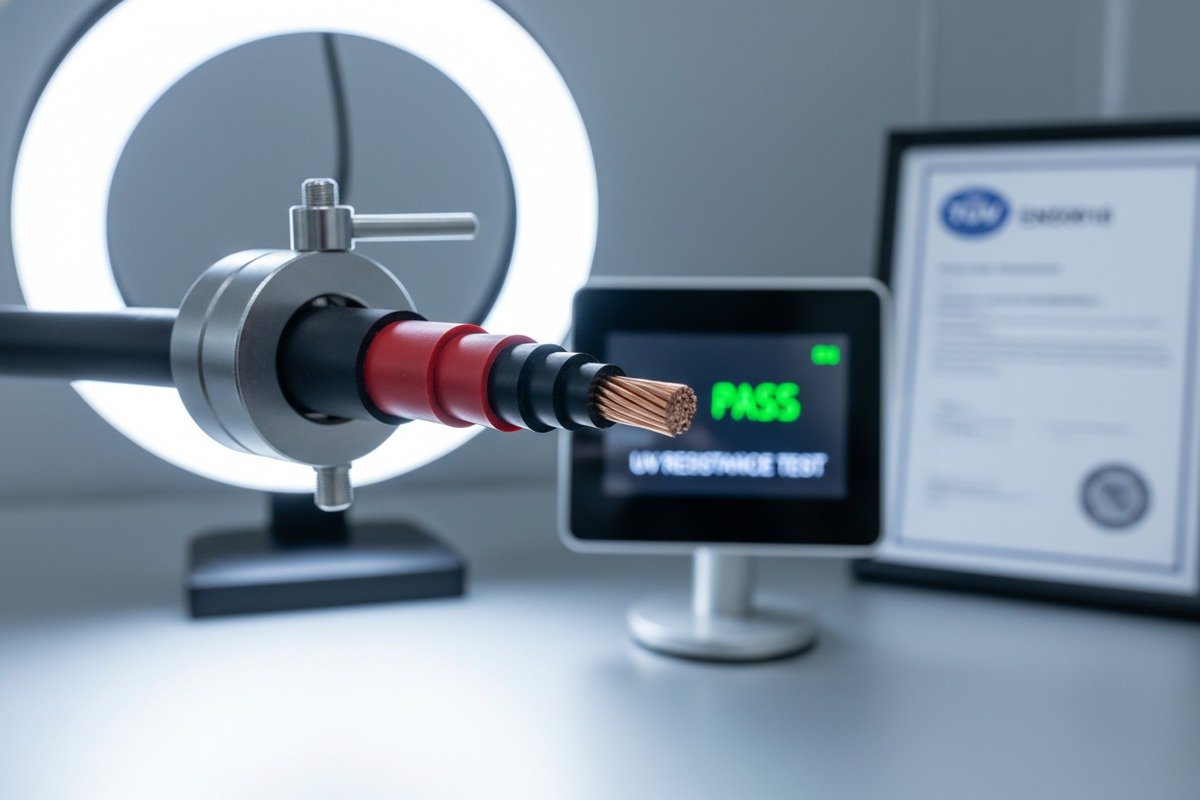
Verify compliance by requesting the original TUV or UL certificate number, then cross-checking it on the certifying body's online database (e.g., TUV SUD's Certipedia or UL's Product iQ). Insist on batch-specific test reports, inspect cable markings for continuous meter printing with the standard designation, and consider third-party pre-shipment inspection.
Key Standards Explained
There are two primary international standards for 1500V-rated solar cables:
- EN 50618 (TUV certified): The European standard for solar cables rated up to 1500V DC. It specifies insulation and sheath material requirements, UV resistance, ozone resistance, temperature range (–40°C to +90°C continuous, 120°C short-circuit), and mechanical strength. EN 50618 (TUV certified) 6 This is the standard Klaus Weber and other German EPC buyers demand.
- UL 4703: The North American standard for photovoltaic wire. It covers 600V, 1000V, and 2000V ratings. For 1500V systems in the US or Canada, you need UL 4703 7 cables rated at 2000V. This standard addresses flame resistance, cold bend, and sunlight resistance.
Verification Checklist
Here is the process we recommend to every buyer, and it is the same process we follow when certifying our own production:
- Request the certificate PDF directly from the supplier. Do not accept screenshots.
- Check the certificate number on TUV's Certipedia (certipedia.com) or UL's Product iQ (iq.ulprospector.com). Both databases are free and public.
- Match the certificate scope to the exact cable type, cross-section, and voltage rating you are ordering. A TUV certificate for PV1-F at 1000V does NOT cover H1Z2Z2-K at 1500V.
- Verify the certificate holder matches your supplier's legal entity name.
- Check the expiration date. TUV certificates typically require annual surveillance audits. An expired certificate is as bad as no certificate.
- Inspect cable markings. Compliant cables are printed continuously along their length with: manufacturer name, standard designation (e.g., "H1Z2Z2-K" or "EN 50618"), voltage rating, cross-section, and production date/batch code.
- Request batch test reports. These include results for insulation resistance, high-voltage withstand (typically 6.5kV for 1500V-rated cables), tensile strength, and elongation at break.
Standards Comparison Table
| Feature | EN 50618 (TUV) | UL 4703 |
|---|---|---|
| Region | Europe, Middle East, Asia, Africa | North America (US, Canada) |
| Max DC voltage | 1500V | 2000V |
| Temperature range | –40°C to +90°C (120°C short-circuit) | –40°C to +90°C |
| UV resistance | Required (EN 50618 Annex) | Required (Sunlight Resistant marking) |
| Fire rating | CPR classification available (Eca to Cca) | VW-1 flame test |
| Insulation material | Electron-beam cross-linked polyolefin (XLPO) | XLPE or XLPO |
| Mechanical strength | 30% higher than PV1-F specification | Comparable crush/impact tests |
| Cable marking | Continuous print with standard, voltage, size | Continuous print with UL listing mark |
CPR Fire Safety Compliance
For European projects, the Construction Products Regulation (CPR) 8 adds another compliance layer. Cables installed in buildings must carry a fire classification. Our H1Z2Z2-K cables are tested and classified to Dca-s2,d2,a2 as standard. For projects requiring Cca class—common in commercial rooftop installations in Germany and the Netherlands—we offer an upgraded compound at a modest premium.
We ship every container with a Declaration of Performance (DoP) document linked to the CPR classification. This prevents the customs hold-ups and building authority rejections that plague buyers who source from uncertified factories.
What are the potential risks to my system if I use 1000V cables in a high-voltage 1500V environment?
During a factory audit last year, one of our visiting clients from Brazil shared photos of a burnt combiner box. The root cause was a 1000V-rated PV1-F cable used on a string reaching 1,280V in winter.
Using 1000V-rated cables in a 1500V system risks insulation breakdown, leading to DC arcing, ground faults, cable fires, and complete system failure. This also voids equipment warranties, violates electrical codes (IEC 60364, NEC 690), and creates serious liability for installers and project owners.
Insulation Breakdown: The Core Danger
PV1-F cables are designed with insulation rated to withstand 1000V DC continuously and pass a high-voltage withstand test at roughly 5kV. H1Z2Z2-K cables for 1500V systems are tested at 6.5kV or higher. The difference is not just a number on paper. The insulation thickness, material cross-linking density, and dielectric strength are all engineered for the higher voltage class.
When you apply 1200V, 1300V, or 1500V across insulation built for 1000V, the electric field stress exceeds the material's design limit. insulation breakdown 9 Micro-cracks, moisture ingress, and UV degradation—normal wear over a 25-year lifespan—accelerate this failure. What might take 20 years to degrade in a properly rated cable can fail in 3–5 years in an overstressed one.
Failure Cascade
Here is what happens in sequence:
- Partial discharge begins inside micro-voids in the insulation. This is invisible and undetectable without specialized equipment.
- Insulation resistance drops over months. Leakage current increases.
- A ground fault develops. The inverter may detect it and shut down, or it may not—depending on the fault impedance.
- DC arc ignition. If the fault creates an air gap, a sustained DC arc forms. DC arcing 10 Unlike AC arcs, DC arcs do not self-extinguish at zero-crossing. They burn continuously.
- Fire. The arc temperature can exceed 3,000°C, igniting cable insulation, mounting structures, and roofing materials.
Real-World Consequences
We have heard from multiple EPC contacts that post-incident investigations almost always trace cable fires back to one of two causes: improper connector crimping, or voltage-mismatched cables. The second cause is entirely preventable through proper sourcing.
Financial and Legal Impact
Beyond the obvious physical danger, the financial fallout is severe:
- Insurance claims denied if the investigation reveals code-noncompliant cables.
- Equipment warranties voided by inverter and module manufacturers.
- Project downtime during investigation and re-cabling, often 2–6 months.
- Regulatory fines in markets with strict electrical inspection regimes (Germany, Australia, California).
- Litigation risk from property damage or personal injury claims.
Mechanical Strength Gap
It is not only about voltage. The 1500V-rated H1Z2Z2-K cable has roughly 30% higher mechanical strength in compression and tension compared to PV1-F. In utility-scale installations where cables are directly buried, run through cable trays over long distances, or exposed to high wind loads, this extra strength prevents physical damage that could compromise insulation integrity over the system's lifetime.
Our production lines for H1Z2Z2-K use electron-beam cross-linked polyolefin insulation that withstands 125°C short-circuit temperatures. PV1-F insulation typically handles 120°C. That 5°C margin may seem small, but at high fault currents, it is the difference between an intact cable and a melted one.
Do Not Retrofit—Replace
Some installers ask whether they can "derate" a 1500V system to keep it under 1000V and use cheaper cables. Technically, yes—by shortening strings. But this defeats the entire purpose of the 1500V architecture. You lose the BOS savings, the lower current advantage, and the efficiency gains. If you have committed to a 1500V inverter and array design, use 1500V cables. There is no safe shortcut.
Conclusion
Choosing between 1000V and 1500V solar PV cables comes down to your system voltage, project scale, and long-term cost strategy. Calculate your string Voc, match it to the right cable standard, verify certifications independently, and never compromise on voltage ratings. If your next project is above 50kW, 1500V H1Z2Z2-K cables from a certified manufacturer like Lonsoncable are the safer, smarter, and more economical choice.
Footnotes
1. Defines open-circuit voltage (Voc) as the maximum voltage from a solar cell at zero current. ↩︎
2. Explains standard test conditions (STC) for solar panels, including irradiance and temperature. ↩︎
3. Explains what balance of system costs entail in solar PV projects. ↩︎
4. Describes MC4 connectors as essential for safe and efficient solar panel interconnections. ↩︎
5. Explains resistive losses (I²R losses) as energy loss due to current flow through resistance. ↩︎
6. Details EN 50618 as the European standard for low smoke, halogen-free PV cables. ↩︎
7. Provides the scope of UL 4703, the North American standard for photovoltaic wire. ↩︎
8. Explains the Construction Products Regulation (CPR) and its fire performance requirements for cables. ↩︎
9. Discusses how high temperatures and environmental factors influence insulation breakdown voltage in cables. ↩︎
10. Explains DC arcing as a serious fault in PV systems that can lead to fire and system damage. ↩︎