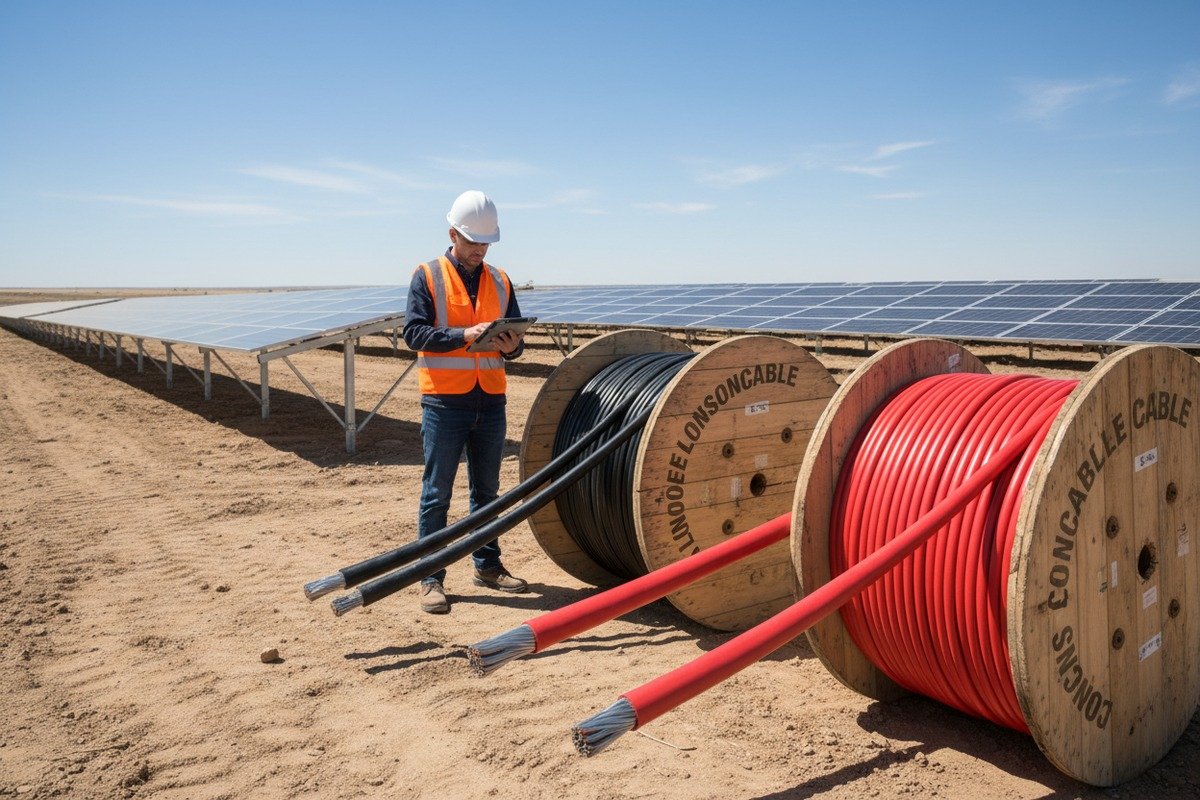
Every year, our production lines ship millions of meters of solar PV cable 1 to utility-scale projects across four continents. Yet procurement teams still tell us the same story: they ordered too much cable and wasted budget, or worse, ran short mid-installation and faced costly delays.
To calculate total solar PV cable length for a large-scale ground-mounted plant, sum all DC string cable runs, AC collection cable runs, and array-to-inverter distances. Then multiply by two for positive and negative conductors, and add a 5–10% safety margin for routing, terrain, and installation slack.
This guide breaks down the full process into clear steps utility-scale projects 2. We will cover DC string estimation, terrain-based safety margins, inverter architecture impact, and drum-length optimization. Let's walk through each one.
How do I accurately estimate the DC string cable length for my large-scale ground-mounted project?
When our engineering team reviews cable orders from EPC clients, DC string cable 3 is almost always the largest single line item. Getting this number wrong can throw off your entire procurement budget.
To estimate DC string cable length, measure the intra-row wiring per string, add the home-run distance from each string to the inverter or combiner box, multiply by two for positive and negative conductors, and then multiply by the total number of strings in your plant.
Break the Problem Into Segments
The key to accuracy is breaking the total cable path into segments. Do not try to estimate one average number for the whole plant. Instead, treat each segment separately.
A typical DC string cable route has three segments:
- Intra-string wiring — the cable connecting modules in series within one string.
- String tail drop — the cable descending from the module frame down to ground level or cable tray.
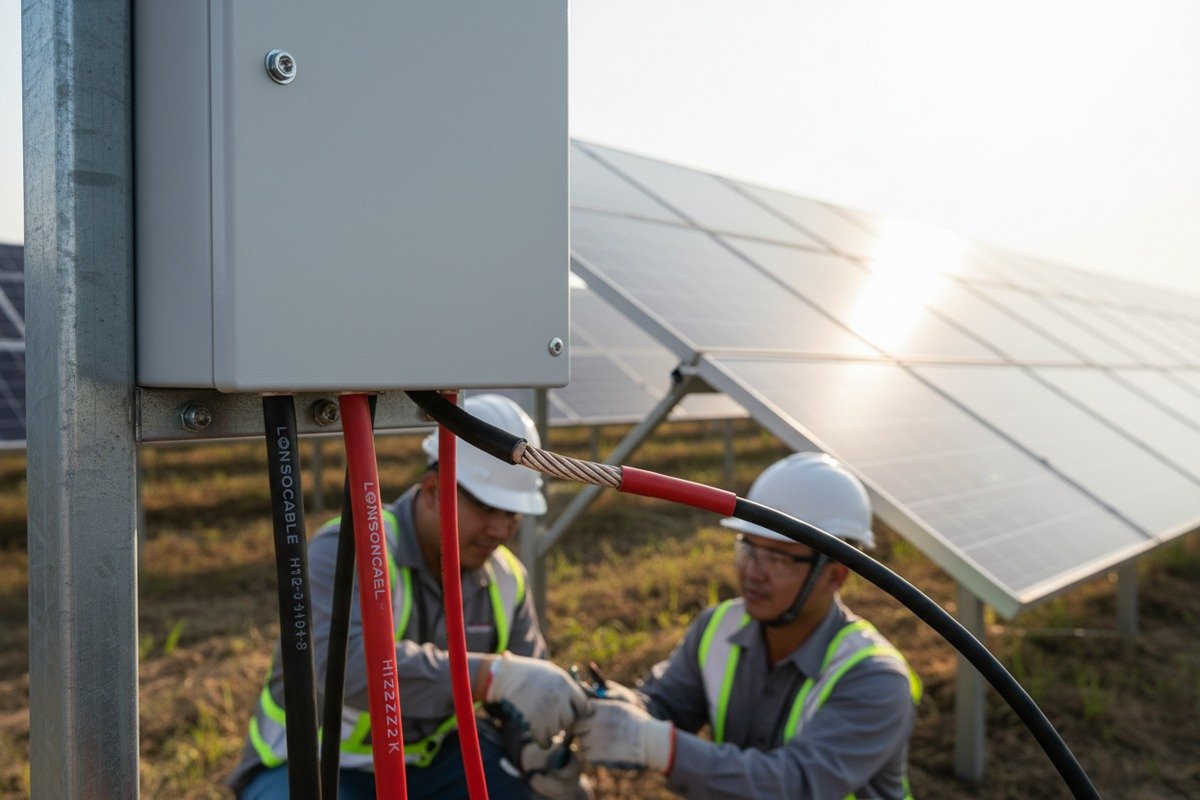
- Home-run to inverter/combiner — the cable running horizontally from the end of the string to the inverter or combiner box 4.
Intra-String Wiring
This segment depends on your module orientation 5 (portrait or landscape), the number of modules per string, and the module dimensions. In portrait orientation, modules sit side by side, so the cable runs roughly equal to the string count times the module width. In landscape, it equals the string count times the module height.
| Parameter | Portrait Orientation | Landscape Orientation |
|---|---|---|
| Module dimension used | Width (~1.13 m) | Height (~2.28 m) |
| Cable run per module | ~1.2 m (with connector slack) | ~2.4 m (with connector slack) |
| 28-module string total | ~33.6 m | ~67.2 m |
| Positive + Negative (×2) | ~67.2 m | ~134.4 m |
These numbers show how orientation alone can double your intra-string cable. Always confirm which orientation your racking vendor specifies.
Home-Run Distance
The home-run is the cable that travels from the last module in the string to the combiner box or inverter input. This distance varies by row position. Rows closer to the inverter need shorter home-runs. Rows at the far end of the array need much longer ones.
For a plant with 20 rows spaced 6 meters apart, the nearest row might have a 10-meter home-run while the farthest row has a 130-meter home-run. You must calculate each row individually, not use a single average.
Worked Example
Consider a 5 MW ground-mounted plant:
- 10,000 modules at 500 Wp each
- 28 modules per string → 357 strings
- Portrait orientation, intra-string cable ≈ 34 m per string
- Average home-run distance ≈ 65 m per string
- String tail drop ≈ 3 m per string
Total per string (one conductor) = 34 + 65 + 3 = 102 m
Both conductors (×2) = 204 m
Total DC string cable = 357 × 204 = 72,828 m
This is a rough estimate. Real projects require row-by-row measurement. But this framework keeps you within a reasonable range for procurement planning.
Do Not Forget the Doubling Rule
One of the most common mistakes we see is forgetting that every cable run needs both a positive and a negative conductor. A 50-meter run means 100 meters of cable. On a utility-scale project, this oversight can mean tens of thousands of meters of missing cable.
What percentage of extra cable should I factor in for site-specific terrain and installation slack?
Our customers in Southeast Asia and the Middle East often deal with uneven terrain, sandy soil, and wide temperature swings. From decades of shipping cable to these regions, we have learned that the "on-paper" length is never the actual length you need on-site.
For large-scale ground-mounted PV plants, add a safety margin of 5–10% for flat terrain and 10–15% for hilly or irregular terrain. This margin covers routing detours, installation slack at junction points, cutting waste, and cable tray bends that add length beyond straight-line measurements.
Why Straight-Line Measurements Fail
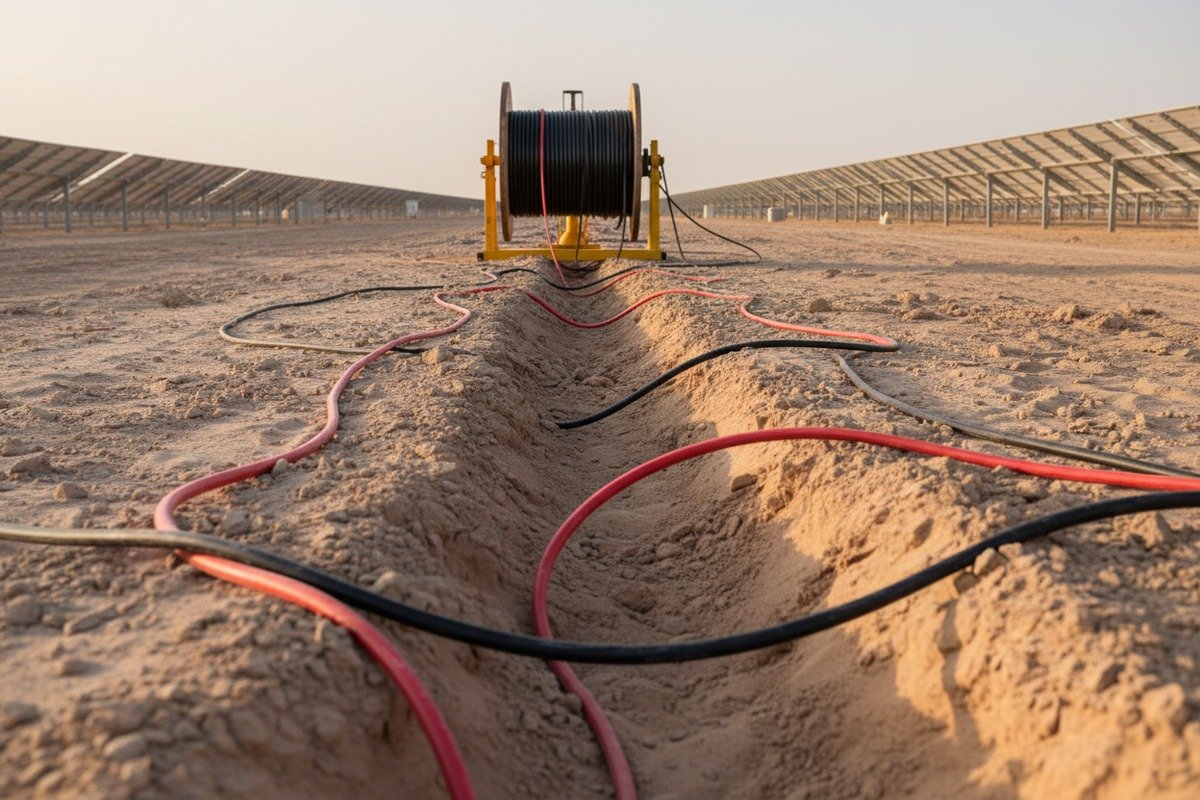
Design software often calculates cable distances as point-to-point lines. But cables do not travel in straight lines. They follow cable trays, dip into trenches, rise over obstacles, and bend around equipment. Every bend adds length. Every descent from a module frame to a trench adds a vertical drop segment.
On a single string, these additions might seem small — maybe 2 to 5 extra meters. But multiply that across 300 or 400 strings, and you are looking at 600 to 2,000 meters of unaccounted cable.
Terrain Categories and Recommended Margins
| Terrain Type | Typical Challenges | Recommended Safety Margin |
|---|---|---|
| Flat, cleared land | Minimal routing detours | 5–7% |
| Gently rolling hills | Elevation changes, longer trench runs | 8–10% |
| Rocky or irregular terrain | Frequent detours around rock, extra bends | 10–15% |
| Sloped sites (>5° grade) | Vertical drops, retaining walls, longer tray runs | 12–15% |
Specific Factors That Add Length
Cable tray bends: Each 90-degree bend in a cable tray adds roughly 0.3 to 0.5 meters depending on tray width. A typical row might have 4 to 6 bends.
Junction box and combiner connections: At each connection point, you need extra slack for termination — usually 0.5 to 1 meter per end.
Trench entry and exit: When cables transition from above-ground trays to underground trenches, the vertical rise or drop adds 1 to 3 meters per transition.
Thermal expansion allowance: In hot climates, cables expand slightly. Professional installers leave a small amount of slack to prevent tension on connectors.
A Practical Rule of Thumb
For most flat-terrain projects in Europe or the Middle East, we recommend 7–8% as a practical safety margin. This number has been validated across hundreds of projects our cable has been used on. For projects in mountainous regions of Latin America or island sites in Southeast Asia, go to 12–15%.
The cost of ordering 10% extra cable is far less than the cost of halting construction because you ran short. Shipping emergency cable orders by air freight can cost 5 to 10 times the normal logistics rate.
How will my choice between central and string inverters change my total PV cable quantity?
This is a question we get weekly from EPC procurement teams, especially those bidding on projects across different markets. The inverter architecture decision is often made by the system designer, but the procurement team needs to understand how it reshapes the entire cable bill of materials.
Choosing central inverters typically requires longer DC cable runs to a single collection point but fewer AC cables, while string inverters shorten DC runs dramatically but require significantly more AC cable and more individual cable connections. The total cable quantity and cost can differ by 15–30% between the two architectures.
Central Inverter Architecture
In a central inverter layout, multiple strings feed into combiner boxes, and combiner boxes feed into one large inverter (typically 1 MW to 4.6 MW capacity). This means:
- DC cables run from every string to a combiner box, then from the combiner box to the central inverter.
- The inverter is often placed at the center or edge of a large array block.
- DC home-run distances can be very long — 50 to 200 meters from the farthest strings.
- AC cable from the inverter to the transformer is short and thick, but there are fewer AC runs overall.
String Inverter Architecture
With string inverters 6 (typically 100 kW to 350 kW), each inverter sits close to the strings it serves. This means:
- DC cable runs are very short — often just 10 to 30 meters from the string end to the inverter input.
- No combiner boxes are needed, eliminating that cable segment entirely.
- However, each string inverter outputs AC power, requiring AC cable runs from every inverter to the AC collection point or transformer.
- The number of AC cable runs is much higher.
Cable Quantity Comparison
| Cable Type | Central Inverter (5 MW block) | String Inverter (5 MW block) |
|---|---|---|
| DC string cable (total) | ~73,000 m | ~28,000 m |
| DC combiner-to-inverter cable | ~8,000 m | 0 m |
| AC inverter-to-transformer cable | ~1,500 m (thick, few runs) | ~18,000 m (thinner, many runs) |
| Total cable length | ~82,500 m | ~46,000 m |
| Total cable cost (relative) | Higher (long DC runs, thick AC) | Lower total length but more connectors |
These numbers are approximations for a typical 5 MW block. Actual quantities depend on layout, spacing, and inverter placement.
Cost Is Not Just About Length
While string inverters often result in less total cable length, the procurement picture is more complex. String inverter systems need more MC4 connectors, more AC disconnects, and more individual cable terminations. Labor costs for connecting hundreds of string inverters can offset the cable savings.
On the other hand, central inverter systems require thicker DC cables for the long home-runs to maintain acceptable voltage drop 7. A 150-meter run at high current may need 10 mm² or even 16 mm² cable instead of the standard 6 mm² or 4 mm². Thicker cable costs more per meter and weighs more, which affects shipping and handling.
Voltage Drop Implications
Longer DC cable runs in central inverter systems increase voltage drop. The formula is straightforward:
Voltage Drop (V) = 2 × Length (m) × Current (A) × Resistivity (Ω/m)
If the voltage drop exceeds 2–3%, you must either increase the cable cross-section or redesign the layout. Both options add cost. This is why many modern utility-scale plants are shifting toward string inverters — they reduce DC cable length and voltage drop simultaneously.
From our production side, we have seen a clear trend: orders for 4 mm² and 6 mm² H1Z2Z2-K solar cable 8 have grown faster than orders for 10 mm² and 16 mm², reflecting the industry's shift toward string inverters with shorter DC runs.
How can I calculate the optimal drum lengths to avoid excessive scrap and reduce my procurement costs?
One detail that separates experienced procurement teams from first-timers is how they order cable drum lengths 10. Our warehouse ships standard drums of 500 m and 1,000 m, but we also cut custom lengths — and there is a good reason why smart buyers request them.
To minimize scrap, map out the most common cable run lengths in your plant, then select drum sizes that are exact multiples of those runs. For example, if your typical home-run is 85 meters, order 510-meter drums (6 × 85 m) instead of standard 500-meter drums, reducing cut-off waste from each drum to near zero.
Why Standard Drum Lengths Create Waste
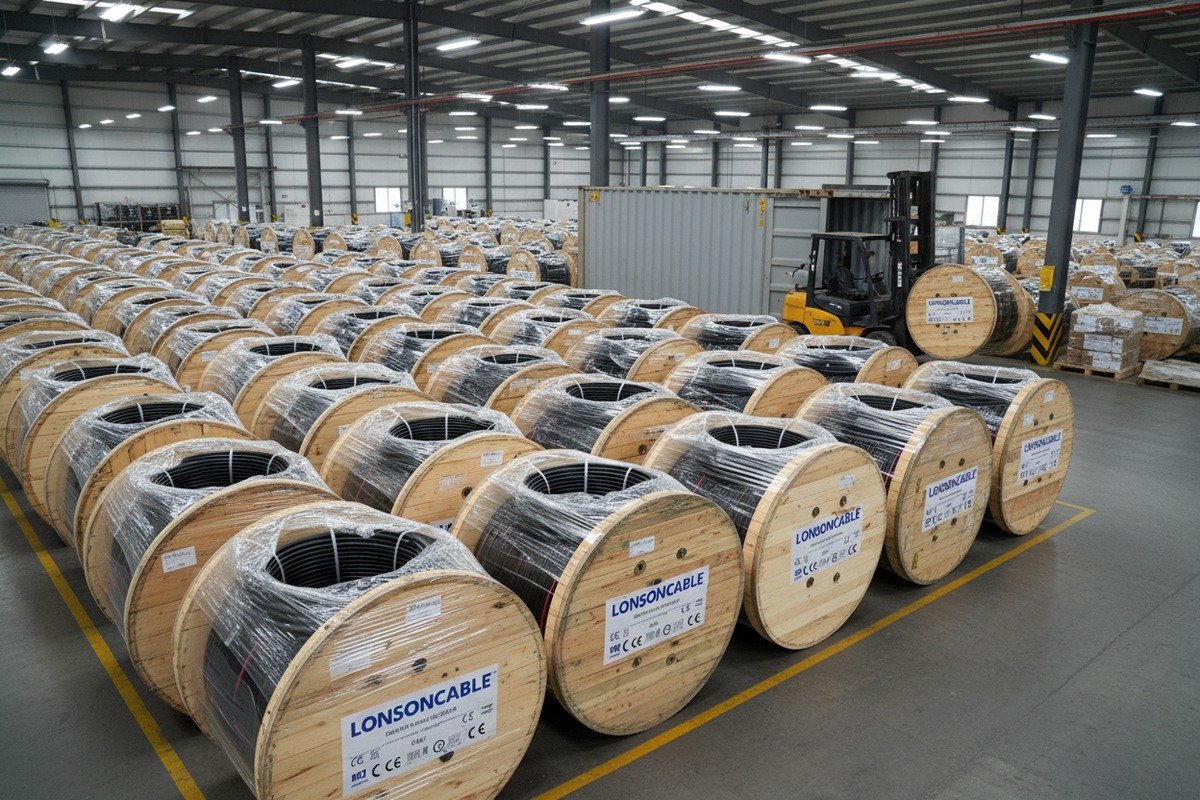
Standard drums come in round numbers — 500 m or 1,000 m. But real cable runs are almost never round numbers. If your typical string cable cut is 112 meters, a 500-meter drum gives you 4 cuts (448 m used) with 52 meters left over. That leftover piece is too short for another full run. Across 200 drums, that is 10,400 meters of scrap — enough to buy several additional drums you did not need.
The Optimization Method
Here is a step-by-step approach:
Step 1: List all unique cable run lengths in your plant. Group them by cable type and cross-section.
Step 2: For each group, find the most common run length. This is your "base unit."
Step 3: Calculate how many base units fit into various drum sizes. Choose the drum size that leaves the smallest remainder.
Step 4: For less common lengths, check if leftover pieces from one drum size can serve shorter runs elsewhere in the plant.
Worked Example
Suppose your 5 MW plant has the following DC cable runs:
| Run Type | Length per Cut | Number of Cuts | Total Cable Needed |
|---|---|---|---|
| Near-row home-run | 45 m | 120 | 5,400 m |
| Mid-row home-run | 85 m | 120 | 10,200 m |
| Far-row home-run | 125 m | 120 | 15,000 m |
| Intra-string | 34 m | 357 | 12,138 m |
For the 85-meter cuts: A standard 500-m drum yields 5 cuts (425 m) with 75 m waste. But a custom 510-m drum yields 6 cuts (510 m) with 0 m waste. Over 20 drums needed for 120 cuts, the standard drums waste 1,500 m total. The custom drums waste nothing.
For the 34-meter intra-string cuts: A 510-m drum gives exactly 15 cuts (510 m) with 0 m waste. A 500-m drum gives 14 cuts (476 m) with 24 m waste per drum. Over 26 drums, that is 624 m of waste.
Negotiate Custom Drum Lengths With Your Supplier
Not all manufacturers offer custom drum lengths, but at our facility, we routinely produce drums in non-standard sizes for large project orders. The tooling cost is minimal, and the savings for the buyer are real. Ask your supplier about this option during the RFQ stage. Provide your cut schedule, and a good supplier will recommend optimal drum sizes.
Packaging and Logistics Considerations
Custom drum lengths also affect shipping. Heavier drums require sturdier wooden reels. We reinforce our reels for drums over 800 meters to prevent collapse during ocean freight — a problem that has delayed more than a few projects when inferior packaging failed in transit. Make sure your drum specification includes reel strength requirements compatible with automated cable-laying machines commonly used on utility-scale sites.
Scrap Rate Benchmarks
A well-optimized drum order should keep scrap below 2%. Poorly planned orders routinely see 5–8% scrap. On a 40,000-meter cable order, the difference between 2% and 7% scrap is 2,000 meters of wasted cable — real money that goes straight to the landfill.
Conclusion
Accurate cable length calculation is the foundation of cost-effective large-scale solar PV procurement. Measure every segment, double for both conductors, add terrain-appropriate margins, and optimize your drum lengths to minimize waste.
Footnotes
1. IEC standard for photovoltaic DC cables. ↩︎
2. Overview of utility-scale solar projects by a leading industry association. ↩︎
3. Replaced HTTP 404 Wikipedia link with a working, authoritative Wikipedia page on photovoltaic systems that discusses strings and cabling. ↩︎
4. Explains the purpose and function of a PV combiner box. ↩︎
5. Provides general information about solar panels, including orientation. ↩︎
6. Replaced HTTP 403 manufacturer product page with an authoritative Wikipedia page section on string inverters. ↩︎
7. Provides tools and information for calculating voltage drop in electrical circuits. ↩︎
8. Details the specifications and standards for H1Z2Z2-K solar cable. ↩︎
9. Describes central inverter technology from a major manufacturer. ↩︎
10. Discusses the management and optimization of cable drums in the industry. ↩︎