Every week, our sales team fields calls from European procurement managers stunned by the gap between the FOB quote they accepted and the final invoice that landed on their desk. The cable price looked competitive. The shipping seemed reasonable. But then came customs duties, VAT, inspection fees, packaging surcharges, and currency conversion losses — costs that turned a smart sourcing decision into a budget nightmare.
To calculate total landed cost for solar PV cables from China, add together the product price, international freight, marine insurance, customs duties, VAT or sales tax, third-party inspection fees, certification verification costs, specialized packaging charges, and currency conversion expenses. Each component must be itemized per unit to reveal the true delivered price.
This guide breaks down every cost layer so you can build an accurate, line-by-line budget before you place your next order. Let's walk through each component together.
How do I accurately calculate import duties and VAT for EN50618 solar cables arriving from China?
One issue we see repeatedly from our export documentation desk 1 is buyers underestimating what customs will actually charge them. A wrong HS code or a missing certificate can trigger delays, extra fees, or even a full shipment hold at the port.
To calculate import duties and VAT on EN50618 solar cables, first classify them under the correct HS code (typically 8544.49 or 8544.60 depending on voltage rating), then apply the destination country's duty rate to the CIF value. VAT is then charged on the CIF value plus the duty amount.
Getting the HS Code Right
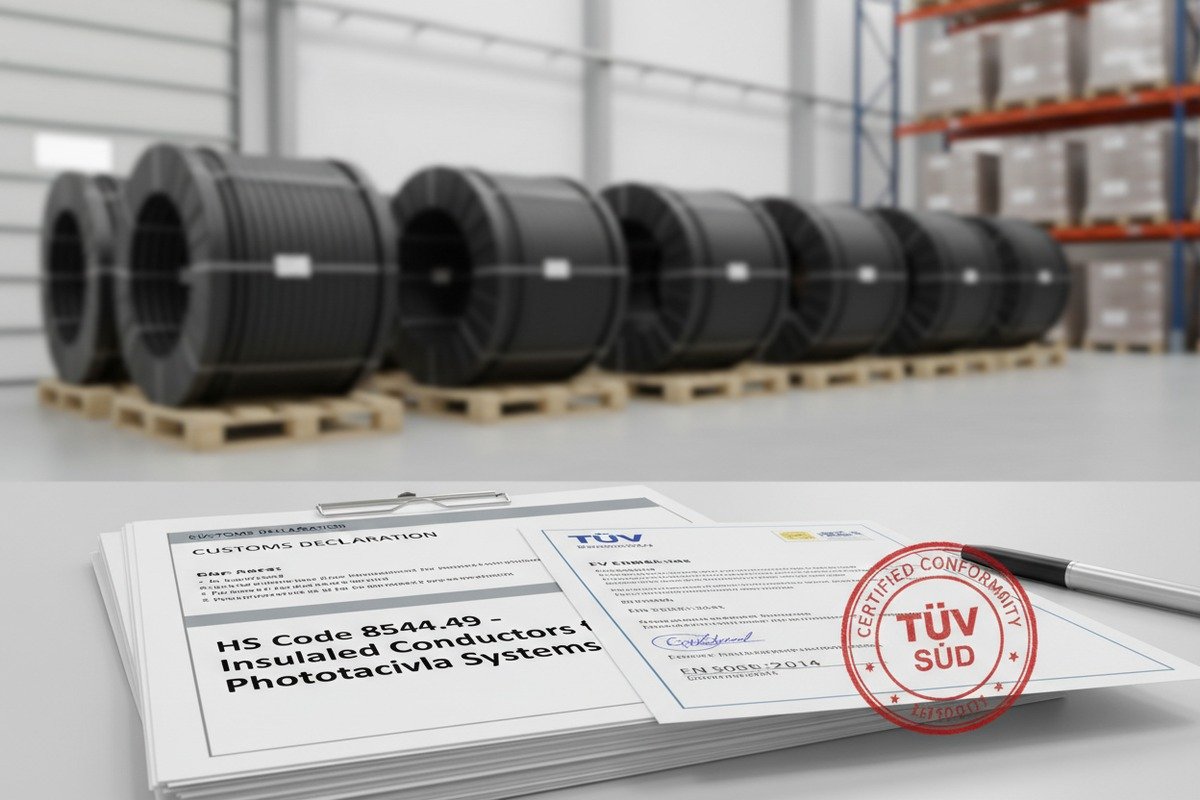
The Harmonized System code is the single most important number in your import cost calculation. Solar PV cables are typically classified under HS 8544 (insulated wire 2, cable, and other insulated electric conductors). But the exact sub-heading matters. In the EU, EN50618-certified solar cables rated up to 1.5 kV DC often fall under 8544.49.93 or similar national extensions.
A wrong code means a wrong duty rate. Worse, it can flag your shipment for inspection. We always recommend buyers confirm the HS code with their customs broker before we ship.
How Duty Is Calculated
The duty percentage applies to the customs value. In most cases, this is the CIF value 3 — that is, the cost of goods plus insurance plus freight. Here is a simplified example for a European importer:
| Cost Component | Amount (EUR) | Notes |
|---|---|---|
| FOB price (10,000 m of 6 mm² H1Z2Z2-K cable) | €8,500 | Negotiated unit price |
| Sea freight (Shanghai to Hamburg) | €1,200 | 20ft container, LCL |
| Marine insurance | €97 | 1% of FOB value |
| CIF value | €9,797 | Customs valuation base |
| Import duty (3.3% for HS 8544.49) | €323 | Applied to CIF |
| Value for VAT | €10,120 | CIF + duty |
| VAT (19% Germany) | €1,923 | Applied to CIF + duty |
| Total duties + VAT | €2,246 | Added to your cost |
Anti-Dumping and Countervailing Duties
Standard duty rates are only part of the picture. Some solar products from China face anti-dumping duties 4 (ADD) or countervailing duties (CVD). As of now, solar PV cables are generally not subject to ADD/CVD in most EU markets, but this can change with trade policy shifts. Always check the latest EU TARIC database or US HTSUS schedule before finalizing your budget.
VAT Recovery
For B2B buyers registered for VAT in the EU, the import VAT paid at customs is typically recoverable as input VAT. This means the VAT does not become a permanent cost — but it does affect your cash flow. You pay it upfront and recover it later, sometimes weeks or months later. Factor this timing into your working capital plan.
Common Mistakes
Many buyers forget that port handling charges 5, customs broker fees, and storage charges at the port are also subject to VAT in some jurisdictions. These small amounts add up. A thorough landed cost model includes every taxable line item.
What logistics and insurance fees must I include to determine my final door-to-door shipping price?
Our logistics coordinators arrange hundreds of shipments per year from our 230,000 m² factory to ports across Europe, Southeast Asia, and the Americas. We have learned that the freight quote is never the full shipping cost.
For door-to-door delivery, include origin charges (factory pickup, export customs, terminal handling), ocean or air freight, marine cargo insurance, destination port charges, import customs clearance, brokerage fees, inland trucking, and any warehousing or demurrage fees incurred during transit.
Origin-Side Costs
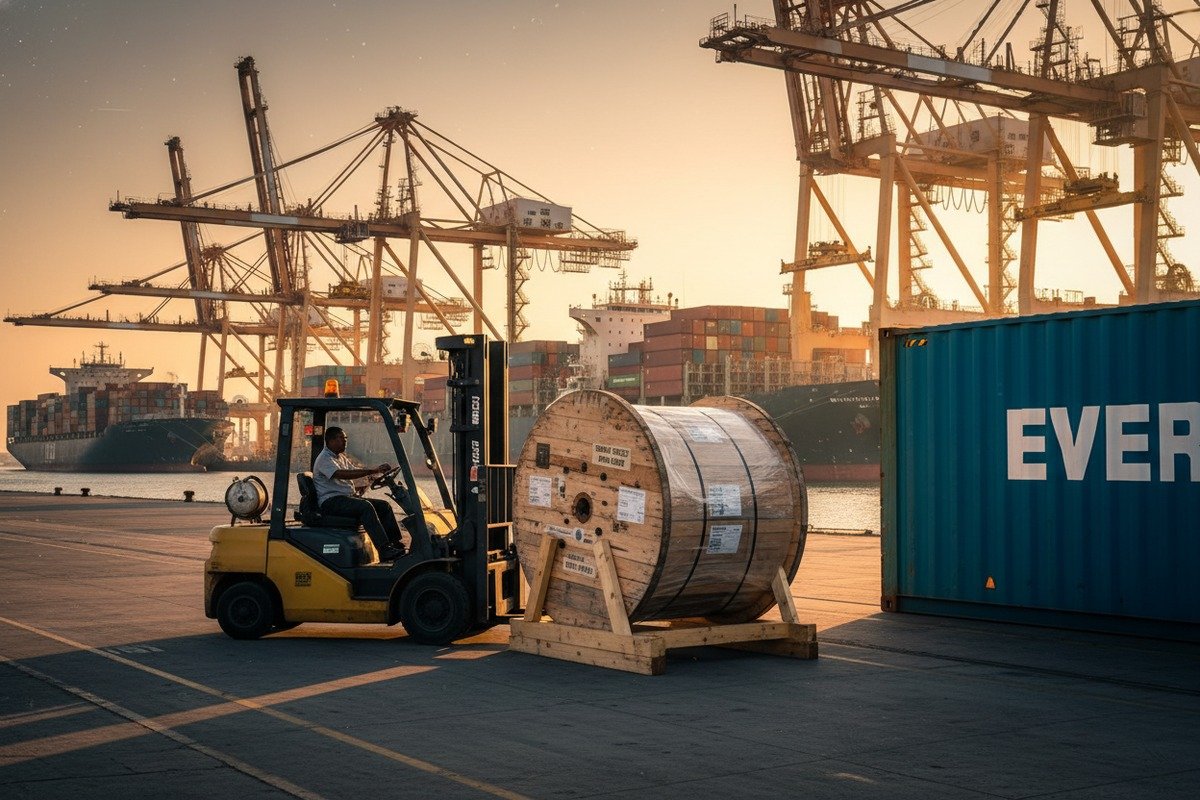
Before your cable even reaches the vessel, several charges apply at the Chinese end. These include:
- Factory-to-port trucking: Typically ¥800–¥2,500 depending on distance.
- Export customs declaration: Around ¥200–¥500 per shipment.
- Terminal handling charge (THC): ¥600–¥1,200 at major ports like Shanghai or Ningbo.
- Bill of lading fee: ¥300–¥700 per set.
If your Incoterm is FOB, most of these costs fall on us as the seller. If it is EXW, they all fall on you. This is why Incoterm selection directly impacts your landed cost.
Ocean Freight Variables
Sea freight is the largest logistics cost for solar cables. Several factors drive the price:
| Factor | Impact on Cost |
|---|---|
| Container type (FCL 20ft vs. 40ft) | 40ft costs ~60% more but holds ~100% more cargo |
| Shipment mode (FCL vs. LCL) | LCL charges per CBM; FCL is flat rate per container |
| Season (Jan–Feb, Aug–Oct peaks) | Peak rates can be 20–40% higher |
| Port pair (e.g., Ningbo → Rotterdam vs. Hamburg) | Route and port congestion affect pricing |
| Cable weight and drum size | Heavy coils may hit weight limits before volume limits |
For solar cables on large wooden drums, weight often becomes the limiting factor before cubic volume does. A 20ft container can typically hold 18–22 metric tons. Heavy 95 mm² or 120 mm² copper conductor cables may fill the weight allowance well before filling the space.
Marine Cargo Insurance
Standard cargo insurance 6 costs 0.3%–1.0% of the CIF value. For solar cables, we recommend "All Risks" coverage (Institute Cargo Clauses A) rather than basic coverage. Cables are vulnerable to moisture damage if containers are not properly ventilated, and drum damage during port handling is not uncommon.
A €10,000 shipment would cost roughly €30–€100 to insure. This is a small price compared to the cost of a lost or damaged shipment.
Destination-Side Costs
Once your container arrives at the destination port, expect these charges:
- Destination THC: €150–€350 per container in European ports.
- Customs clearance and brokerage: €50–€200 per shipment.
- Port storage: Free for 3–5 days, then €30–€100 per day.
- Inland trucking: Varies widely by distance. Hamburg to Munich might cost €400–€700.
Demurrage and Detention
These are the hidden killers. Demurrage is charged when your container sits at the port beyond the free period. Detention is charged when you hold the container at your facility too long. Both can run €50–€150 per day. A customs hold or missing document can easily trigger a week of demurrage — adding €350–€1,050 to your cost.
Plan for this by having all documentation ready before the vessel arrives. We provide all export documents — commercial invoice, packing list, certificate of origin, test reports, and TUV certificates — at least five days before estimated arrival.
How much should I budget for third-party quality inspections and CPR compliance verification to protect my project?
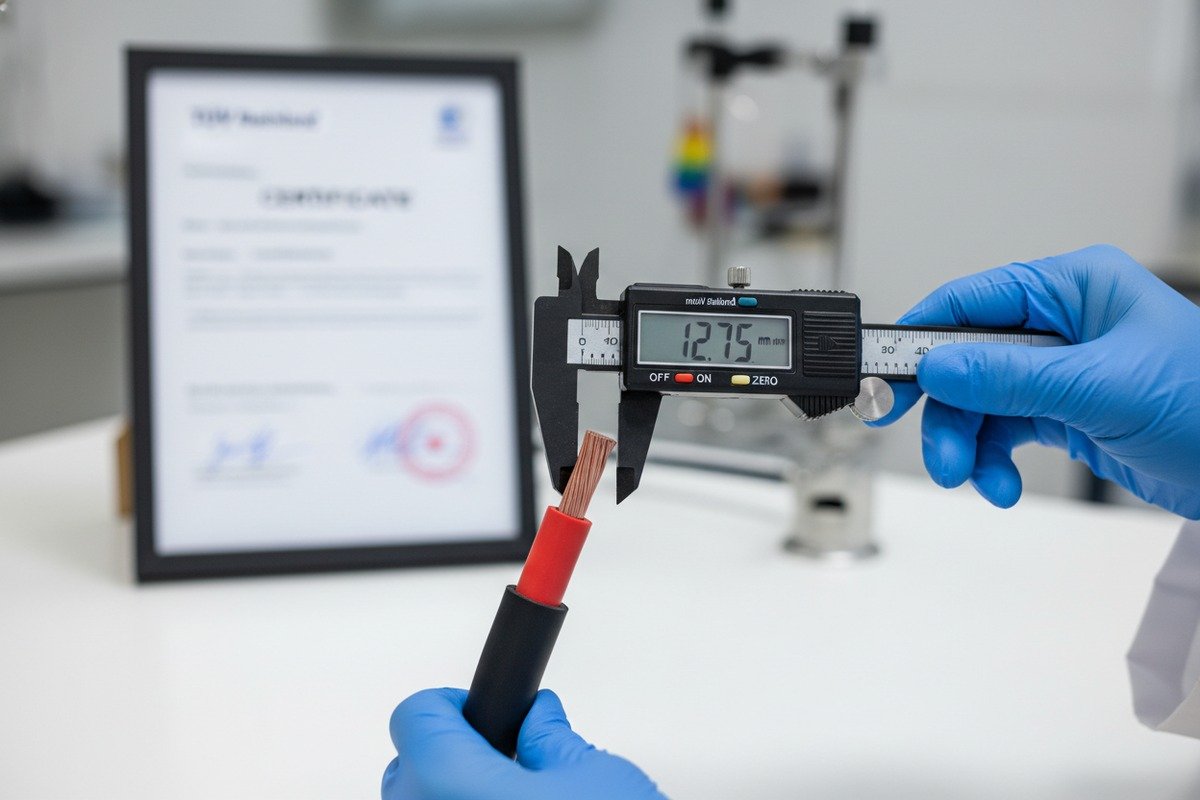
From our production floor, we run rigorous in-house testing on every batch — conductor resistance, insulation thickness 7, UV aging, and flame retardancy. But we also understand why buyers need independent verification. When a 50 MW solar farm depends on cable reliability for 25 years, trust must be backed by data.
Budget €800–€3,000 per shipment for third-party inspections and CPR compliance verification. This typically covers a pre-shipment inspection (€250–€500), independent lab testing for EN50618 or IEC 62930 compliance (€400–€1,500), and CPR fire classification verification (€200–€800), depending on scope and cable variants.
Pre-Shipment Inspection (PSI)
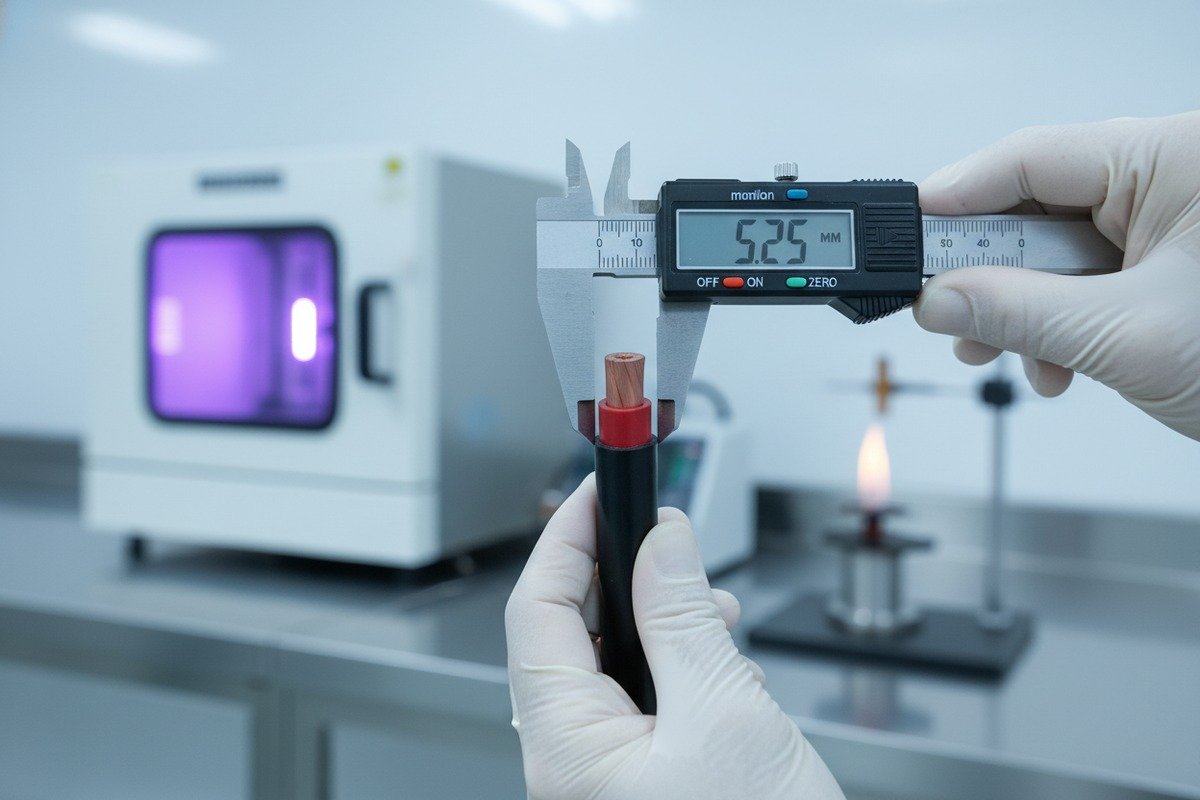
A PSI is the most common quality gate. Companies like SGS, Bureau Veritas, TÜV Rheinland, or Intertek send an inspector to the factory to verify:
- Cable markings match the order specification.
- Conductor cross-section and material match the datasheet.
- Insulation and sheath thickness meet EN50618 or H1Z2Z2-K requirements.
- Drum packaging is intact and labeled correctly.
- Quantity matches the purchase order.
A standard man-day inspection costs €250–€500. For large orders with multiple cable types, you may need two days.
Independent Laboratory Testing
Beyond visual and dimensional checks, lab testing verifies electrical and mechanical performance. Common tests include:
| Test | Standard | Typical Cost |
|---|---|---|
| Conductor resistance | IEC 60228 | €100–€200 |
| Insulation resistance | EN50618 / IEC 62930 | €150–€250 |
| Voltage withstand (AC/DC) | EN50618 | €150–€300 |
| UV resistance (1,000+ hours accelerated aging) | EN50618 Annex | €300–€600 |
| Flame retardancy (single cable vertical) | IEC 60332-1-2 | €200–€400 |
| Cold bend test (-40°C) | EN50618 | €150–€250 |
Not every test is needed for every shipment. A risk-based approach works well: run the full battery on the first order from a new supplier, then reduce to spot checks on subsequent orders.
CPR Fire Safety Verification
The EU Construction Products Regulation (CPR) requires cables installed in buildings or structures to carry a Declaration of Performance 8 (DoP) with a fire classification. Solar cables routed through buildings typically need at least Eca or Dca classification.
Verifying CPR compliance involves:
- Checking the DoP document against the actual product batch.
- Confirming the cable's reaction-to-fire classification through an accredited test body.
- Ensuring the manufacturer holds a valid Factory Production Control (FPC) certificate from a notified body.
We maintain active CPR certification for our H1Z2Z2-K and EN50618 product lines, with FPC audits conducted annually. But as a buyer, you should still request and verify the DoP number against the EU NANDO database. This step costs minimal time but saves enormous risk.
The Real Cost of Skipping Inspection
A failed batch discovered at the project site costs far more than any inspection fee. Rework, replacement cable, shipping, project delays, and potential grid-connection penalties can run into tens of thousands of euros. For a €1,500 inspection budget, you are protecting a project worth hundreds of times that amount.
Procurement directors like Klaus, who manage multi-megawatt EPC projects across Europe, know that a €2,000 inspection spend is not a cost — it is insurance against catastrophic project failure.
How do I factor in currency fluctuations and specialized packaging costs to avoid unexpected budget overruns?
Our finance team settles transactions in USD, EUR, and CNY daily. We have seen how a 3% currency swing over a 45-day payment term can wipe out the margin a buyer carefully calculated. And on the packaging side, our production managers deal with a recurring challenge: cables that arrive in perfect electrical condition but on drums that cannot fit the installer's cable-laying equipment.
To avoid budget overruns, lock exchange rates using forward contracts or agree on a fixed-rate clause in your purchase agreement. For packaging, specify drum dimensions, material (wood, steel, or plastic), and stacking requirements upfront. Budget 2–5% of FOB value for currency risk and €15–€80 per drum for specialized packaging.
Currency Risk Is Real and Measurable
Most Chinese solar cable manufacturers quote in USD. European buyers then convert to EUR. The EUR/USD rate can shift 2–5% within a typical order cycle of 30–60 days. On a €50,000 order, a 3% adverse movement costs €1,500.
Here are practical strategies to manage this:
- Forward contracts: Lock in today's exchange rate for a future payment date through your bank. Cost is typically 0.1–0.5% of the transaction value 9.
- Price adjustment clauses: Agree with the supplier that if the exchange rate moves beyond a defined band (e.g., ±2%), the price adjusts proportionally.
- Multi-currency accounts: Hold USD in a dedicated account and buy when rates are favorable.
- Split payments: Pay 30% deposit at order confirmation and 70% before shipment. This spreads currency exposure across two dates.
Wire Transfer and Payment Processing Fees
International bank transfers (T/T) carry fees at both ends. Your bank charges a sending fee (€10–€40), and the correspondent or receiving bank deducts another €10–€30. For a €20,000 transfer, this is minor. But for multiple smaller payments, fees accumulate.
Letters of Credit (L/C) offer more security but cost significantly more — typically 1–3% of the transaction value for issuance, amendment, and negotiation fees. For solar cable orders, T/T with a 30/70 split is the most common and cost-effective arrangement.
Specialized Packaging Costs
Solar PV cables are heavy. A 500-meter coil of 6 mm² H1Z2Z2-K cable weighs approximately 40–50 kg. Drums must be robust enough to survive sea freight, crane handling at ports, and forklift movement on site.
| Drum Type | Typical Cost | Best For |
|---|---|---|
| Standard wooden drum (reusable) | €15–€35 | General shipments, manual handling |
| Reinforced wooden drum (heat-treated, ISPM-15 compliant) | €30–€55 | International sea freight to EU/US/AU |
| Steel drum (heavy-duty) | €50–€80 | Large cross-section cables, automated laying |
| Plastic drum (lightweight, recyclable) | €25–€45 | Clean site requirements, indoor projects |
ISPM-15 compliance is mandatory for wooden packaging 10 entering the EU, US, Australia, and many other markets. Non-compliant drums are rejected at the port — causing delays and fumigation costs of €100–€300 per container.
Drum Dimensions and Site Compatibility
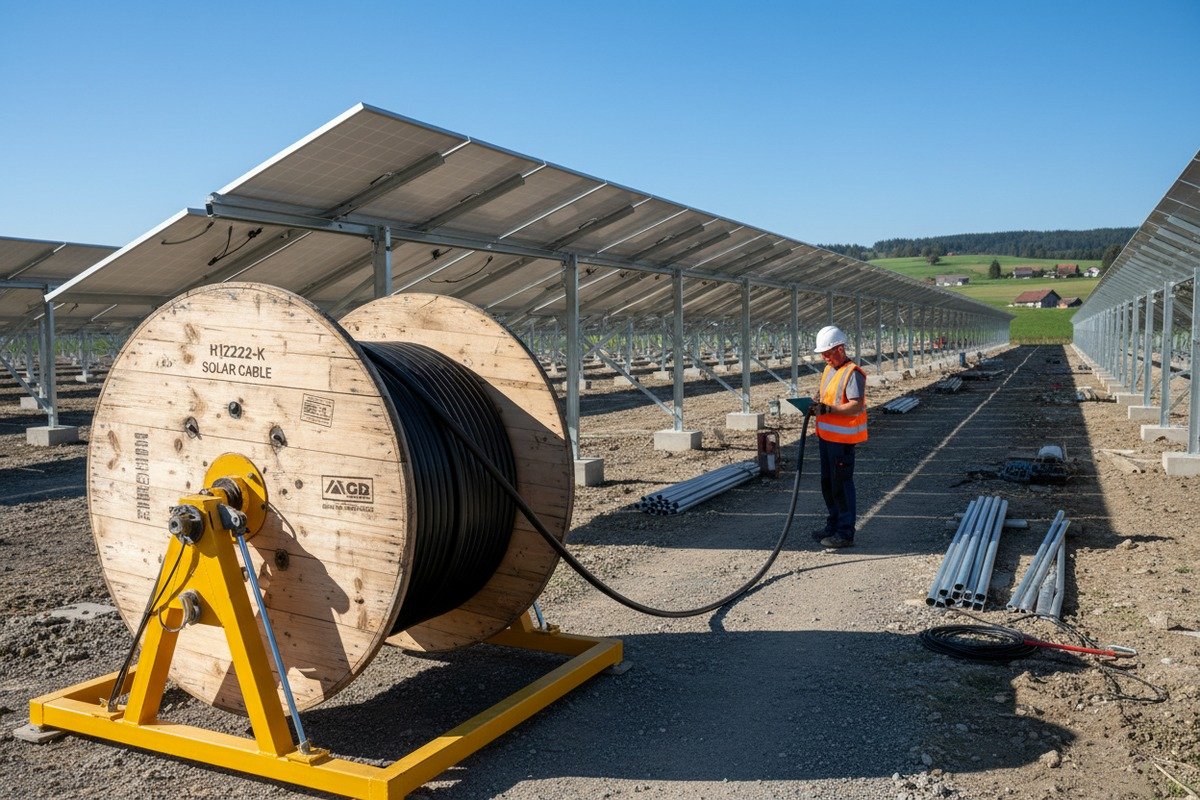
This is a pain point we have worked hard to solve. Field installers use cable-laying machines with specific drum-mount specifications. If the drum flange diameter or core hole size does not match, the crew cannot mount the drum. They must unspool cable manually — a slow, expensive process on a large solar farm.
We now ask every buyer for their preferred drum specifications before production begins. Flange diameter, core hole diameter, barrel width, and maximum weight per drum — these four numbers prevent costly site delays.
Building a Contingency Buffer
Even with careful planning, unexpected costs appear. A port strike adds storage days. A customs audit requires additional documentation. A currency spike hits between deposit and final payment. Industry best practice is to add 5–10% contingency to your total landed cost estimate.
For a landed cost of €21 per unit, a 7% buffer adds €1.47 per unit. This small cushion can be the difference between a profitable project and one that bleeds margin from day one.
Conclusion
Calculating total landed cost for solar PV cables from China requires itemizing every expense — from FOB price through duties, freight, insurance, inspections, packaging, and currency risk. A thorough, line-by-line approach protects your margins and prevents costly surprises.
Footnotes
1. The administrative department responsible for managing and verifying all paperwork required for international shipping and trade. ↩︎
2. A single conductor covered with a non-conductive material to prevent electrical leakage. ↩︎
3. International commerce term representing the cost, insurance, and freight of goods during shipping. ↩︎
4. Protectionist tariffs imposed by domestic governments on foreign imports believed to be priced below fair market value. ↩︎
5. Fees levied by port authorities for the movement and handling of cargo at shipping terminals. ↩︎
6. Protection against physical damage or loss of goods during transit by sea, land, or air. ↩︎
7. Critical safety parameter for electrical cables ensuring protection against electric shock and short circuits. ↩︎
8. Legal document identifying the characteristics and performance of a construction product under EU regulations. ↩︎
9. Replaced HTTP 404 with an authoritative .gov source (eCFR) defining 'transaction value' for customs purposes. ↩︎
10. International standard for wood packaging material to prevent the global spread of timber pests. ↩︎