
Every year, our sales team fields hundreds of RFQs from contractors and distributors who later discover their ADSS cable budgets were off by 30% or more. ADSS optical cables 1 The gap between a quoted price and the real landed cost has caused delayed projects, blown budgets, and strained partnerships across markets from Brazil to the Philippines.
To budget accurately for ADSS optical cables, you must go beyond the base per-kilometer price. Factor in accessory costs (10–25% of total), shipping and duties, installation labor, compliance testing, and long-term maintenance. Hidden costs typically represent 30–50% of your true procurement spend if left unaccounted.
This guide breaks down the real numbers, the traps inside low quotes, and the budget line items most buyers miss. We will walk through each cost layer so you can build a reliable procurement budget from day one.
Over the past 30 years on our production lines, we have seen competitors win bids with quotes 15–30% below market — only for those cables to fail within 3–5 years. The pattern is almost always the same: corners cut on aramid yarn 2 tensile strength or jacket UV resistance.
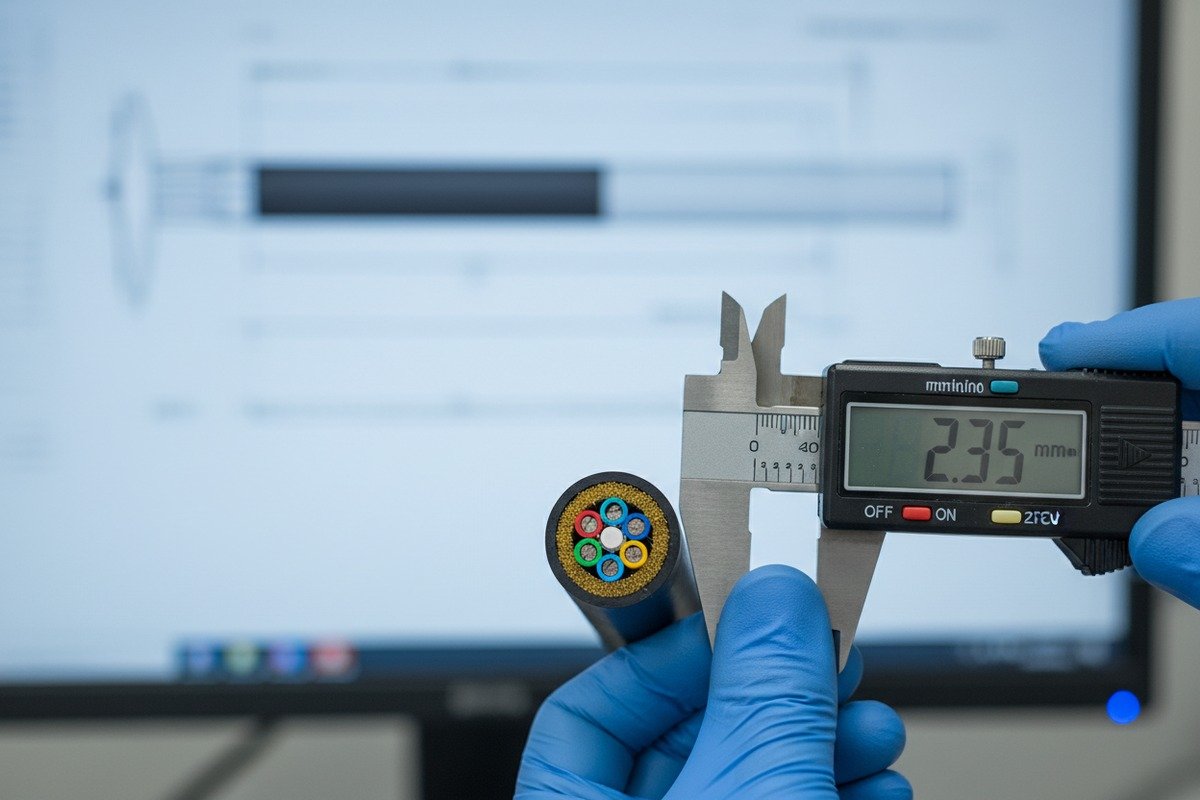
A suspiciously low ADSS quote often signals reduced aramid yarn fill, thinner jacket walls, or substitution of generic PE for anti-tracking sheath material. Request detailed cross-section diagrams, aramid yarn brand certificates, and jacket thickness data. Compare these specs against IEC 60794-4-20 minimums before accepting any bid.
Where the Cost Cuts Actually Happen
Aramid yarn is one of the most expensive raw materials in an ADSS cable. It provides the tensile strength that lets the cable span between poles without a messenger wire. When a factory wants to lower its price, reducing aramid yarn content is the easiest lever to pull. Each 10 kN reduction in rated tensile strength can drop material costs by roughly 8%. That sounds small, but across a 200 km order, the savings are significant — and so is the risk.
The jacket is the second target. A proper ADSS cable for high-voltage corridors needs an anti-tracking (AT) sheath 3, not standard polyethylene. AT jackets resist electrical erosion caused by dry-band arcing 4. Standard PE jackets cost less but degrade rapidly in HV environments, sometimes within 3 years. We have seen cases in Brazil where ISPs deployed cheap ADSS on medium-voltage lines and faced a 40 km outage because the jacket eroded through to the aramid layer.
Red Flags in a Low Quote
Here is a quick checklist to evaluate any ADSS quote that seems too good:
| Red Flag | What It Means | What to Request |
|---|---|---|
| No aramid yarn brand listed | Possible use of generic or recycled yarn | Brand certificate (e.g., Kevlar, Twaron) |
| Jacket type listed only as "PE" | May lack anti-tracking properties | AT sheath test report per IEC 60815 |
| No cross-section diagram provided | Dimensions may not match stated specs | Detailed cable cross-section drawing |
| Tensile rating vague or missing | Cable may not handle your span loads | Mechanical load calculation sheet |
| Price 20%+ below market average | Multiple cost-cutting measures likely | Full BOM (Bill of Materials) breakdown |
How to Verify Before You Commit
Ask the supplier for a sample reel and send it to an independent lab. A basic material test costs $500–$1,200 but can save you hundreds of thousands in field failures. At our facility, we provide factory OTDR reports and third-party test certificates with every shipment because we know buyers need proof, not promises. If a supplier hesitates to share these documents, that hesitation tells you everything.
Also compare the cable weight per kilometer. A 48-fiber ADSS cable should weigh roughly 85–120 kg/km depending on span rating. If the quoted cable is significantly lighter, the aramid fill or jacket thickness has been reduced.
When our logistics team ships containers to Latin America or Southeast Asia, we often see buyers budget only for the cable price and basic freight. Then the real costs arrive: customs duties 5, fumigation fees for wooden reels, port handling charges, and sometimes damaged cargo from substandard packaging.
Hidden logistics costs for ADSS cables include ocean freight, inland trucking, customs duties (5–15% depending on country), wooden reel fumigation/ISPM-15 compliance, port demurrage, insurance, and potential re-spooling fees. These can add 8–18% to your total cable cost, more for remote inland destinations.
The Reel Problem Nobody Talks About
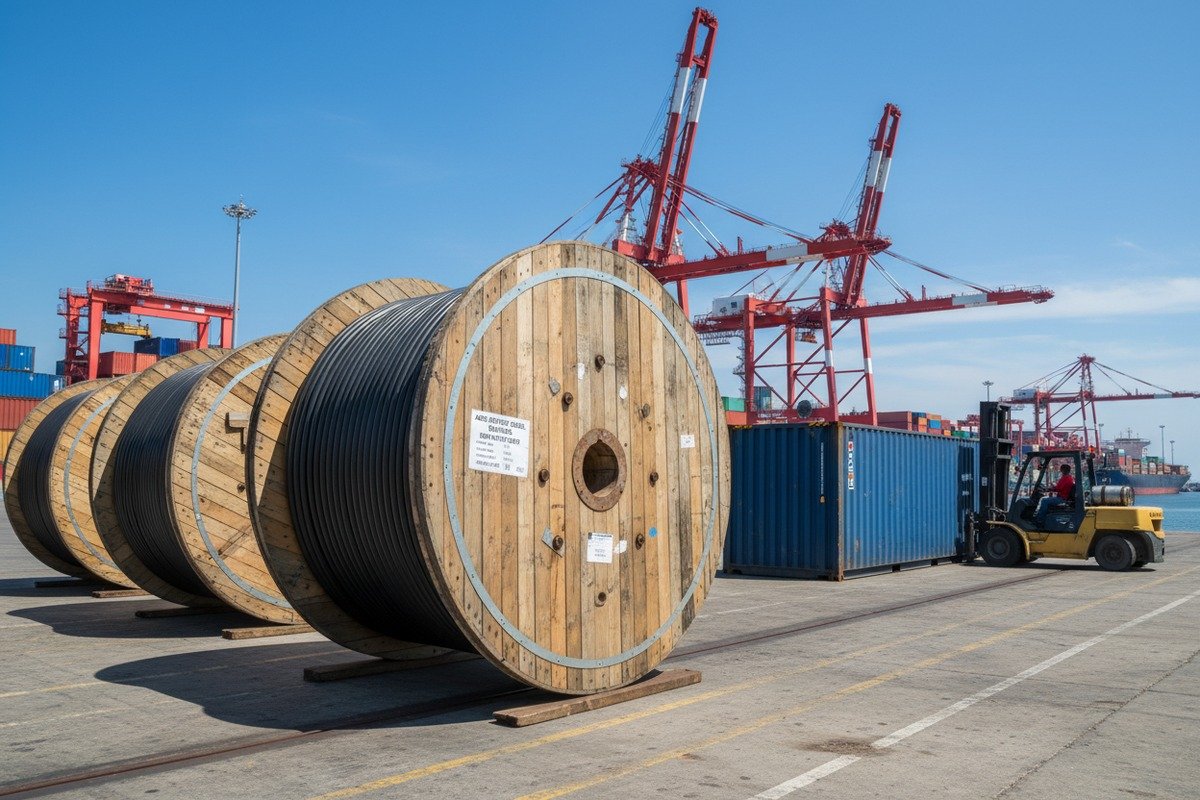
ADSS cables ship on large wooden or plywood reels. A standard reel for 4–6 km of cable weighs 80–150 kg empty. If the reel is poorly built — thin flanges, weak hubs, no steel reinforcement — it can collapse during ocean transit. We have heard from buyers who received entire containers of damaged cable because the reels cracked under container stacking pressure. A collapsed reel can kink the cable, creating micro-bends that permanently increase attenuation. The entire reel becomes scrap.
Our reels are built to export standards with reinforced hubs and ISPM-15 heat-treated lumber. ISPM-15 compliance 6 But not all suppliers do this. Budget for reel quality inspection or specify reel construction standards in your purchase order.
Logistics Cost Breakdown Table
| Cost Item | Typical Range (% of Cable Cost) | Notes |
|---|---|---|
| Ocean freight (FCL) | 3–7% | Varies by origin/destination and fuel surcharges |
| Customs duties | 5–15% | Country-specific; check HS code 8544.70 |
| Inland trucking (destination) | 1–4% | Higher for rural or remote project sites |
| Insurance (marine cargo) | 0.3–0.8% | CIF vs. FOB terms matter |
| Wooden reel fumigation (ISPM-15) | $15–$40 per reel | Required for most import countries |
| Port handling & demurrage | $200–$800 per container | Delays at customs increase this fast |
| Re-spooling (if reel damaged) | $3–$5 per meter | Often needed if cable must transfer to new reel |
How to Reduce These Costs
First, consolidate shipments. If you are ordering ADSS cable plus accessories like suspension clamps, tension clamps, vibration dampers, and joint closures, ship everything in one container. This saves on per-item freight charges and reduces customs processing fees.
Second, negotiate DDP (Delivered Duty Paid) terms 7 with your supplier. At Lonsoncable, we offer DDP shipping to many destinations, which means we handle freight, duties, and customs clearance. This gives you one predictable landed cost instead of five surprise invoices.
Third, always insure your cargo. marine cargo insurance 8 Marine insurance costs less than 1% of cargo value but covers the full replacement if a container is lost or damaged. Skipping insurance to save $300 on a $40,000 shipment is a gamble no smart procurement manager should take.
How do I account for the price variations caused by my specific span length and environmental requirements?
Our engineering team runs mechanical calculations for every custom ADSS order. Two buyers ordering "48-fiber ADSS" can receive very different cables — and very different prices — because their span lengths and environments demand different designs.
ADSS cable pricing shifts significantly based on span length and environment. Longer spans (300 m+) require more aramid yarn, increasing cost ~8% per additional 10 kN of tensile strength. High-voltage or coastal environments demand AT-sheath or UV-stabilized jackets, adding 10–20% over standard PE. Always specify your exact conditions before comparing quotes.

Why Span Length Drives Cost
ADSS cables are rated by maximum allowable span (MAS). A cable designed for 100 m spans between poles needs far less aramid yarn than one designed for 600 m river crossings. The relationship is roughly linear: each additional 10 kN of tensile strength adds about 8% to material costs.
Many buyers make the mistake of over-specifying. They choose a 200 m span-rated cable for a route where 95% of spans are under 80 m, simply because one or two crossings are longer. A smarter approach is to order two cable types: a standard-span cable for most of the route and a heavy-span cable for the crossings. This can cut your total cable cost by 10–15%.
Environmental Factors That Add Cost
| Environmental Condition | Required Specification | Cost Impact vs. Standard |
|---|---|---|
| High-voltage corridor (>35 kV) | AT (anti-tracking) sheath | +15–20% |
| Coastal/salt spray zone | UV-stabilized + salt-resistant jacket | +10–15% |
| Extreme cold (below -30°C) | Low-temperature rated jacket | +5–10% |
| High wind/ice loading zones | Increased aramid + ice load rating | +10–20% |
| Standard medium-voltage, temperate | Standard PE jacket | Baseline |
Avoiding the Over-Specification Trap
When our sales engineers receive an RFQ, we always ask for the route survey data: pole heights, span distances, voltage class, and local weather extremes. Without this information, suppliers either guess conservatively (over-specifying and overcharging) or guess aggressively (under-specifying and putting your project at risk).
If you do not have route survey data yet, at minimum provide the voltage of the power line, the average and maximum span lengths, the local wind speed and ice loading standards, and the expected operating temperature range. These four data points let us — or any serious manufacturer — calculate the correct cable design without unnecessary cost padding.
A common mistake we see in procurement is buyers requesting "ADSS 48-core, 200 m span, AT sheath" for every project without checking whether AT sheath is actually needed. On medium-voltage lines under 35 kV, standard PE is often sufficient, saving 15–20% on material cost alone.
The Real-World Cost Difference
Consider a 500 km backbone project. At $250/km for standard 48-fiber ADSS, the base cable costs $125,000. If you over-specify to a 300 m span AT-sheath cable at $330/km, you are now at $165,000 — a $40,000 difference just from spec inflation. That money could cover all your accessories and a portion of installation labor.
What are the potential long-term financial risks if I overlook factory OTDR reports and third-party certifications?
We invest heavily in testing equipment and third-party lab partnerships because we have watched buyers learn this lesson the expensive way. One distributor in Southeast Asia skipped certification verification to save two weeks on lead time — and spent six months dealing with splice loss issues across a 300 km network.
Skipping factory OTDR reports and third-party certifications exposes you to fiber attenuation inconsistencies, splice failures, non-compliance penalties, and warranty voidance. Re-testing alone costs $12,000–$18,000 per project. Field failures on uncertified cable can double your total cost through re-pulls, downtime, and contractor idle time — risks that far exceed any upfront savings.
What OTDR Reports Actually Tell You
An OTDR (Optical Time-Domain Reflectometer 9) report is like an X-ray of every fiber in the cable. It shows attenuation per kilometer, splice points, connector losses, and any anomalies like micro-bends or breaks. When we produce a reel of ADSS cable, our QC team runs OTDR tests on every fiber at 1310 nm and 1550 nm wavelengths. The report is shipped with the cable.
If a supplier does not provide OTDR reports, you have no baseline data. When your installation team finds high attenuation on a span, you cannot prove whether the problem existed before shipping or was caused during installation. This ambiguity kills warranty claims and leaves you absorbing the cost.
The Cost of Not Having Certifications
Third-party certifications like IEC 60794-4-20 10, IEEE 1222, and UL listings are not just paper credentials. They confirm the cable was tested for tensile load, crush resistance, temperature cycling, UV aging, and optical performance by an independent lab. Without them:
- Your project may fail local regulatory inspection, requiring cable replacement.
- Insurance companies may deny coverage for network infrastructure built with uncertified materials.
- You may need to pay $12,000–$18,000 for independent re-testing to satisfy your end client or utility partner.
Real Financial Impact Comparison
Let us put numbers to this. Consider a hypothetical 200 km ADSS deployment.
| Scenario | Certified Cable | Uncertified Cable |
|---|---|---|
| Base cable cost (48-fiber) | $54,000 ($270/km) | $42,000 ($210/km) |
| OTDR reports included | Yes (no extra cost) | No (re-test: $15,000) |
| Third-party cert available | Yes | No (re-test: $12,000) |
| Field failure rate (5-year) | <1% | 8–15% |
| Re-pull cost (per failure km) | — | $4/m × failed sections |
| Estimated 5-year total cost | $54,000 | $42,000 + $27,000 + downtime = $80,000+ |
The "cheap" cable costs 48% more over five years. And this does not include the reputational damage to your business when your client's network goes dark.
What Standards to Demand
At minimum, request the following from any ADSS supplier:
- Factory OTDR report for every reel, at 1310 nm and 1550 nm.
- IEC 60794-4-20 compliance certificate for aerial cable mechanical performance.
- IEEE 1222 compliance if deploying on electric utility structures in North America.
- UL or CSA listing for projects requiring North American safety certification.
- ISO 9001 quality management system certificate for the manufacturing facility.
Our facility holds all of these certifications, and we provide them proactively with every shipment. If a supplier makes you ask multiple times or delivers vague responses, consider that a warning sign about their quality systems overall.
Protecting Your Long-Term ROI
High-reliability ADSS cables are designed for 20–30 year lifespans. A case study from Chile documented ADSS cables still performing to spec after 20+ years, while a similar deployment in Brazil using budget cable required full replacement after just 3 years. The 20-year cable cost more upfront but delivered roughly 7x better cost-per-year performance.
When you budget for ADSS, think in decades, not quarters. The factory OTDR report and the third-party certification are your proof that the cable will last. Without them, you are simply hoping.
Conclusion
Budgeting for ADSS cables means looking far beyond the per-kilometer price. Account for material quality, logistics, environmental specs, and certifications — because hidden costs can add 30–50% to your real spend.
Footnotes
1. Provides a general overview and definition of ADSS optical cables. ↩︎
2. Explains the material properties and applications of aramid yarn. ↩︎
3. Details the purpose and application of anti-tracking sheaths in ADSS cables. ↩︎
4. Replaced with an article from T&D World, a reputable industry publication, explaining dry-band arcing. ↩︎
5. Explains what customs duties are and their role in international trade. ↩︎
6. Found the official ISPM 15 publication page on the International Plant Protection Convention (IPPC) website, which is the authoritative source. ↩︎
7. Links to the official Incoterms rules, defining DDP responsibilities. ↩︎
8. Replaced with a comprehensive article on marine cargo insurance from a reputable insurance broker. ↩︎
9. Replaced with the Wikipedia page for Optical Time-Domain Reflectometer, which is an authoritative and accessible source. ↩︎
10. Links to the official standard for aerial optical cables along power lines. ↩︎