Every summer, we see cable failure reports from Spanish and Italian solar farms land on our engineering desk. The root cause is almost always the same: someone sourced cables without properly verifying temperature ratings for real Mediterranean conditions. That gap between datasheet claims and field reality can cost hundreds of thousands of euros.
To verify solar PV cable temperature ratings for Southern Europe, request third-party TUV-certified EN 50618 test reports, confirm XLPO insulation rated to 120°C conductor temperature, validate thermal aging data per IEC 60811, and apply ambient derating factors for climates exceeding 40°C.
This guide walks you through each verification step. We cover insulation testing 1, the exact TUV reports to demand, UV and heat durability for 25-year lifespans, and the thermal aging data that proves grid-connection compliance. Let's start with the insulation itself.
How can I verify that the XLPO insulation truly meets the 120°C thermal endurance required for my project?
Our production lines run XLPO insulation through rigorous cross-linking process 2es every day, and we still test every batch. The truth is, not all XLPO is created equal. Cheap formulations can pass basic checks but fail within five years under real rooftop heat.
Request IEC 60811 thermal aging test certificates showing insulation retention of tensile strength and elongation after 168 hours at 150°C. Genuine XLPO meeting 120°C continuous conductor rating will retain at least 80% of original mechanical properties after this accelerated aging protocol.

What Is XLPO and Why Does It Matter?
XLPO stands for cross-linked polyolefin. It is a thermoset material. Once cross-linked, it will not melt or soften at high temperatures the way PVC or standard polyethylene 3 would. This makes it ideal for solar cables that sit in direct sun on rooftops or in cable trays where ambient air can hit 50°C or more.
The cross-linking process is what gives XLPO its thermal endurance. If a supplier skips proper cross-linking or uses a lower-grade base resin, the insulation may look identical but will degrade much faster. We have seen cables from other factories where the cross-linking degree was below 65%. Those cables cracked within three years in Andalusia.
The Tests You Must Request
There are specific IEC 60811 sub-tests that directly prove thermal endurance. Here is what to ask for:
| Test | Standard Reference | What It Proves | Pass Criteria |
|---|---|---|---|
| Thermal aging (air oven) | IEC 60811-401 | Insulation survives prolonged heat | ≥80% retention of tensile strength after 168h at 150°C |
| Hot set test | IEC 60811-507 | Cross-linking degree is sufficient | Elongation ≤175% at 200°C, permanent set ≤15% |
| Heat pressure test | IEC 60811-508 | No deformation under load at high temp | Indentation ≤50% at 140°C |
How to Spot a Fake Certificate
Always cross-reference the certificate number with the issuing body. TUV Rheinland and TUV SUD both maintain online databases. If the certificate number does not appear, walk away. Also check the cable model listed on the certificate matches exactly what you are buying. Some suppliers hold one valid certificate but ship a different, cheaper product.
When we prepare shipments for European EPC clients 4, we include batch-specific test reports alongside the type-test certificates. This is the level of traceability you should demand. If a supplier cannot provide batch-level data, that is a red flag.
Cross-Linking Degree Verification
Beyond the standard test reports, you can request a gel content test result. This measures the actual percentage of cross-linked material in the insulation. For reliable XLPO, the gel content should be above 70%. Anything below 65% indicates incomplete cross-linking, which means the cable will not hold up at 120°C over 25 years.
Which TUV EN50618 test reports should I request to confirm temperature ratings for Southern European climates?
When our export team ships H1Z2Z2-K cables 5 to projects in Greece or southern Italy, we always prepare a specific documentation package. We have learned that European grid inspectors reject vague certificates. They want precise test reports that match the exact conditions Southern Europe will impose on these cables.
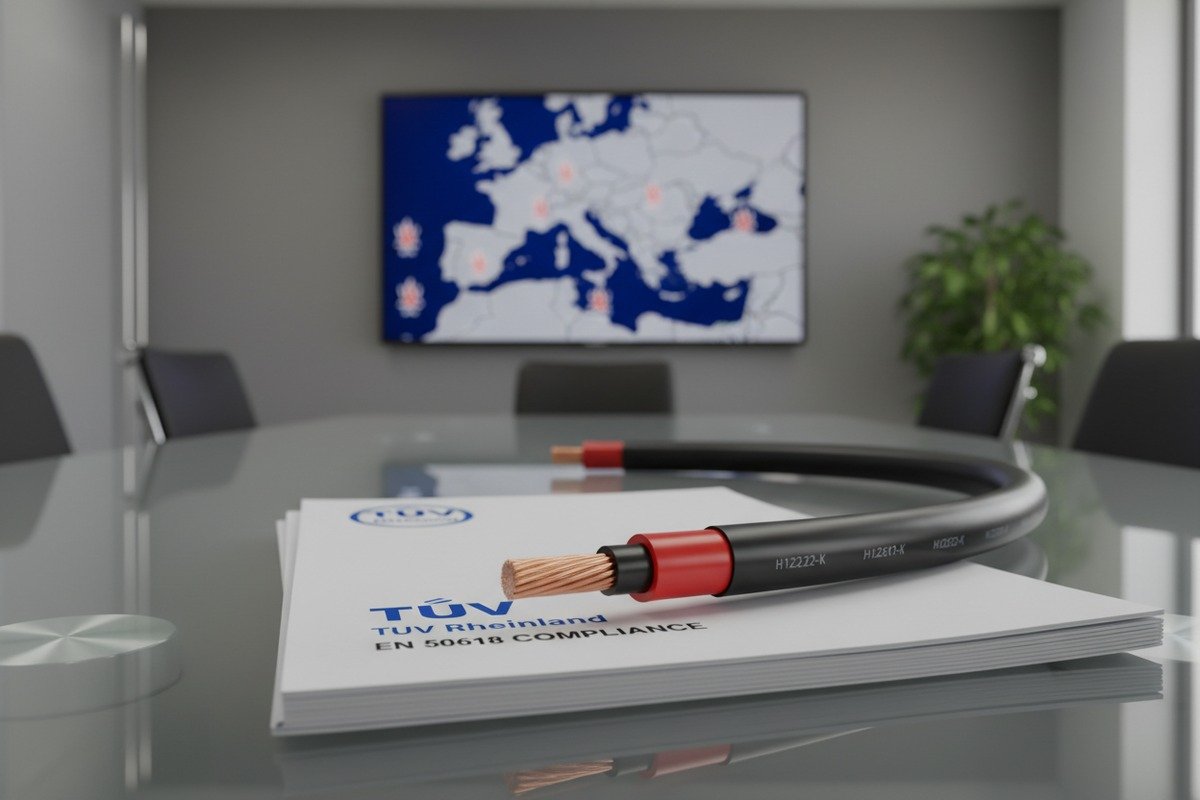
Request the full TUV EN 50618 type-test report covering voltage withstand at 1.5kV DC, thermal cycling from -40°C to +120°C, UV resistance per ISO 4892-2 (1000+ hours), cold bend/impact at -40°C, and CPR fire classification. These reports collectively confirm the cable's suitability for hot Mediterranean climates.
The Complete EN 50618 Test Report Package
EN 50618 replaced the older TUV 2PfG 1169 standard. It is now the mandatory EU harmonized standard 6 for solar PV cables. The full type-test report covers far more than just temperature. Here is a breakdown of the critical sections you need to review:
| Report Section | Test Method | Southern Europe Relevance | What to Check |
|---|---|---|---|
| Conductor resistance | EN 60228 Class 5 | Ensures low losses at high temp | Resistance values at 20°C match spec |
| Voltage withstand | EN 50618 Clause 8 | 1.5kV DC system safety | No breakdown at test voltage |
| Thermal aging | IEC 60811-401 | Summer heat endurance | 168h at 150°C, pass criteria met |
| Cold bend & impact | IEC 60811-504/505 | Winter installation in mountains | No cracking at -40°C |
| UV resistance | ISO 4892-2 | Intense Mediterranean sun | 720h minimum, 1000h+ preferred |
| Ozone resistance | EN 50396 | Coastal ozone exposure | No cracking after ozone exposure |
| CPR fire classification | EN 13501-6 | Rooftop and building installs | Dca-s2,d2,a2 or better |
| Hot pressure | IEC 60811-508 | Cable tray heat buildup | ≤50% indentation at 140°C |
EN 50618 vs. TUV PV1-F: Know the Difference
Many suppliers still offer TUV 2PfG 1169 (PV1-F) certified cables. These are not the same as EN 50618. PV1-F was a private TUV standard rated for 1.0kV DC. EN 50618 is a CENELEC harmonized standard rated for 1.5kV DC. While both share similar temperature ranges, EN 50618 adds CPR fire classification, stricter mechanical tests, and halogen-free requirements.
For Southern Europe, EN 50618 is not optional. It is mandatory under EU Construction Products Regulation. If a supplier offers only PV1-F certificates, that cable may be rejected at customs or during grid inspection.
How to Validate the Certificate Online
TUV Rheinland maintains a public certificate database at certipedia.com. TUV SUD has a similar portal. Enter the certificate number from the report. Verify the certificate holder matches the factory name. Check the expiration date. Certificates older than five years may have been superseded.
We also recommend asking the supplier for the annual surveillance audit report. TUV conducts factory audits to maintain certification. If the supplier cannot show a recent audit, the certificate may no longer be valid.
CPR Declaration of Performance
For any cable entering the EU market for use in buildings or structures, a Declaration of Performance (DoP) is required. This document states the cable's fire reaction class. For rooftop solar in Spain or Italy, local building codes typically require at least Dca class. Some municipalities demand Cca. Ask your supplier for the DoP and match it against your project's local requirements.
How do I ensure my solar cables will maintain their 25-year lifespan under extreme Mediterranean UV and heat?
During our R&D testing cycles, we expose cable samples to conditions that simulate 30 years of Mediterranean exposure in just months. Even with that rigor, we have seen formulations that looked good at year one fall apart by the equivalent of year eight. The Mediterranean is brutal on cables. UV, salt air, thermal cycling, and dust all attack the insulation simultaneously.
Ensure 25-year cable lifespan by confirming UV resistance tested per ISO 4892-2 for at least 720 hours, verifying halogen-free LSZH sheath compounds, selecting tinned copper conductors for corrosion resistance, and applying conservative ampacity derating for ambient temperatures above 40°C.

The UV Challenge in Southern Europe
Southern Spain, Sicily, and the Greek islands receive over 2,500 hours of direct sunlight per year. UV radiation breaks molecular bonds in polymer insulation. Over time, this causes surface cracking, chalking, and loss of flexibility. EN 50618 requires UV testing per ISO 4892-2. The minimum is 720 hours of accelerated exposure 7 using xenon arc lamps. But for Southern Europe, we recommend cables tested to at least 1,000 hours.
Look at the test report carefully. Check that the samples retained at least 80% of their original tensile strength and elongation after UV exposure. If the supplier only shows pass/fail without numbers, push for the actual data.
Thermal Cycling and Mechanical Fatigue
Daily temperature swings in the Mediterranean can be extreme. A rooftop cable might see 70°C at midday and 15°C at night. Over 25 years, that is over 9,000 thermal cycles. Each cycle causes the insulation to expand and contract. Eventually, micro-cracks form. These cracks allow moisture in, which accelerates degradation.
EN 50618 includes thermal cycling tests, but they are relatively short-term. For real confidence, ask the supplier for extended thermal cycling data. Our testing lab runs 1,000 cycles between -20°C and +90°C on representative samples. This goes beyond the standard requirement but reflects what cables actually face in the field.
Ampacity Derating for Hot Climates
This is where many projects go wrong. A 6mm² H1Z2Z2-K cable is rated for about 36A at 30°C ambient. But in Southern Europe, ambient temperatures in cable trays on rooftops can exceed 50°C. At that temperature, the same cable is only good for about 26A. That is a 28% reduction.
| Ambient Temperature | 6mm² Ampacity (Air) | 10mm² Ampacity (Air) | Derating Factor |
|---|---|---|---|
| 30°C (reference) | 36A | 50A | 1.00 |
| 40°C | 32A | 44A | 0.88 |
| 45°C | 29A | 40A | 0.82 |
| 50°C | 26A | 36A | 0.72 |
| 55°C | 22A | 31A | 0.63 |
| 60°C | 18A | 25A | 0.50 |
If you do not derate, the cable runs hotter than designed. This shortens its life dramatically. A cable running at its maximum for years in 50°C ambient will not last 25 years. It might last 12 to 15.
Oversizing as Insurance
Many experienced EPC firms in Southern Europe now routinely oversize their string cables by one step. Instead of 4mm², they use 6mm². Instead of 6mm², they use 10mm². The additional material cost is roughly €0.50–€1.00 per meter. Over a 100MW project, this adds perhaps €30,000–€50,000. But it virtually eliminates temperature-related degradation risk and reduces resistive losses by 30–40%, paying for itself within two to three years of operation.
Tinned Copper vs. Bare Copper
For coastal Mediterranean sites 8, salt-laden air causes oxidation on bare copper conductors. This increases contact resistance at terminations. Tinned copper adds a protective layer that resists corrosion for the full cable lifespan. EN 50618 specifies tinned copper Class 5 flexible conductors. Verify this in your supplier's material certificate. Some budget cables use bare copper, which fails much faster in coastal environments.
What specific thermal aging data must I see from a supplier to guarantee my grid-connection compliance?
Our quality control team processes grid-connection documentation for projects across Spain, Italy, Greece, and Portugal every month. We know what inspectors look for because we have seen shipments delayed when documentation fell short. The thermal aging data you collect from your supplier is not just a formality. It is the single document most likely to be scrutinized during grid-connection approval.
Demand IEC 60811-401 accelerated thermal aging reports showing tensile strength retention ≥80% and elongation retention ≥80% after 168 hours at 150°C, plus long-term 20,000-hour aging data at 120°C if available, and a humidity resistance report per IEC 60068-2-78 confirming 1,000 hours at 90°C/85% RH without degradation.
Understanding Accelerated Aging Tests
Accelerated aging uses elevated temperatures to simulate decades of real-world exposure in a short time. The Arrhenius equation governs this relationship: for every 10°C increase in test temperature 9, degradation speed roughly doubles. So testing at 150°C for 168 hours approximates many years of operation at 70–80°C.
The key numbers to look for in the aging report are:
- Tensile strength before and after aging. The after-aging value should be at least 80% of the before-aging value.
- Elongation at break before and after aging. Same 80% retention threshold.
- Visual inspection results. No cracking, discoloration beyond acceptable limits, or surface defects.
If any of these fall below thresholds, the cable will not pass a European grid-connection audit.
Long-Term Aging Data: The Gold Standard
Short-term aging at 168 hours is the minimum EN 50618 requires. But the best suppliers also offer 20,000-hour aging data at the rated conductor temperature of 120°C. This data is far more predictive of actual 25-year field performance. It shows whether the insulation compound maintains its properties over extended exposure, not just a one-week snapshot.
At our facility, we maintain a dedicated long-term aging oven that runs continuously. Samples from each major insulation batch are placed in this oven and tested at regular intervals over months. This data is available to clients who request it.
Humidity and Combined Stress Testing
Southern Europe is not just hot. Coastal areas in Portugal, southern France, and the Greek islands combine heat with high humidity and salt air. The IEC 60068-2-78 damp heat test 10 subjects cables to 1,000 hours at 90°C and 85% relative humidity. This simulates years of combined thermal and moisture stress.
After this test, the insulation resistance must remain above specified thresholds. If it drops, moisture has penetrated the insulation, which will eventually cause electrical failure.
What Grid Inspectors Actually Check
Based on our experience supplying cables for projects that have passed grid inspections in Spain (Red Eléctrica) and Italy (Terna), here is what inspectors typically review:
- EN 50618 type-test certificate with the issuing body's stamp
- Batch-specific test reports matching the cable lot numbers on site
- CPR Declaration of Performance with fire classification
- IEC 60811-401 thermal aging report with specific numeric results
- UV resistance test report per ISO 4892-2
- Conductor material certificate confirming tinned copper Class 5
Missing any single document can delay grid connection by weeks. In Southern Europe, where feed-in tariff deadlines are strict, this delay can cost €50,000–€100,000 per week on a utility-scale project.
Red Flags in Supplier Documentation
Watch for these warning signs:
- Test reports without specific numeric values (only "pass" or "compliant")
- Certificates issued by unknown or unaccredited labs
- Mismatched cable model numbers between the certificate and the product
- No factory audit report from the certification body
- Inability to provide batch-specific data for the shipment you are ordering
We have invested heavily in documentation systems precisely because our European clients demand this level of transparency. Every coil of cable we ship includes a QR code linking to its batch-specific test data. This is the standard you should hold every supplier to.
Conclusion
Verifying solar PV cable temperature ratings for Southern Europe requires hands-on scrutiny of EN 50618 test reports, XLPO aging data, UV resistance certificates, and proper ampacity derating for real Mediterranean conditions.
Footnotes
1. Explains the importance of testing insulation materials for solar cable reliability. ↩︎
2. Defines the chemical process that enhances thermal endurance in polymers. ↩︎
3. Provides chemical background on polyethylene used in cable insulation. ↩︎
4. Defines the role of EPC firms in large-scale engineering projects. ↩︎
5. Links to the international standard governing H1Z2Z2-K solar cables. ↩︎
6. Explains the framework for harmonized technical standards in the EU. ↩︎
7. Original URL was a 404. Replaced with a relevant and authoritative Wikipedia page on weather testing of polymers, which includes accelerated aging and exposure concepts. ↩︎
8. Provides environmental context for the Mediterranean region's unique challenges. ↩︎
9. Explains the scientific basis for temperature-dependent material degradation. ↩︎
10. Details the testing procedures for moisture and heat resistance. ↩︎