Every year, our production lines spool out millions of meters of solar PV cable in two dominant colors — and the reason goes far beyond aesthetics.
Black and red sheath colors in solar PV cables serve as critical polarity identifiers under standards like TUV EN 50618, IEC 62930, and UL 4703. Red marks the positive DC conductor, black marks the negative. This color coding reduces wiring errors by up to 99.99%, prevents reverse-polarity damage to inverters, and is mandatory for code-compliant installations worldwide.
But the story does not stop at color. Sheath color choices influence UV durability, thermal performance, supply chain logistics 1, and even compliance across different regional codes TUV EN 50618 2. Let me walk you through everything you need to know.
Why must I use different sheath colors to identify polarity in my solar PV installations?
When our engineering team reviews field failure reports from EPC clients across Europe and Latin America, one pattern stands out: polarity reversal remains a top-three cause of commissioning delays cross-linked polyolefin (XLPO) 3.
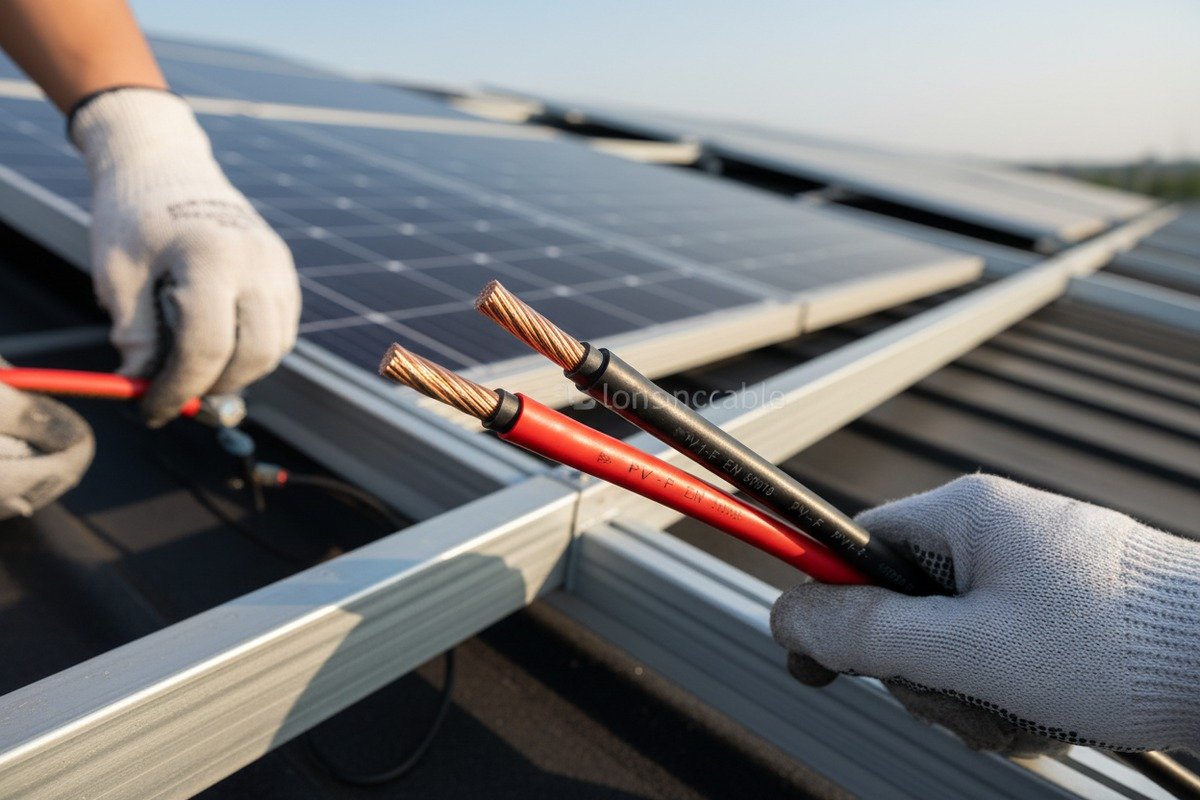
Different sheath colors — red for positive, black for negative — are required in solar PV installations because they allow installers to identify DC polarity within 2–3 seconds, reducing reverse-polarity wiring errors to below 0.01%. This visual coding is mandated or strongly recommended by NEC, IEC 62930, EN 50618, and UL 4703 standards.
The Real Cost of Getting Polarity Wrong
Reverse polarity 4 in a DC solar string is not a minor inconvenience. It can destroy inverter input capacitors rated at 5,000 µF or higher in seconds. In 2024, a utility-scale solar farm in Texas traced a fire incident back to a single string where an installer swapped positive and negative leads. The post-incident audit revealed that unlabeled, single-color cables were used on that string. The rest of the site, wired with red and black cables, passed inspection without issue.
Our clients who manage large-scale projects — some running 50 MW or more — tell us that color-coded cables are non-negotiable. A 2–3 second visual polarity check multiplied across thousands of connections saves days of commissioning time.
How Color Coding Works in Practice
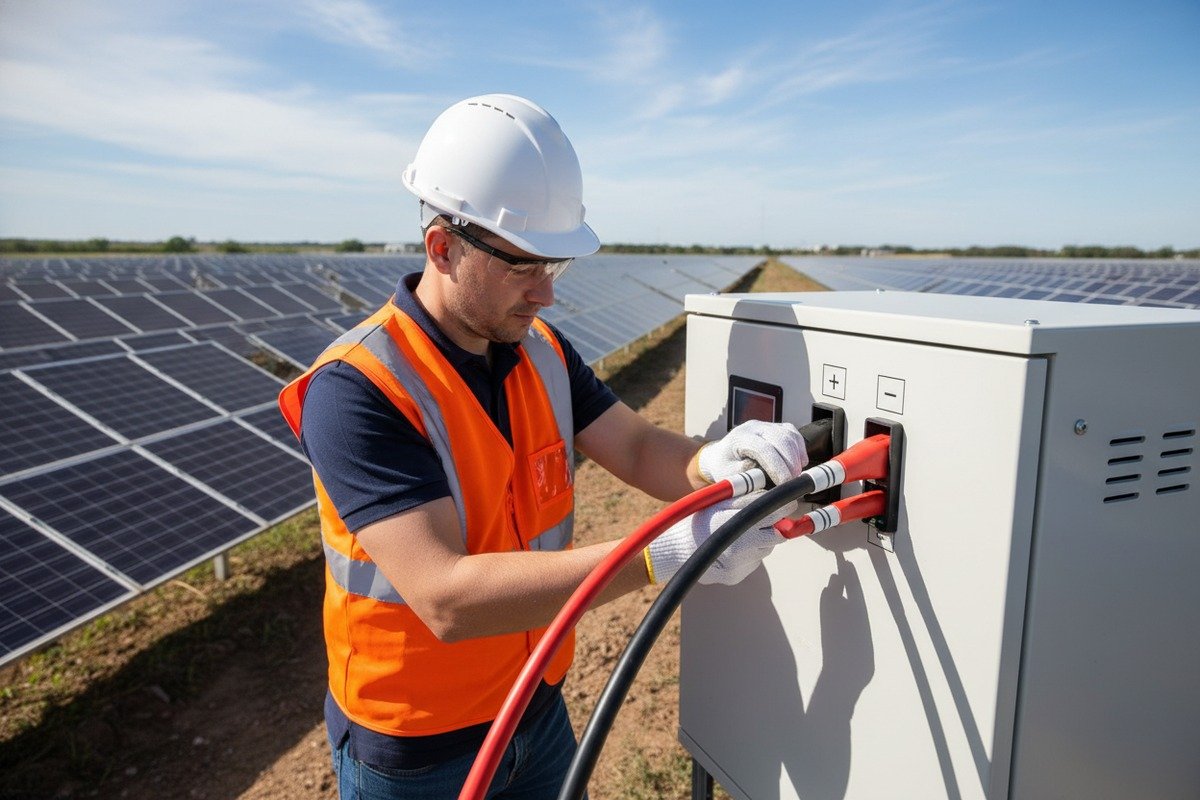
The principle is simple. Red sheath means the cable carries the positive DC conductor. Black sheath means negative. At every junction box, combiner box, and inverter input, an installer can visually confirm correct wiring before energizing.
This is not just a best practice. It is embedded in code. NEC Article 690.31 5 requires that PV source and output circuit conductors be identified by color, labeling, or other approved means. In practice, color is fastest.
DC vs AC: Where Confusion Creeps In
One common trap appears in hybrid systems that combine DC solar wiring with AC grid connections. On the AC side, black typically indicates a hot conductor — not negative. This creates a mental conflict for electricians trained in AC work.
| Parameter | DC Solar PV (IEC/NEC) | AC Mains (NEC) |
|---|---|---|
| Red wire | Positive (+) | Hot (secondary) |
| Black wire | Negative (−) | Hot (primary) |
| White wire | Not used | Neutral |
| Green / bare | Ground | Ground |
| Risk of confusion | High in hybrid systems | Standard practice |
This table highlights why training and clear sheath colors matter even more in hybrid solar-plus-storage installations. Our team always recommends that EPC contractors label junction points in addition to using color coding, especially where DC and AC circuits run within the same conduit zone.
Why Labels Alone Are Not Enough
Some argue that labels and tags can replace color coding entirely. While NEC does permit alternative identification methods, labels fade, peel, and fall off. In desert environments like the Middle East — where we ship significant volumes of H1Z2Z2-K cable — adhesive labels can degrade within 3–5 years. Sheath color, molded into the polymer, persists for 25 years or more.
Will choosing red cables over black ones affect the 25-year UV resistance of my system?
This question comes up frequently in our technical discussions with distributors in Southeast Asia and Africa, where solar irradiance pushes cable sheaths to their thermal and UV limits.
Red and black solar PV cable sheaths made from cross-linked polyolefin (XLPO) or XLPE both achieve 25-year UV resistance when manufactured to EN 50618 or UL 4703 standards. However, black sheaths absorb more solar radiation, which can raise operating temperatures by 5–15°C in high-irradiance environments, potentially requiring cable derating.
Material Science Behind Sheath Color
The UV resistance of a solar cable sheath depends on the polymer formulation and UV stabilizer package — not purely on color. Both our red and black EN 50618 cables use XLPE insulation rated for 90°C continuous operation (wet) and up to 120°C in short-circuit conditions. The key UV stabilizer in black sheaths is carbon black 6, which is inherently excellent at absorbing and dissipating UV radiation. Red sheaths use alternative UV stabilizer compounds — typically hindered amine light stabilizers (HALS) 7 — that provide equivalent protection when correctly dosed.
Our quality team runs accelerated aging tests simulating 25 years of UV exposure per IEC 62930 8 protocols. Both red and black sheaths pass with less than 5% degradation in tensile strength and elongation at break.
Thermal Absorption: The Hidden Variable
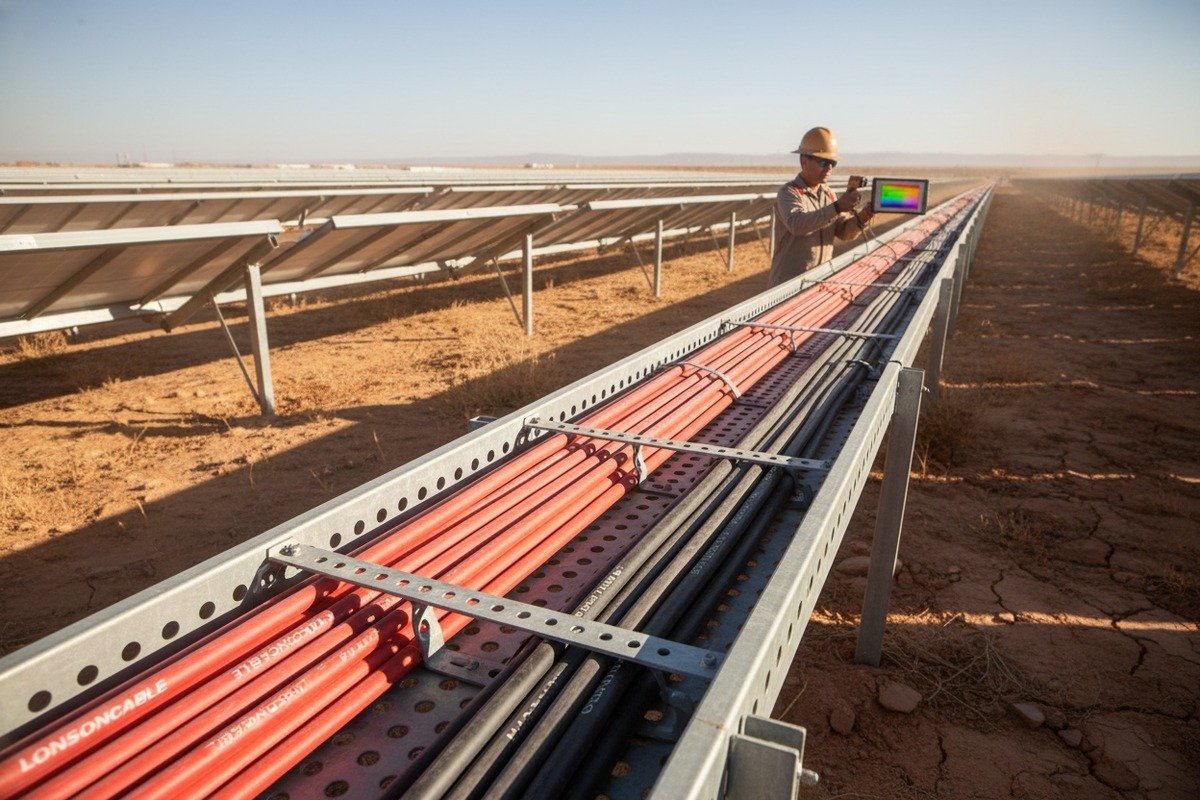
Here is where the practical difference emerges. Black absorbs more broadband solar radiation than red. On a rooftop in Jakarta or Riyadh, surface temperatures of black cable sheaths can reach 80–90°C on peak summer days, while red sheaths on the same tray may run 5–15°C cooler.
This matters for ampacity. Higher cable temperatures mean higher conductor resistance, which increases voltage drop and I²R losses. In extreme cases, it triggers derating requirements under NEC Table 310.15(B)(2) or IEC 60364-5-52.
| Sheath Color | Peak Surface Temp (Desert, 45°C Ambient) | UV Stabilizer Type | 25-Year Tensile Retention | Derating Required? |
|---|---|---|---|---|
| Black (XLPE) | 85–95°C | Carbon black | ≥95% | Possible at high fill ratios |
| Red (XLPE) | 70–80°C | HALS-based | ≥95% | Less likely |
| Black (XLPO) | 80–90°C | Carbon black | ≥95% | Possible at high fill ratios |
| Red (XLPO) | 68–78°C | HALS-based | ≥95% | Less likely |
Practical Recommendation
For exposed outdoor runs on rooftops or ground-mount arrays in hot climates, we advise clients to consider the thermal impact when sizing cables. A 4 mm² cable rated for 40 A at 30°C ambient may need to be derated to 32 A at 50°C ambient. If that cable is black and running in direct sun on a dark rooftop, effective ambient could exceed 60°C.
The solution is not to avoid black cables. It is to size correctly. Many of our European EPC clients specify 6 mm² where 4 mm² would technically suffice at standard conditions — building in a thermal margin that accounts for color-related heat gain.
Aesthetic Considerations
For residential rooftop projects, black cables blend better with dark PV modules and black mounting rails. This is a real selling point for installers competing on visual appeal. Our German distribution partners consistently order 60% black, 40% red for residential kits — using black for both visible runs and negative conductors, and red only for positive leads routed under panels.
How do TUV and EN50618 standards define the color requirements for my DC cable runs?
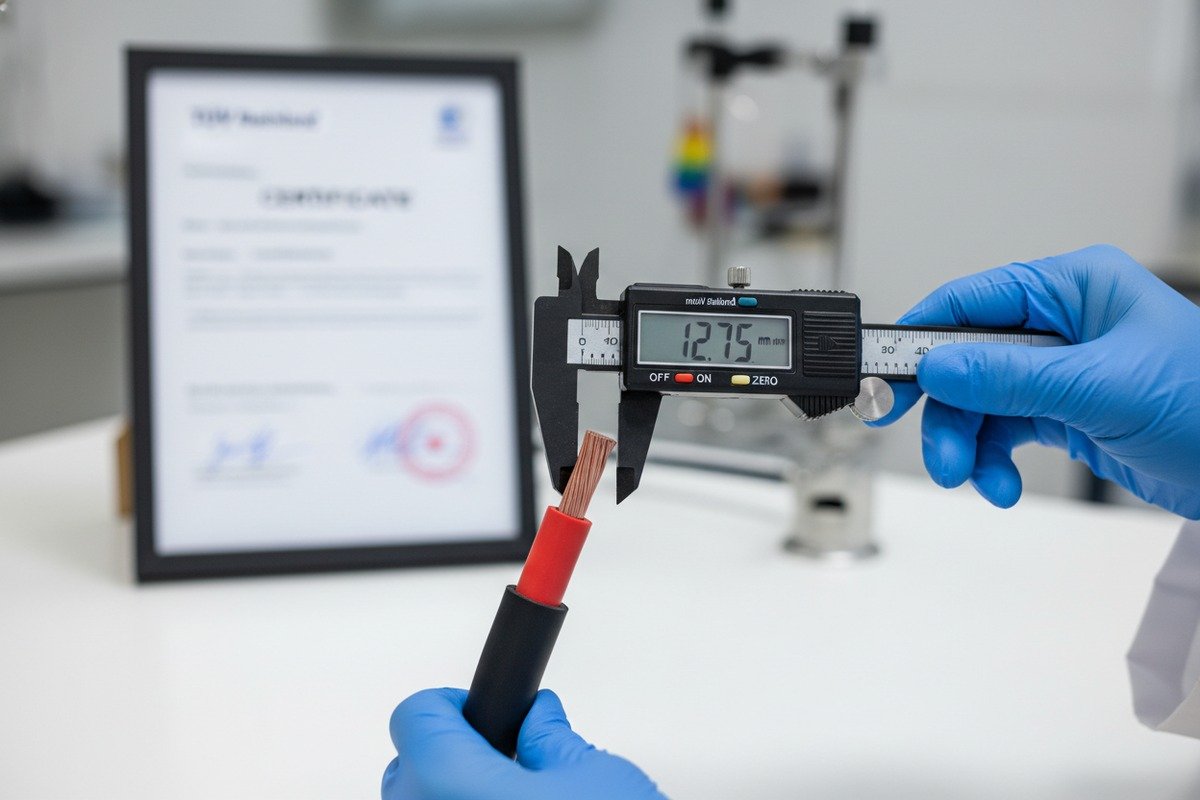
When we prepare certification documentation for TÜV Rheinland or TÜV SÜD audits at our facility, the question of sheath color requirements always comes up in the compliance review.
TUV certification under EN 50618 does not mandate specific sheath colors for DC solar cables. Instead, it requires that cables be clearly identifiable by polarity through color, marking, or labeling. The standard specifies performance criteria — UV resistance, flame retardancy (EN 60332-1-2), and insulation class — while leaving color choice to regional installation codes and project specifications.
What EN 50618 Actually Says About Color
EN 50618:2014 (revised 2020) defines requirements for "electron beam or chemically cross-linked insulated cables" for photovoltaic systems. It specifies:
- Conductor material (copper or aluminum, tinned or bare)
- Insulation and sheath material (cross-linked elastomeric or thermoplastic compounds)
- Temperature ratings (−40°C to +90°C continuous)
- Voltage rating (up to 1.5 kV DC)
- Flame retardancy per EN 60332-1-2
- UV resistance per EN ISO 4892-2
Nowhere does it say "positive must be red" or "negative must be black." The color requirement comes from installation standards — primarily IEC 60364-5-52 and national wiring codes.
Regional Color Code Conflicts
This is where things get complicated for international procurement managers. The color conventions differ between regions, and our export team deals with these conflicts daily.
| Region / Standard | Positive (+) Color | Negative (−) Color | Ground | Authority |
|---|---|---|---|---|
| North America (NEC/UL 4703 9) | Red | Black | Green / bare | NFPA 70 |
| Europe (IEC 60364-7-712) | Brown | Blue | Green-yellow | CENELEC |
| Australia (AS/NZS 5033) | Red | Black | Green-yellow | Standards Australia |
| Japan (JIS C 8955) | Red | White or black | Green | JIS |
| Common export default | Red | Black | Green-yellow | Industry convention |
For our German EPC client Klaus, this means his domestic projects technically require brown positive and blue negative per IEC 60364. But when he sources cable from us for a pan-European portfolio — say, projects in Spain, Poland, and the Netherlands — he often defaults to red and black because his installation crews are trained on that convention and it aligns with the cable marking on most commercial inverters.
TUV vs UL Certification: Different Approaches
TÜV certifies the cable product against EN 50618 performance standards. It confirms the cable can handle the rated voltage, temperature, UV exposure, and flame conditions. It does not police installation color choices.
UL 4703 (the North American equivalent) similarly certifies cable performance. But NEC Article 690 — the installation code — goes further by requiring conductor identification. Most US inspectors expect red positive and black negative as the default.
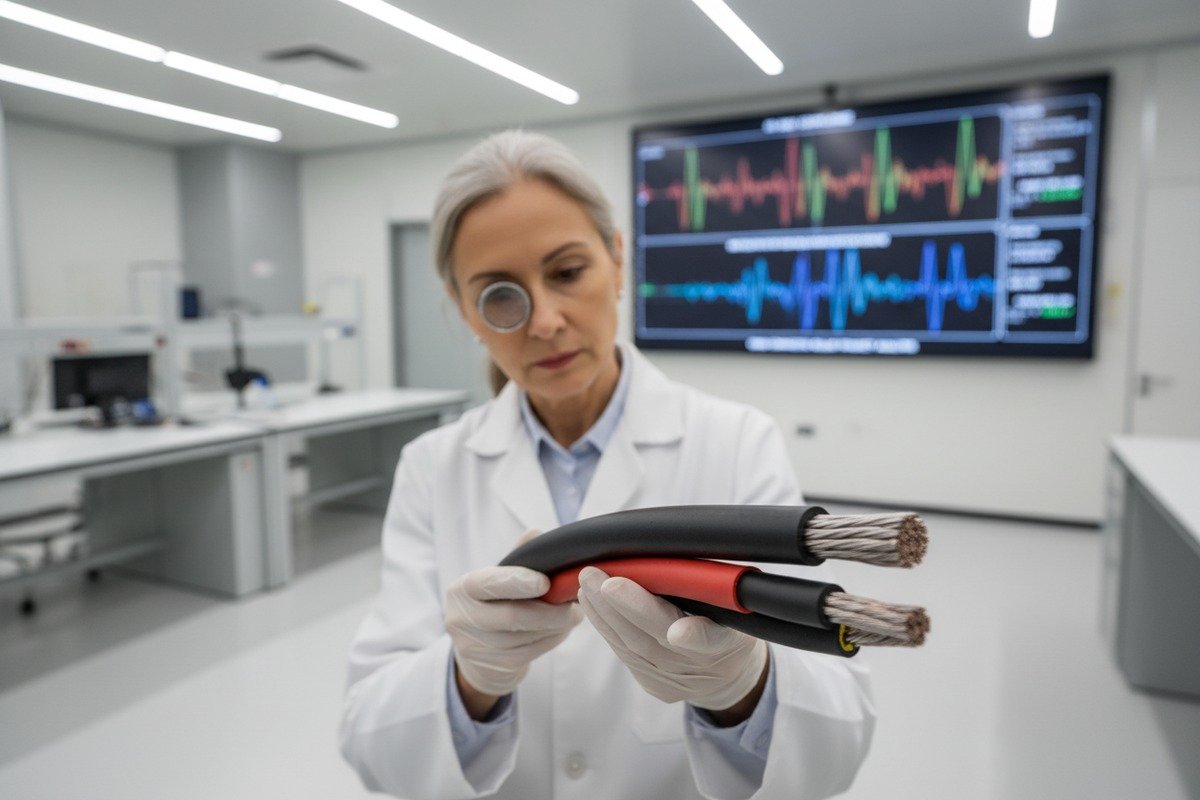
Our cables carry both TÜV and UL certifications where requested. We print the applicable standard number, voltage rating, conductor size, and manufacturer code directly on the sheath in white ink. This marking persists for the cable's lifetime and supplements color-based identification.
CPR Fire Classification and Sheath Color
For European projects, the Construction Products Regulation (CPR) 10 adds another layer. Solar cables installed in buildings must carry a fire classification — typically Dca-s2,d2,a2 or higher. This classification depends on the flame retardant additives in the sheath compound, not on the sheath color. Both our red and black sheaths achieve identical CPR ratings because the formulation base is the same XLPE compound with the same flame retardant package.
Can I use black cables for both poles to streamline my project inventory and logistics?
Our logistics team in Hainan handles hundreds of container shipments annually, and we hear this question from cost-conscious distributors at least once a week.
You can technically use black cables for both positive and negative conductors if you permanently mark polarity at every termination, splice, and junction point using tape, tags, or printed sleeves — as permitted by NEC 690.31(B) and IEC 60364. However, this approach increases installation labor, raises error risk, and is rejected by most utility-scale EPC specifications and local inspectors.
The Inventory Argument
The logic is straightforward. If you stock only black 6 mm² solar cable, you carry one SKU instead of two. That means fewer purchase orders, simpler warehouse management, and lower minimum order quantities per color. For a small distributor in the Philippines or Colombia serving residential installers, this can cut inventory carrying costs by 15–20%.
We understand this pressure. That is why we offer flexible MOQ structures — as low as 1,000 meters per color per gauge — and maintain buffer stock of both red and black in our most popular sizes (4 mm², 6 mm², and 10 mm²) for 15–20 day delivery.
Why Most Projects Still Require Both Colors
Despite the inventory savings, the field reality pushes back hard against single-color wiring.
First, inspection time increases dramatically. When an inspector or commissioning engineer opens a combiner box and sees all black wires, they must trace each conductor back to its source or check every label. With red and black, polarity is instant. On a 10 MW ground-mount project with 2,000+ string connections, this difference translates to 2–3 extra days of commissioning labor.
Second, maintenance becomes riskier. After 10 years of UV exposure and dust accumulation, printed labels and colored tape can fade or peel. A maintenance technician troubleshooting a faulty string at 1,000 V DC cannot afford to guess polarity. The sheath color is the last reliable identifier.
What the Codes Actually Allow
NEC 690.31(B) states that PV conductors must be "identified at all points of connection, termination, or splice by separate color coding, marking tape, tagging, or other approved means." Using all-black cable with red tape at termination points is technically compliant. But "approved means" is interpreted by the local Authority Having Jurisdiction (AHJ), and many AHJs in the US and Europe prefer integral sheath color over applied markings.
Cost Comparison: Single-Color vs Dual-Color
| Factor | All-Black + Tape Marking | Red + Black (Standard) |
|---|---|---|
| Cable SKUs in inventory | 1 | 2 |
| Material cost per meter | Same | Same |
| Marking labor (per 1,000 connections) | 8–12 hours | 0 hours |
| Inspection pass rate (first attempt) | 85–90% | 98–99% |
| 10-year maintenance error risk | Moderate | Very low |
| Compliance with most EPC specs | Conditional | Full |
| Recommended for utility-scale? | No | Yes |
Our Recommendation
For residential projects under 30 kW where the installer controls the entire process end-to-end, using black cables with proper termination marking can work. But for any project that involves third-party inspection, utility interconnection, or long-term O&M contracts, dual-color cable is the professional standard. The marginal inventory cost of stocking red alongside black is far less than the cost of a failed inspection or a field wiring error.
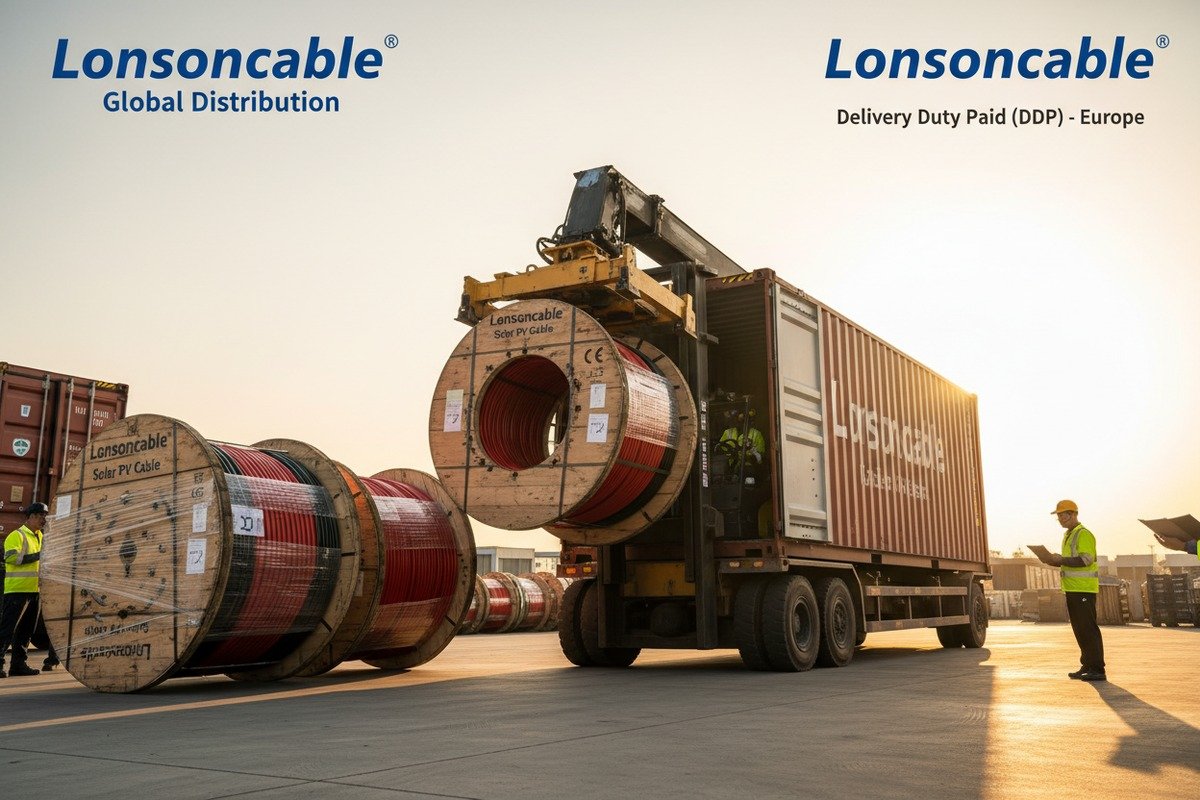
We ship red and black cables on separate drums — clearly labeled with color, gauge, standard, and batch number. Our packaging uses reinforced wooden drums rated for automated cable-laying machines, so there is no on-site handling bottleneck even when managing two color SKUs.
Conclusion
Black and red sheath colors are not cosmetic choices — they are safety infrastructure. Choose dual-color cables, match them to your regional code, and build installations that stay compliant for 25 years.
Footnotes
1. IBM's definition and explanation of supply chain logistics. ↩︎
2. Official TÜV Rheinland page explaining EN 50618 for PV cables. ↩︎
3. Compares XLPO and XLPE, detailing properties and applications. ↩︎
4. Explains causes, risks, and fixes for reverse polarity in solar inverters. ↩︎
5. An article from a reputable electrical industry publication detailing wiring methods for PV systems and referencing NEC Article 690.31. ↩︎
6. Provides a comprehensive overview of carbon black, including its use as a UV protection agent. ↩︎
7. Explains hindered amine light stabilizers (HALS) and their mechanism in polymers. ↩︎
8. Official IEC webstore page for the IEC 62930 standard. ↩︎
9. Official UL Standards & Engagement page for the UL 4703 standard. ↩︎
10. Official European Commission information on the Construction Products Regulation. ↩︎