
Every year, our quality team catches dozens of fake TÜV certificates from competing suppliers during trade shows and sample evaluations. The problem is growing fast.
To verify TÜV SÜD or Rheinland testing, search the supplier's certificate number on Certipedia (TÜV Rheinland) or the TÜV SÜD product finder, cross-check the certified cable model and specifications, inspect physical jacket markings, and request recent factory audit reports to confirm ongoing compliance.
This guide walks you through the exact steps our procurement partners use to confirm that the solar PV cables 1 they source—whether H1Z2Z2-K, PV1-F, or EN 50618 2 types—carry genuine, current TÜV certification. Let's break it down section by section.
How do I use the TÜV SÜD or Rheinland online database to check my supplier's certificate number?
When we ship H1Z2Z2-K cables 3 to European EPC projects, the first question buyers ask is: "Can I verify your TÜV certificate online?" It's the right question to start with.
To check a certificate, visit TÜV Rheinland's Certipedia at certipedia.com or TÜV SÜD's product finder, enter the certificate number provided by your supplier, and confirm the listed manufacturer name, product model, and applicable standard match your order details exactly.

Step-by-Step: TÜV Rheinland Certipedia
TÜV Rheinland 4 is the dominant certification body for PV cables globally. Their Certipedia database is free and publicly accessible. Here is how to use it:
- Go to certipedia.com.
- Enter the certificate number your supplier provided. It usually starts with a format like "2PfG" followed by digits.
- Hit search. The result should display the manufacturer's legal name, factory address, certified product designation (e.g., H1Z2Z2-K 1x6mm²), and the standard (e.g., EN 50618:2014 or TÜV 2PfG 1169).
- Compare every detail against what the supplier claims.
If the search returns no results, the certificate may be fake, expired, or entered incorrectly. Ask the supplier to clarify. If they hesitate, that is a warning sign.
Step-by-Step: TÜV SÜD Product Finder
TÜV SÜD 5's database works similarly but is less PV-cable-specific. Their focus leans more toward solar modules and inverters. Still, some cable manufacturers hold TÜV SÜD marks. Use their online product finder or contact their regional office directly with the certificate number.
Key Fields to Cross-Check
| Field on Database | What to Verify | Red Flag If... |
|---|---|---|
| Manufacturer Name | Matches supplier's legal entity | Name differs or is a trading company, not the factory |
| Product Designation | Matches exact cable model (e.g., H1Z2Z2-K 1x4mm²) | Only a generic "solar cable" is listed |
| Applicable Standard | EN 50618, TÜV 2PfG 1169, or IEC 62930 | No standard listed or an outdated reference |
| Certificate Validity | Current, not expired | Expiry date has passed |
| Factory Address | Matches the factory you plan to order from | Address is in a different city or country |
What If Certipedia Is Down?
Certipedia occasionally experiences server errors (503 errors have been reported). If this happens, take a screenshot of the error, email TÜV Rheinland directly with the certificate number, and ask for written confirmation. Do not skip this step just because the website is temporarily unavailable. At our facility, we keep a direct contact at TÜV Rheinland's Cologne office for exactly this purpose—our clients can request verification through us at any time.
What red flags should I look for to spot a fake or expired solar cable test report?
Our engineers have encountered counterfeit TÜV reports that looked nearly perfect—until we checked the fine print. The solar cable counterfeit problem is real, and it costs buyers millions in failed inspections.
Red flags include mismatched certificate numbers, missing or incorrect TÜV hologram marks, blurry logos, expired validity dates, generic product descriptions without specific cable models, and test reports referencing outdated or irrelevant standards not applicable to solar PV cables.

Visual Clues on the Certificate Document
Fake certificates often betray themselves through small visual errors. Look for:
- Blurry or pixelated TÜV logos. Genuine certificates use high-resolution vector graphics.
- Inconsistent fonts. TÜV uses standardized templates. If the font changes mid-document, be suspicious.
- No unique certificate ID. Every real TÜV certificate has a unique alphanumeric identifier.
- Missing signatory details. Genuine reports include the name and title of the certifying engineer.
Date and Standard Issues
Check the certificate's issue date and expiry date. TÜV certifications are not permanent. They require renewal, typically every five years, with annual surveillance audits in between. An expired certificate means the manufacturer may no longer be under active monitoring.
Also check the referenced standard. For solar PV cables sold in Europe, the current benchmarks are EN 50618:2014 and TÜV 2PfG 1169/08.2007. If a report references only a vague "internal standard" or an unrelated IEC number, the cable may not have been tested for PV-specific requirements.
Common Fake Report Patterns
| Red Flag | Why It Matters | What to Do |
|---|---|---|
| Certificate number returns no result on Certipedia | Likely fabricated | Reject the supplier or demand explanation |
| Report lists "solar cable" without model number | Certification may not cover your specific product | Ask for the exact scope of certification |
| Test results show impossibly perfect numbers | Real tests have minor variations; perfect scores suggest fabrication | Request raw test data or a third-party retest |
| No factory address or wrong address listed | Certificate may belong to a different factory | Verify the production site independently |
| Validity expired more than 6 months ago | No active surveillance; quality may have degraded | Ask for renewal evidence or walk away |
Physical Cable Inspection
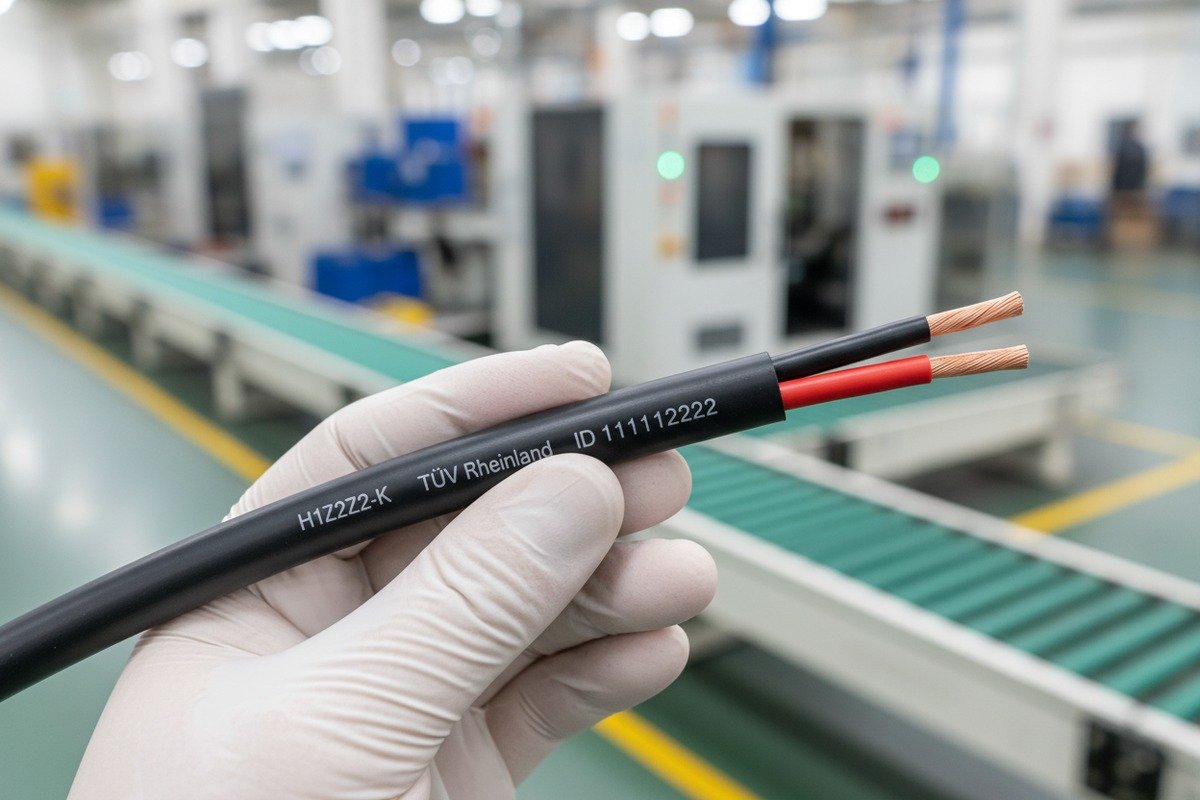
Beyond the paperwork, inspect the cable itself. Genuine TÜV-certified PV cables carry continuous meter markings printed on the jacket. These markings include the manufacturer's name, the PV1-F or H1Z2Z2-K designation, rated voltage (e.g., 1.0/1.5 kV DC), cross-section size, and the TÜV mark with its ID number. PV1-F designation 7 If markings are missing, inconsistent, or easily rubbed off, the cable is likely not genuinely certified.
We also recommend weighing a one-meter sample. For example, a 6mm² copper H1Z2Z2-K cable should weigh approximately 53.4 g/m. Significant underweight means the conductor is thinner than specified—a common tactic used by counterfeiters to cut costs.
How can I confirm that the specific H1Z2Z2-K cable model I need is actually covered by the certification?
One mistake we see repeatedly is buyers accepting a supplier's "blanket" TÜV certificate without checking whether their exact cable size and configuration is listed in the scope. A certificate for 4mm² does not automatically cover 6mm² or 10mm².
To confirm coverage, review the certificate's annex or scope document, which lists every certified cable model, cross-section size, and voltage rating. Match your required specification—such as H1Z2Z2-K 1x6mm² 1.5kV DC—against this list. If it is not explicitly listed, it is not certified.
Understanding Certification Scope
Every TÜV certificate comes with a scope document or annex. This annex is the critical document. It specifies exactly which products fall under the certification. For solar PV cables, the scope typically lists:
- Cable designation (e.g., H1Z2Z2-K)
- Conductor material (copper or tinned copper)
- Cross-section sizes (e.g., 1x2.5mm², 1x4mm², 1x6mm², 1x10mm², 1x16mm²)
- Rated voltage (e.g., 1.0/1.5 kV DC)
- Insulation and sheath material (e.g., XLPO)
- Temperature range (e.g., -40°C to +90°C)
If your required cable configuration—say H1Z2Z2-K 1x10mm² with tinned copper conductor—is not explicitly listed in the annex, the certification does not apply to it. Period.
What Tests Does the Certification Cover?
The TÜV certification for H1Z2Z2-K cables under EN 50618 or TÜV 2PfG 1169 encompasses a rigorous battery of tests. Here is a summary:
| Test Category | Standard Reference | Key Requirement |
|---|---|---|
| Conductor Resistance | EN 50395 | Must meet maximum resistance per km for stated size |
| High Voltage Test | EN 50618 | Withstand 6.5 kV AC or 15 kV DC without breakdown |
| Insulation Resistance | EN 50618 | Minimum insulation resistance after water immersion |
| UV/Weathering Resistance | EN 50618 / HD 605 | Retain properties after 1,000+ hours UV exposure |
| Cold Bend Test | EN 60811-504 | No cracking at -40°C |
| Ozone Resistance | EN 60811-403 | No cracking after ozone exposure |
| Thermal Aging | EN 60811 | Tensile strength change max -30% after 150°C aging |
| Acid/Alkaline Resistance | EN 60811-404 | No degradation after immersion |
| Smoke Emission | EN 61034-2 | Minimum 60% light transmittance |
| Flame Retardancy | EN 60332-1-2 | Self-extinguishing within specified limits |
Why "Close Enough" Is Not Good Enough
Some suppliers argue that a certificate for one cross-section "covers" all sizes. This is false. Each size has different conductor resistance values, different mechanical properties, and different insulation thicknesses. TÜV tests each size independently or within defined families. If you install a non-certified size on a European solar farm, the grid inspection authority can reject the entire installation. We have seen this happen to clients who sourced from suppliers making this exact claim.
At our production facility, we maintain TÜV Rheinland certification for the full range of H1Z2Z2-K sizes from 1x2.5mm² through 1x35mm². We provide our customers with the complete scope annex so they can verify every model before placing an order. If a size is missing from the scope, we tell them upfront—because discovering it on-site is far more expensive than discovering it during procurement.
Why should I request a recent factory inspection report alongside the TÜV certificate to ensure long-term compliance?
When we prepare shipments for major European solar farms, our clients don't just ask for the certificate—they ask for the latest factory audit report too. They know that a certificate alone is a snapshot, but an audit report shows ongoing discipline.
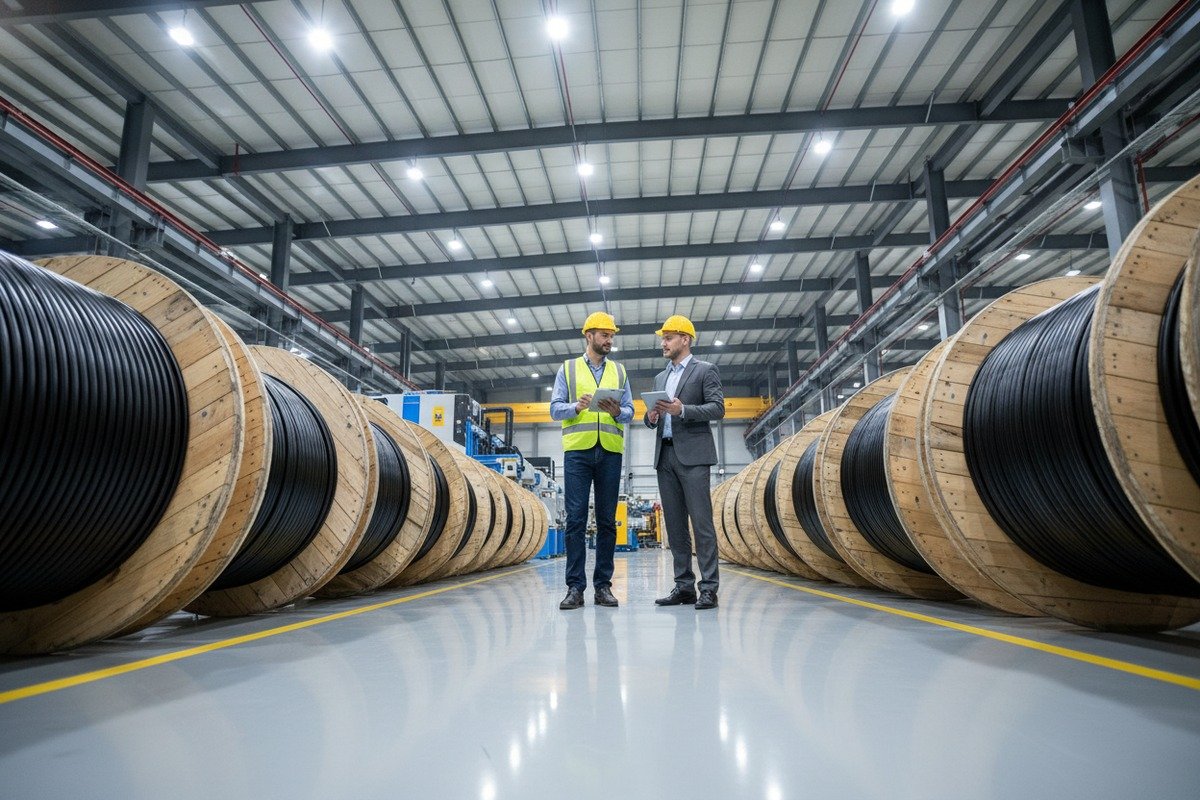
A TÜV certificate confirms initial product testing, but a recent factory inspection report proves that the manufacturer maintains consistent quality control, raw material sourcing, and production processes through ongoing surveillance audits, reducing the risk of receiving degraded or non-compliant cables over time.
The Difference Between a Certificate and an Audit
Think of the TÜV certificate as a diploma. It proves the product passed at a point in time. But the factory audit report is like a performance review. It shows whether the manufacturer is still meeting the standards every day.
TÜV Rheinland and TÜV SÜD both conduct annual (sometimes biannual) surveillance audits at certified factories. During these audits, inspectors check:
- Raw material incoming inspection records
- Production line calibration and process controls
- In-process and final product testing records
- Traceability systems from raw material to finished cable
- Storage conditions and packaging standards
- Corrective actions from previous audit findings
What a Good Factory Audit Report Tells You
A credible factory inspection report should include the audit date, the auditor's name and credentials, the scope of inspection, findings (including any non-conformances), and the overall result (pass, conditional pass, or fail). It should be dated within the last 12 months.
Here is what to look for and what to question:
| Audit Report Element | Good Sign | Warning Sign |
|---|---|---|
| Audit date | Within the last 12 months | More than 18 months old |
| Non-conformances | Minor issues with documented corrective actions | Major non-conformances with no resolution |
| Scope | Covers your specific cable type | Covers unrelated products only |
| Auditor credentials | Named TÜV auditor with ID | No auditor name or generic "quality team" |
| Raw material checks | Incoming inspection logs present | No traceability for copper or XLPO compound 8s |
| Test equipment calibration | Current calibration certificates shown | Outdated or missing calibration records |
Why This Matters for Long-Term Projects
Solar PV installations are designed to last 25 to 30 years. A cable that passes initial testing but comes from a factory with declining quality control will degrade faster in the field. UV exposure, thermal cycling, and mechanical stress amplify any manufacturing defect over time. Requesting the factory audit report is your insurance policy against slow-onset failures that won't show up until year 5 or year 10.
Complementary Quality Indicators
Beyond the TÜV audit, ask about the manufacturer's ISO 9001 certification 9. This covers the overall quality management system. Also inquire about batch-specific test reports. At our facility, we issue a test report for every production batch, including conductor resistance measurements, high-voltage withstand results, and insulation thickness checks. This level of traceability means that if a problem ever arises on-site, we can trace it back to the exact production run, raw material lot, and testing data.
We also encourage our partners to request CPR (Construction Products Regulation 10) documentation if the cables are destined for European buildings. CPR fire safety ratings like Dca or Cca require separate testing and a Declaration of Performance (DoP). This is distinct from TÜV PV cable certification and must be verified independently.
The Cost of Skipping This Step
One European distributor we work with shared a cautionary tale. They sourced PV cables from a supplier who held a valid TÜV certificate but had not undergone a factory audit in over two years. The supplier had quietly switched to a cheaper XLPO compound. The cables passed initial visual checks but failed independent UV aging tests within 500 hours—half the required minimum. The entire shipment was rejected at the project site. The distributor lost the contract and faced legal claims from the EPC company. A simple request for the latest audit report would have prevented the entire situation.
Conclusion
Verifying TÜV certification is not optional—it is your strongest defense against counterfeit cables, project failures, and costly warranty disputes in solar PV installations.
Footnotes
1. Replaced with the Wikipedia page for 'Photovoltaic system', which includes information on solar cables. ↩︎
2. Official information on the European standard for photovoltaic cables. ↩︎
3. Provides technical specifications and details for H1Z2Z2-K solar cables. ↩︎
4. Official website for TÜV Rheinland, a leading international certification service. ↩︎
5. Official website for TÜV SÜD, a global testing and certification body. ↩︎
6. Official database for verifying TÜV Rheinland certifications. ↩︎
7. Details the specifications and applications of PV1-F solar cables. ↩︎
8. Replaced with an academic article on cross-linked polyolefins (XLPOs) from a highly authoritative source (PMC). ↩︎
9. Official information on the international standard for quality management systems. ↩︎
10. Explains the European Union regulation for construction products. ↩︎