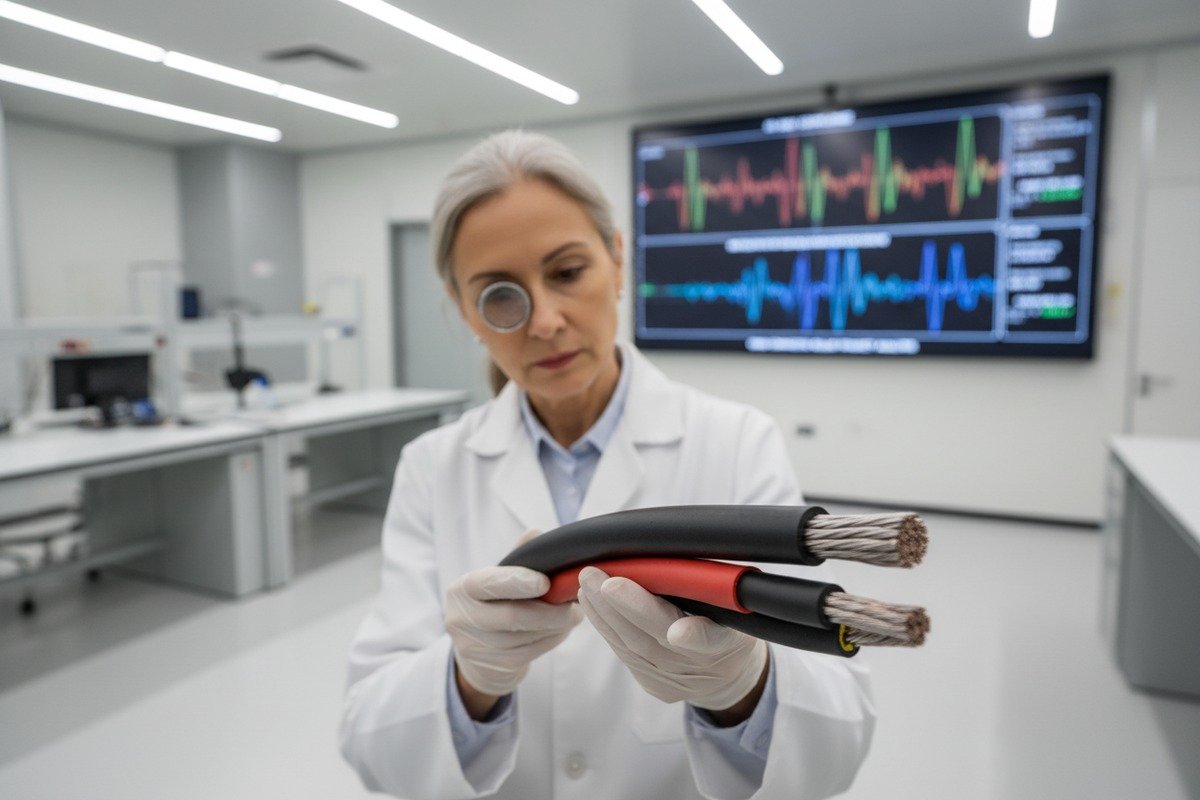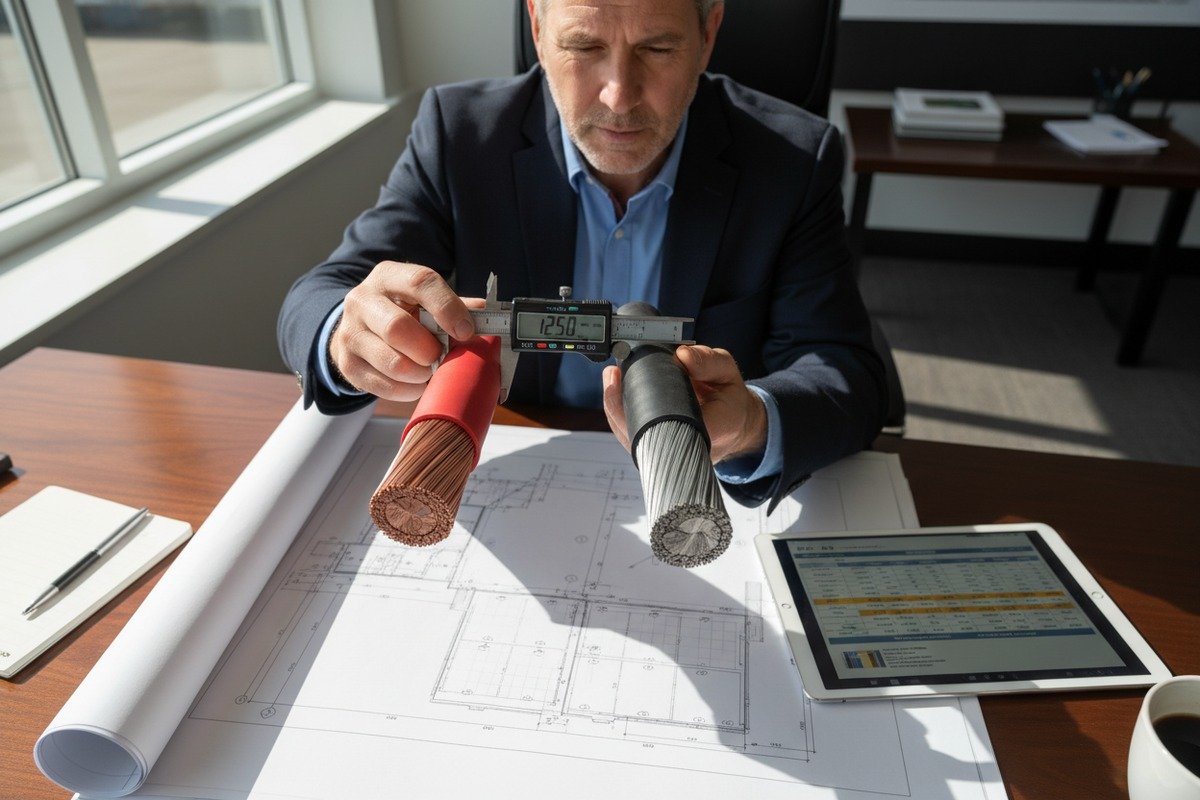

Every week, our quality control team rejects insulation samples that look identical on the outside but tell completely different stories under the microscope. The gap between premium XLPE and cheap substitutes is invisible to the naked eye—yet it determines whether your solar farm runs for 25 years or fails in five.
To evaluate XLPE insulation quality across solar PV cable brands, you must compare cross-linking degree via Hot Set Tests, verify additive packages for UV stabilizers, demand third-party lab reports on dielectric strength and thermal aging, and confirm that TUV or UL certifications match the exact batch you receive. These steps expose hidden material differences that spec sheets alone cannot reveal.
This guide walks you through the exact evaluation methods we use internally and recommend to our procurement partners. Each section targets a specific pain point—from spotting inferior materials to verifying fire safety compliance. Let's get into the details.
How can I distinguish between high-grade XLPO and inferior insulation materials during my supplier evaluation?
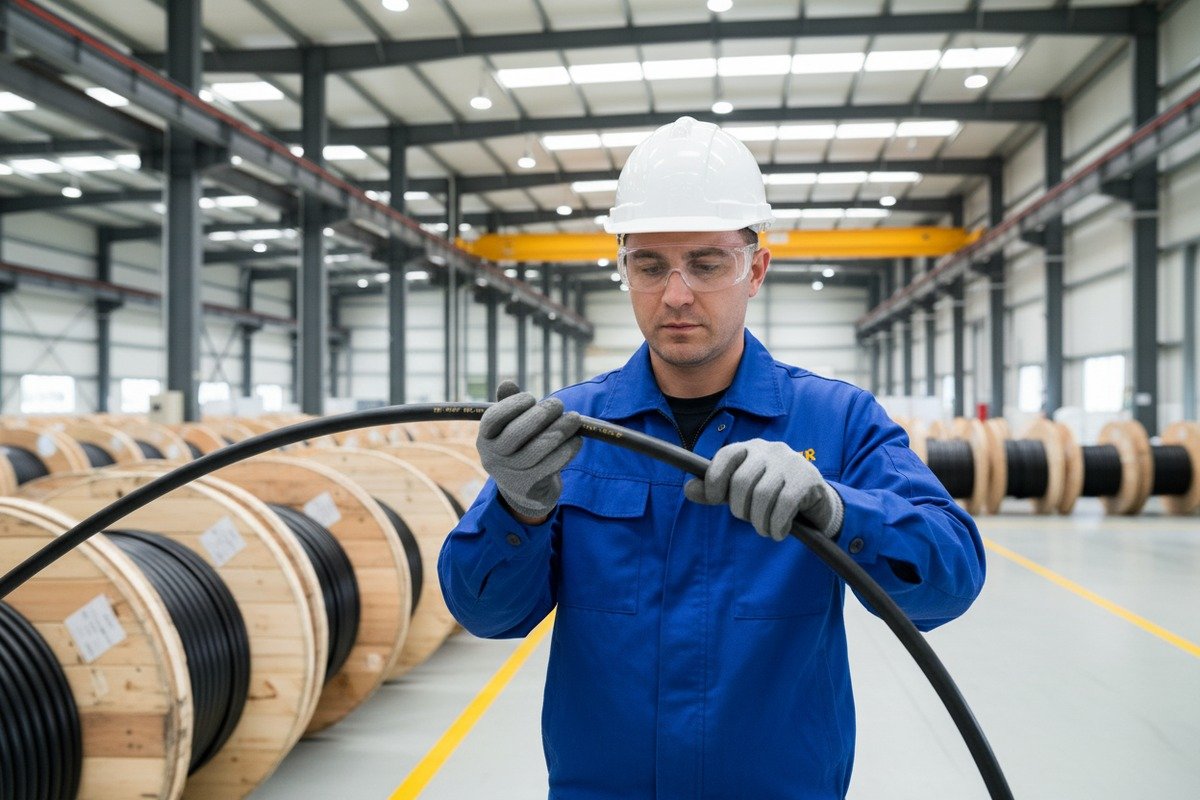
When we run incoming material inspections at our 230,000 m² facility, we catch substandard insulation compounds more often than most buyers would expect. The difference between a cable that lasts decades and one that cracks in three years often comes down to the polymer blend 1 and cross-linking chemistry hiding beneath the jacket.
You can distinguish high-grade XLPO from inferior insulation by requesting Hot Set Test results, checking gel content percentages above 65%, verifying UV stabilizer concentrations in the compound formula, and performing a simple bend-and-crease field test. Certified third-party lab data is always more reliable than manufacturer claims alone.
Understanding the Material Landscape
XLPE and XLPO are both cross-linked polymers, but they serve different roles. XLPE (cross-linked polyethylene) is the dominant insulation for solar PV cables because it handles continuous temperatures up to 90°C and short-circuit spikes to 250°C. XLPO (cross-linked polyolefin) is a broader category that sometimes includes XLPE but often refers to blends with added flexibility and lower toxicity.
The problem is this: some manufacturers label cables as "XLPE" but actually use a lightly cross-linked or non-cross-linked polyethylene compound. This saves money but destroys long-term performance. Our engineering team has tested cables from over 40 suppliers, and we've seen gel content values range from a poor 40% to a robust 80%. A gel content below 60% means the cross-linking process was incomplete, and the insulation will soften, deform, and eventually fail under sustained heat.
Key Tests to Request from Suppliers
| Test | What It Measures | Acceptable Result | Red Flag |
|---|---|---|---|
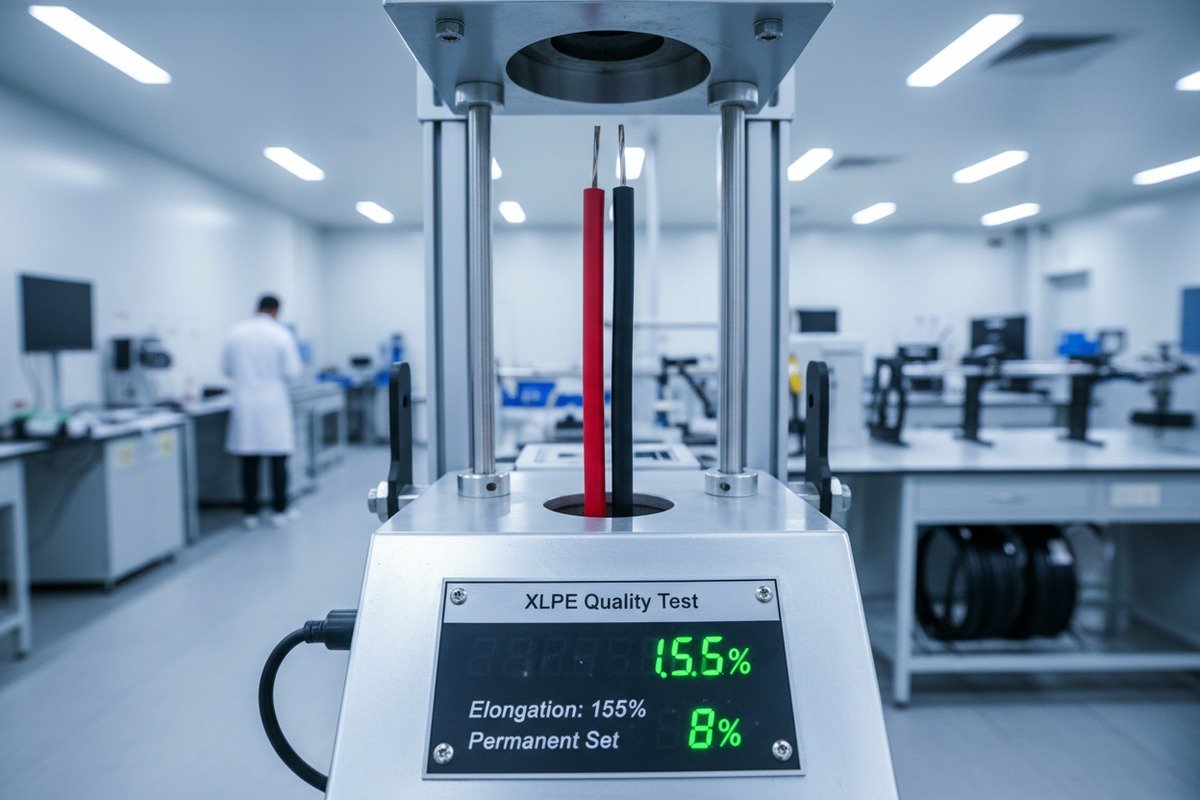
| Hot Set Test (IEC 60811-507) | Cross-linking degree under heat and load | Elongation ≤175%, permanent set ≤15% | Elongation >200% or set >20% |
| Gel Content (ASTM D2765) 2 | Percentage of cross-linked polymer | ≥65% for XLPE, ≥60% for XLPO | Below 55% |
| Tensile Strength | Mechanical integrity | ≥12.5 MPa (typical XLPE) | Below 10 MPa |
| UV Resistance (1000h Xenon Arc) | Aging under simulated sunlight | Tensile retention ≥80% | Retention below 70% |
| Oxygen Induction Time (OIT) | Antioxidant level in compound | ≥20 minutes at 200°C | Below 10 minutes |
Quick Field Checks You Can Do Yourself
When visiting a supplier or receiving samples, try these simple checks. First, bend the cable 180 degrees around a mandrel equal to four times the cable diameter. High-grade insulation bounces back without whitening or cracking. Inferior material will show stress marks or micro-cracks at the bend point. Second, cut a thin slice of insulation and hold it to strong light. Good XLPE appears uniform and translucent. Poor compounds show voids, bubbles, or inconsistent color—signs of incomplete mixing or contamination.
Also pay attention to the surface finish. Our production lines use precision extrusion heads that produce a smooth, consistent surface. Rough, wavy, or pitted surfaces suggest temperature control issues during manufacturing, which typically correlate with inconsistent cross-linking inside the insulation wall.
The Additive Package Matters More Than You Think
The base polymer is only half the story. UV stabilizers 3, antioxidants, and flame retardants form the additive package that determines outdoor survival. Ask your supplier for the specific type and concentration of UV stabilizer used. Hindered amine light stabilizers (HALS) at 0.3–0.5% by weight are standard for 25-year outdoor life. If a supplier cannot name their stabilizer type or provide concentration data, that is a clear warning sign.
What are the key indicators that my solar cable insulation will actually survive a 25-year outdoor lifespan?
Our R&D department conducts accelerated aging tests that simulate 30 years of harsh outdoor exposure in just a few months. We've learned that the cables which survive real-world conditions share a very specific set of measurable characteristics—and the ones that fail almost always had early warning signs that buyers overlooked.
The key indicators for 25-year outdoor survival include thermal aging retention above 80% after 20,000 hours at 135°C, UV resistance with less than 20% property loss after 1,000 hours of xenon arc exposure, moisture resistance below 50 mg/cm absorption, and a verified cross-linking degree with gel content exceeding 65%.
Thermal Endurance Is Non-Negotiable
Solar cables face relentless temperature cycling. Rooftop installations in the Middle East can see cable surface temperatures exceed 80°C daily. Over 25 years, that is roughly 9,000 days of thermal stress. XLPE rated for 90°C continuous operation handles this well—but only if the cross-linking was done properly and the antioxidant package is sufficient.
Request accelerated thermal aging test data per IEC 60216 4. The cable insulation should retain at least 80% of its original tensile strength and elongation after extended heat exposure. If a manufacturer only provides room-temperature data, they are hiding something.
Environmental Exposure Factors
| Environmental Factor | Test Standard | 25-Year Survival Threshold | Common Failure Mode |
|---|---|---|---|
| UV Radiation | ISO 4892-2 (Xenon Arc) | ≤20% tensile loss after 720–1000h | Surface cracking, chalking |
| Ozone Exposure | IEC 60811-403 | No cracking at 25 pphm, 72h | Circumferential cracks |
| Water Absorption | IEC 60811-402 | ≤50 mg/cm after immersion | Water treeing 5, dielectric loss |
| Cold Bend | IEC 60811-504 | No cracking at -40°C | Brittle fracture in winter |
| Chemical Resistance | IEC 60811-404 | Mass change ≤10% after immersion | Swelling, softening |
Water Treeing: The Silent Killer
Water treeing is perhaps the most dangerous degradation mechanism for buried or tray-installed solar cables. Moisture slowly penetrates micro-defects in the insulation, creating tree-shaped channels that eventually cause dielectric breakdown. We have seen cables from low-cost manufacturers develop water trees within 5 years because their extrusion process introduced micro-voids.
To prevent this, demand that your supplier uses a clean-room extrusion environment and triple-layer co-extrusion for the insulation. Ask for water treeing resistance test data. A well-made XLPE insulation will show minimal tree growth even after 1,000 hours of accelerated water treeing tests at elevated voltage.
Mechanical Durability for Real Job Sites
Construction sites are brutal on cables. They get stepped on, dragged across gravel, bent around sharp edges, and crushed under heavy equipment. Good insulation should have a tensile strength of at least 12.5 MPa and elongation at break above 200%. These numbers come straight from the EN 50618 6 and IEC 62930 standards for solar PV cables.
Our quality team also tests abrasion resistance. We run cables through a standardized abrasion test where a blade rocks back and forth under a 7N load. The insulation must withstand a minimum number of cycles before the conductor is exposed. This test directly simulates what happens when cables are pulled through conduit or laid along metal support structures on solar farms.
How do I verify that a manufacturer's TUV certification for insulation matches the actual materials used in my order?
One of the most frustrating conversations we have with new customers starts the same way: they've been burned by a previous supplier who showed a valid TUV certificate during the quotation stage but shipped cables made with completely different materials. In our industry, certification fraud is not rare—it's systematic in certain markets.
To verify TUV certification authenticity, cross-reference the certificate number on TUV's official online database, confirm that the certified product model and factory address match your purchase order, request batch-specific test reports tied to your shipment, and arrange independent third-party testing at a TUV-accredited lab before accepting delivery.
Step-by-Step Verification Process
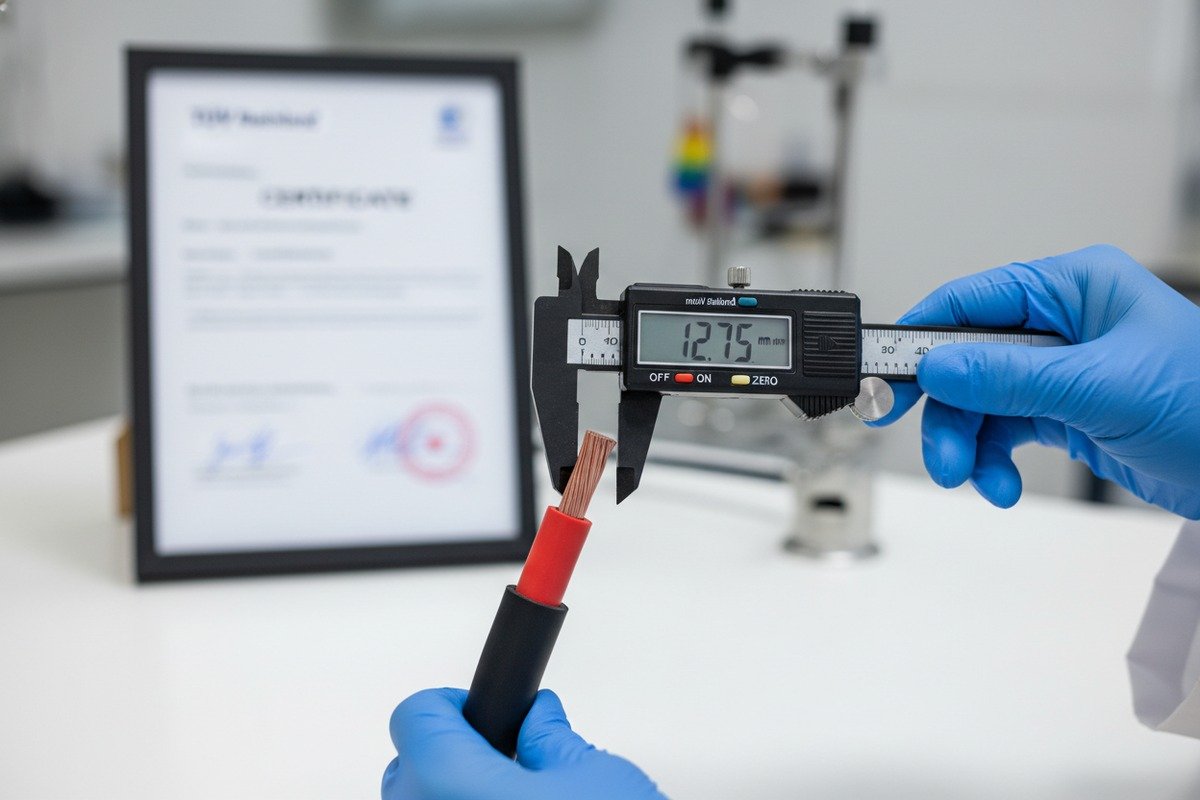
Start by asking the manufacturer for a clear copy of their TUV certificate. Every legitimate certificate has a unique ID number, the name of the certified entity, the factory address, the specific product model, and a validity date. Go to the TUV official website (such as TUV Rheinland's Certipedia 7 or TUV SUD's certification database) and search that ID number. The database entry must match every detail on the certificate the manufacturer provided.
Here's what to check specifically:
- The factory address on the certificate must match the actual production facility. Some suppliers hold a certificate for one factory but manufacture your order at a different, uncertified location.
- The product model listed must exactly match what you are ordering. A TUV certificate for "H1Z2Z2-K 1×4mm²" does not cover "H1Z2Z2-K 1×6mm²."
- The certificate must be current. Expired certificates are not valid, period.
Batch-Level Traceability
A certificate alone only proves that a product type was tested at some point. It does not guarantee that your specific shipment uses the same materials. This is where batch-level verification becomes critical.
At our factory, every production batch receives a unique lot number. We can provide test reports linked to that lot number, including raw material certificates from our polymer supplier, Hot Set Test results from that batch, and dimensional inspection data. When we ship to European
Footnotes
1. Discusses polyethylene blends for HVDC cable insulation. ↩︎
2. Official standard for determining gel content in crosslinked ethylene plastics. ↩︎
3. Replaced with a Wikipedia article section providing a general overview of UV stabilizers in polymers, a highly authoritative and accessible source. ↩︎
4. Defines procedures for thermal endurance testing of electrical insulating materials. ↩︎
5. Details the degradation mechanism of water treeing in cable insulation. ↩︎
6. Specifies requirements for cables used in photovoltaic systems. ↩︎
7. Official database for verifying product and system certifications. ↩︎