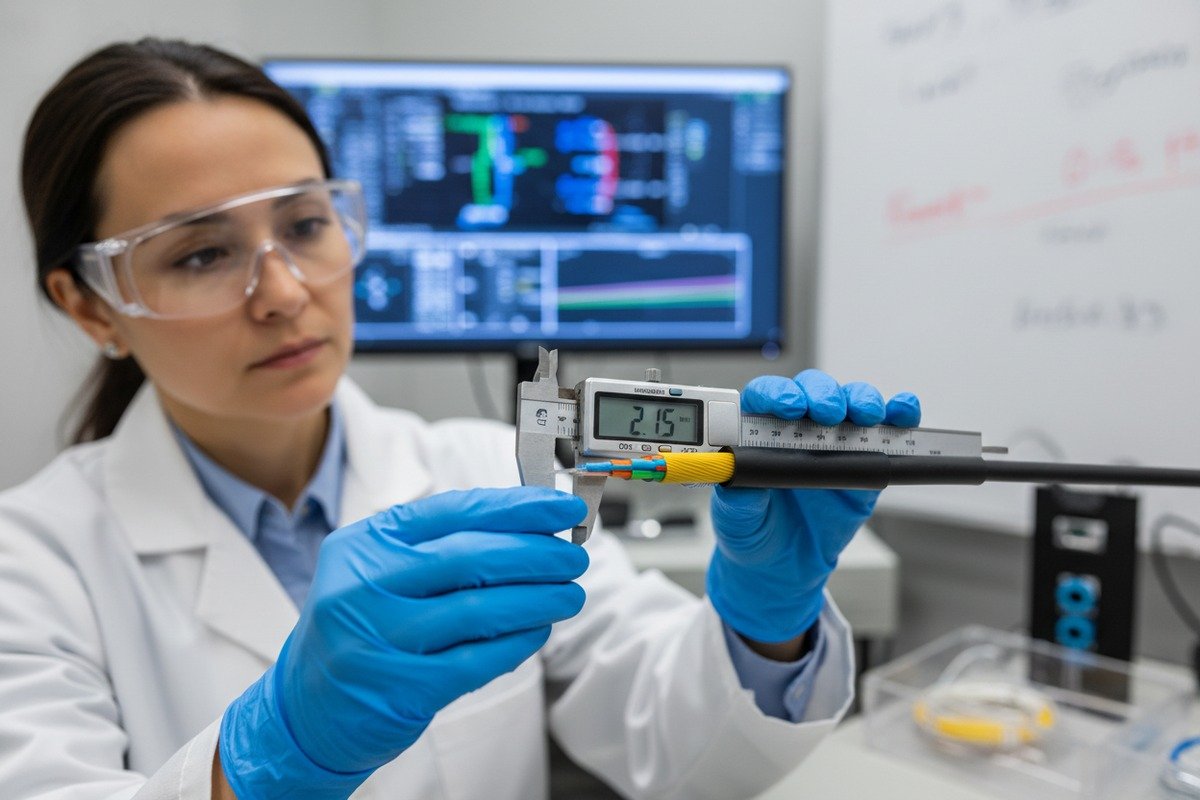
Every year, our production lines ship thousands of kilometers of ADSS cable to power grids and telecom networks across Southeast Asia, Latin America, and Africa. Yet the question we hear most from procurement managers is not about price—it is about which optical specs truly protect their investment from costly failures down the road.
The most critical optical performance parameters for ADSS fiber optic cables are attenuation (signal loss per kilometer), chromatic dispersion, and polarization mode dispersion (PMD). These three specs directly control how far, how fast, and how reliably your signal travels across long aerial spans near power lines.
Below, we break down the four questions our engineering team gets asked most often. Each answer is backed by real production data and field experience. Let's start with the single most important number on any ADSS spec sheet: attenuation 1.
How do I determine the maximum allowable attenuation for my ADSS project?
We have seen projects in the Philippines delayed by months because the buyer accepted cables with borderline attenuation values, only to discover signal failure after installation. The problem is not rare. It is predictable—and preventable.
To determine maximum allowable attenuation, calculate your total link budget by subtracting connector losses, splice losses, and safety margins from your equipment's optical power budget, then divide the remaining budget by total cable length to get the maximum dB/km you can tolerate at your operating wavelength.
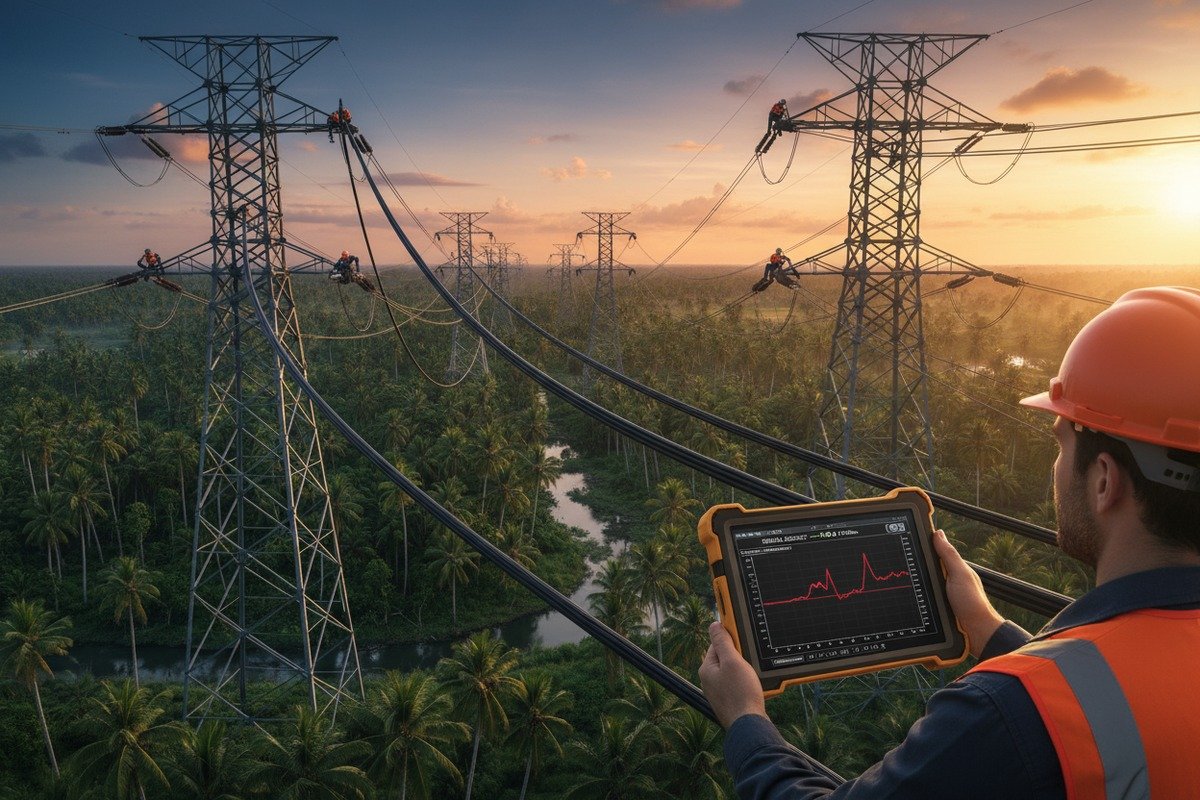
Why Attenuation Is the First Number You Should Check
Attenuation tells you how much optical power your signal loses for every kilometer of fiber. Think of it as fuel efficiency for light. A cable with high attenuation burns through your signal budget fast, forcing you to add expensive optical amplifiers or repeaters.
For standard single-mode G.652D fiber—the type used in most ADSS cables we produce—industry benchmarks look like this:
| Wavelength | Maximum Attenuation (ITU-T G.652D 2) | Lonsoncable Typical Value | Best-in-Class Target |
|---|---|---|---|
| 1310 nm | ≤ 0.35 dB/km | 0.33 dB/km | ≤ 0.32 dB/km |
| 1550 nm | ≤ 0.22 dB/km | 0.20 dB/km | ≤ 0.19 dB/km |
| 1625 nm | ≤ 0.24 dB/km | 0.22 dB/km | ≤ 0.21 dB/km |
| 1383 nm (water peak) | ≤ 0.31 dB/km | 0.29 dB/km | ≤ 0.28 dB/km |
How to Build a Simple Link Budget
Here is a practical example. Suppose your optical transceiver has a transmit power of 0 dBm and a receiver sensitivity of −28 dBm. Your power budget is 28 dB. Now subtract:
- Connector losses: 2 connectors × 0.5 dB = 1.0 dB
- Splice losses: 10 splices × 0.1 dB = 1.0 dB
- Safety margin: 3.0 dB (for aging, temperature shifts, and repairs)
Remaining budget: 28 − 1.0 − 1.0 − 3.0 = 23 dB. If your route is 100 km, maximum allowable attenuation is 23 ÷ 100 = 0.23 dB/km at 1550 nm. That is tight. You need a cable that consistently tests at or below 0.22 dB/km.
The 1383 nm Water Peak Trap
One detail many buyers overlook is hydrogen-induced attenuation near 1383 nm. Over time, hydrogen molecules from cable materials or the environment can seep into the fiber. This raises loss at the water peak wavelength. Our engineers use hydrogen-aged fiber testing protocols to confirm long-term stability. If you plan to use CWDM systems 3, demand a low water peak fiber (compliant with ITU-T G.652.D, not just G.652.B) and ask for hydrogen aging test data.
Microbending Under Dynamic Loads
ADSS cables sway in wind, sag under ice, and vibrate near power lines. Each of these motions can cause tiny bends in the fiber—microbends—that leak light and raise attenuation unpredictably. Static factory tests may not capture this. When we test our cables, we simulate dynamic loading conditions to measure attenuation variation under stress. Ask your supplier if they test under vibration, not just on a bench.
Which operating wavelengths should I specify to ensure compatibility with my existing equipment?
When our sales team receives an inquiry, the first technical question we ask is: "What wavelengths does your network equipment use?" The answer shapes every fiber selection decision that follows. Getting this wrong means expensive rework.
Specify operating wavelengths that match your transceivers and multiplexing plan—typically 1310 nm and 1550 nm for standard links, plus 1625 nm for OTDR monitoring, and the full 1260–1625 nm range if you use CWDM or DWDM systems for future capacity expansion.

Standard Wavelength Windows
Most telecom and power utility networks operate in three main windows:
| Window | Wavelength | Common Use | Key Spec to Check |
|---|---|---|---|
| O-Band | 1260–1360 nm (center 1310 nm) | Short/medium reach, PON upstream | Attenuation ≤ 0.35 dB/km |
| C-Band | 1530–1565 nm (center 1550 nm) | Long-haul, DWDM | Attenuation ≤ 0.22 dB/km, chromatic dispersion ≤ 18 ps/(nm·km) |
| L-Band | 1565–1625 nm | Extended DWDM, OTDR monitoring | Attenuation ≤ 0.24 dB/km |
| E-Band | 1360–1460 nm (center 1383 nm) | CWDM channels | Low water peak required (≤ 0.31 dB/km) |
Chromatic Dispersion: The Speed Limiter
At 1550 nm, chromatic dispersion becomes a real concern for 10G, 40G, and 100G links. Different wavelengths of light travel at slightly different speeds inside the fiber. This spreads your signal pulse over distance. For G.652D fiber, the zero-dispersion wavelength falls between 1300 and 1324 nm, with a slope below 0.092 ps/(nm²·km). At 1550 nm, dispersion can reach up to 18 ps/(nm·km).
If you run 10 Gbps over 80 km, that dispersion adds up. Our engineering team always recommends that buyers share their link speed and distance so we can confirm the fiber type and dispersion budget match. For ultra-long-haul or 100G+ links, consider G.654 or dispersion-shifted fibers, though G.652D handles the vast majority of ADSS applications.
PMD: The Hidden Bottleneck for High-Speed Networks
Polarization mode dispersion 5 is less intuitive than attenuation but equally dangerous for fast networks. Light in a fiber travels in two polarization states. If the fiber is not perfectly round—due to manufacturing variation or mechanical stress—these states arrive at different times. The ITU-T limit is ≤ 0.2 ps/√km. For a 100 km link, that is 2.0 ps of spreading.
At 10 Gbps, 2.0 ps is manageable. At 40 Gbps, it starts causing bit errors. At 100 Gbps, it can shut down a link entirely. If you plan to upgrade speeds within the cable's 25-year life, demand PMD below 0.1 ps/√km. This is where spending a bit more on fiber quality pays off enormously.
Effective Area and Nonlinear Effects
For buyers running high-power DWDM systems, the fiber's effective area (Aeff) 6 matters. Standard G.652D has an Aeff around 80 µm². A larger effective area reduces nonlinear effects like four-wave mixing and self-phase modulation, which degrade signal quality in dense WDM channels. If your system pushes more than 16 DWDM channels over 60+ km, discuss Aeff with your supplier.
Cable Cut-Off Wavelength
The cable cut-off wavelength must be below 1260 nm. This ensures the fiber operates in single-mode across the entire O through L band. If cut-off is too high, higher-order modes propagate and cause signal distortion. Every spool we ship includes a cable cut-off measurement on the test report. Confirm this value before accepting delivery.
How can I confirm that the factory's OTDR test results are authentic and accurate?
Trust is the hardest thing to build in international cable procurement. Our customers in Brazil and Indonesia have told us stories of receiving test reports that looked perfect on paper—but the cables failed in the field within months. Fraudulent or sloppy testing is a real risk.
Confirm OTDR test authenticity by requesting full bidirectional traces at both 1310 nm and 1550 nm for every reel, verifying event markers match your ordered length, cross-checking with an independent third-party lab test, and insisting on witnessing factory acceptance testing (FAT) either in person or via live video.

What a Genuine OTDR Report Should Include
An OTDR (Optical Time Domain Reflectometer) 7 sends pulses of light into the fiber and measures reflections. The trace shows attenuation, splice points, breaks, and connector losses along the entire length. A legitimate report includes:
- Bidirectional measurements at 1310 nm and 1550 nm (averaging both directions eliminates measurement bias)
- Fiber length matching your purchase order within ±1%
- Event table listing every splice, connector, and anomaly with location and loss
- Point discontinuity values below 0.05 dB at any single event
- Test equipment details: OTDR model, serial number, calibration date
- Operator name and date of testing
Red Flags That Indicate Fake or Manipulated Reports
Here are warning signs our quality team trains buyers to spot:
- Identical traces across multiple reels. Each reel is unique. If two PDFs look pixel-identical, the report was copied.
- Missing backscatter slope. A real trace shows a gradual downward slope. A flat line suggests the data was fabricated.
- Round numbers everywhere. Real measurements include decimals like 0.192 dB/km, not clean 0.20 dB/km on every reel.
- No event markers. Even a perfect cable has at least start and end reflections.
- Calibration date older than 12 months. OTDR accuracy degrades without annual calibration.
Third-Party Verification
The strongest protection is independent testing. Before shipment, pull random samples and send them to an accredited lab (e.g., one with ISO/IEC 17025 certification 8). At Lonsoncable, we welcome third-party inspections and provide full factory access. We also offer live-streamed FAT sessions where the buyer's engineer watches the OTDR test in real time via video call. This has become standard practice for our projects in Africa and the Middle East.
Matching OTDR Data to Real-World Performance
Even a genuine OTDR test done in a temperature-controlled factory may not predict field performance perfectly. Temperature swings from −20°C to +60°C cause minor attenuation changes. Wind-induced vibration adds transient microbend loss. Ask for temperature cycling test data and dynamic bend loss results in addition to the standard OTDR trace. These supplementary tests give a more complete picture of how the cable will perform on your towers.
What is the relationship between cable tension and the long-term optical stability of my fiber?
On our production floor, we run tension-attenuation correlation tests on every new ADSS cable design before it goes to market. The results consistently prove one thing: mechanical design and optical performance are inseparable. Ignore tension specs, and your fiber degrades silently over years.
Cable tension directly affects fiber strain inside the ADSS structure—when tension exceeds design limits, the fiber stretches beyond its safe strain threshold (typically 0.05–0.1% at maximum allowable tension), causing permanent attenuation increases, accelerated fatigue, and eventual signal failure across the cable's service life.
Understanding the Tension Hierarchy
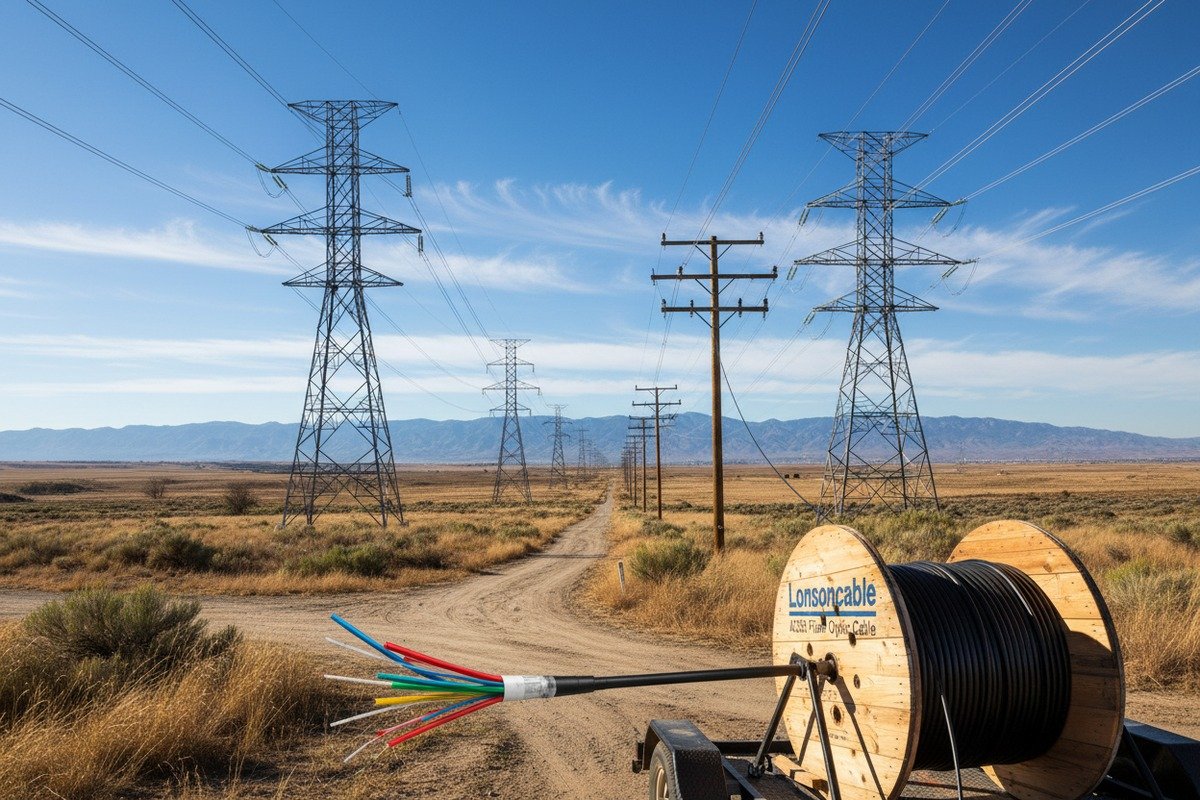
ADSS cables are self-supporting. They hang between towers with no messenger wire. The cable itself bears all wind, ice, and gravity loads. Engineers define several tension levels, each with a specific optical impact:
| Tension Level | Definition | Typical Value (% of RTS) | Fiber Strain | Optical Impact |
|---|---|---|---|---|
| Everyday Stress (EDS) | Normal load, no wind/ice | 16–25% RTS | ≈ 0% (zero strain) | No additional attenuation; baseline condition |
| Maximum Allowable Tension (MAT) | Worst-case weather load | ~40% RTS | ≤ 0.05–0.1% | Minimal, recoverable attenuation increase |
| Ultimate Everyday Stress (UES) | Extreme overload event | > 60% RTS | 0.35–0.5% | Temporary increase; must recover when load drops |
| Rated Tensile Strength (RTS) 9 | Breaking point | 100% | > 1.0% | Permanent fiber damage and cable failure |
How Span Length Drives Tension Requirements
Longer spans need stronger cables. A 100-meter span across a road might only need 1.8 kN of MAT. A 200-meter river crossing could require 3.77 kN or more. Our design engineers use sag-tension calculation software that factors in local wind speed, ice thickness, temperature range, and tower height to select the right cable construction.
For example, a 96-fiber ADSS cable designed for a 100-meter span might have an 11 mm outer diameter and 1.8 kN MAT. The same fiber count for a 200-meter span jumps to a 12.2 mm diameter and 3.77 kN MAT. The extra strength comes from additional aramid yarn layers, which also add cost. Oversizing wastes money. Undersizing risks fiber damage.
Central Tube vs. Stranded Loose Tube
The cable's internal structure determines how well it isolates fibers from external tension:
- Central tube design: Fibers sit in a single central buffer tube with excess fiber length (EFL). Simpler and cheaper, suitable for spans up to about 150 meters with 12–48 fibers. Fiber strain tolerance is typically up to 0.5% at UES.
- Stranded loose tube design: Multiple buffer tubes are stranded around a central strength member. Better strain isolation for longer spans (150–300+ meters) and higher fiber counts (48–144+). Fiber strain tolerance is around 0.35% at UES because the helical lay provides mechanical decoupling.
Long-Term Fatigue and Creep
Aramid yarn and the PE jacket creep over time under constant load. This means the cable elongates slightly, changing sag and potentially increasing fiber strain. Our cables undergo 1,000-hour creep testing at elevated temperature and tension to predict 25-year behavior. If a cable's EDS is set too high (above 25% RTS), creep accelerates and the fiber strain margin shrinks. This is why we recommend an EDS no higher than 20% RTS for most tropical installations where sustained high temperatures amplify creep.
Aeolian Vibration and Galloping
Wind-induced vibration is the silent killer of ADSS cables. Low-frequency galloping 10 in ice-prone regions and high-frequency aeolian vibration in open terrain both flex the cable millions of times over its life. Each flex cycle adds a tiny amount of fatigue stress. Without proper dampers and an appropriate EDS, the aramid fibers and even the optical fibers can develop micro-cracks. We specify damper placement at every tower for spans over 120 meters and provide vibration fatigue test data to support the recommendation.
The key takeaway is this: optical performance and mechanical design are two sides of the same coin. You cannot evaluate attenuation, dispersion, and PMD without understanding how much tension, vibration, and temperature stress the cable will endure across its entire installed life.
Conclusion
Purchasing ADSS fiber optic cable is not just a procurement decision—it is an engineering decision. Prioritize attenuation, chromatic dispersion, PMD, and the tension-to-strain relationship. Verify every test report independently. Your network's reliability for the next 25 years depends on the specs you demand today.
Footnotes
1. Provides a clear explanation of fiber attenuation and its causes. ↩︎
2. Refers to the international standard for single-mode optical fiber characteristics. ↩︎
3. Describes a technology for increasing network capacity by multiplexing different wavelengths of light. ↩︎
4. Defines a key parameter for calculating maximum allowable attenuation in fiber networks. ↩︎
5. Explains a critical optical parameter affecting high-speed network performance and signal integrity. ↩︎
6. Describes a fiber characteristic important for high-power DWDM systems and nonlinear effects. ↩︎
7. Defines a key instrument used for testing and characterizing fiber optic cables. ↩︎
8. Specifies the international standard for the competence of testing and calibration laboratories. ↩︎
9. Explains a critical mechanical property of ADSS cables related to their breaking point. ↩︎
10. Authoritative source (Wikipedia) with a clear explanation of conductor galloping. ↩︎