
Every year, our factory ships thousands of cable drums to European solar farms EN 50399 1. Yet the most common sourcing mistakes still happen on the AC side, not the DC side, of the system.
To select AC-side solar PV cable specs for European grid projects, you must verify CPR fire safety classifications, match voltage ratings (0.6/1.0 kV minimum) and conductor sizing to inverter output, confirm EN 50618 and IEC 60364-7-712 compliance, and validate XLPO insulation longevity for a 25-year service life under local climate conditions.
This guide breaks down the four most critical questions our European EPC buyers ask us before placing orders. Each section gives you a clear checklist so you can source with confidence and avoid costly project delays.
How do I ensure my AC-side cables meet the latest European CPR fire safety classifications for grid-connected projects?
A single rejected shipment at customs can stall an entire solar farm build by weeks. Our export team in Hainan has seen CPR compliance trip up even experienced procurement managers.
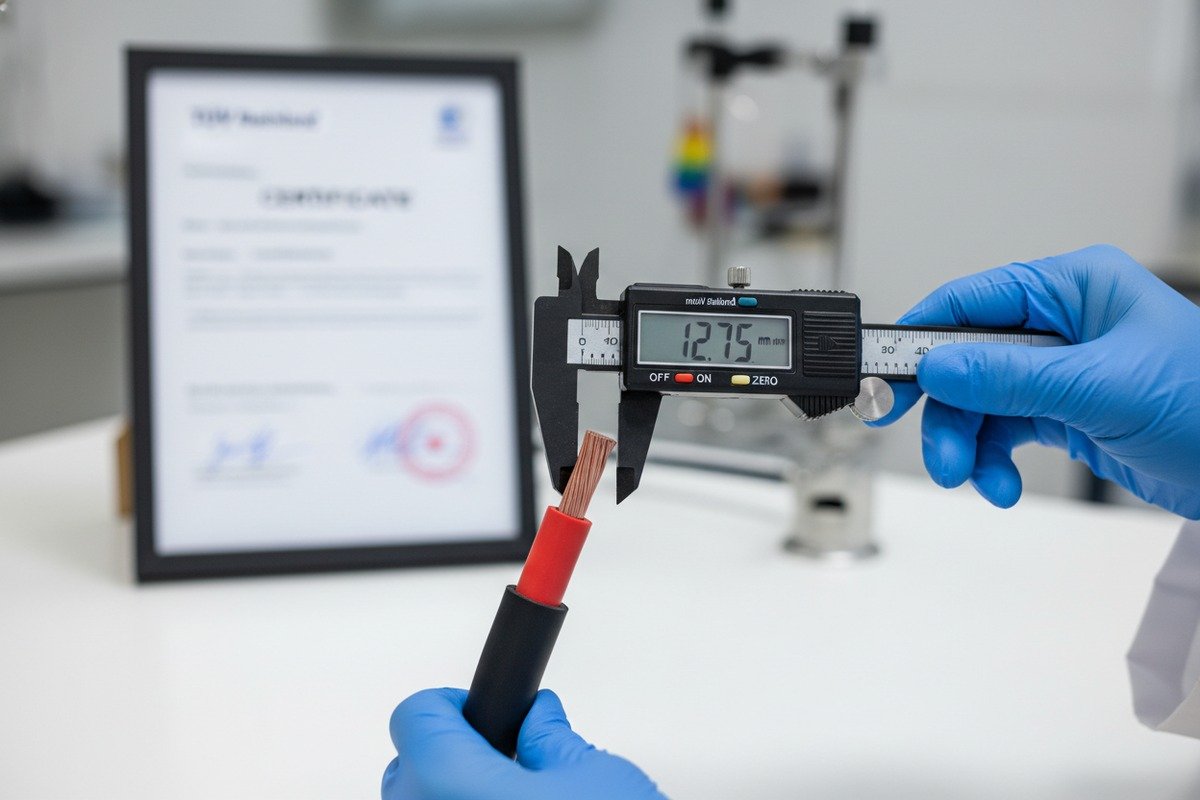
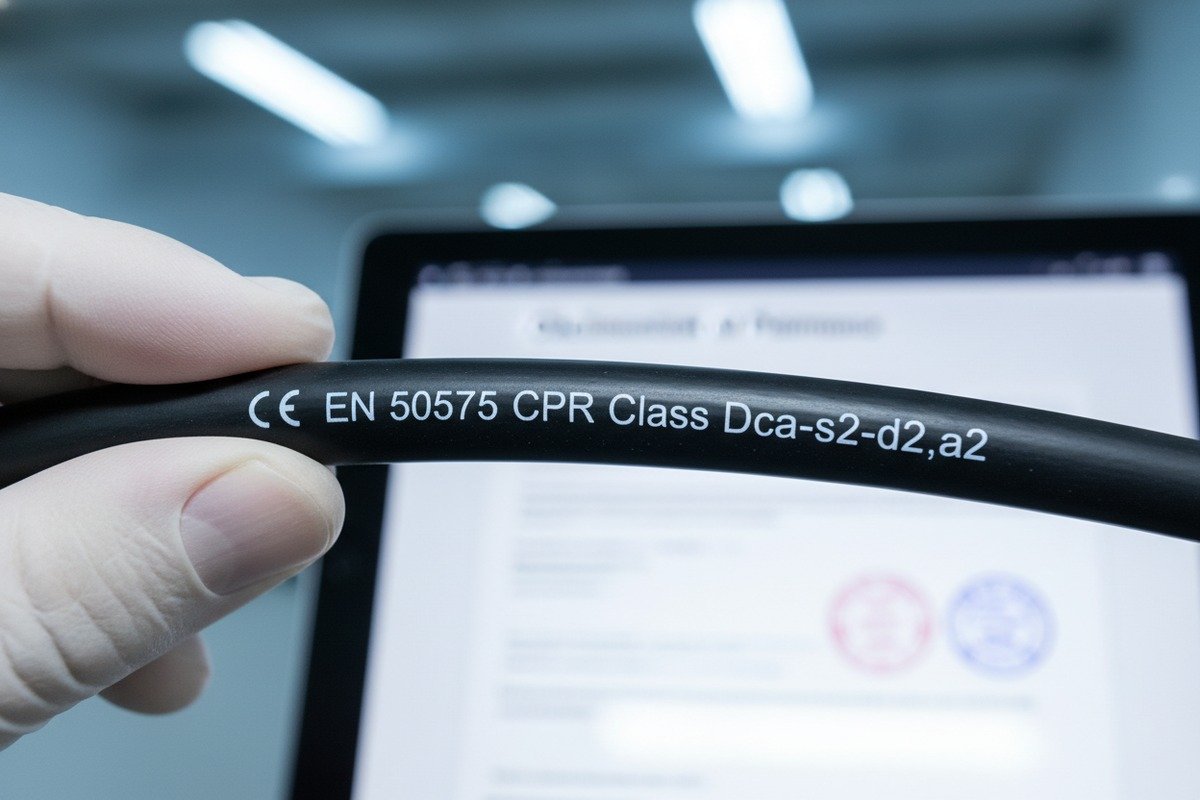
To meet European CPR fire safety requirements, your AC-side cables must carry a valid Declaration of Performance (DoP) with a minimum Dca-s2,d2,a2 classification. Verify the cable's CE marking references EN 50575, and request independent third-party test reports for every production batch before shipment.
What Is the CPR and Why Does It Matter for PV Cables?
The Construction Products Regulation (EU) No. 305/2011 requires all cables permanently installed in buildings and civil engineering works to carry a fire classification. CPR fire safety classifications 2 This applies to AC-side cables routed through structures, cable trays in substations, or any fixed installation on a European solar project.
The CPR classifies cables from Aca (best) down to Fca (no performance determined). For most grid-connected solar projects, local building authorities require at least Dca class. Some countries like the Netherlands and Germany push for Cca or even B2ca in public buildings and critical infrastructure.
CPR Classification Comparison Table
| CPR Class | Fire Behavior | Smoke Production | Typical Use Case |
|---|---|---|---|
| B2ca | Very limited contribution to fire | s1 (low smoke) | Critical infrastructure, tunnels |
| Cca | Limited contribution to fire | s1 or s2 | Commercial rooftops, public buildings |
| Dca | Medium contribution to fire | s2 (medium smoke) | Standard solar farm AC runs |
| Eca | Passes small flame test only | Not classified | Short indoor runs, limited use |
| Fca | No performance determined | Not classified | Not acceptable for EU installations |
How to Verify Genuine CPR Compliance
Do not rely on a supplier's word alone. Here is what we recommend based on years of working with German and Dutch importers:
- Request the Declaration of Performance (DoP). Every CPR-compliant cable must have a unique DoP number. Declaration of Performance (DoP) 3 Cross-check this number against the manufacturer's published database.
- Check the Notified Body number. The CE marking on the cable must reference a recognized Notified Body (NB). You can verify the NB number on the EU NANDO database 4.
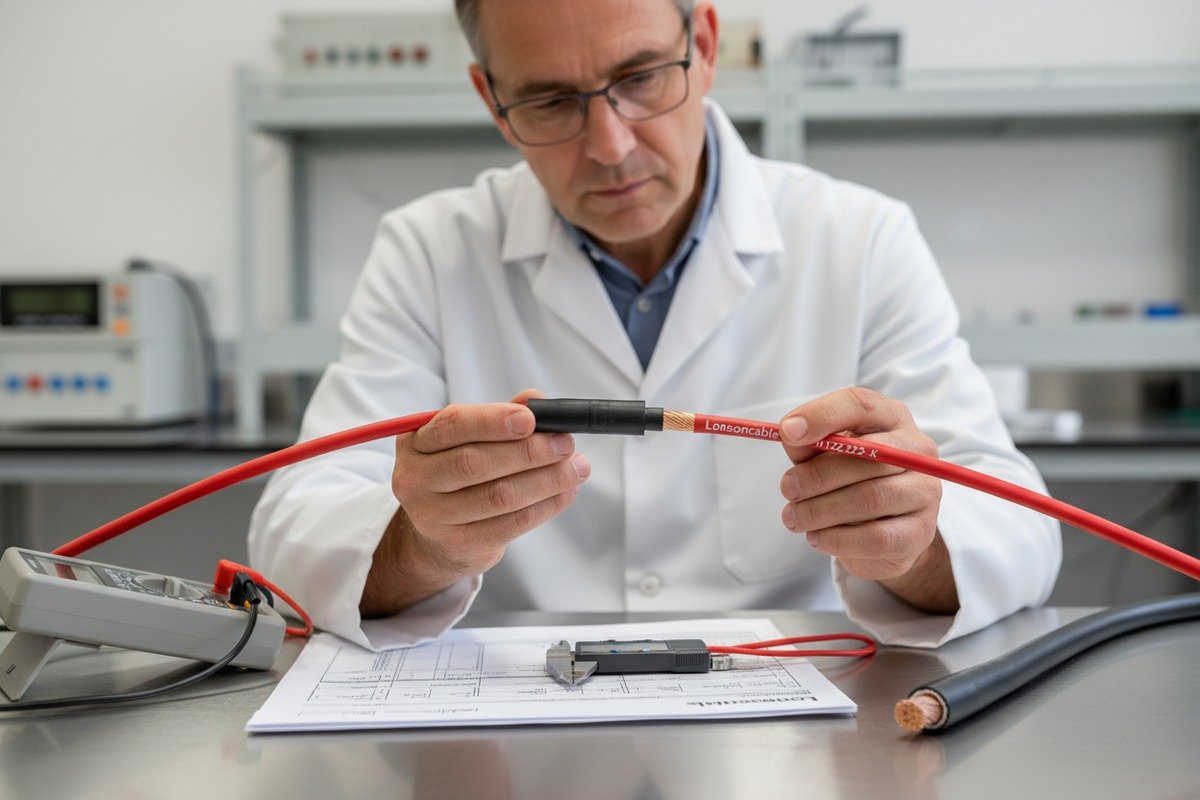
- Ask for batch-specific test reports. Reputable manufacturers test every production batch. We run IEC 60332-1 5 and EN 50399 tests on our production lines and can provide certificates tied to your specific order.
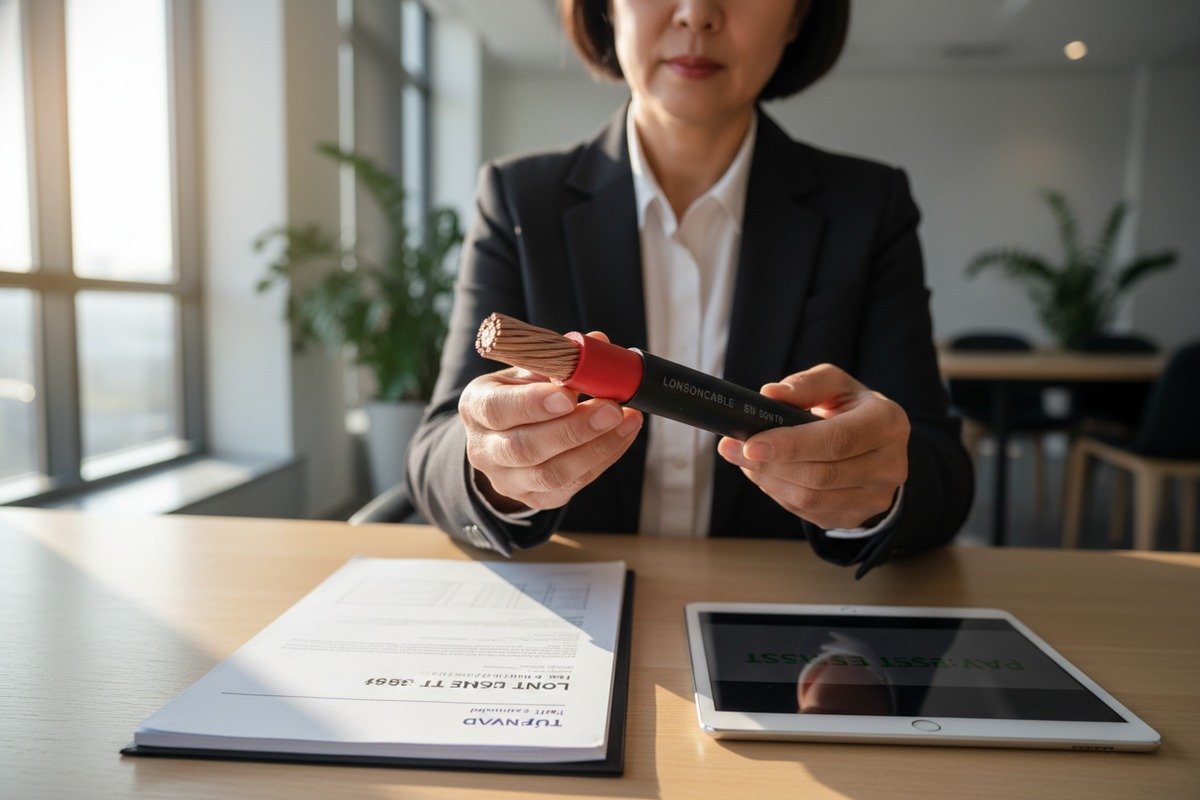
- Inspect the cable marking. The physical cable jacket must be printed with the CPR class, the standard reference (EN 50575 6), and the manufacturer's identification.
A common mistake is assuming that a TÜV certificate for the cable type automatically covers CPR. It does not. TÜV 2PfG 1169 and EN 50618 certify electrical performance. CPR is a separate fire safety regime. You need both.
Country-Specific Nuances
Germany requires cables in public and commercial installations to meet at least Dca. The Netherlands has pushed many project specs to Cca-s1,d1,a1. Denmark often mandates reinforced cable specs per IEC 60364-7-712 7. Always confirm with your local building authority or EPC partner before locking in specs.
What specific voltage ratings and conductor materials should I prioritize for my large-scale European grid connections?
When we design cable specs for European utility-scale projects, the conversation always starts with two numbers: voltage rating and conductor cross-section. Get either one wrong, and you face grid rejection or dangerous overheating.
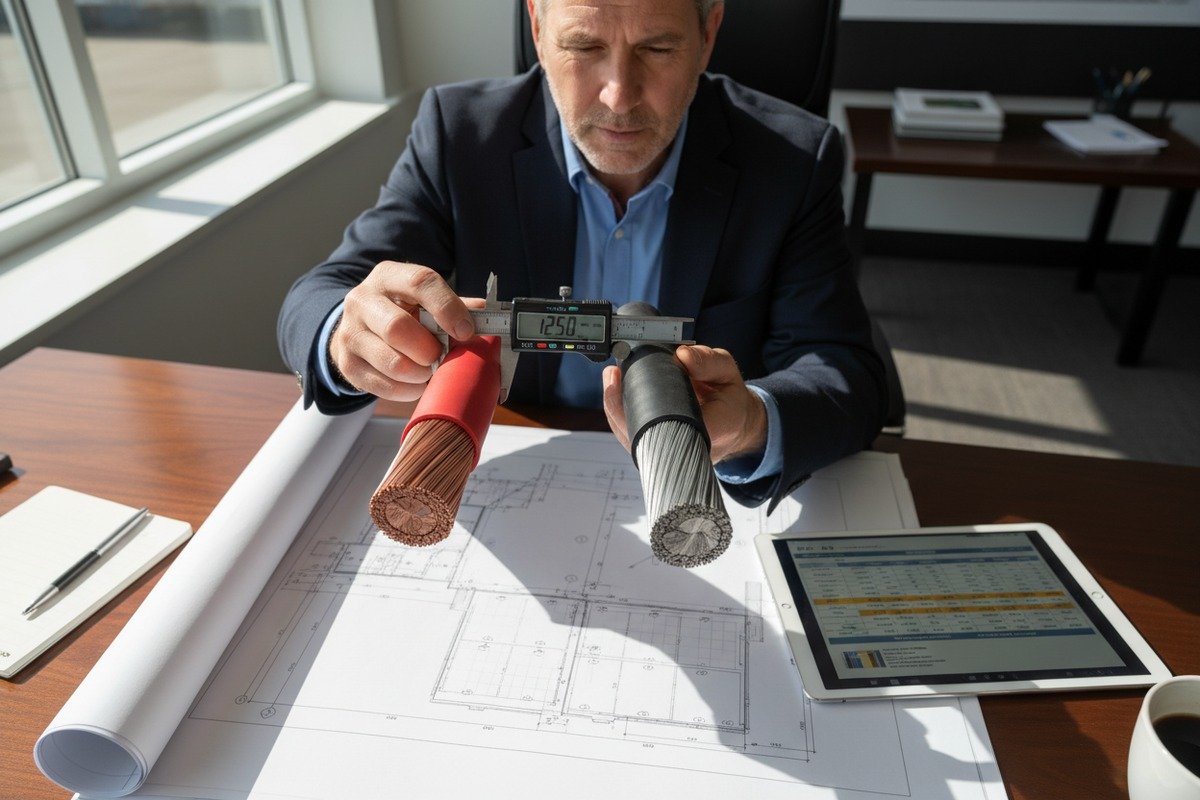
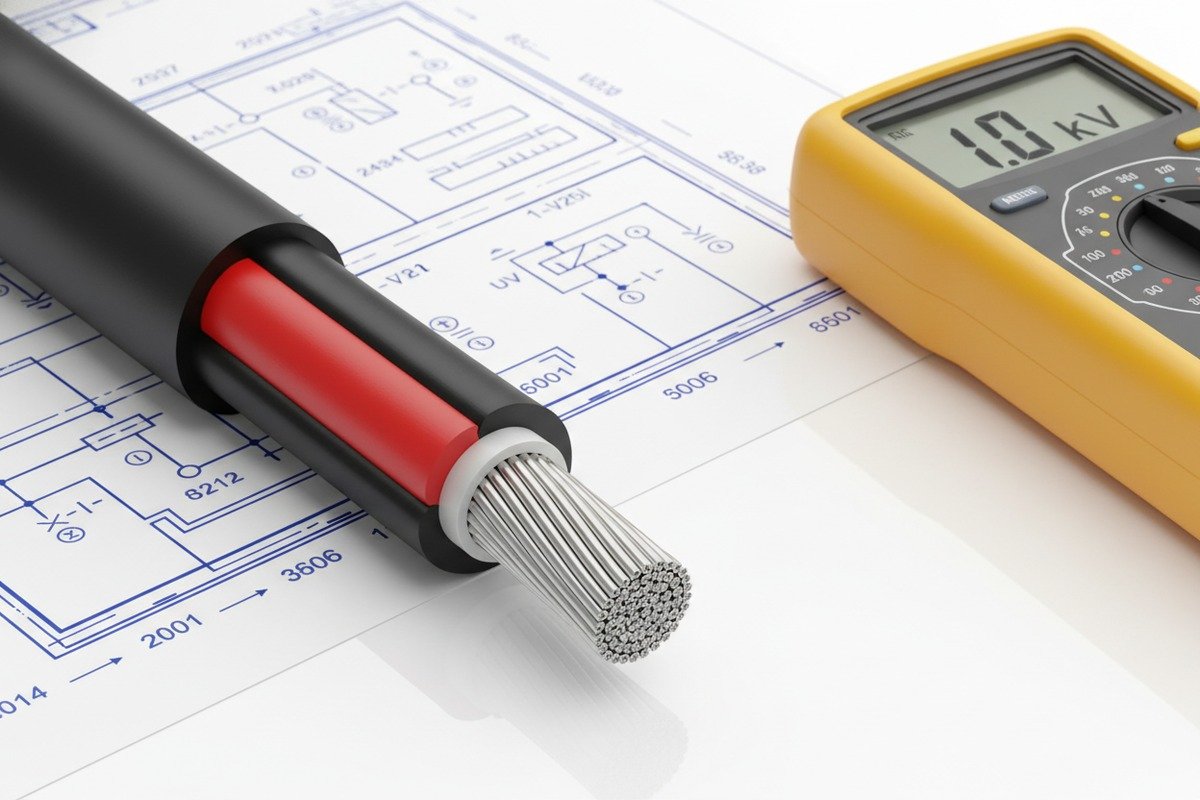
For large-scale European AC-side connections, prioritize cables rated at least 0.6/1.0 kV with tinned copper Class 5 flexible conductors per EN 60228. Size conductors from 6mm² to 400mm² based on inverter maximum output current, and keep voltage drop below 2% using the formula △U = (I × L × 2) / (γ × S).
Voltage Rating Requirements
European AC-side PV cables must handle the nominal grid voltage plus safety margins. For low-voltage systems (up to 1,000V AC), a 0.6/1.0 kV rating is standard. For medium-voltage collector cables in utility-scale farms, you may need 6/10 kV or higher ratings, but most inverter-to-transformer runs stay within low-voltage territory.
The rated voltage on the cable refers to two values: U₀ (voltage between conductor and earth) and U (voltage between conductors). A 0.6/1.0 kV cable handles 600V to earth and 1,000V between phases. This covers the vast majority of three-phase inverter outputs in European commercial and utility projects.
Conductor Material and Class
| Parameter | Recommended Spec | Reason |
|---|---|---|
| Conductor material | Tinned copper | Superior conductivity, corrosion resistance, solder-friendly |
| Conductor class | Class 5 (EN 60228 8) | Flexible, easier routing and termination |
| Cross-section range | 6mm² – 400mm² | Matches inverter outputs from 27A to 600A+ |
| Max conductor temp | 90°C continuous | Standard for XLPE/XLPO insulated cables |
| Aluminum alternative | Class 2 solid or stranded | Lower cost for long buried runs, but requires larger cross-sections |
Copper remains the default for most European EPC projects. Our production lines handle both copper and aluminum conductors up to 400mm². However, aluminum requires roughly 1.6× the cross-sectional area of copper to carry the same current. For space-constrained cable trays, copper wins.
Sizing for Voltage Drop
The voltage drop on the AC side must stay below 2%. Here is a practical example:
- Inverter output: 100 kW three-phase, 400V, max current 145A
- Cable run: 80 meters one-way
- Copper conductivity (γ): 56 m/(Ω·mm²)
- Target voltage drop: < 2% of 400V = 8V
Using △U = (I × L × 2) / (γ × S):
Rearranging for S: S = (145 × 80 × 2) / (56 × 8) = 23,200 / 448 = 51.8mm²
You would select a 70mm² cable to provide margin. In practice, our engineers always recommend one size up from the calculated minimum. Ambient temperature derating, cable bundling, and conduit installation all reduce effective current capacity.
Derating Factors to Watch
| Installation Condition | Typical Derating Factor |
|---|---|
| Ambient temp 40°C | 0.87 |
| Ambient temp 50°C | 0.71 |
| 3 cables bundled in tray | 0.80 |
| Direct burial (no duct) | 1.00 (reference) |
| In conduit, exposed to sun | 0.70 |
Always apply the worst-case combination. A cable tray on a rooftop in Southern Spain at 50°C with three bundled circuits can see effective capacity drop by 40% or more. This is where undersized cables fail silently for months before causing a fault.
Three-Phase vs. Single-Phase Configurations
Three-phase inverters dominate European commercial and utility projects. They require five-core cables (3 phases + neutral + earth) or three single-core cables plus separate neutral and earth conductors. Single-phase systems use three-core cables. Confirm your inverter's wiring diagram before ordering. Our team routinely reviews inverter datasheets with buyers to match cable core configurations exactly.
How can I verify that the cable drum packaging will withstand sea freight and fit my automated on-site laying equipment?
Broken drums and crushed cable coils are not rare events. On our production floor, we learned years ago that packaging engineering deserves the same rigor as cable engineering. A perfect cable inside a failed drum is a worthless delivery.
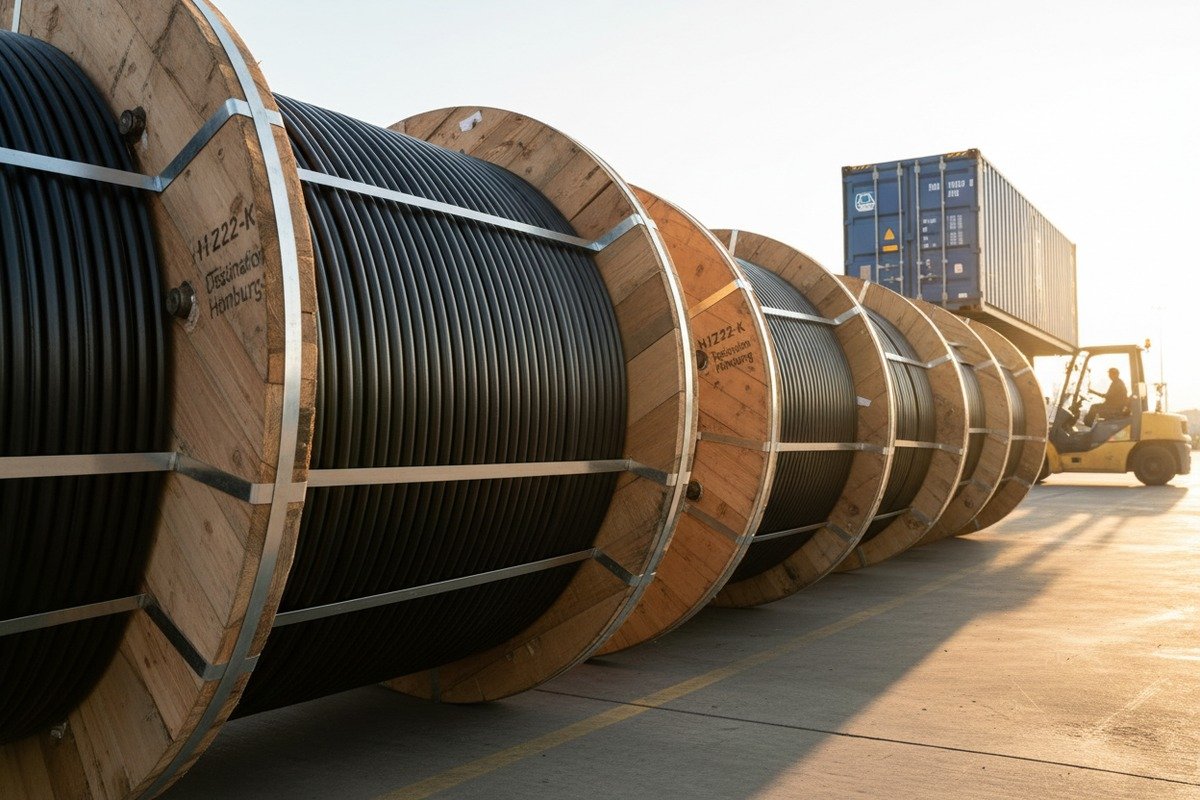
Verify drum packaging by requesting drum dimension drawings that match your laying machine's spindle diameter and width capacity, specifying marine-grade plywood or steel drums with fumigation certificates (ISPM-15), and requiring shock/tilt indicators on each pallet to detect mishandling during sea freight.
Why Packaging Fails Happen
Most packaging failures trace back to three root causes:
- Drum material too weak for cable weight. A 500-meter run of 70mm² copper cable can weigh over 2,000 kg. Standard softwood drums crack under this load during container stacking.
- Drum dimensions mismatched to laying equipment. Automated cable-laying machines have fixed spindle sizes and width limits. A drum that is 20mm too wide will not mount.
- No moisture or fumigation treatment. Untreated wood drums get detained by European customs under ISPM-15 phytosanitary rules.
Drum Specification Checklist
Here is what we include in every packaging specification discussion with European buyers:
- Drum core diameter: Matches the minimum bend radius of the cable (typically 6–8× outer diameter for AC cables).
- Flange diameter: Sized so cable layers do not exceed the flange edge. Overfilled drums cause cable damage during unwinding.
- Spindle hole diameter: Must match the buyer's laying machine. Common European sizes are 70mm, 80mm, and 100mm.
- Material: Marine-grade plywood for drums under 1,500 kg total. Steel or reinforced drums for heavier loads.
- ISPM-15 marking: Heat-treated or fumigated wood with the official stamp. ISPM-15 marking 9 Without this, your shipment gets quarantined.
Protecting Cables During Transit
Sea freight subjects drums to vibration, humidity swings, and potential container condensation (container rain). We wrap cable ends with heat-shrink caps to prevent moisture ingress. Each drum gets banded to a pallet base. Shock indicators (tilt-watch or shock-watch stickers) on the outside let your receiving team know immediately if the container was dropped or tilted beyond safe limits.
For automated laying, the cable's unwinding behavior matters too. We wind cables under controlled tension to ensure smooth payout. Loose or tangled winding causes jams in mechanical feeders, forcing expensive manual intervention on site.
Pre-Shipment Inspection Points
Before any container is sealed, we recommend buyers or their agents check:
- Drum dimensions against the purchase order drawing.
- Cable length marking on the drum tag matches the tested length.
- ISPM-15 stamp is visible and legible.
- No visible drum cracks, loose nails, or warped flanges.
- Shock/tilt indicators are in place and un-triggered.
These steps take 30 minutes per container and can save weeks of project delay.
How do I vet a manufacturer's XLPO insulation quality to guarantee a 25-year lifespan under extreme European weather conditions?
Our R&D lab runs accelerated aging tests on every insulation compound we formulate. Even so, we know that buyers should never take a manufacturer's internal data at face value. Independent verification is the only way to trust a 25-year claim.
Vet XLPO insulation quality by requesting third-party accelerated aging test reports per EN 50618, verifying UV resistance to at least 720 hours (ISO 4892-2), confirming a continuous operating temperature range of -40°C to +90°C, and checking that the cross-linking degree exceeds 70% through hot-set testing per IEC 60811-507.
Why XLPO and Not PVC or Standard XLPE?
Cross-linked polyolefin (XLPO) 10 has become the insulation of choice for solar PV cables because it combines the thermal stability of XLPE with the halogen-free, low-smoke properties needed for CPR compliance. PVC degrades faster under UV and emits toxic hydrogen chloride gas when burned. Standard XLPE performs well thermally but often contains halogens. XLPO gives you the best of both worlds for a 25-year outdoor installation.
Critical Tests You Should Request
| Test | Standard | Pass Criteria | What It Proves |
|---|---|---|---|
| Hot-set test | IEC 60811-507 | Elongation ≤175%, permanent set ≤15% | Cross-linking degree is adequate |
| UV resistance | ISO 4892-2 | No cracking after 720h xenon arc | Survives 25 years of sun exposure |
| Cold bend | IEC 60811-504 | No cracking at -40°C | Handles Scandinavian winters |
| Thermal aging | IEC 60811-401 | Tensile strength retention >80% after 240h at 135°C | Long-term heat resistance |
| Ozone resistance | EN 50396 | No visible cracks after 72h | Withstands atmospheric ozone |
| Water absorption | IEC 60811-402 | < 5 mg/cm² | Insulation integrity in wet conditions |
How to Spot Substandard XLPO
Inferior insulation compounds cut costs by reducing the cross-linking agent (typically peroxide) or by blending cheaper filler materials. Here are red flags:
- Hot-set results above 175% elongation. This means the insulation is under-crosslinked and will creep under heat stress, eventually cracking.
- UV test duration below 720 hours. Some suppliers test at 200–300 hours and claim compliance. That covers perhaps 5–8 years, not 25.
- No third-party lab name on the report. If the test report does not carry a recognized lab's accreditation mark (ILAC/MRA), question its validity.
- Insulation surface is sticky or discolored on sample. Properly crosslinked XLPO feels smooth and matte. Tackiness indicates incomplete curing.
Real-World Durability Factors
European weather extremes test cable insulation relentlessly. Alpine sites see -30°C winters and intense summer UV at altitude. Coastal installations face salt spray corrosion. Mediterranean rooftops can push surface temperatures above 80°C.
Our engineers design insulation formulations targeting a 1.4× safety factor above the rated 90°C conductor temperature. This accounts for localized hot spots near cable glands, junction boxes, and conduit entries where airflow is restricted.
We also recommend buyers request a sample spool before committing to a full order. Cut a 1-meter section, bend it around the minimum bend radius at room temperature, then place it in a freezer at -25°C for 24 hours and bend again. Visual cracks indicate a compound that will not survive a Northern European winter. This simple test has saved several of our German partners from accepting substandard material.
Traceability and Batch Consistency
A 25-year lifespan guarantee means nothing if batch-to-batch insulation quality varies. Ask your supplier for:
- Raw material supplier certificates for the XLPO compound.
- In-line cross-linking degree measurements (hot-set tested per batch).
- Retention samples stored for at least 10 years.
- A written warranty that references specific test standards, not vague language.
At our Hainan facility, every production batch is tagged with a unique code that traces back to the compound lot, extrusion date, curing parameters, and test results. This level of traceability is what European grid inspectors expect.
Conclusion
Selecting the right AC-side solar PV cable for European grids demands attention to CPR fire ratings, conductor sizing, packaging logistics, and insulation durability. Verify every claim with independent test data, and your projects will run on time and on spec.
Footnotes
1. Wikipedia provides an overview of the EN 50399 standard for reaction to fire tests for bundled cables. ↩︎
2. Official EU source explaining the Construction Products Regulation and its fire safety requirements. ↩︎
3. Official EU guidance on the Declaration of Performance, a key document for CPR compliance. ↩︎
4. Official European Commission database for Notified Bodies, essential for verifying certification validity. ↩︎
5. Wikipedia provides a general overview of the IEC 60332 series of standards for flame propagation tests. ↩︎
6. BSI provides information on the harmonized standard for cables under the Construction Products Regulation. ↩︎
7. BSI provides details on the standard for electrical installations of photovoltaic (PV) power supply systems. ↩︎
8. Wikipedia explains the European standard specifying conductor types and dimensions for insulated cables. ↩︎
9. Official source for the International Standards for Phytosanitary Measures No. 15 for wood packaging. ↩︎
10. Prysmian Group provides information on halogen-free cables, which often utilize XLPO for safety and performance. ↩︎