Every week, our sales team fields the same question from EPC buyers and distributors across Europe, Latin America, and the Middle East: should I go with aluminum alloy or copper for my solar PV cables?
To evaluate aluminum alloy versus copper solar PV cables, compare five critical factors: electrical conductivity and required upsizing, total lifecycle cost including installation labor, mechanical durability under thermal cycling, corrosion resistance at connection points, and compliance with certifications like TUV EN 50618 or UL 4703 for your target market.
The choice is not as simple as picking the cheaper option International Annealed Copper Standard 1. Below, we break down each decision factor so you can match the right conductor material to your specific project type, budget, and regulatory environment.
How can I balance the lower cost of aluminum alloy with the long-term conductivity requirements of my solar project?
Price pressure on solar projects is real. Our quoting engineers see it every day — buyers want to cut cable costs by 30% or more, but they also need systems that perform reliably for 25 years bimetallic lugs 2.
Balance aluminum alloy's lower cost against conductivity needs by upsizing the cable cross-section (typically two AWG sizes larger), then calculating total lifecycle cost — including efficiency losses, larger conduit, and additional installation labor — against copper's higher upfront price but lower resistive losses.
Understanding the Conductivity Gap
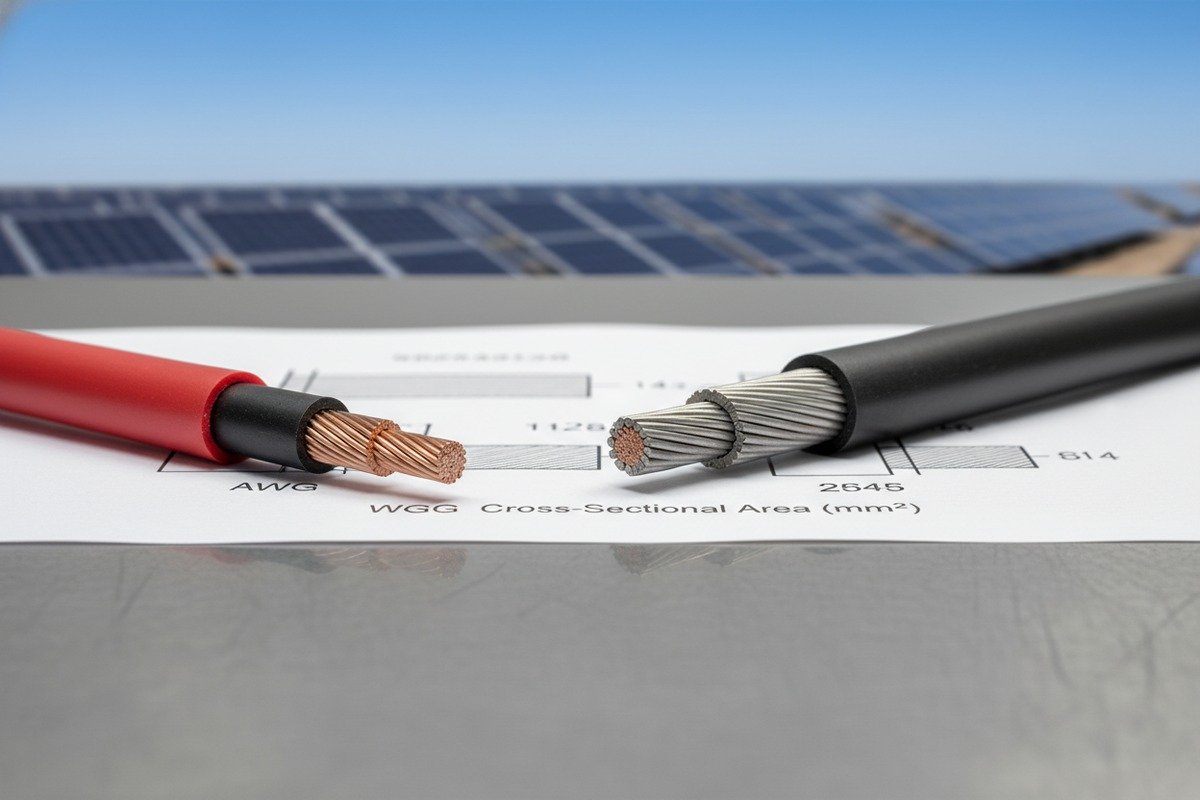
Copper has an electrical conductivity 3 of roughly 100% IACS (International Annealed Copper Standard). Aluminum sits at about 61% IACS. This means that for the same cross-sectional area, an aluminum cable carries significantly less current anti-oxidant paste 4. In practical terms, if a 10 AWG 5 copper cable meets your ampacity needs, you will need an 8 AWG aluminum cable to deliver the same performance.
This upsizing has a ripple effect. Larger cables require larger conduits, bigger cable trays, and heavier junction boxes XLPO (Cross-Linked Polyolefin) 6. These costs are easy to overlook in early budgeting.
The Real Cost Equation
Many buyers look only at the per-kilogram price of the conductor. Aluminum alloy is typically 30–50% cheaper per kilogram than copper. But the "loaded cost" — which includes transportation, conduit sizing, connectors, labor, and long-term efficiency losses — tells a different story.
Here is a simplified comparison for a typical 10 MW ground-mounted solar installation:
| Cost Factor | Copper Cable | Aluminum Alloy Cable |
|---|---|---|
| Raw material cost per km | $4,200 | $2,500 |
| Required cross-section for same ampacity | 1x (baseline) | 1.5–1.6x larger |
| Conduit and tray costs | Baseline | +15–20% |
| Installation labor | Baseline | +5–10% (specialized connectors) |
| Estimated resistive loss over 25 years | Lower (baseline) | +3–5% higher |
| Theft and security risk | Higher (copper scrap value) | Lower |
| Total lifecycle cost (estimated) | Higher upfront, lower long-term | Lower upfront, variable long-term |
When Aluminum Alloy Makes Financial Sense
For utility-scale and large ground-mounted projects with long cable runs, the sheer volume of material makes aluminum alloy's cost advantage very significant. On a 100 MW plant, our customers in Southeast Asia and Latin America have reported saving 20–30% on cable procurement budgets by switching to aluminum alloy — even after accounting for upsizing and specialized connectors.
However, for smaller distributed rooftop systems or projects in high-humidity coastal environments, copper often wins on total cost because the maintenance, connector, and corrosion prevention expenses of aluminum erode the initial savings.
Carbon Footprint Considerations
There is also a sustainability angle that European buyers like Klaus increasingly care about. Aluminum production has a lower embodied carbon 7 than copper on a per-conductor basis for equivalent capacity cables. Studies suggest 35% lower lifecycle carbon emissions for aluminum-cabled 100 MW plants. This aligns with EU green procurement frameworks.
What specific technical adjustments must I make to my system design when switching from copper to aluminum alloy cables?
When our engineering team supports customers transitioning from copper to aluminum alloy, we always provide a detailed technical adjustment checklist. Skipping even one step can cause failures that are expensive to fix once panels are live.
When switching to aluminum alloy, you must upsize cable gauge for equivalent ampacity, use bimetallic or compression-type connectors at all copper-aluminum junctions, apply anti-oxidant compound to terminations, increase conduit diameters, and recalculate voltage drop across all string and trunk cable runs to ensure compliance with system design limits.
Cable Sizing and Voltage Drop Recalculation
This is the first and most critical step. You cannot simply swap a 4 mm² copper cable for a 4 mm² aluminum alloy cable. You need to recalculate. A good rule of thumb is to go up by at least one standard size, but always run voltage drop calculations based on your actual string lengths and system voltage.
For a 1,500V DC system with 200-meter string cable runs, the difference is meaningful:
| Parameter | 4 mm² Copper | 6 mm² Aluminum Alloy |
|---|---|---|
| DC resistance at 20°C (Ω/km) | ~4.61 | ~5.09 |
| Voltage drop at 10A over 200m | ~18.4V | ~20.4V |
| Percentage drop (1500V system) | ~1.23% | ~1.36% |
| Ampacity at 30°C ambient | ~42A | ~42A |
| Cable weight per km | ~86 kg | ~38 kg |
Note that even with upsizing, the aluminum cable may still produce a slightly higher voltage drop. In long cable runs, this compounds. Our recommendation is to run the numbers for each specific layout, not rely on generic tables.
Connector and Termination Requirements
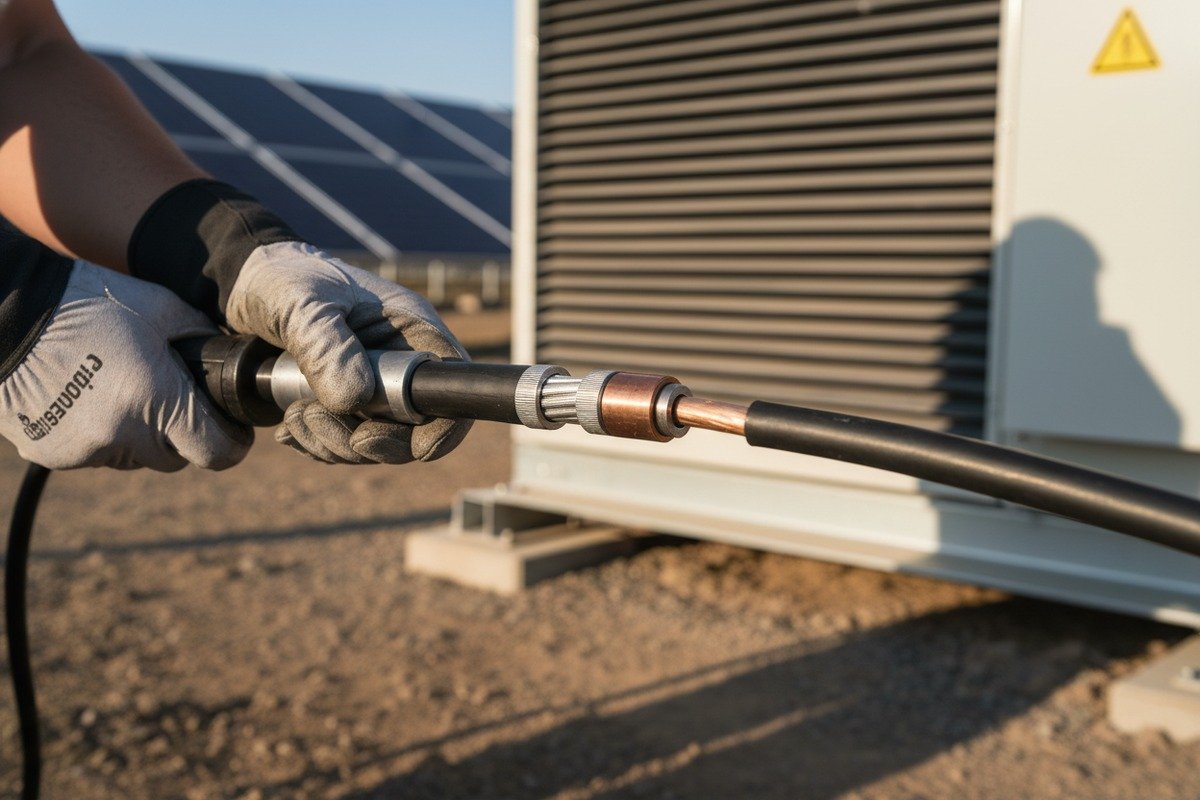
This is where most aluminum cable failures happen. Aluminum forms an oxide layer almost instantly when exposed to air. This oxide is resistive. If you use standard copper lugs on aluminum conductors, you create a point of high resistance. Over time, this generates heat, loosens the connection, and can cause arcing.
You must use one of the following:
- Bimetallic lugs (copper on one end, aluminum on the other) designed for transition points
- Compression connectors rated specifically for aluminum alloy conductors
- Anti-oxidant paste applied at every termination point before crimping
In our production facility, we test every batch of cables with specific connector types to verify contact resistance. We have seen contact resistance rise by 35% after 1,000 thermal cycles on aluminum joints using incorrect connectors, versus only 8% on properly terminated copper joints.
Conduit and Raceway Adjustments
Larger cables mean larger conduit fill. If your existing design uses 32 mm conduit for copper runs, you may need 40 mm conduit for the equivalent aluminum alloy cable. This affects trenching width for ground-mounted systems and cable tray capacity for rooftop installations.
Thermal Expansion Management
Aluminum's coefficient of thermal expansion 8 is roughly twice that of copper. In regions with extreme temperature swings — desert installations in the Middle East, for example — this means cable connections expand and contract significantly between day and night. Design your cable management with expansion loops or slack at junction boxes. Do not pull aluminum cables taut.
Grounding and Bonding
Check your local electrical code. Some jurisdictions require specific grounding conductor materials. In many cases, the equipment grounding conductor must remain copper even if the power conductors are aluminum alloy.
How do I ensure that aluminum alloy cables will meet the 25-year lifespan and UV resistance standards required for my installation?
One of the biggest concerns we hear from our European EPC customers is durability. A solar plant must operate for 25 years minimum. That is 25 years of UV bombardment, temperature cycling, moisture exposure, and mechanical stress. Will aluminum alloy cables survive?
Ensure 25-year lifespan and UV resistance by specifying cables with XLPO or XLPE insulation tested to EN 50618 or UL 4703, verifying accelerated aging test results (at least 20,000 hours UV exposure), demanding 8000-series aluminum alloy conductors with documented creep resistance data, and requiring the manufacturer to provide independent third-party test certificates.
The Insulation Is Your First Line of Defense
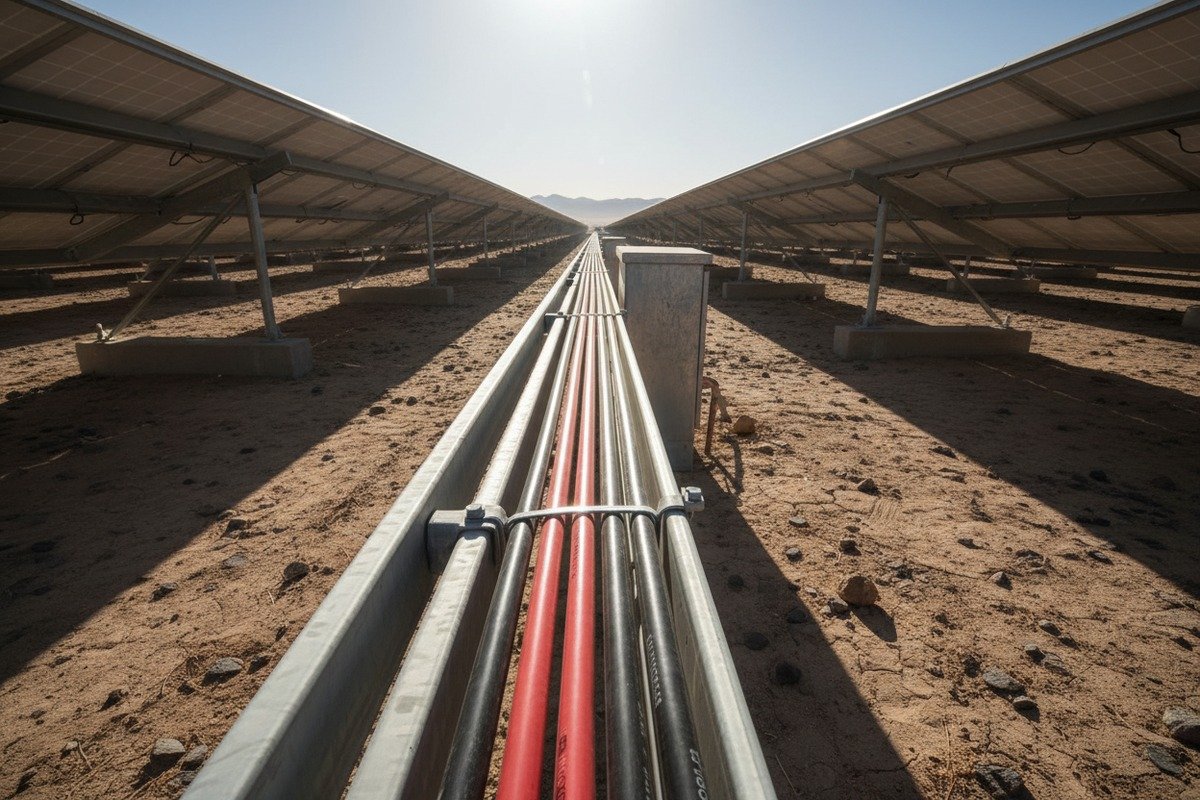
Regardless of whether the conductor is copper or aluminum, the insulation and jacket must withstand decades of outdoor exposure. The key materials used in modern solar PV cables are:
- XLPO (Cross-Linked Polyolefin): Excellent UV resistance, halogen-free, good for European CPR compliance
- XLPE (Cross-Linked Polyethylene): High dielectric strength, good thermal resistance
- LSZH (Low Smoke Zero Halogen) jackets: Required for enclosed spaces and buildings
At our factory, we use electron beam cross-linking for our insulation layers. This produces a more uniform cross-link density compared to chemical cross-linking, which translates to more consistent long-term UV and thermal performance. We test every production batch to confirm a minimum gel content of 65%, which indicates proper cross-linking.
Conductor Alloy Grade Matters
Not all aluminum is equal. Pure aluminum (1350 series) is soft, prone to creep, and unreliable for long-term connections. Modern solar PV cables should use 8000-series aluminum alloys (such as AA 8030 or AA 8176). These alloys contain iron, copper, and other trace elements that dramatically improve:
- Creep resistance — the tendency of metal to slowly deform under sustained mechanical stress
- Fatigue resistance — improved by approximately 25% over pure aluminum
- Flexibility — critical for installation bending without conductor damage
Ask your supplier for the specific alloy designation and a material test certificate. If they cannot provide one, that is a red flag.
Accelerated Aging and Testing Protocols
The following tests are essential for verifying 25-year performance:
| Test | Standard | What It Verifies |
|---|---|---|
| UV resistance (accelerated weathering) | EN 50618 9 / UL 4703 | Insulation integrity after simulated 25-year UV exposure |
| Thermal cycling | IEC 62930 | Connection stability through repeated expansion/contraction |
| Ozone resistance | EN 50396 | Jacket integrity in high-ozone environments |
| Damp heat (85°C/85% RH) | IEC 61215 (adapted) | Long-term moisture ingress resistance |
| Creep test | IEC 61284 | Conductor deformation under sustained load |
| Tensile strength and elongation | EN 60228 | Mechanical robustness of conductor |
We provide full test reports to our customers. For our H1Z2Z2-K cables, the accelerated UV aging test simulates over 20,000 hours of exposure, equivalent to roughly 25 years of Central European sunlight. The insulation must retain at least 50% of its original elongation to pass.
Practical Tips for Installation Longevity
Even the best cable will fail if installed poorly. Key practices include:
- Use UV-rated cable ties and clips — cheap nylon ties degrade in two to three years outdoors
- Avoid sharp bends below the minimum bending radius — this cracks insulation over time
- Seal all junction boxes and entry points against moisture, especially in tropical or coastal climates
- Perform thermographic inspections of aluminum terminations during the first year of operation to catch loose connections early
Which international certifications should I verify to guarantee the safety and fire performance of aluminum alloy versus copper cables?
Our compliance team spends a significant portion of their time helping customers navigate the certification landscape. The stakes are high — a cable with a fake or expired certificate can result in rejected customs shipments, failed grid inspections, or worse, a fire on a rooftop.
Verify TUV-certified EN 50618 or IEC 62930 for European markets, UL 4703 listing for North America, CPR fire classification (Dca or Cca minimum) for EU building installations, and ensure certificates are current, batch-traceable, and independently verifiable on the issuing body's website — for both aluminum alloy and copper cables equally.
The Core Certifications You Need
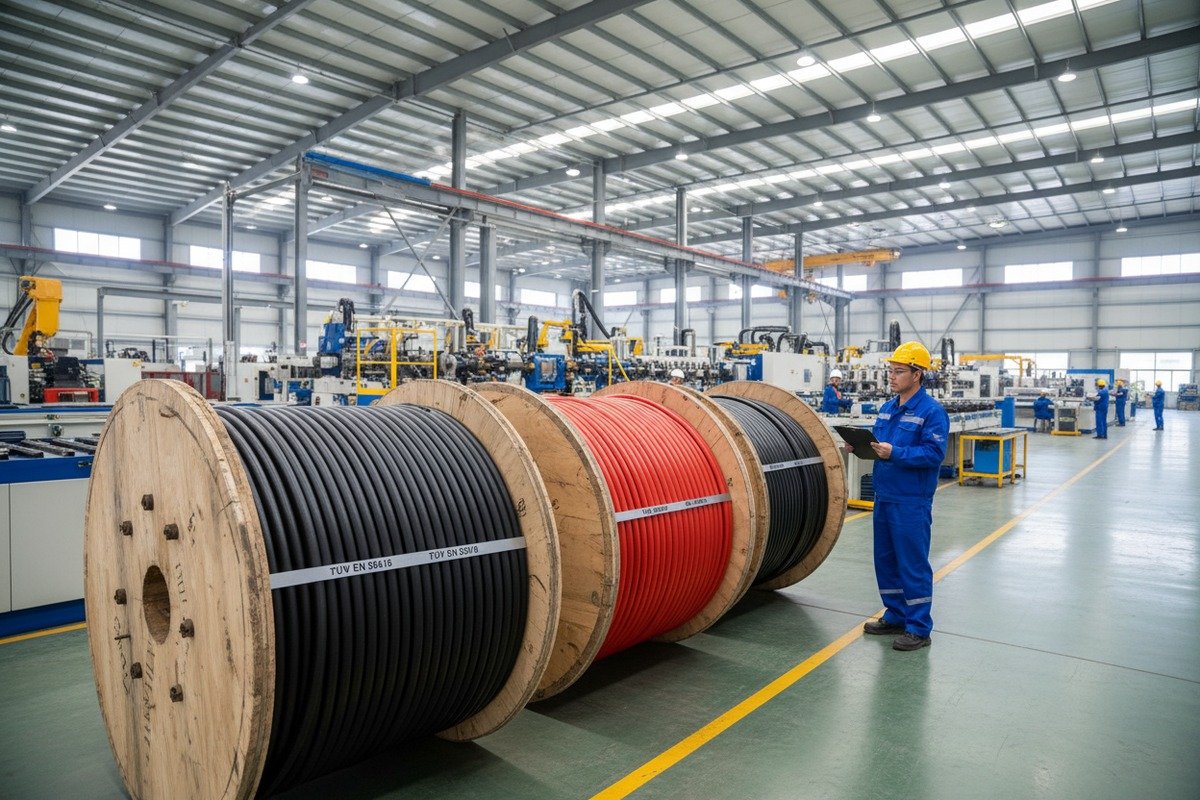
The certification requirements differ by market. Here is a clear breakdown:
For European projects:
- EN 50618 — The harmonized European standard for solar PV cables. Covers voltage rating (typically 1.5 kV DC), insulation requirements, UV resistance, and mechanical properties.
- TUV certification — Most EPCs and grid operators in Germany, France, and the Netherlands require TUV Rheinland or TUV SUD certification specifically.
- CPR (Construction Products Regulation) — Required for cables installed in buildings or structures. Fire classes range from Fca (no performance) to Aca (highest). Most commercial rooftop solar projects require Dca or Cca class.
For North American projects:
- UL 4703 — The UL standard for PV wire. Covers 600V to 2,000V DC ratings. Requires specific flame tests, wet insulation resistance, and sunlight resistance.
- CSA certification — Required for Canadian installations.
For other markets:
- IEC 62930 — The international standard gaining adoption in Asia, Latin America, and the Middle East. Closely aligned with EN 50618.
How to Spot Fake or Expired Certificates
This is a real problem in the industry. We have seen competitors submit certificates that were issued years ago for a different product line, or certificates from testing bodies that do not exist.
Here is what to check:
- Verify the certificate number directly on the issuing body's website (e.g., TUV Rheinland's Certipedia database)
- Confirm the certificate holder name matches the actual manufacturer — not a trading company
- Check the product scope — the certificate must cover the specific cable type, voltage rating, and conductor material you are ordering
- Look at the validity date — TUV certificates are typically valid for five years and require annual factory audits
- Request batch-level test reports — a certificate covers a product line, but a test report confirms that your specific shipment was actually tested
Fire Performance: CPR Classes Explained
For European customers, CPR compliance is not optional. Here is what each class means:
| CPR Fire Class | Reaction to Fire | Typical Application |
|---|---|---|
| Aca | Virtually non-combustible | Critical infrastructure, tunnels |
| B1ca | Very limited contribution to fire | High-rise buildings, hospitals |
| B2ca | Limited contribution to fire | Commercial buildings |
| Cca | Limited flame spread, low heat release | Standard commercial rooftop PV |
| Dca | Moderate contribution to fire | Ground-mounted PV, industrial |
| Eca | Basic flame resistance | Short cable runs, open-air |
| Fca | No performance determined | Not recommended for PV |
Most commercial and industrial rooftop solar installations in Germany and France now require a minimum of Dca-s2,d2,a2. The "s" stands for smoke, "d" for flaming droplets, and "a" for acid gas. Each has sub-levels.
Our H1Z2Z2-K cables are tested and certified to Dca class as standard. We can also supply Cca-rated versions for projects with stricter fire safety requirements, such as installations on schools or hospitals.
Does Conductor Material Affect Fire Certification?
The conductor material (copper vs. aluminum) does not directly change the fire class. Fire classification is determined by the insulation and jacket materials. However, aluminum's higher thermal expansion can contribute to loose connections, which generate heat and can indirectly increase fire risk. This is why proper connector selection and torque specifications are critical — and why some fire safety engineers prefer copper in high-density installations where maintenance access is limited.
Certification for Aluminum-Specific Properties
When sourcing aluminum alloy solar cables, also verify:
- The conductor meets IEC 60228 Class 2 (stranded) requirements for the specified alloy
- The alloy is certified as 8000 series with a traceable mill certificate
- The completed cable assembly has been tested for thermal cycling with the specific connectors you plan to use
Conclusion
Choosing between aluminum alloy and copper for solar PV cables demands careful analysis of conductivity, lifecycle cost, installation requirements, durability, and certifications — matched precisely to your project's scale, environment, and regulatory context.
Footnotes
1. Explains IACS as a standard for electrical conductivity of copper. ↩︎
2. Defines bimetallic lugs as connectors for dissimilar metal conductors. ↩︎
3. Defines electrical conductivity as a material's ability to conduct electric current. ↩︎
4. Explains anti-oxidant paste prevents oxidation and improves electrical connections. ↩︎
5. Defines AWG as a standardized wire gauge system for conductors. ↩︎
6. Defines XLPO as a broad family of cross-linked polymers used in cable insulation. ↩︎
7. Replaced HTTP 404 with an authoritative .gov source on embodied carbon. ↩︎
8. Defines how a material's size changes with temperature. ↩︎
9. Identifies EN 50618 as the European standard for solar PV cables. ↩︎
10. Describes 8000-series aluminum alloys as advanced materials with high strength and corrosion resistance. ↩︎