In today's highly interconnected digital age, data is the lifeblood that keeps the world running, and fiber optic cables are the major arteries that transport it. From the seamless 4K streaming videos we watch daily and the massive data synchronization of multinational corporations, to the submarine communication networks connecting continents—fiber optic technology is everywhere. Yet, despite fiber completely revolutionizing the landscape of modern communication, many people still only understand it as "the really fast internet wire."
This comprehensive guide will break down the core knowledge you need about fiber optic cables, covering the physics behind them, their internal construction, classification standards, practical applications, how they compare to traditional copper cables, and future development trends.
I. How Fiber Optic Cables Work: Total Internal Reflection
To understand why fiber optics are so powerful, we first need to understand how they transmit data. Traditional copper cables transmit electrical signals through the movement of electrons, whereas fiber optics transmit information using light pulses.
The core physical principle behind fiber optic communication is Total Internal Reflection. When light passes from a medium with a higher refractive index (like glass) into a medium with a lower refractive index, if the angle of incidence is greater than a certain critical angle, the light will not pass through the boundary. Instead, it acts like a mirror, reflecting completely back into the original medium. This optical phenomenon can be described by Snell's Law:
n1 sin(θ1) = n2 sin(θ2)
(Where n1 and n2 are the refractive indices of the two media, and θ1 and θ2 are the angles of incidence and refraction, respectively).
In a fiber optic cable, data-carrying laser or LED beams are fired into the center of the fiber. Because the center's refractive index is slightly higher than the outer layer's, the light constantly undergoes total internal reflection at the boundary. It bounces forward in a zig-zag or spiral pattern along the flexible cable, ensuring the light doesn't leak out even when the cable bends. This allows data to be transmitted over long distances with extremely low loss at speeds approaching the speed of light (about two-thirds the speed of light in a vacuum when traveling through glass).
II. The Physical Construction of Fiber Optic Cables
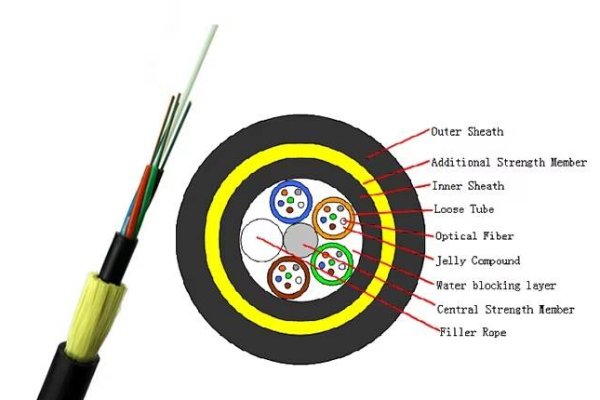
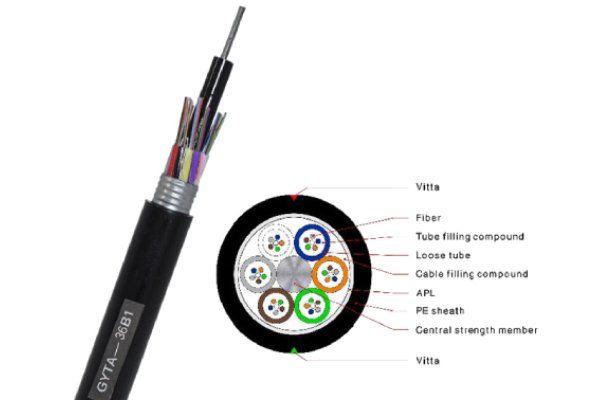
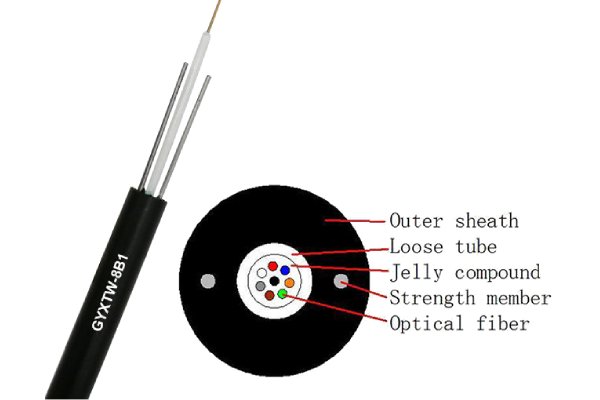
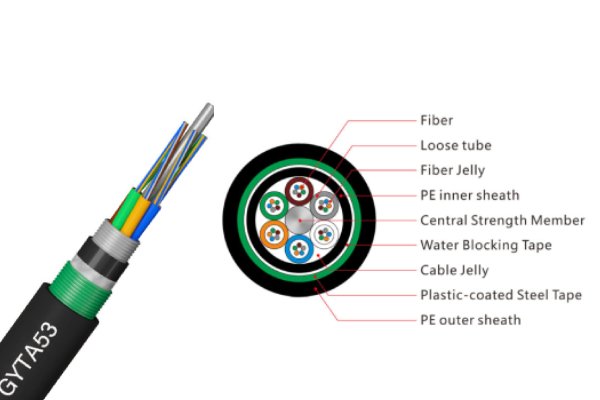
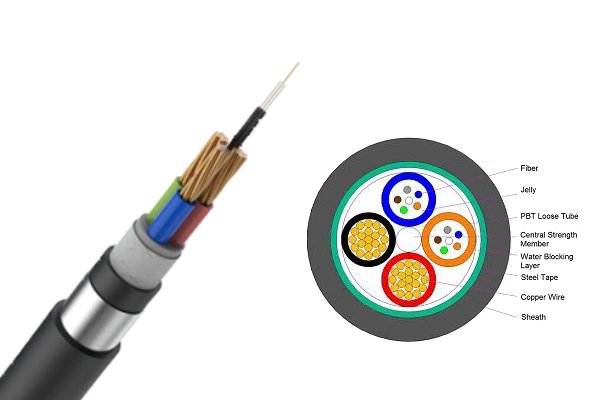
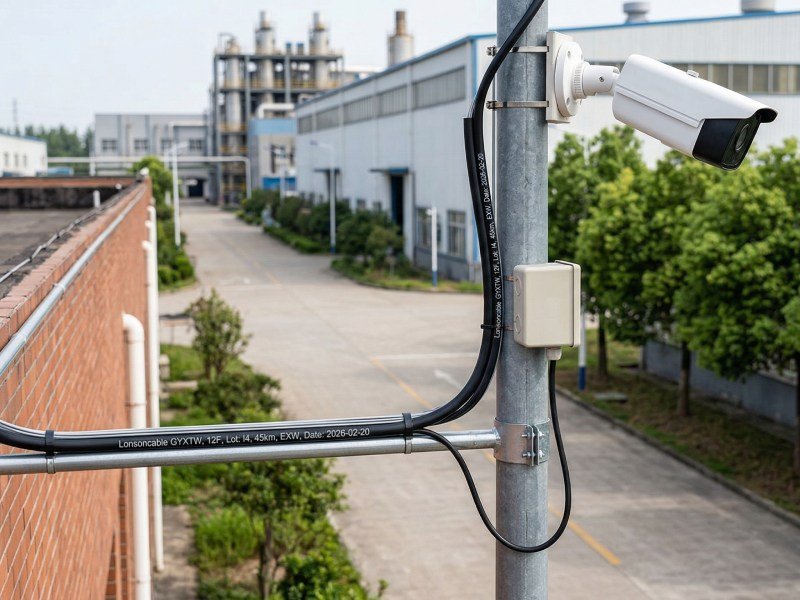
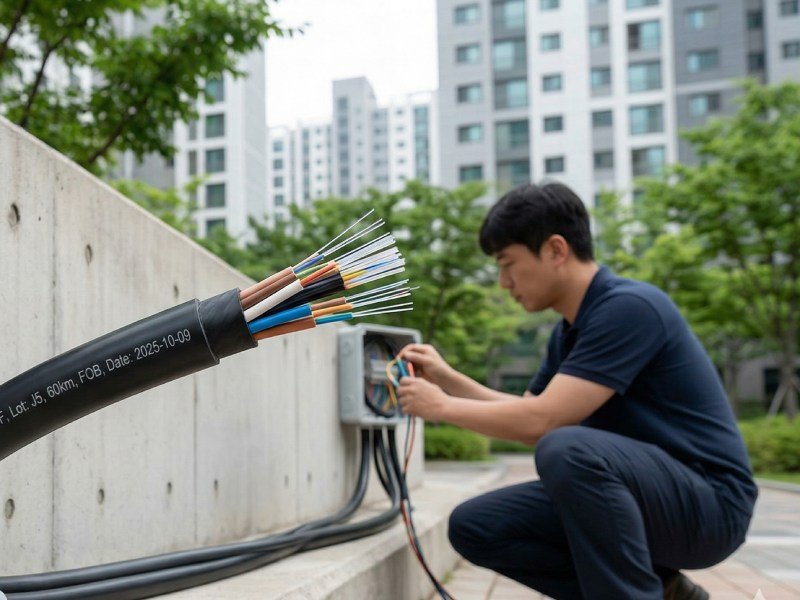
Although a single optical fiber is often as thin as a human hair, a complete fiber optic cable contains multiple precisely designed structural layers to ensure stability and durability in complex environments. From the inside out, it typically includes the following components:
- Core: This is the innermost layer and the actual pathway where light pulses travel. It is usually made of ultra-high-purity silica (quartz glass) or specialized plastic. Single-mode fibers have extremely thin cores (typically 8 to 10 µm), while multi-mode fibers have thicker cores (usually 50 or 62.5 µm).
- Cladding: The layer tightly wrapped around the core. It is also made of glass or plastic, but its optical refractive index is intentionally designed to be lower than that of the core. This difference in refractive index is what causes total internal reflection, "locking" the light inside the core.
- Coating / Buffer: A plastic protective layer (usually acrylate) whose primary function is to absorb mechanical shock and protect the fragile glass core and cladding from physical damage, moisture intrusion, and micro-bending loss caused by slight curves.
- Strengthening Members: To prevent the cable from breaking easily when pulled, installed, or suspended, tensile-resistant materials are added inside the cable. The most common is aramid yarn (like Kevlar), though fiberglass rods or steel wires are sometimes used.
- Outer Jacket: The outermost line of defense, directly exposed to the external environment. Depending on the application, the jacket may be made of PVC, polyethylene (PE), or Low Smoke Zero Halogen (LSZH) materials to resist UV rays, chemical corrosion, extreme temperatures, and even rodent bites.
III. Main Classifications of Fiber Optic Cables
Fiber optic cables are primarily divided into two major categories based on the modes in which light travels through the core: Single-Mode Fiber (SMF) and Multi-Mode Fiber (MMF).
1. Single-Mode Fiber (SMF)
- Physical Characteristics: Extremely thin core (approx. 9 µm).
- Mechanism: Because the core is so narrow, light can only travel straight forward in a single path (mode). This means the light pulses experience almost no dispersion (the difference in arrival times of different light rays).
- Light Source: Typically uses expensive, highly precise lasers.
- Applications: Ideal for long-haul, ultra-high-bandwidth data transmission. Commonly used in submarine cables, cross-city metropolitan area networks (MANs), university campus backbones, and telecom operator infrastructure. Common standards include OS1 and OS2.
2. Multi-Mode Fiber (MMF)
- Physical Characteristics: Thicker core (typically 50 µm or 62.5 µm).
- Mechanism: The wider channel allows light to travel simultaneously across multiple different paths (modes). However, this causes "modal dispersion"—meaning light on different paths arrives at the receiver at slightly different times, which can blur the signal over long distances.
- Light Source: Typically uses lower-cost LEDs or VCSELs (Vertical-Cavity Surface-Emitting Lasers).
- Applications: Suited for short-distance, high-capacity data transmission, such as server connections within data centers, Local Area Networks (LANs), and building wiring. Multi-mode fibers are categorized by performance into OM1, OM2, OM3, OM4, and OM5 (higher numbers support greater bandwidths and longer distances).
IV. Common Fiber Optic Connectors
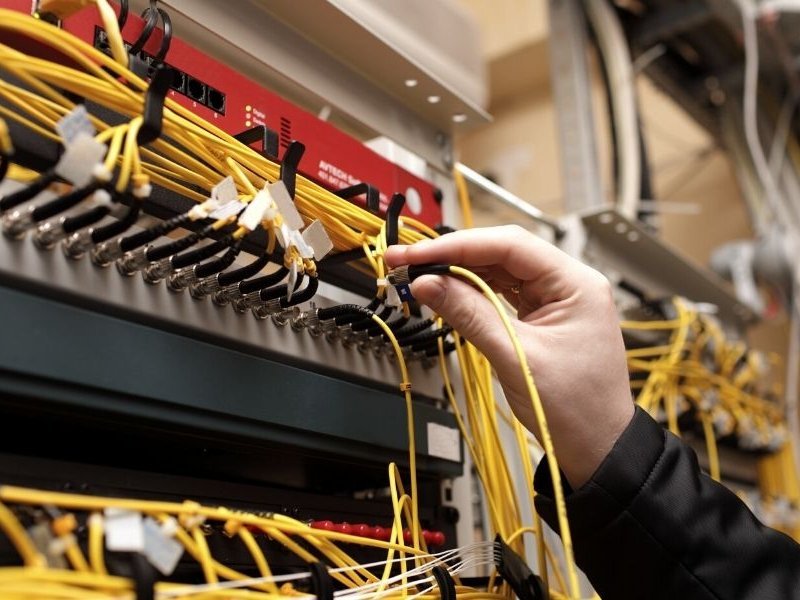
The ends of fiber optic cables require specific connectors to plug into switches, routers, or servers. Different connectors suit different equipment panels and plugging requirements.
- LC (Lucent Connector): One of the most popular connectors today. It features a small form-factor design, making it perfect for high-density wiring in data centers. It uses an RJ45-style push-and-latch locking mechanism.
- SC (Standard/Subscriber Connector): Features a square housing and a push-pull locking mechanism. It was once widely used in telecom and data networks and is about twice the size of an LC connector.
- ST (Straight Tip): Has a round appearance and uses a bayonet-style twist-lock structure similar to a BNC connector. Mostly used in older multi-mode networks and patch panels.
- FC (Ferrule Connector): Uses a threaded screw-on locking mechanism, making the connection extremely secure so it won't loosen even in high-vibration environments. Primarily used in single-mode networks, cable TV (CATV), and testing/measurement instruments.
V. Fiber vs. Traditional Copper Cables
For decades, twisted pair (like Cat5e, Cat6) and coaxial cables have been the mainstream for network wiring. However, fiber optics are rapidly taking over due to overwhelming physical advantages:
- Infinite Bandwidth Potential: Copper cables have a physical limit to their frequency transmission; currently, high-end copper (like Cat8) peaks at 40Gbps over short distances. Fiber bandwidth is virtually unlimited. A single fiber strand can easily achieve Tbps (Terabits per second) speeds using Wavelength Division Multiplexing (WDM)—transmitting multiple colors of light through the same strand.
- Extended Transmission Distance: Due to electrical resistance and signal attenuation, copper cables are limited to 100 meters (328 feet) under Ethernet standards. Single-mode fiber can transmit Gigabit or 10-Gigabit signals for tens of kilometers without the need for signal amplifiers.
- Total Immunity to EMI/RFI: Copper transmits electrical signals and is highly susceptible to electromagnetic interference from high-voltage wires, motors, radio waves, and lightning, causing data loss. Fiber transmits photons and is entirely immune to electromagnetic interference, making it perfect for heavy industrial floors or near high-voltage substations.
- Maximum Security: Hackers can eavesdrop on copper cables by sensing the electromagnetic fields around them. Fiber emits no electromagnetic field. If someone physically tries to cut and tap into a fiber line, it causes an immediate, massive loss of light signal and triggers system alarms, making fiber the only choice for military, financial, and highly classified networks.
- Small Size and Lightweight: For the same bandwidth, the cross-sectional area and weight of fiber cables are a fraction of copper. This significantly relieves congestion in data center underground conduits and ceiling cable trays.
VI. Installation and Testing Challenges
Despite its many advantages, deploying fiber is much more complex than "plug-and-play" copper cables and requires highly skilled technicians.
- Fusion Splicing: When two fibers need to be joined, or a broken fiber needs repair, they cannot simply be twisted together like copper wire. A precision fusion splicer must be used. The machine makes a micron-level cut on the fiber ends, then uses an electric arc generating thousands of degrees of heat to melt and weld the two glass cores together perfectly. The margin of error must be kept to fractions of a micron.
- Bending Loss (Micro/Macro): While fiber has some flexibility, bending it past its minimum allowable bend radius destroys the conditions for total internal reflection. Light signals will penetrate the cladding and leak out, causing the network to drop.
- End-Face Cleaning: Fiber optic communication is the art of "light." Even a microscopic speck of dust, a smudge of oil, or a fingerprint on the connector end-face will block the light path, causing severe signal degradation or even burning out the equipment's lasers. Therefore, strict cleaning using lint-free wipes and high-purity alcohol is mandatory during installation.
- OTDR Testing: After installation, an Optical Time-Domain Reflectometer (OTDR) is generally used to fire laser pulses into the fiber. By analyzing the scattered light that reflects back, it precisely maps the loss distribution of the entire optical link and can even pinpoint the exact location of a cable break kilometers away.
VII. Future Trends in Fiber Optic Technology
The scientific and industrial communities have never stopped pushing the limits of fiber optic technology. With the dense deployment of 5G/6G base stations, the explosion of AI computing power, and the exponential growth of Internet of Things (IoT) devices, fiber technology continues to evolve:
- Hollow-Core Fiber (HCF): Traditional fiber has a solid glass core, but hollow-core fiber has a core made of actual air (or vacuum). Because light travels about 30% faster in air than in glass, HCF can dramatically reduce network latency. This is revolutionary for high-frequency trading (where a microsecond can mean a million-dollar difference) and remote precision medical surgeries.
- Multi-Core Fiber: Encapsulating multiple independent cores within a single fiber strand. This is like upgrading a single-lane highway into a multi-lane expressway on the same footprint, exponentially increasing the data throughput of a single cable without increasing its outer diameter to handle future global data tsunamis.
- Widespread FTTH (Fiber to the Home): Once reserved strictly for national backbone networks, fiber is rapidly extending to routers in millions of homes worldwide. Optical Network Terminals (ONTs) will become increasingly affordable, and Gigabit or even Multi-Gigabit internet straight to the home will become standard infrastructure for future smart cities.
Conclusion
From theoretical deductions in a laboratory to the massive networks circling the globe today, fiber optic cables are undeniably one of the greatest masterpieces of modern human engineering. In their incredibly unassuming form—a few tiny glass threads wrapped in plastic—they quietly carry the internet memories, commercial transactions, scientific data, and emotional connections of human civilization.
Understanding fiber optics is no longer just a requirement for IT professionals. In this era of universal connectivity, gaining a deep understanding of the "invisible backbone of modern society" helps us better grasp the pulse and potential of future technological development. Whether building next-generation data centers or planning the underlying architecture of the industrial IoT, fiber optic cables will remain the indispensable superhighway to the future.